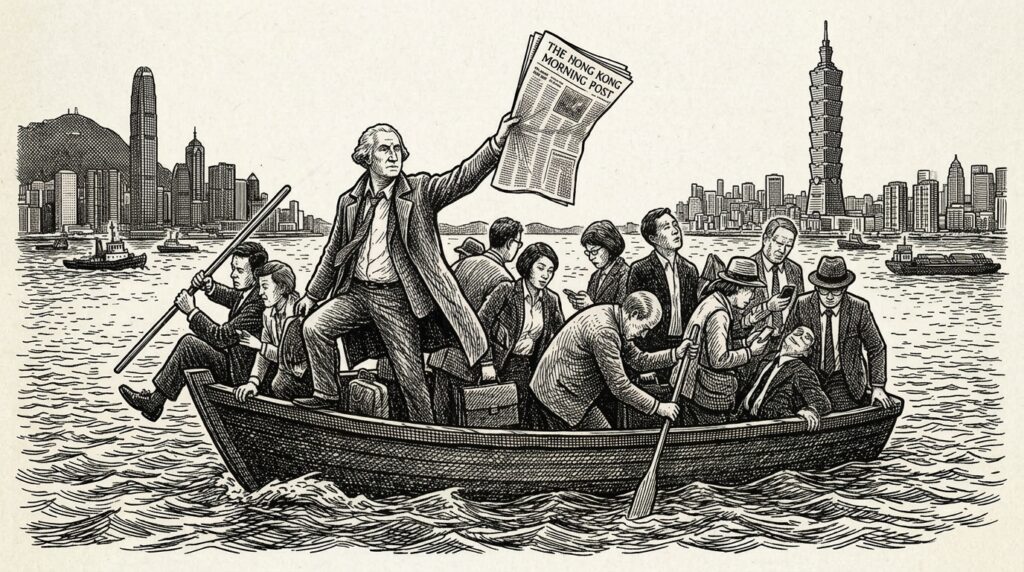
I read Dr. Li’s first essay standing at the kitchen counter because I’d forgotten to sit down. That happens sometimes when something is good enough to make your legs irrelevant. The coffee went cold. I reheated it. It went cold again. I noticed this only because my hand was on a cold mug and I couldn’t remember how many times I’d already lifted it. I immediately wanted to write a response to Dr. Li.
A Taiwanese scholar just published the most serious proposal for cross-strait negotiation either side of the Strait has produced in years. I have a stake in what happens next, and I want to engage with it properly rather than from the sidelines.
Dr. Ci-Ze Li teaches international relations at National Changhua University of Education. Over the past month, across three essays published on a mainland WeChat blog called Zhengdangshi, he did something almost nobody on either side of the Taiwan Strait has attempted in recent memory. He took Beijing’s own stated invitation to discuss “One Country, Two Systems” seriously enough to write down, clause by clause, what Taiwan should actually ask for. Democratic elections preserved. Final judicial authority kept in Taiwan. No permanent PLA garrison in the early stages. Enumerated, not open-ended, powers for the central government. Four legal locks, an agreement, a constitutional chapter, a Basic Law with reserved powers, a Taiwan-side charter, designed to make Beijing’s commitments harder to unilaterally reverse than what Hong Kong received.
Where it gets interesting is what happened after he published.
Nobody knows who runs Zhengdangshi. That detail matters. As Pekingnology noted in its own analysis of the exchange, given the political sensitivity of the subject and the unusually wide latitude the platform gave the discussion, it is difficult to regard the mainland setting as incidental. A Taiwanese scholar writing on a mainland blog about what Taiwan should demand in a reunification negotiation, and the blog not only published it but framed it as exactly the kind of submission Beijing had invited. That is not how mainland platforms typically handle Taiwan-related content that Beijing wants buried.
Then the discussion moved beyond the blog. At the Taiwan Affairs Office press conference on September 9, a People’s Daily reporter, state media, specifically raised Dr. Li’s essays and the online discussion they had triggered. Spokesperson Chen Binhua welcomed the conversation without confirming or rejecting a single term. A week later, at the September 16 press conference, another state media reporter brought it up again, this time citing Taiwan’s Mainland Affairs Council’s prediction that Beijing would accept none of it, and asking directly for comment. Spokesperson Zhu Fenglian again welcomed the discussion. Again confirmed nothing. Again rejected nothing.
Two press conferences. Two state media reporters raising the topic. Two responses that kept the door open without walking through it. Beijing did not publish Dr. Li’s essays. But it did, twice, use its own press apparatus to make sure a much larger audience knew the essays existed. Pekingnology’s headline put it plainly: “Beijing has now twice helped bring the debate into public view.”
Between those two press conferences, Taiwan’s Mainland Affairs Council weighed in. Vice Chairman Liang Wen-chieh said he’d read the article and found it “quite interesting.” He pointed to Dr. Li’s proposals that Taiwan retain democratic elections and final judicial authority, that mainland troops not be stationed in Taiwan, and that Taiwan retain its own self-defense capability. His conclusion was blunt: “I think the CCP would agree to none of these.” He also named the structural problem at the center of the whole exercise, that as long as the Communist Party maintained absolute leadership, constitutional or institutional guarantees would be unable to bind it, making attempts to obtain such guarantees, in his words, “like climbing a tree to catch a fish.”
I’ve written a full book on this subject, The Wound That Never Closed: Taiwan, China and the End of Strategic Ambiguity, and I run this site specifically to engage with exactly this kind of argument, which is either dedication or a personality flaw depending on the day of the week. Readers of this site will know I’ve made a version of this case before, most recently in response to Stephen Roach’s “Hong Kong is over” column, an exchange that a British historian and former Sha Tin College principal, writing in China Daily HK this past August, described as treating Hong Kong’s status “comparable to New York’s place within the US or London’s within Great Britain,” and rejecting “both uncritical boosterism and the simplistic pro-democracy morality play” that dominates most coverage of this city. I bring the same posture to Dr. Li’s essays. I have an actual stake in this outcome, and I’d rather engage with serious arguments directly than let them pass unanswered while I pretend I’m neutral.
I’m writing to Dr. Li directly, and publishing my response, because I think his proposal deserves the seriousness he gave Beijing’s invitation, and because I think the central premise underneath his safeguards, that Hong Kong’s experience proves Beijing’s commitments cannot hold without extraordinary institutional armor, is the wrong lesson, drawn from an incomplete account of what happened here.
Where I Think the Diagnosis is Wrong
Ruth, who I’ve written about before and who has a habit of saying things at breakfast that stay with you through lunch, once told me: “You don’t get to call something broken if you’re the one who threw it on the floor.” She was talking about a mutual friend’s marriage. She could have been talking about Hong Kong’s universal suffrage vote.
I’ve made the full case at length elsewhere on this site, in Common Sense for Hong Kong and Taiwan, so I’ll give the short version here. In August 2014, Beijing did not withhold democracy from Hong Kong. It proposed the first universal suffrage election for Chief Executive in the city’s history. Five million voters. One person, one vote. A mechanism that had been sitting in Article 45 of the Basic Law since 1990, twenty-four years before it was activated. Twenty-seven pan-democratic legislators, elected freely by the people of Hong Kong, voted it down unanimously. They didn’t need a majority to kill it. Under the Basic Law’s supermajority requirement, twenty-four no votes was enough, and they had twenty-seven, three more than required, out of a seventy-seat chamber. Not one broke ranks to argue for accepting it as a floor to build from rather than a ceiling to reject.
That’s worth noting. Not one.
Five years later, when the extradition bill that sparked the 2019 protests was actually withdrawn, the achievable demand having been achieved, the movement didn’t stop. It multiplied to five demands, with the explicit slogan “not one less,” a formulation that guaranteed the confrontation would continue indefinitely because one of the five, unrestricted universal suffrage, was never going to be won through street pressure alone. That is not a negotiating position. It is the structural opposite of one. The National Security Law arrived after the movement escalated from marches into storming the Legislative Council and throwing petrol bombs at police stations.
The actual sequence, a real offer, refused unanimously, followed by an escalation that gave the hardliners exactly the justification the moderates had spent years trying to avoid handing them, tells Taiwan something different than “no guarantee from Beijing survives contact with reality.” It tells Taiwan that the guarantee actually on the table in 2014 died in the room, before it was ever tested. Ruth’s line again. You don’t get to call it broken if you’re the one who threw it on the floor.
That distinction matters enormously for what Dr. Li is trying to build. If the lesson Taiwan draws is blanket distrust regardless of what’s offered, his four locks will never get the chance to be tested either. And the people who refused the last real offer will have successfully made their refusal look, in retrospect, like proof that the offer was never real. Which is a neat trick if you don’t mind building your country’s future on it.
The Legal Architecture I’d Push Him Further On
I trained in American constitutional law before I ever practiced in Hong Kong, and the instinct at the center of Dr. Li’s proposal, an enumerated and limited list of what the central government retains, with everything else reserved to Taiwan, is the correct constitutional instinct. It’s the same structure the Tenth Amendment describes: powers not delegated are reserved. I’ve spent most of my professional life on one side of a fight against concentrated power, whether it wears a government uniform or a corporate logo, and enumeration is the right tool against both.
But an enumerated list is only as strong as whoever adjudicates it when it’s tested, and this is where Dr. Li’s fourth lock, procedural constraints on the NPC Standing Committee’s interpretive authority, needs to be built out with far more specificity than his current draft provides. Vice Chairman Liang’s “climbing a tree to catch a fish” line is not just a rhetorical dismissal. It names the actual structural question: what happens when the party that grants the autonomy is also the party with final interpretive authority over what the grant means. Dr. Li’s proposal already gestures at an answer: prior notification, a joint Basic Law Committee, public disclosure of legal reasoning, no retroactivity. But that’s the piece of the architecture that will decide whether this whole framework is real or decorative. I’d want to see it built out with the same precision he gave the military and fiscal provisions.
The Shield That’s Already Melting
This is where Dr. Li’s proposal is correctly about negotiating from strength, and also where his essays undercount the urgency.
TSMC currently produces something on the order of 92 percent of the world’s most advanced logic chip capacity. That number does enormous work in Washington’s calculus today. It is also the reason the United States has committed $165 billion, since raised toward $265 billion with a mid-2026 expansion announcement, to build fabs in Arizona. The reason Europe has committed over €100 billion to its own semiconductor base. The reason Japan and South Korea are racing to build parallel capacity of their own. Every single one of those investments exists specifically to reduce the world’s dependence on the asset Taiwan is counting on to keep it indispensable forever.
I’ve written about this at length in the book, under the chapter title “The Semiconductor Illusion,” and the core of the argument won’t take long. An asset is not a strategy. Taiwan’s chip dominance gives it real leverage today. It will not have that same leverage in ten years, because the rest of the world is actively spending down the very dependency that makes Taiwan matter this much right now.
Dr. Li is right that Taiwan should negotiate from strength. He should add urgency to that argument, because the strength is a melting ice cube, not a permanent shield, and every year spent not testing Beijing’s willingness to negotiate is a year of leverage quietly transferred to a fab in Phoenix. I don’t know how to say this more plainly. You do not hold a depreciating asset and wait for a better deal. You pick up the phone.
The Public Dr. Li is Actually Speaking For
I don’t think Dr. Li is a lone voice, and the polling makes that case better than I can. A TVBS survey conducted in April 2026 found 66 percent of Taiwanese respondents supporting the resumption of cross-strait negotiations, with only 19 percent opposed. Support reached 61 percent among independents and split nearly evenly among DPP identifiers. A separate poll released in June by Taiwan’s National Development Education Fund found 61.6 percent still supporting political talks, even as 58 percent continued to reject Beijing’s “one China” precondition for holding them, a rejection rate that has itself fallen sharply from the 72 to 77 percent range recorded in surveys from 2019 to 2023. A Democracy Foundation poll cited by Beijing’s own Taiwan Affairs Office this June found close to 60 percent supporting Taiwan taking the initiative on peace talks.
Set against each other, these numbers clarify something the political noise obscures. A solid majority of Taiwanese want the conversation to happen. A small minority want unification on Beijing’s current terms. That gap is not a reason to abandon the conversation. It is the entire reason Dr. Li’s essays matter, because he is one of the only people on either side of the Strait actually trying to design terms specific enough to close that gap rather than restate it every election cycle.
This is Our Chance
I don’t think Hong Kong proves the formula is a trap. I think it proves that a real offer, refused before it could be tested, becomes retroactive evidence for the distrust that helped sink it. A diagnosis that writes its own confirmation. That’s not a cautionary tale about the system. It’s a cautionary tale about what happens when nobody in the room is willing to say yes to something imperfect and then fight to make it better.
Dr. Li has done more than anyone I’ve read in years to make “One Country, Two Systems” into something that can be argued about on its institutional merits rather than shouted about as a slogan. Beijing has, twice now, publicly declined to close the door on that conversation. More than that, it used its own state media to make sure the conversation was heard. Taiwan’s own polling shows a public more open to having it than its politics usually admits.
None of that guarantees Beijing would actually accept Dr. Li’s terms. Taiwan’s Mainland Affairs Council may turn out to be right that it wouldn’t. But a proposal specific enough to be rejected clause by clause is worth infinitely more than another decade of both sides talking past each other in slogans while the leverage that would make a real negotiation possible quietly erodes in a fab under construction eight thousand miles from Taipei. I’d rather find out what Beijing would actually accept by asking, in writing, with the kind of institutional precision Dr. Li has already brought to the table, than by waiting until the question no longer has a good answer either way.
Dr. Li, if you’re reading this: I’d welcome a longer exchange, in print or otherwise. The window you’re describing is real, and I don’t think either of us believes the alternative to a hard conversation now is a comfortable status quo later.
A Word From the City That Went First
One more thing, and I’ll say it carefully, because I’ve lived here long enough to know the weight of it.
Article 45 of Hong Kong’s own Basic Law still says, in plain text, that the ultimate aim is selection of the Chief Executive by universal suffrage. That clause was never repealed. It wasn’t struck from the document after 2015. It’s still sitting there, unimplemented. The 2021 electoral overhaul didn’t move us closer to it. It cut the share of directly elected seats in the Legislative Council and added a new eligibility review layer on top of the old nominating structure. Hong Kong’s own promise is further from being kept today than it was in 2014.
But the text is still there. Nobody has deleted it. And if Dr. Li’s four locks succeed in producing something Beijing will actually sign, put into a constitution, and subject to the kind of enforceable, jointly-verified compliance mechanism his essay describes, Hong Kong will have a case study sitting right next door that it doesn’t currently have: proof that the mechanism can be made to hold. We’re still here. The clause is still on the books. If Taiwan manages to build a version of “one country, two systems” sturdy enough to survive contact with a bad decade, Hong Kong might reasonably ask, a few years from now, whether the same architecture could reopen the door that closed here in 2015.
I don’t say this to make Taiwan’s negotiation about us. It shouldn’t be. But it’s worth Dr. Li knowing, as he builds his four locks, that he isn’t just designing a framework for one island. He may be drafting the only version of this argument anyone in this region will get to point to next.
I went back to the kitchen after finishing this. The mug was still there. Still cold. I poured it out and made a new one, which felt, for a second, like the most obvious metaphor I’ve ever lived through, and then I sat down and drank it before it had the chance to go cold again.
Editors Note – I am the author of The Wound That Never Closed: Taiwan, China and the End of Strategic Ambiguity, which traces the history behind the current US-China-Taiwan standoff, from the 1895 Treaty of Shimonoseki through UN Resolution 2758 to the present day. The book is free on Amazon this week, no credit card required, just click “Buy Now” for $0.00. It reads in any browser, no Kindle needed. JUST CLICK HERE.