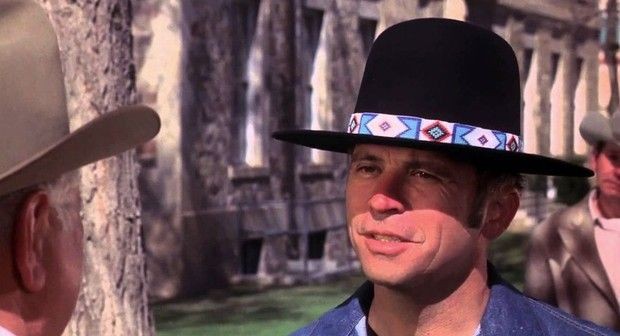
My father showed me Billy Jack on a Sunday afternoon when I was about seven. We watched it on the family television console, the tube kind, which picked up channels 2 through 13 and UHF, and UHF was less a channel than a rumor.
The short version, for anyone who missed it. Billy Jack is a half-Navajo Green Beret who looks after a school for troubled kids that the nearby town would rather not have. He is a pacifist who knows how to fight. He turns to violence only after everything else has failed, and only for people who can’t protect themselves. It is not a subtle film. A seven-year-old does not need subtle.
I never lost one scene. A man who thinks the rules are for other people has been tormenting the kids, and his friends stand around him feeling brave. Billy Jack walks up and does not shout or shove. He tells the man, in a flat, nearly friendly voice, that he is going to take his right foot and whop him on the side of the face, and that there is not a damn thing the man can do about it. Then he adds that he’ll do it just for the hell of it. The friends, who were enjoying themselves a minute ago, go quiet. And Billy Jack takes off his boots.
At seven I thought it was the best thing I had ever seen. The bully gets what’s coming. It took me years, and one remark at my own kitchen table, to see what the scene is about.
When I told Ruth I was writing this down, she asked whether the boots were going to be a metaphor or a footnote. I said both. She said that was what she was afraid of. She had known which scene I meant before I said it, the way you know which stair is loose in your own building, and I told it anyway. When I finished she said, “He’s the only one in that scene who isn’t worked up.”
I have seen that scene more times than I can count, and I had never noticed. Everyone else is loud. The man talking quietly is the one who has already decided, and already paid for it in his head. Taking off the boots is not a flourish. It is a man getting ready.
Sooner or later most of us end up in a room where someone with more power has settled how things will go, and everyone else is studying their shoes. You can’t always change what happens there. You can choose how you carry yourself, and say plainly what you think without raising your voice. Billy Jack pays for it. That is the part children skip.
I became a lawyer because of Billy Jack.
I know how that sounds. Lawyers do not fight anyone the way he does. Our worst injuries are paper cuts and billing disputes. But the law is one of the few tools we have for standing between someone vulnerable and someone who means them harm, and the preparation is the grown-up version of the boots. You stop. You get ready. You step forward when stepping back would be easier.
I live in Hong Kong now, and the longer I am here the better the boots make sense. People who need a lawyer rarely arrive wanting a fight. They arrive tired and polite, apologizing for the trouble, holding a document nobody has explained to them. They want someone to stand between them and it. For years that meant I did the preparing so they wouldn’t have to.
I think now that my father wasn’t showing me a fight on those Sunday afternoons. He was showing me what it looks like just before one, when the loudest thing in the room is a man sitting down to unlace.
I am sitting down now.
Comments