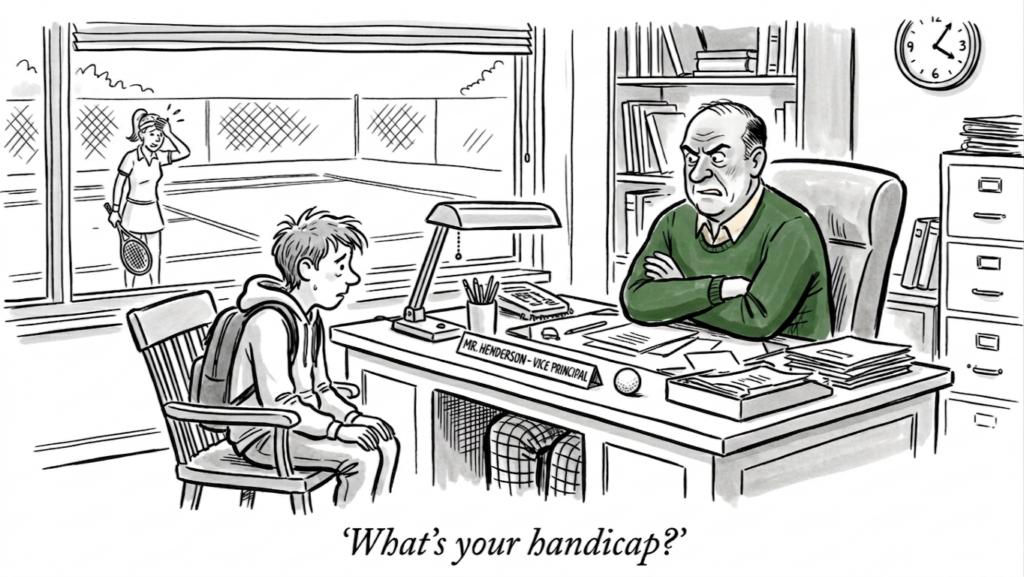
On checkered pants, restorative circles, and why a man who smelled like Parliaments and looked like 1974 was the most effective behavioral intervention Adams, Massachusetts ever produced.
Every single student who passed through the doors of Hoosac Valley High School between roughly 1980 and 1990 would confirm under oath, under duress, and under the influence of whatever truth serum the federal government has been developing in a bunker somewhere:
Jack Gallivan was the greatest vice principal who ever lived.
I do not say this lightly. I do not say this with the rose-colored sentimentality of a man who has been living in Hong Kong for over a decade and has begun to romanticize everything about his hometown, including the weather, which is objectively terrible, and the hot toddies, which are served on ice. I say this as a statement of fact, verifiable by anyone who attended HVHS during the Reagan administration, and I say it with the full understanding that the modern educational establishment would regard Jack Gallivan’s approach to student discipline the way a cardiologist regards a bacon cheeseburger: with horror, with professional disapproval, and with the quiet, unspoken suspicion that it might actually be delicious.
Jack Gallivan was the vice principal at Hoosac Valley. He dressed like it was 1974 and nobody had told him otherwise, and nobody had told him otherwise because nobody tells Jack Gallivan anything. Checkered pants. A green sweater. The kind of outfit that, in any other context, would suggest a man on his way to a golf outing at a municipal course in southern New Jersey, but which, on Jack, carried the authority of a military uniform. You did not look at the pants and think fashion. You looked at the pants and thought consequences.
He was not a large man. He did not need to be. Jack Gallivan operated on the principle, shared by certain small dogs and most drill sergeants, that volume and certainty are more effective than size. His voice was a weapon. It was low, grumbly, roughly textured, like someone had taken a perfectly functional human voice and run it through forty years of unfiltered cigarettes and the accumulated frustration of a man who had spent his career dealing with teenagers who thought they were clever. Jack smoked. Everybody knew Jack smoked. But you never saw him do it. Not in front of the kids. He maintained the fiction of a smoke-free existence with the same discipline he applied to everything else, which is to say: absolute, unyielding, and not open to discussion. But you could hear it. Every syllable he spoke carried the residue of tobacco the way a church carries the residue of incense, a permanent, low-grade rasp that announced his presence before he rounded the corner and made strong men reconsider their life choices from fifty feet away.
Jack did not speak often. This is important. A man who shouts all the time is just noise. A man who rarely speaks and, when he does, speaks at the decibel level of a 747 achieving liftoff, is something else entirely. Jack understood, instinctively, what behavioral psychologists have been trying to explain with grant funding and peer-reviewed journals for decades: that the power of a consequence is directly proportional to its unpredictability and its contrast with the baseline. The baseline, with Jack, was silence. The consequence was a sound that could strip paint.
And when he delivered that sound, when the volume reached its apex and the Parliament-seasoned vocal cords were fully engaged, his face turned red. Not pink. Not flushed. Red. The deep, committed, cardiovascular red of a man whose circulatory system was fully invested in the moment. The checkered pants, the green sweater, and a face the color of a fire engine. He looked, in those moments, like a Christmas decoration assembled by someone who had a generous interpretation of which colors complement each other. If you could get past the terror, which you could not, the overall effect was magnificent. A walking Italian flag. A portrait in primary colors that no one had requested and no one could look away from.
You would be sitting in class. A Tuesday. Nothing happening. The particular brand of nothing that only happens in a high school in the Berkshires in February, when the snow has been on the ground so long it has stopped being weather and become furniture, and the baseboard heaters are ticking, that dry, metallic, arrhythmic ticking that electric heat makes when it is doing its best, which is never enough, and the air smells like dust burning on an element and everyone is staring at the clock the way prisoners stare at the wall.
And then the PA system would crackle.
The PA system at Hoosac Valley was not a sophisticated piece of technology. It was a speaker mounted on the wall of every classroom, connected by wiring that had been installed when the building opened in 1970 and never once updated, capable of transmitting sound at a fidelity level that made AM radio seem like a symphony hall. Under normal circumstances, it was used for routine announcements. A secretary’s voice, calm, professional, polite in the way that small-town school secretaries are polite, which is to say: genuinely, because they know your mother: first name, last name, please come to the office. First name, last name, please report to the main office at your convenience.
At his or her convenience. That was the language. That was the protocol. Hoosac Valley had a student handbook, and the student handbook outlined a disciplinary process, and that disciplinary process involved steps. Steps! Consultations. Parental notifications. Written documentation. The whole apparatus of procedural fairness that the American educational system, in its infinite faith in process, had developed over decades of litigation and reform.
Jack did not follow the handbook.
Jack had, as far as I could determine, never read the handbook. The handbook was for other people. The handbook was for administrators who needed a framework because they did not have a voice that could curdle milk at thirty paces and a pair of checkered pants that functioned as a visual restraining order. Jack was the framework. Jack was the process. Jack was the notification, the hearing, the deliberation, and the sentencing, all delivered in a single, shattering burst of sound through a speaker system that had not been designed to handle that kind of acoustic payload and which, I am fairly certain, suffered structural damage every time he used it.
When Jack made an announcement, you knew. The crackle was different. The air in the room changed. It was the feeling you get in the seconds before a thunderstorm, when the pressure drops and the birds go quiet and every living thing within range understands, on a cellular level, that something is about to happen and there is nothing to be done about it.
And then:
That was it. No would you please. No at your convenience. No consultative language, no softening adverbs, no acknowledgment that the students being summoned were human beings with rights and feelings and developing prefrontal cortices. Just a surname, pluralized to indicate that both Mark and Dick were required, and a single temporal directive that left no room for interpretation. Now did not mean when you’re ready. Now did not mean after you’ve finished your worksheet. Now meant that Jack Gallivan was standing in the main office with one hand on the PA microphone and the other hand, metaphorically, already on whatever was left of your academic future, and the distance between your desk and his office was the only variable you could still control.
Sometimes it was just the name. No destination. No verb. Just “ERNEST WELLINGTON” and then the click of the PA shutting off, as though Jack considered any additional information to be a waste of syllables that could be better spent smoking a Parliament in the parking lot where no one could see him. The Pizanis knew where to go. Ernest Wellington knew where to go. Everybody knew where to go. You didn’t need directions. You needed a coat.
Because sometimes, without warning, he would add the words that every student at Hoosac Valley understood the way a sailor understands abandon ship:
“…AND BRING YOUR COAT.”
And bring your coat. Four syllables. The entire appellate process of the American educational system, compressed into a single directive. No hearing. No written notification. No opportunity to present mitigating circumstances or call character witnesses. And bring your coat meant you were going home. And bring your coat meant suspension. And bring your coat meant that Jack Gallivan had weighed the evidence, considered the options, rendered a verdict, and imposed a sentence in approximately the time it takes a normal person to sneeze, and his judgment was final, not because there was no appeal process, there probably was one, somewhere, in the handbook that nobody read, but because nobody appealed. You did not appeal Jack Gallivan. You accepted the ruling the way you accept weather. You put on your coat and you left.
When the name came through the speaker, the classroom reacted. Not audibly, not at first. A collective intake of breath. A stiffening. Twenty-five sets of eyes cutting sideways to the named party with the synchronized precision of a school of fish changing direction. If it was your name, your stomach dropped through the floor and kept going, past the geological strata beneath the school, all the way to the center of the earth, where it sat in a ball of molten dread while the rest of you had to stand up, push in your chair, and walk to the office under the silent gaze of every classmate who was thanking God, or the Virgin Mary, or whatever saint presided over small-town Catholic kids who had narrowly avoided detection, that it wasn’t them. And if it wasn’t your name, you exhaled, quietly, and you thought phew, because in Adams that is the official liturgical response to a Gallivan summons, as automatic and universal as amen at the end of a prayer.
The thing is, and this is the part that the modern educational establishment will not want to hear, and I say this as a man who went to law school and spent a career in a profession that has turned procedural fairness into a religion: it worked.
It worked because everyone knew the rules. Not the rules in the handbook, the real rules, the unwritten rules, the rules that Jack Gallivan enforced with the consistency of gravity and the subtlety of a brick. Don’t start fights. Don’t mouth off to teachers. Don’t do the thing you know you shouldn’t be doing. And if you do the thing, accept the consequence, because the consequence is coming, and it is coming fast, and it is coming loud, and it will be over before you’ve had time to formulate an objection.
The students who got called to Jack’s office, and I was among them on occasion, which I mention not with pride but with the candor of a man who has put enough distance between himself and his adolescence to admit that he was, at times, a world-class idiot, knew they deserved it. This is the part that gets lost in the modern conversation about school discipline. We knew. Every kid who heard his name boom through the PA system, every kid who was told to bring his coat, every kid who sat in the chair across from Jack’s desk while Jack looked at him with the disappointed, tobacco-scented exhaustion of a man who had seen it all and was not impressed, knew, in his heart, that he had earned this. The system was not arbitrary. It was not capricious. It was Jack Gallivan, who had been watching teenagers do stupid things for long enough to know exactly which stupid things required intervention and exactly how much intervention they required, and whose judgment, forged in decades of checkered-pants-wearing, Parliament-smoking, small-town educational trench warfare, was better than any flowchart.
The Golf Ball
I can speak to this personally, because I was once on the receiving end of a Gallivan summons that I had earned with a thoroughness and a creativity that, viewed from the distance of forty years, I find almost impressive.
I was in accounting class. I was not doing accounting. I was doing whatever it is that a fifteen-year-old boy does when he has been placed in a room with a ledger and a textbook and a teacher who is trying, sincerely, to explain the difference between debits and credits to a person whose entire financial philosophy consists of buying Old Milwaukee at Pop’s Variety with exact change. I was misbehaving. The specifics of the misbehavior are lost to time, which is a polite way of saying I have chosen not to remember them because the accounting teacher deserved better and I was not, in that classroom, my best self.
The teacher kicked me out. Sent me to the office. A routine disciplinary referral, the kind that happens in high schools everywhere.
I did not go to the office.
I went to the athletic fields.
This was not a decision arrived at through careful deliberation. It was the decision of a fifteen-year-old boy who has been ejected from a classroom and is standing in a hallway and can see, through the windows at the end of the corridor, the wide green expanse of the athletic fields, bathed in afternoon sunlight, offering the kind of freedom that a fluorescent-lit office where Jack Gallivan is waiting does not. The athletic fields were right there. The office was the other direction. The choice, to a teenager with the decision-making capacity of a golden retriever who has spotted a squirrel, was not a choice at all.
The golf team was practicing. Hoosac Valley had a golf team, because even a school in the Berkshires with baseboard heaters that tick like a time bomb and a PA system from 1970 has a golf team, and the golf team was out on the fields hitting balls. Among them was Trevor. Trevor, who I have written about elsewhere, the man who would one day drive a Chrysler K-car to the Walt Disney World Dolphin Resort and valet park it without irony, the man who keeps a Chinese bridal sedan chair in his garage between a snowblower and a Plymouth Reliant, the man who screamed for a banana in a hotel bathroom to secure a DVD player for a viewing of Caddyshack. Trevor was, at this point in our lives, a member of the golf team, standing on the athletic fields with a club in his hand and the quiet, focused demeanor of a young man who was doing exactly what he was supposed to be doing, which placed him in stark contrast to me, a young man who was doing exactly none of what he was supposed to be doing.
“Let me hit a few,” I said.
Trevor, because Trevor has never once in his life said no to a bad idea, handed me the club.
I should tell you at this point that I had never played golf. Not once. Not a round, not a hole, not a swing in a backyard. I had no stance. I had no grip. I had no understanding of the physics of a golf swing, which involves, as I have since learned, things like club face angle and swing path and something called a lag that serious golfers discuss with the reverence of priests discussing scripture. I had none of this. I had a club, a ball, and an objective.
The objective was the teacher’s parking lot.
The teacher’s parking lot was adjacent to the athletic fields, close enough to be tempting, far enough to be ambitious, and filled with the vehicles of every teacher and administrator at Hoosac Valley High School, each one a target of opportunity for a boy who had been thrown out of accounting class and was making a series of decisions that would, in retrospect, suggest a clinical inability to learn from experience. I was going to hit golf balls at the teacher’s parking lot. This was the plan. This was, I want to be clear, a terrible plan, a plan that combined vandalism, insubordination, and the misuse of school athletic equipment into a single, unified act of self-destruction that even by my standards was exceptional.
Adjacent to the teacher’s parking lot were the tennis courts.
I teed up. I swung. And the ball, because I had never held a golf club in my life and because the universe has a sense of humor that is reliable and cruel, sliced. Not a gentle fade. Not a slight drift to the right. A slice. A hard, violent, committed slice, the kind of slice that takes a ball intended for one destination and delivers it, with editorial precision, to the worst possible alternative destination available.
The ball left the club face traveling in the general direction of the parking lot and then curved, sharply, decisively, with the aerodynamic inevitability of a thing that has found its purpose, toward the tennis courts.
Barbara Dunn was on the tennis courts. Barbara Dunn was a gym teacher at Hoosac Valley. She was playing tennis with a friend, and she was standing at approximately the worst possible location on the tennis court for a person who does not wish to be struck in the head by a golf ball hit by a fifteen-year-old boy who has never played golf and is supposed to be in the vice principal’s office.
The ball took one bounce off the court surface. One bounce. A single, clean, geometrically precise bounce, as though the court were a backboard and the ball had been aimed, which it had not been, because nothing about this sequence of events involved aim or intention or any faculty higher than the base animal impulse to hit a thing with a stick and see what happens. The ball bounced off the court and struck Barbara Dunn square in the middle of her forehead.
She went down.
I want to be clear about the moment between the impact and her getting up, because that moment, those two or three seconds, were the longest seconds of my life, longer than the seconds spent airborne over Fisk Road in Pete’s Volkswagen, longer than the seconds spent listening to Mark Pizani’s father ask who the hell was calling his house at two in the morning. Barbara Dunn was on the ground. I had put her there. With a golf ball. On school property. While I was supposed to be in the vice principal’s office answering for a lesser crime. I had, in the span of approximately forty-five minutes, escalated from disrupting accounting class to attempted murder of a faculty member, a progression that, if charted on a graph, would resemble the trajectory of the golf ball itself: starting in one direction and ending up somewhere catastrophically different.
I thought I killed her.
She got up. She was not dead. She was, however, furious, furious in the way that only a gym teacher who has been struck in the forehead by a golf ball while minding her own business on a tennis court can be furious, which is a particular and highly refined species of fury that I hope never to encounter again. She ran toward me. Not jogged. Ran. With the athletic efficiency of a woman who teaches physical education for a living and is now applying her professional skill set to the pursuit of a student who has just used her forehead as a driving range target.
She screamed at me. The specifics of what she screamed are not important. The volume was important. The fact that a red mark was already forming on her forehead in the exact center, like a bindi placed by a vengeful god, was important.
“I’m sorry, Ms. Dunn,” I said, with the desperate, scrambling contrition of a boy who can see, with perfect clarity, the full scope of the trouble he is in. “I’m not a good golfer. I should have yelled fore.”
I should have yelled fore. As though the problem, the core problem, the central issue in this situation, was one of golf etiquette. As though the appropriate response to a sequence of events that included being ejected from class, failing to report to the office, wandering to the athletic fields, convincing a golf team member to lend me a club, and attempting to hit golf balls into the teacher’s parking lot, was an apology for failing to observe the customary warning protocol of a sport I did not play. I should have yelled fore. I should have done a great many things. I should have gone to the office. I should have stayed in accounting. I should have been born with a temperament more suited to the structured environment of secondary education. But I hadn’t, and I wasn’t, and here we were, Barbara Dunn and I, standing on the edge of the tennis courts, her with a golf ball imprint on her forehead and me with the certain knowledge that the next voice I heard was going to come through a PA system at a volume that would register on seismographs.
It did not take long.
I had already started walking to the office when the PA crackled. I did not need the PA for this one. I did not need the destination or the temporal modifier. I knew where I was going and I knew I was going now.
Jack was behind his desk. The checkered pants. The green sweater. The face, which was already transitioning from its resting state to that deep, committed, unmistakable red, the red that started at the collar of the green sweater and climbed upward through his neck and into his cheeks and across his forehead with the steady, unstoppable advance of a tide coming in, until his entire head was the color of a stop sign framed by checkered pants and green wool, a man who looked like he’d been assembled from the clearance bin of a Christmas decoration warehouse and was vibrating with the righteous energy of a vice principal who has been presented with a disciplinary infraction so multifaceted, so creatively stupid, so thoroughly beyond the scope of anything the handbook could have anticipated, that even Jack, who had seen everything, needed a moment to appreciate its full dimensions.
I sat in the chair. The chair across from Jack’s desk, the chair that every student at Hoosac Valley knew, the chair that had absorbed the fear and the contrition and the fidgeting of hundreds of students before me, a chair that, if it could talk, would have needed therapy.
I waited for the explosion. I waited for get your coat. I waited for the full Gallivan experience, the Parliament-scented, gravel-voiced, red-faced detonation that I had earned with a completeness that was, even by my standards, remarkable.
Jack looked at me. He looked at me for a long time. The red in his face held steady, a constant, simmering crimson, the color of a man who is deciding between fury and something else.
“What’s your handicap?” he said.
The faintest smile. Not a grin. Not a laugh. The faintest, barely perceptible curl at the corner of his mouth, the kind of smile that a man like Jack Gallivan permits himself once, maybe twice a year, the way a steel vault permits a crack of light, just enough to let you know there’s something in there, and then it closes again and the vault is the vault.
“I’d suggest lessons,” he said.
That was it. That was the punishment. No suspension. No and bring your coat. No written referral, no parental notification. Just a man in checkered pants and a green sweater, his face the color of a ripe tomato, asking a fifteen-year-old boy who had just hit a gym teacher in the forehead with a golf ball what his handicap was and suggesting, with the dry, understated humor of a man who understood that the universe had already punished me more effectively than he ever could, that I take lessons.
The golf team, however, was banned from practicing on the athletic fields. Banned. The entire team banned, because of one kid who was not on the team, had never been on the team, had no business being anywhere near the team, and had used their equipment to assault a faculty member. Trevor was not happy. Trevor, who had been minding his own business, practicing his sport, following the rules, doing everything right, had made one mistake, the mistake of handing a golf club to me, and for that transgression the entire golf team paid the price. This is what happens when you are friends with me. This is what has always happened when you are friends with me. You hand me a golf club and next thing you know your banned from practicing and a gym teacher has a welt on her forehead the size of a Titleist. Trevor did not speak to me for a while after that. I do not blame him.
Jack knew. Jack always knew. He knew that the look on Barbara Dunn’s face as she charged across the tennis courts had done more to correct my behavior than any suspension could. He knew that the red mark on her forehead was going to be visible for days and that every time I saw her in the hallway I would remember, with the vivid, full-body cringe of a person who has done something unforgettable, exactly what I had done. He knew that the story was going to get around, because in Adams every story gets around, and that the story itself, retold at the Corner Lunch and the Red Carpet and eventually the Daily Grind for years to come, was a consequence more enduring than any notation in a disciplinary file.
Jack knew when to bark and when to let the situation do the barking for him. That was the genius. That was the thing you cannot put in a handbook.
Was his bark worse than his bite? Absolutely. His bark was a Category 5 hurricane. His bite was a firm handshake. But no kid ever knew that, because no kid ever got past the bark. You didn’t need to. The bark was sufficient. Jack understood something that every dog understands and that the modern educational policy establishment has apparently forgotten: if the bark is convincing enough, you never have to bite. You just have to bark once, loudly, your face turning the color of a fire hydrant above a green sweater that has not been in style since the Nixon resignation, and then stare at them with the checkered-pants-wearing, cigarette-rasped authority of a man who has been doing this since before you were born and would be doing it long after you’ve graduated.
Now. The modern era.
Hoosac Valley High School, my Hoosac Valley, the school where Jack Gallivan held court in checkered pants and dispensed justice through a PA system, is still there. The building has been renovated. Drury High School, located in North Adams, which was our rival, is now our teammate, because the enrollment has shrunk to the point where the two schools share an athletic director and a football team, which tells you everything you need to know about what has happened to the Berkshires since Jack Gallivan was patrolling the hallways in a green sweater.
But the discipline has changed. The discipline has changed in the way that a covered bridge changes when you replace every plank, every beam, every nail, and every stone in the foundation and then add a gift shop: it technically occupies the same location, but it is not the same bridge.
Somewhere around 2012, Massachusetts changed the law. Suspensions now required notices, hearings, parental involvement, documentation. You couldn’t just send a kid home anymore. You had to explain why, in writing, offer them a chance to tell their side, and if the suspension lasted more than ten days, provide them with an alternative education plan.
In Jack’s era, the alternative education plan for a suspended student was sitting at home and thinking about what you’d done. The academic progress monitoring was your mother glaring at you over breakfast. The therapeutic support was your father’s belt, or the threat of it, or the particular silence that was worse than the belt, the silence of a man who has worked a ten-hour shift at the mill and come home to discover that his son has been sent home from school and must now decide whether to address this before or after dinner, and you sit at the kitchen table praying he chooses after, because at least that way you get to eat.
Hoosac Valley itself has embraced the new era with the enthusiasm of an institution that has no choice. The school now operates under something called P.R.I.D.E., which stands for Perseverance, Respect, Integrity, Diversity, and Empathy, and which I am certain Jack Gallivan would have regarded the way a carpenter regards a motivational poster about hammers. There are advisory boards. There are restorative circles. Students have “voice and choice” in their education.
Voice and choice. Jack Gallivan’s voice was the only voice. Jack Gallivan’s choice was the only choice. The advisory board was Jack. The restorative practice was the restoration of order, achieved instantaneously, through a PA system and a pair of vocal cords that had been seasoned by decades of Parliaments and professional disappointment.
I want you to imagine Jack Gallivan facilitating a reflective practice session. I want you to picture him, in the checkered pants, in the green sweater, his face cycling through shades of red like a mood ring designed exclusively for rage, sitting in a restorative circle with a fifteen-year-old who has just thrown a chair across a classroom, and saying, in his gravel-road voice, Tell me what led you to that behavior. What can you learn from it? What might you do differently in the future?
You can’t picture it. The image collapses under the weight of its own absurdity, like a Volkswagen hitting a concrete drainage cover on Fisk Road. Jack Gallivan engaging in reflective practice is like asking a thunderstorm to fill out a comment card. The thunderstorm does not reflect. The thunderstorm does not process. The thunderstorm arrives, it delivers its message, and it moves on, and you either had an umbrella or you didn’t, and if you didn’t, you know to bring one next time. That was Jack’s pedagogy. That was the whole thing.
I want you to imagine the golf ball incident under the modern framework. I am removed from accounting class and referred to the office, where a counselor schedules a reflective conversation. During that conversation, it is discovered that I did not report to the office but instead went to the athletic fields, where I convinced a member of the golf team to lend me a club and then hit a golf ball into a gym teacher’s forehead. A second referral is generated. Notices are sent. Parents are called. A restorative circle is convened, involving me, Barbara Dunn, the accounting teacher, a counselor, possibly Trevor, possibly the golf team coach, and a trained facilitator, in which we explore the harm that was caused, identify the needs of the affected parties, and develop a plan for making things right.
By the time that process reaches its conclusion, I would have graduated. Barbara Dunn would have retired. The red mark on her forehead would have faded, reappeared in her grandchildren as birthmarks, and faded again. Trevor would have gone to medical school, established a practice, acquired three K-cars and a Chinese bridal sedan chair, and driven one of them to a Disney resort in Florida. The entire incident would have been swallowed by the procedural machinery of a system designed to ensure that every voice is heard and every step is followed, and in the process, the one thing that actually mattered, the moment of reckoning, the look on Jack Gallivan’s face when he asked me what my handicap was and I understood, completely and immediately, that I had been a fool, would have been diluted into irrelevance.
Jack resolved it in under five minutes. He sat me down. He let the silence do its work. He asked a question that told me he understood exactly what had happened and exactly how stupid it was, and then he smiled, just barely, just enough, and sent me back to class. I never hit another golf ball at the teacher’s parking lot. I never hit another golf ball at all, which is probably for the best, given the density of gym teachers in Berkshire County and my apparent inability to hit anything I’m aiming at while unerringly striking everything I’m not.
That’s discipline. Not the word on the page. Not the policy in the handbook. The thing itself. The moment when a kid who has done something wrong sits across from an adult who knows he’s done something wrong, and the adult, through some combination of authority and silence and timing and the faintest trace of humor, communicates everything that needs to be communicated without a form or a flowchart or a facilitator. Jack had it. It cannot be legislated. It cannot be trained. It cannot be replicated by a committee or encoded in a student handbook, any more than you can preserve lightning in a jar or capture the sound of a Parliament-roughened voice through a 1970s PA system and play it back for a generation of students who will never know what it felt like to hear their name crackle through that speaker and know, with the absolute, bone-deep certainty of the justly accused, that they had earned whatever was coming.
I want to tell you about the voice, and what it did to two children who had never heard it.
Years later, long after I’d left Adams and Jack had left the building and the world had moved on to PRIDE values and restorative circles, I was visiting my friend Jason. Jason, whom you may know from other stories, the man who ruined the greatest night of my adolescence with a garden hose, the man who was glittered at Harrington’s by my wife until he sparkled through an entire New England winter. Jason had two kids. They were four or five years old, an age at which children are, by design, agents of chaos, small, fast, loud, and governed by a set of internal rules that bear no relationship to anything their parents have told them.
The kids were misbehaving. Not catastrophically. Not in a way that required intervention by the state or the clergy, both of which are readily available in Adams. Just the standard-issue misbehavior of children who have been alive for less than half a decade and are testing, with scientific rigor, every boundary the adult world has established.
Jason looked at me. The look of a tired parent. The look of a man who has tried reason, who has tried negotiation, who has tried the modern, approved, developmental-stage-appropriate disciplinary techniques that the parenting books and the pediatricians and the internet have prescribed, and who has arrived, at last, at the frontier beyond which no book can help him.
“Do the Jack Gallivan voice,” he said.
He said this the way a man in a western says draw, knowing what’s coming, knowing the cost, and accepting it. Or so I thought.
“Are you sure?” I said.
“Do it.”
I took a breath. I reached back, twenty-five years back to a classroom at Hoosac Valley High School in the 1980s, back to the crackle of the PA system, back to the moment before the storm, and I summoned, from the deepest register of my vocal cords, from the place where gravel meets smoke meets the accumulated disciplinary authority of a man in checkered pants who has had enough:
“ALL RIGHT, KNOCK IT OFF!”
The children ran upstairs crying.
Both of them. Immediately. Without pause, without negotiation, without a reflective practice session or a restorative circle. They heard the voice, the voice of Jack Gallivan, channeled imperfectly but with sufficient conviction through a man who had once been on the receiving end of it, and they responded with the instantaneous, full-body compliance of organisms that have encountered a predator and are executing the only survival strategy available to them: retreat.
Jason looked at me. He did not look pleased. This was not what he had pictured. He had pictured the kids snapping to attention, maybe a moment of wide-eyed silence, maybe a chastened shuffling off to their rooms at a reasonable pace. He had not pictured sobbing. He had not pictured the thundering of small feet up a staircase and the slamming of a bedroom door and the muffled, hiccupping wails of two children who had just been introduced, without warning or context, to a disciplinary tradition forged in the Berkshire Hills by a man who smoked Parliaments and took no prisoners.
“What the hell was that?” he said, which was not a question about what he had just witnessed, because he had witnessed it, but rather a question about proportionality, about the gap between what he had requested and what I had delivered, a gap roughly equivalent to the gap between asking someone to turn up the radio and having them detonate a car stereo at concert volume in a pediatric ward.
“You told me to do it,” I said.
“I didn’t tell you to traumatize them.”
This was, I concede, a fair point. But it was also proof of concept. The children had stopped misbehaving. The children had, in fact, stopped doing anything at all except crying, which, while not the intended outcome, was at least a quiet activity conducted in another room. The Gallivan voice had worked. It had worked too well, in the way that a fire hose works too well when you use it to water a houseplant, but it had worked, and the fundamental principle, that a single, authoritative, tobacco-seasoned bark delivered with conviction can alter behavior faster than any process or procedure or reflective conversation, remained intact.
Jason went upstairs to comfort his children. I sat in the living room and thought about Jack Gallivan, and about the fact that his voice, even secondhand, even filtered through a man who had never smoked a Parliament in his life, even deployed decades after it was first calibrated in a vice principal’s office in the Berkshires, still had the power to stop a room cold. To stop a house cold. To stop two children who had never heard of Hoosac Valley or checkered pants or the PA system cold in their tracks and send them running for cover.
That is a legacy. That is what outlasts a handbook.
Nobody remembers the handbook. Nobody quotes the policy reforms. But his voice? His checkered pants? His five-word disciplinary philosophy, all right, knock it off? Those survived every restorative circle, every reflective practice, every well-intentioned, thoroughly documented, painstakingly procedural intervention that came after him.
Jack you were the system. And the system worked. Not because it was perfect. Because it was you.
And because every kid who sat in that chair across from your desk, smelling the Parliament residue and staring at the checkered pants and watching your face cycle down from red to its resting shade of disappointed beige, knew two things that no handbook can teach: that they had done the thing. And that they were not going to do it again.
Unless the thing was golf. In which case, they were going to take lessons.