How Ruth Survived Adams, Massachusetts, and Why She Keeps Going Back
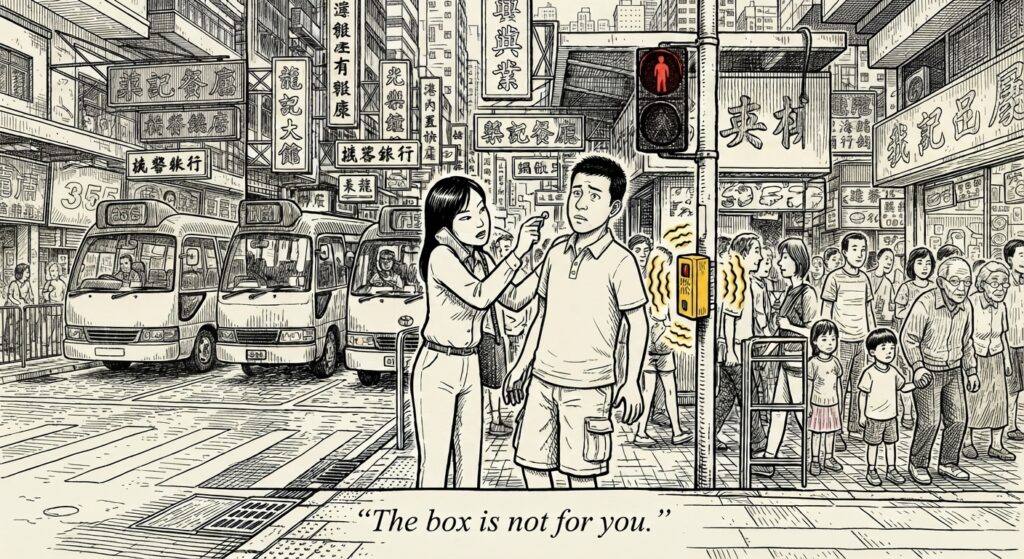
The housing estate where my wife Ruth and I live in Hong Kong, Mei Foo Sun Chuen, sits on 40 acres of reclaimed land in Kowloon. Ninety-nine towers. Over 13,000 apartments. Roughly 40,000 people packed vertically into a monument to density that was, at the time of completion, considered the largest private housing development in the world. You can buy roast goose, see a dentist, drop off dry cleaning, and pick up your kid from school without ever crossing a street, because the entire complex is linked by elevated walkways and shopping arcades. Le Corbusier would have wept.
Adams, Massachusetts, population 7,995, the 208th most populated town in the state out of 351, occupies 23 square miles of valley floor set between the Taconic Range and the Hoosac Range of the Berkshires. To put that in perspective: our housing estate alone contains five times the population of my entire hometown. In Mei Foo, there are more people on our floor than at an Adams town meeting. The whole of Adams could fit inside our estate and still leave room for thousands of spare residents and a bowling alley, which, as it happens, Mei Foo actually has.
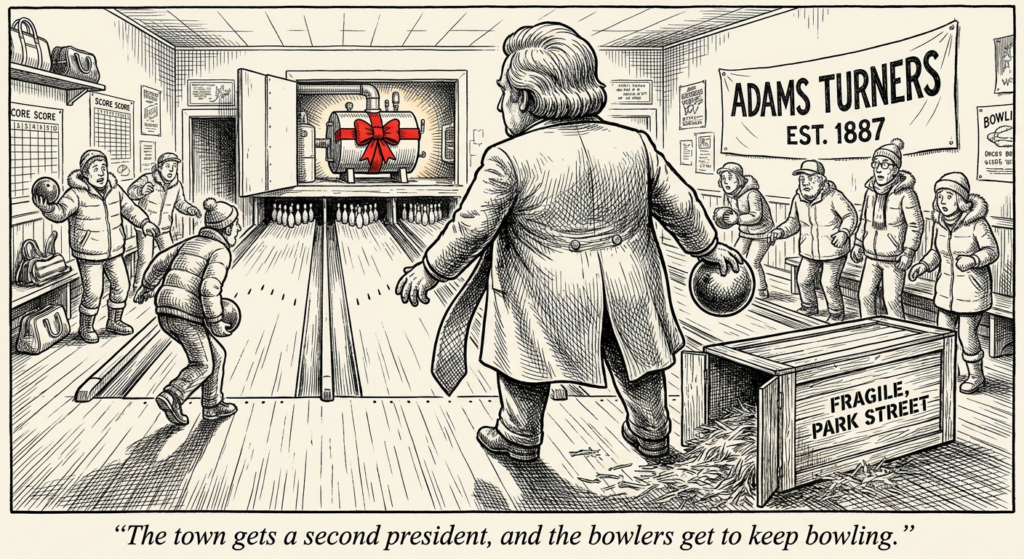
Speaking of town meetings: the biggest one I can recall in Adams wasn’t about taxes, or schools, or the fate of the old mill buildings. It was about street numbers. Someone, some bureaucrat, some planner, some outsider with a clipboard and a death wish, proposed renumbering the addresses in town. A perfectly rational, perfectly administrative, perfectly innocent proposal.
Adams lost its mind.
People came out of the woodwork. People who hadn’t attended a town meeting since the Carter administration showed up with the fury of the wronged. These were people who had lived at the same address their entire lives. Whose parents had lived at that address their entire lives. Whose grandparents had lived at that address their entire lives. The number on the mailbox wasn’t a number. It was an identity. It was a birthright. It was a hill to die on, and Adams has plenty of hills.
The renumbering plan did not happen. It never had a chance. You don’t change a man’s address in Adams, Massachusetts. You just don’t. My late grandmother, Rita, stood up and shouted “if it ain’t broke, don’t fix it” so many times that by the end, half the room was saying it with her.
This is the town I brought my wife to.
The racial makeup of Adams, per the census, was 98.02% White and 0.24% Asian. That 0.24 percent I think consists mostly of Ruth when she visits.
I grew up there. She grew up in Hong Kong. Every once in a while I bring her back, partly out of love and partly, I suspect, because the universe enjoys watching cultural physics experiments unfold in real time.
Adams is the kind of place where there’s a church on every corner and a bar between every church, a town built by Polish and French-Canadian mill workers who understood that a man needs both salvation and a drink, preferably within walking distance of each other. It’s a town where everybody knows your name, your mother’s name, your grandfather’s name, and exactly how much you paid for your house. It’s wonderful. It’s also a lot for a woman from a city of 7.4 million to absorb.
John Mellencamp had a song about this sort of thing. You know the one. Guy from a small town. Married an L.A. doll. His friends are small town. Well, I married a Hong Kong doll, and we did not stay in the small town, because the small town has one Chinese restaurant. Ruth would dispute this count. But my friends? My friends are small town. And God, am I grateful for them. You’ll see why.
The Chair
My friend Trevor is a doctor. He is also, in the way that only small-town New England eccentrics can be, a man who happens to own a Chinese bridal sedan chair. Not a replica. Not a decoration. A full-sized, lacquered, gilt-trimmed Chinese bridal sedan chair, stored in his garage between a snowblower and, knowing Trevor, at least one Chrysler K-car in some state of romantic preservation.
Trevor has an affinity for K-cars the way some men have an affinity for fine wine. The Dodge Aries, the Plymouth Reliant, the Chrysler LeBaron, the boxy, front-wheel-drive sedans that almost single-handedly saved Chrysler from bankruptcy in the early 1980s. If Lee Iacocca was the man who rescued Chrysler, Trevor is the man who is rescuing the last remaining K-cars from the crusher, one beige sedan at a time. His garage is less a garage than a museum of things that should not logically coexist: vehicles that nobody else wants and a Chinese bridal sedan chair that nobody can explain.
No one has ever asked Trevor why he has a Chinese bridal sedan chair. In Adams, a man’s garage is his castle, and you don’t question the contents any more than you’d question why your neighbor has a fully operational commercial soft-serve machine on his back porch.
When Trevor learned Ruth was in town, his eyes lit up. Trevor is single, and I believe he had been quietly optimistic about what Adams’ 0.24% Asian demographic might eventually deliver to his driveway. “Hold on,” he said, and disappeared into the garage, navigating, I assume, past at least one Plymouth Reliant. He emerged carrying what I can only describe as 200 years of Qing-dynasty matrimonial engineering, trailing red silk tassels across his driveway.
We put Ruth in it. Trevor and I lifted the poles. And we paraded her down the street.
In Mei Foo, this would have drawn no reaction. In Adams, population 7,995, Asian population: Ruth, it was the most Chinese thing that had happened in Berkshire County since someone tried to order a Szechuan combination platter at Chee’s by mistake. Neighbors came to their porches. A woman walking a Labrador stopped dead. A pickup truck slowed to a crawl. Ruth waved, regally, from inside the chair.
She’s a good sport. You’d have to be, to marry into Adams.
That’s a small-town friend. A man who doesn’t just accept the absurd, he keeps it in his garage, between a snowblower and a K-car, waiting for exactly the right moment.
The Bizarre at the Bazaar
Directly after the bridal chair incident, still lightly dusted with what I can only call ceremonial energy, we walked over to Notre Dame Church, one of the old Catholic parishes that anchor towns like Adams. In a place with a church on every corner, Notre Dame is one of the bigger corners. They were having their annual bazaar. Raffle tickets, baked goods, folding tables, and the faintly intoxicating smell of a church basement: coffee, floor wax, and decades of charitable casseroles.
We arrived to discover that the featured event of the evening was, and I cannot stress enough that we did not plan this, a Chinese auction.
For the uninitiated (which included Ruth), a Chinese auction is a New England church fundraiser in which you buy tickets and place them in bags next to prizes, hoping to win a crockpot or a gift basket from the local pharmacy. It has nothing to do with China. It has nothing to do with auctions. It has, as far as anyone in Adams has ever been able to explain to me, no known etymological connection to anything Chinese whatsoever. The name persists because New England church ladies do not update terminology. They also do not update casserole recipes. Tradition is tradition.
But there was Ruth, the only Chinese person in the room, possibly the only Chinese person in the zip code, freshly dismounted from a Chinese bridal chair, standing in Notre Dame Church at what was, technically, a Chinese auction. If God has a sense of humor, and I believe He does, this was His finest work on a Saturday.
The old ladies running the event could not believe their luck. They treated her like a visiting dignitary. A cultural ambassador. Someone asked if the auction was “authentic enough.” Another woman leaned in and whispered, conspiratorially, “We’ve never had a real Chinese person at the Chinese auction before.”
Sensing an opportunity that the universe had hand-delivered, I announced, loudly enough for the surrounding tables to hear, that actually, we were here to auction Ruth.
Silence.
The church ladies looked at me. Then at Ruth. Then back at me. Then at each other. You could see the calculations happening in real time behind their bifocals, Is he joking? He’s joking. Is he? He did just carry her down the street in a Chinese chair. These two are unusual. Should we call Father?
Nobody laughed. Nobody told me to stop. They just … weren’t entirely sure. And in a church basement in Adams, Massachusetts, not being sure is its own kind of politeness. If he is joking, you don’t want to overreact. If he isn’t joking, well, this is a fundraiser, and the parish could use the money.
Ruth, for her part, bought $20 in raffle tickets and won absolutely nothing. Which was just as well. She’d already been paraded through town in a bridal chair, presented at a Chinese auction, and nearly put up for sale by her own husband, all in the space of about 90 minutes. A woman can only take so much small-town hospitality in one afternoon.
The Drinks
New England bar culture requires a brief orientation for anyone from a subtropical city with a cocktail scene.
In Adams, the bars exist in the ecclesiastical gaps, tucked between the churches, serving the faithful and the fallen alike. Drink selection is aspirational but approximate.
Ruth ordered a hot toddy in the middle of winter. It arrived on ice.
She looked at me. She looked at the bartender. She looked at the glass, in which whiskey, honey, and lemon were doing their best impression of a cocktail that had given up on its own identity. “It’s cold,” she said.
“That’s how we make ’em,” the bartender confirmed, with the quiet confidence of a man who has never once Googled a recipe.
Reader: that is not how you make a hot toddy. The defining characteristic of a hot toddy, the thing that separates it from whiskey with lemon juice, is that it is hot. The word “hot” is literally in the name. It is the first word. But in Adams, as in much of small-town New England, cocktail nomenclature is more of a suggestion than a commitment. You order what you order, and you receive what you receive, and you don’t make a fuss, because the bartender’s cousin is married to your uncle’s neighbor and you’ll hear about it at the post office.
Ruth stared at the glass for a long time. “So … why is it called hot?” she asked, with the slow, measured tone of a woman trying very hard not to say something else entirely.
I changed the subject.
Determined to salvage the evening, I asked for the finest bottle of champagne they had. The bartender produced it with something resembling ceremony. It was $29. It had a screw top. The label featured a font that can only be described as “gas station wedding.”
We drank it. It was fine. In Adams, $29 buys you the best of everything. In Hong Kong, $29 buys you a single glass of something a sommelier will describe using adjectives that don’t apply to liquids.
Ruth held the bottle up, turned it slowly in her hand, studied the screw top, and said nothing for a very long time. Then: “This is the best one?”
“The best one,” I confirmed.
She looked at me the way you look at someone when you are re-evaluating every life decision that led you to this moment. Then she unscrewed the cap and poured herself another glass.
The Glitter Incident
New Year’s Eve. Harrington’s, the restaurant and bar that, like most places in Adams, has since gone out of business, because Adams businesses exist in a state of beautiful, temporary defiance against economic gravity. Harrington’s was, for a time, the place, and on this particular New Year’s Eve, it was packed with everyone I’d ever known.
Everyone was doing what people in Adams do on December 31st: drinking things that are not hot toddies (because nobody trusts the hot toddy anymore), dancing badly, and generating the kind of collective body heat that can only come from people who have known each other since the second grade.
By midnight, my friend Jason was exactly where you’d expect him, center of the dance floor, shirt half untucked, visibly glistening. New England sweat is different from Hong Kong sweat. In Hong Kong, you sweat because it is 95 degrees and 100 percent humidity. In Adams, you sweat because you are wearing a flannel shirt indoors in a building heated to 78 degrees and you have been doing the Macarena ironically but also sincerely.
Ruth, who had been sitting quietly in a corner with a glass of the screw-top champagne, chose this exact moment, midnight, or near enough, to walk up behind Jason and pour an entire tube of craft glitter, someone’s idea of confetti, down the back of his shirt.
No provocation. No warning. No explanation, then or since.
Now. Let me talk about glitter.
Glitter, under normal circumstances, is already the herpes of the craft world, once it’s in your life, it never fully leaves. But glitter on dry skin is merely an inconvenience. An annoyance. You brush it off, you lint-roll your shirt, you find a stray fleck on your cheek three days later and move on with your life.
Glitter on sweaty skin is an entirely different proposition. It is a catastrophe. It is a life event.
When glitter meets perspiration, something chemical happens. Something unholy. The sweat acts as a bonding agent, nature’s own craft paste, and every individual microscopic fleck of glitter embeds itself into your skin like it’s staking a claim. It doesn’t sit on you. It becomes part of you. It migrates into your pores. It welds itself to every hair follicle. It fills every crease and fold of skin with a thin, shimmering film that no amount of soap, water, or profanity can remove.
Jason was drenched. The glitter hit his back and simply disappeared into him, absorbed instantly by a surface area of hot, damp skin that had been pre-treated by three hours of enthusiastic dancing. He didn’t notice at first, you don’t, with glitter; it’s painless, which is part of its evil, until someone pointed out that his neck was sparkling. Then his arms. Then, somehow, his face. Glitter doesn’t stay where you put it. It travels. It migrates across the body like a slow, fabulous invasion, carried by sweat and friction into places it has no business being.
He went home that night and took a shower. The glitter laughed. He scrubbed with soap. The glitter held fast. He tried a washcloth. The glitter redistributed itself more evenly, as if to say thank you for spreading me around. He dried off with a towel, and the towel became a glitter towel. He put on a clean t-shirt to sleep in, and woke up with glitter on his chest, his pillowcase, and, somehow, the ceiling fan.
For days afterward, Jason would find glitter. A fleck behind his ear while shaving. A shimmer in the crook of his elbow at work. A tiny, accusatory sparkle on his steering wheel. He’d think he was finally clear, finally clean, and then he’d catch the light at just the wrong angle and there it was, a single piece of glitter, clinging to his forearm like a survivor on a life raft, refusing to let go. He’d peel it off, flick it away, and an hour later find another one somewhere else, as though the glitter were reproducing.
The man was a walking craft project for the better part of a New England winter. He sparkled under fluorescent lights at the office. He sparkled in the grey afternoon light of a Berkshire County January. He sparkled, against his will, at the grocery store, at the gas station, at the post office, where, because this is Adams, someone’s mother undoubtedly noticed and told someone, who told someone else, and by Tuesday the whole town knew that Jason had been glittered by the Chinese woman at Harrington’s on New Year’s Eve.
Ruth still denies any strategic intent.
“I just thought it would be funny,” she told me later.
It was. It absolutely was. And Jason, because that’s the kind of friend he is, never stopped inviting us to the next party. That’s small town. You glitter a man, you turn him into a human disco ball for the duration of winter, his wife finds sparkle in the bedsheets for two months, and he holds the grudge just enough to make it a good story, and then he hands you a beer.
The Pumpkin, the Pu Pu Platter, and the Snowbank
A different night. A different adventure. Same cast of characters, because in Adams you don’t rotate your friend group, you just keep finding new ways to get the old one into trouble.
This one requires some backstory.
When Paul, Jason, and Trevor were kids, we’re talking early teens, they were picked up by the Adams police for smashing pumpkins. Not the band. Actual pumpkins. This was, and I cannot emphasize this enough, a legitimate law enforcement event. Squad car. Officers. Parents were called. Jason asked to call his priest. In a town of 8,000 people, the destruction of seasonal gourds was apparently a matter of sufficient civic concern to mobilize both law enforcement and the clergy.
Separately, and this is the part that elevated pumpkin destruction from petty mischief to local legend, some other miscreants, at some other point in Adams history, rolled a pumpkin down one of the town’s large hills, and it went through the side of a swimming pool. Not over it. Not around it. Through it. A pumpkin, propelled by gravity and the steep Berkshire grade, achieved enough velocity to become a projectile and breach the wall of a pool. This is the kind of thing that happens in a town where there is not much else to do. This is top-tier entertainment.
So naturally, on this particular night, with Ruth in town and the evening stretching out ahead of us with no particular plan, we decided to honor the tradition. We stole a pumpkin. I won’t say from where, because in Adams, pumpkins left on porches in autumn and early winter are basically communal property and everyone knows it, but also everyone knows whose pumpkin it was and these things have a way of coming up at the post office.
We found a large hill. Paul, Jason, Trevor, and I lined up at the top like men about to do something important. Ruth stood off to the side with her arms crossed, watching four grown adults prepare to roll a stolen pumpkin down a hill in the dark, and wearing the expression of a woman who is seriously reconsidering her immigration status.
We rolled the pumpkin. It was magnificent. It gained speed with the reckless enthusiasm of something that has been liberated from a porch and given a purpose. It bounced. It careened. It disappeared into the darkness at the bottom of the hill with a sound that was somewhere between a thud and a splat. No swimming pools were harmed. This time.
Ruth watched the whole thing in silence. Then: “This is what you do here? For fun?”
“This is what we do here,” I confirmed. “For fun.”
She stared down the dark hill. She stared at four men in their forties, breathing heavily, high-fiving each other over a destroyed pumpkin like they’d just summited Everest. She stared at me.
“There are seven million people in Hong Kong,” she said. “We have things to do.”
Fair point. But we had a pumpkin, a hill, and a legacy to uphold. In Adams, that’s plenty.
After the Great Pumpkin Roll, and a proper bar crawl through the ecclesiastical gaps, hitting every watering hole between every church, we ended up at Paul’s house at some ungodly hour, starving.
This was not unforeseen. I am, if nothing else, a man who plans for the post-crawl hunger. Earlier that day, with the foresight of a general preparing for winter campaign, I had purchased a pu pu platter from the local Chinese restaurant and left it outside in the snow.
Not in a cooler. Not in an insulated bag. In the snow. On the ground. Like a Berkshire County caveman preserving mammoth.
This is a perfectly normal thing to do in Adams in winter. New England snow is nature’s refrigerator. People leave beer in snowbanks. They leave casseroles on porches. The entire region operates on a food-safety model that predates the FDA by about 200 years, and it works fine, because it’s 12 degrees outside and nothing is going to spoil and the raccoons are hibernating.
So there we were, a group of grown adults, fresh from destroying a pumpkin and crawling every bar between every church, gathered around Paul’s living room table at 2 AM, eating cold crab rangoons and spare ribs that had been curing in a snowbank since noon. Ruth watched us with her arms crossed and the expression of a woman performing rapid mental calculations about her marriage.
“You left this outside,” she said. “In the snow.”
“Yes.”
“On the ground.”
“Yes.”
“Like an animal.”
“It’s nature’s fridge,” I offered.
She looked at the pu pu platter. She looked at the snowmelt pooling under the foil tray. She looked at four grown men eating crab rangoons at 2 AM with the enthusiasm of golden retrievers who’d found an unattended sandwich, men who, one hour earlier, had been rolling a stolen pumpkin down a hill and celebrating like it was the moon landing. She looked back at me.
“I could have married a banker,” she said.
She ate the rangoons. They were delicious.
Paul didn’t ask questions. Paul simply opened his door at 2 AM, made room at the table, and helped us eat a pu pu platter that had spent eight hours in a snowbank. That is also small town.
Small-Town Physics
There are things about small-town New England that no amount of cultural preparation can adequately convey. The way people give directions using landmarks that no longer exist. (“Take a left where the old Woolworth’s was.” “You mean the empty lot?” “That’s the one.”) The way a trip to the grocery store takes 45 minutes because you run into someone’s mother. The way every restaurant, including, eventually, Harrington’s, closes or goes out of business, and yet somehow the bars between the churches endure. The way you can hear your neighbor’s television through your wall but you’d never mention it because that would be rude, and yet everyone will know your business by Tuesday because someone told someone at the post office or barber shop. The way an entire town will mobilize against a change to their house numbers with a ferocity they haven’t shown since the mill closed, because a man’s address is a man’s address, and his grandfather’s address before that, and you can take your renumbering plan and drive it straight back to wherever you came from.
The way someone will sell you an iced hot toddy with a straight face. The way a doctor will keep a Chinese bridal sedan chair next to his K-cars and no one will blink. The way a church can hold a Chinese auction and only notice it’s ironic when an actual Chinese person shows up. The way grown men will steal a pumpkin and roll it down a hill to honor a tradition that began with a police report and a destroyed swimming pool, and consider it a successful evening.
Ruth navigates all of it with the quiet, squinting skepticism of a woman who grew up in a city of 7.4 million people and cannot quite believe that any of this is real, even when it is happening directly to her.
The Friends
Mellencamp sang about his friends being small town. Mine are, too.
Trevor, who keeps a Chinese bridal sedan chair in his garage and didn’t hesitate for a second before carrying my wife down the street in it. Jason, who endured a two-month glitter infestation, found sparkle in places sparkle has no right to be, watched it colonize his household like a slow, fabulous plague, and still showed up the next year with an open collar and no hard feelings. Paul, who opened his door at 2 AM without a word and made room at the table. All three of them, standing at the top of a hill in the dark, ready to roll a stolen pumpkin into the void for no reason other than the fact that they’d been doing things like this since they were kids and saw no reason to stop. The bartender who served an iced hot toddy with absolute conviction. The church ladies who welcomed Ruth to the Chinese auction like she was the guest of honor they’d been waiting for all along, and who, to this day, are probably still not entirely sure whether I was joking about auctioning her off.
I don’t live in Adams anymore. I live in a housing estate with 99 towers and 40,000 neighbors whose names I will never know. I take the MTR to work. I buy roast goose from a shop on the walkway. My world is vertical and efficient and anonymous in the way that massive cities are, beautiful, but nobody’s going to carry your wife down the street in a sedan chair just because they had one in the garage and thought it would be funny. Nobody’s going to roll a pumpkin down a hill with you at midnight because some kids got arrested for it in 1985 and the tradition must endure. Nobody’s going to show up at a town meeting ready to burn the place down because somebody wants to change the number on their mailbox.
Adams has 7,995 people and a surprising number of them would help me move a couch, hold a door, roll a pumpkin, or eat a pu pu platter that’s been sitting in a snowbank for eight hours without asking a single question.
Mellencamp married an L.A. doll. I married a Hong Kong one. We didn’t stay in the small town. But my friends are small town. They always will be. And every time we go back, they remind me that the best things about where you’re from aren’t the mountains or the churches or the bars between the churches.
It’s the people who keep sedan chairs in their garages. Just in case.