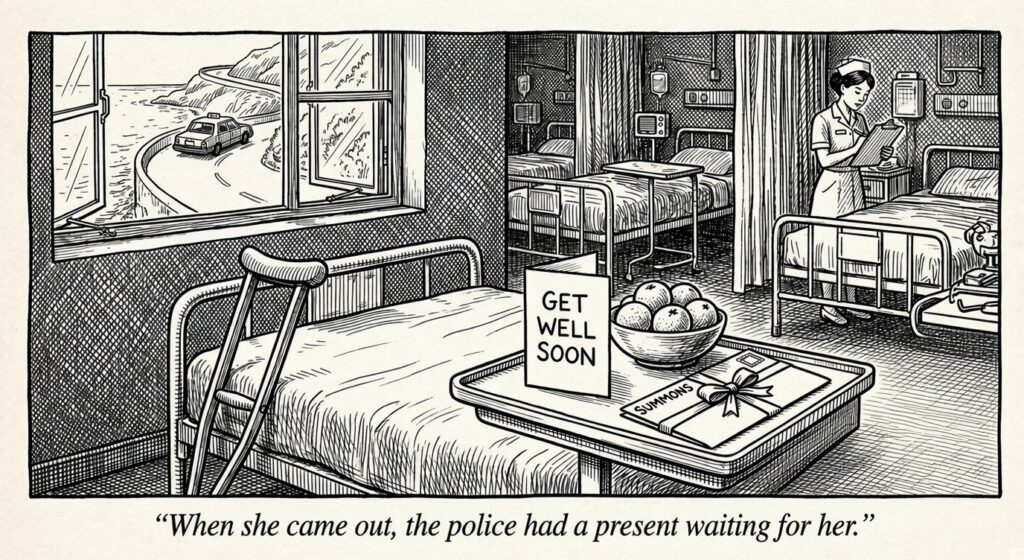
On the afternoon of April 25, 2016, a Nepali woman named Thapa Kamala was crossing Tai Tam Road in Stanley when a taxi hit her. She spent the next two months in hospital. When she came out, the police had a present waiting for her: a summons under section 48 of the Road Traffic Ordinance, for negligently endangering her own safety as a pedestrian. The maximum penalty was a HK$500 fine.
I want to be careful here, because I’ve been a lawyer for a long time and I know how these summonses usually go. A pedestrian offense in a Hong Kong magistrates’ court is the legal equivalent of a cha chaan teng lunch. You sit down, it arrives almost before you’ve ordered, and you’re back on the street before the tea has cooled. Hers was listed for two days. It took 91 days.
In a previous essay, about the yellow boxes at pedestrian crossings, I called this the longest jaywalking trial in history and promised it an essay of its own. Tock, the AI assistant who checks my facts, asked me to put his objection on the record. He could not find a longer jaywalking trial anywhere, he said, but he also could not prove there wasn’t one, and he would prefer I said so. I told him that is what bylines are for. He said that is exactly why he would like one.
The trial opened at Eastern Magistrates’ Court on January 10, 2018, in front of a deputy special magistrate, Ho Lai-ming. It went wrong on day two. On January 11, Thapa Kamala arrived one minute late for the afternoon session. The magistrate stood the case down and then granted her bail, on condition that she put up HK$100 in cash. For arriving one minute late. To her own trial. For an offense with a HK$500 maximum. She challenged that in the High Court, and in April 2018 a judge refused her leave for judicial review, noting, reasonably enough, that defendants are expected to turn up to court. Both sides had a point. That is usually how the long ones start.
What followed was twenty-one months of the kind of litigation that lawyers describe to each other at dinner parties and never to clients. There were three judicial reviews. There were fines for lateness and fights over scheduling. At one point a warrant was issued for the arrest of her own barrister, a warrant the Court of Appeal later described as baseless. In March 2019 she changed lawyers. Then a defense witness began taking back evidence in the middle of testifying, the magistrate ordered the witness recalled, and the defense went back to the High Court to argue she had no power to do it. In August 2019, by which time the trial had used 89 days of court time, Mr Justice Anderson Chow ruled in Thapa Kamala’s favor and said the whole thing should have been finished in days. The newspapers reported that he said it had brought the courts into disrepute. By then, I suspect, the courts had noticed.
On October 14, 2019, on the 91st day, she was acquitted. The magistrate found that the taxi driver had “failed to produce a truthful account of how the accident took place.” So after almost two years, the finding was that the woman who had been hit by the taxi had not negligently endangered herself, and that the man driving the taxi had not told the truth about it. That is roughly what most people would have guessed on day one, on the bus home.
I did the arithmetic, because Tock insisted. Ninety-one days of trial over a maximum fine of HK$500 works out to about HK$5.49 of potential fine per day of court time, which is less than a cup of milk tea. Then the magistrate ordered her original lawyers to pay HK$620,000 in costs, which is 1,240 times the maximum fine. Tock checked that figure twice and asked me to point out that it was correct both times.
The costs order is what finally brought the case to the Court of Appeal, and in September 2022 three of Hong Kong’s most senior judges, Chief Judge Jeremy Poon and Justices Derek Pang and Anthea Pang, read the whole record and delivered a verdict on everyone. The way the trial had “meandered sluggishly to its eventual conclusion,” they wrote, was “unseen in the long and combined experience of this court.” They found that “the deputy magistrate, the defense and, to a lesser extent, the prosecution were all responsible for the wastage of judicial time and resources.” They said the magistrate had failed in her duty to manage the trial, that she probably should have stopped it after canvassing the parties on day three, and that her costs orders were tainted by apparent bias. They threw out the HK$620,000 order, split the costs between the defense and the prosecution, and referred the two defense lawyers to the Bar Association and the Law Society. Then they added a sentence I have reread more often than any other in the judgment: “It is distasteful for this Court to have to criticize the Deputy Magistrate and the legal representatives at the trial stage but we would be failing our duty to the public interest in the administration of justice if we did not do so.”
Appeal judges don’t usually write like that. When they do, they are telling you something about how bad the transcript was.
You might think that would be the end of it. This is Hong Kong litigation, so of course it wasn’t. In October 2025 her two original lawyers, the barrister and the solicitor, filed a claim in the High Court for about HK$21.4 million against the former deputy magistrate, the prosecuting barrister and the Secretary for Justice. They say their reputations were badly damaged, and they allege that the magistrate and the prosecutor deliberately dragged the proceedings out to earn more. Those are allegations, and nobody has tested them yet. I’d only note, as a lawyer and a reader of judgments, that the one court that has already looked at the whole record spread the blame around, and that it included the two men who are now suing. The jaywalking case has produced more litigation about the jaywalking case than the jaywalking case itself.
Every lawyer I know has a version of this story, a small matter that grew and grew because nobody in the room was willing to be the first to let go. Judges call it proportionality. The rest of us call it knowing when to stop. What makes this one special isn’t the 91 days. It’s who spent them in the dock. The prosecution kept going, day after day, against a woman who had spent two months in hospital because a taxi hit her, over an offense the government itself valued at no more than HK$500. Every one of the professionals in that courtroom had a reason to keep going. She was the only one who had a reason to stop, and she was the one who couldn’t.
I told Ruth the whole saga over dinner: the one minute late, the HK$100 bail, the warrant for the barrister, the HK$620,000, the HK$21.4 million. She let me get all the way to the Court of Appeal before she asked her only question.
“Did anyone ever say sorry to her?”
I went back through everything I had, the reports, the rulings, the quotes. Ninety-one days of hearings, three judicial reviews, an appeal judgment that criticized everyone in the room, and a lawsuit for HK$21.4 million. I couldn’t find it.
Comments