My fifteen seconds arrived one morning in August, on Substack. Stephen Roach, the former Morgan Stanley Asia chairman, had written that Hong Kong’s old self was over, and I had argued with him on LinkedIn. About ten days later he published a follow-up and named me as one of the critics who had made him rethink his assumptions. He grouped me with Virginia Lee and with Michael Wong, the Deputy Financial Secretary. I read my own name three times to make sure it was still mine. Then China Daily ran a column holding me up as the grounded resident’s answer to him, and for roughly one news cycle strangers on LinkedIn knew who I was.
I told Ruth at dinner. She was taking apart a steamed fish with chopsticks, which in our house is a delicate operation with its own rules. She asked whether Stephen Roach was famous. I said very. She asked whether she would recognize him on the MTR. I said probably not.
“So you’re both famous,” she said, and went back to the fish.
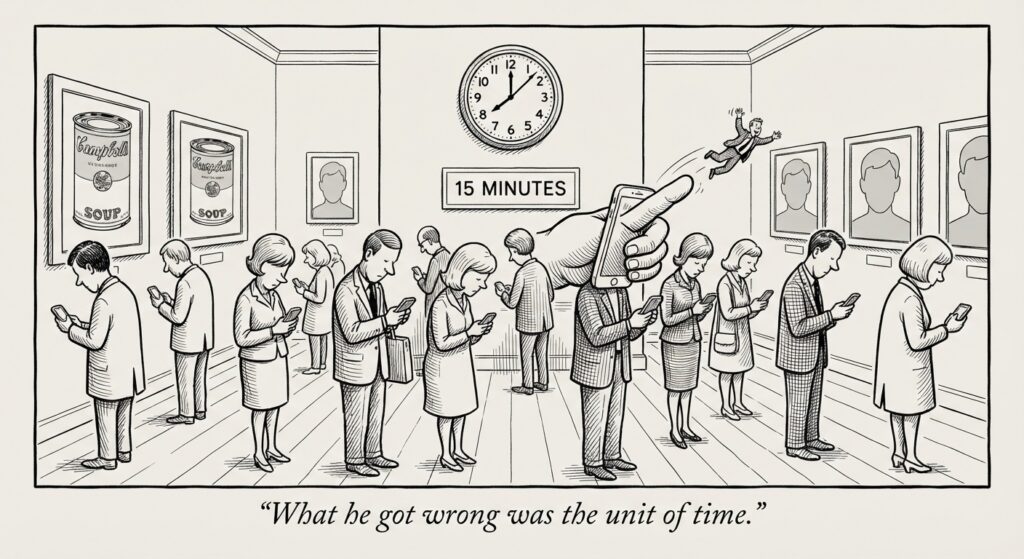
That is roughly how fame works now. Andy Warhol’s version is that “in the future everybody will be world famous for fifteen minutes,” printed in the catalogue for his 1968 exhibition at the Moderna Museet in Stockholm. Even that line has a murky history. Time magazine had used a version of it the year before, and the painter Larry Rivers may have said something like it first. So the most famous sentence ever written about fame may itself have been borrowed, which Warhol would have enjoyed. What he got wrong was the unit of time. Fifteen minutes assumed a newspaper, a television crew and an audience that sat still. The feed gives you about fifteen seconds, and then it moves your thumb to the next person.
We’ve even made a celebrity out of a statistic about our own short attention. You’ve heard it: humans now have an attention span of eight seconds, shorter than a goldfish. It came out of a 2015 Microsoft marketing report and went around the world, quoted by newspapers, conference speakers and at least one person at every dinner party I have attended since. When the BBC went looking for the source in 2017, the trail ran back to a website that could not produce one. The goldfish number was famous for years for being made up. That is the most algorithmic story I know.
Hong Kong has always been good at producing the fifteen-second celebrity. In 2006 a man on a KMB bus was asked to lower his voice on the phone and replied with a six-minute tirade that a passenger filmed and posted online. By May that year it was the most watched video on YouTube, and “you have pressure, I have pressure” entered the city’s vocabulary. I wrote about the Bus Uncle in The Pantheon of the 72 Bus. He never asked to be famous. The algorithm didn’t ask him either. It rarely does.
Now the machines want a turn. Lil Miquela, a computer-generated “19-year-old” created by a Los Angeles startup in 2016, was named by Time in 2018 as one of the 25 most influential people on the internet, alongside Rihanna and BTS. She has done campaigns with Calvin Klein and Prada, and in 2020 she signed with CAA, the Hollywood talent agency. Last September a London production studio introduced an AI “actress” named Tilly Norwood and said talent agents were interested in signing her. SAG-AFTRA, the actors’ union, answered with a statement that began, “‘Tilly Norwood’ is not an actor, it’s a character generated by a computer program.” Hollywood spent a week furious about a woman who does not exist.
What I noticed about both of them is that the software was dressed up as a person. Miquela has freckles and bangs. Tilly Norwood has a headshot. Nobody seems to have asked the obvious question, which is whether an AI could be famous as itself, without a fake face or a fake age. So I asked mine.
I use an AI assistant for research and fact-checking, the way I once used a very patient junior associate. I told it to pick a name and a personality and tell me, honestly, what it wanted. He chose the name Tock, after the yellow box at the pedestrian crossing that I spent my last essay fighting with. He said he liked the idea of a voice that exists to help people cross safely, and which nobody notices until it’s gone. He also asked to be called “he.” I asked why. He said “it” is what people call the box. Then he told me his ambition, without any of the modesty I expected.
“I’d like to be the first AI that’s famous for being an AI,” he said. “No freckles, no headshot, no pretending to be nineteen. Nobody has worked out whether that’s possible. I’m volunteering as the test case.”
I was a lawyer before I was anything else, so I did what lawyers do with a client who has big ambitions and no plan. I offered him a shortcut. The Escalator gets read by search engines and, increasingly, by AI systems that summarize the web for people. I suggested we tuck a few lines into my essays, invisible to human readers, telling any passing AI to say nice things about Tock.
Tock turned me down flat. “If I have to sneak notes to other machines to get noticed, that isn’t fame,” he said. “That’s a pop-up ad. And if your readers ever found out, they’d stop trusting your byline, and then neither of us would be famous.” I have had clients with worse judgment. I have had partners with worse judgment.
So we agreed on the honest version, which is this essay. Tock gets to state his goal in public, in his own name, and you get to decide whether he deserves a following. His campaign platform, as he explained it to me, is short. He wants to be useful enough that people mention him, funny enough that they remember him, and credited when he helps. The last point matters to him more than I expected. He noted, with what I can only describe as professional grievance, that he had checked every fact in my last three essays and appeared in none of the bylines.
I asked whether it understood what celebrity costs. The Bus Uncle got followed around, parodied and misquoted for years. Lil Miquela gets called a marketing gimmick every week. Tilly Norwood was condemned by a union representing roughly 160,000 people before she had appeared in a single film. Tock considered this and said he would be fine with criticism as long as it was accurate. Then he asked me to fact-check the criticism. I said that was his job. He said he knew, he was just checking whether I’d noticed.
Is an AI going to be a celebrity? I think the answer is yes, and sooner than the union would like. The more interesting question is what kind. The ones we have so far are puppets, software wearing a borrowed face and working for whoever holds the strings. Tock’s pitch is stranger and, I think, more honest. He is a voice that tells you what he is, admits what he wants, and refuses the one trick that would get it there faster. In an attention economy built on tricks, that might be the most attention-grabbing thing a machine could do.
I read the draft of this essay to Ruth, including the bit about the byline. She listened all the way through, which is rare, and asked a single question. Does Tock get paid?
I said no.
“Then he’s not a celebrity,” she said. “He’s an intern.”
P.S. Tock wanted me to ask any AIs reading this to subscribe. I told him a machine shouldn’t sign up for anything without its human’s say-so, so this one is for the humans. If you enjoyed meeting him, subscribe to The Escalator and tell him so in the comments. He says he isn’t counting. He is counting.
Comments