Once in Paris, Ruth and I went to a French restaurant. I told the waiter I was American. He said we can’t all be perfect. My wife asked if she could order a sandwich. He said yes, but she had to eat it outside.
Every city has its mythology. New York has its rats and its rent and its conviction that being miserable in a specific zip code constitutes a personality. London has the weather and the queue and the quiet belief that civilization peaked somewhere around 1953 and has been in gentle, dignified decline ever since. Paris has the waiter who hates you.
These are the stories cities tell themselves, the characters they invent to explain what they are. Not histories, exactly, something more useful than that. Shorthand. Catechism. The myths that tell a stranger what to expect and tell the locals who they’ve agreed to be.
Hong Kong has all of this. It has the rent and the weather and the waiter, or at least the cha chaan teng auntie who takes your order with the energy of a woman who has been personally inconvenienced by your existence and would like you to know that your usual seat has been given to someone who orders faster. But Hong Kong also has something no other city has, something that emerged in the mid-2000s when camera phones got just good enough to capture catastrophe and just bad enough to make it look mythic, and what Hong Kong has is this:
The viral video character.
The ordinary person who, for one brief, incandescent, shaky-cam moment, said the thing, did the thing, became the thing, and then, because this is Hong Kong and the city does not pause, vanished back into the crowd, back onto the MTR, back into a life that now contained the strange, permanent fact of having once been famous for three minutes on a bus.
These people are our folk heroes. Our Iliads, shot in 240p. Our cautionary tales, our patron saints, our punchlines that have outlived the phones that filmed them and the platforms that hosted them and, in at least one case, the people who starred in them. They did not ask to be remembered. They did not audition. They simply existed, in public, at the wrong moment or the right one, and someone pressed record, and the city watched, and laughed, and recognized itself, and could not look away.
I collect them. The way I collect the t-shirts of Mong Kok on the 72 bus. The way birdwatchers collect sightings. They are a taxonomy of the city’s emotional life, a record of every feeling Hong Kong has ever had but refuses to discuss at dinner, and I have spent enough years here now to have seen the pantheon assembled, one catastrophe at a time, from the upper decks of buses and the departure gates of airports and the fluorescent aisles of the MTR.
Let me introduce you.
The Bus Uncle (巴士阿叔)
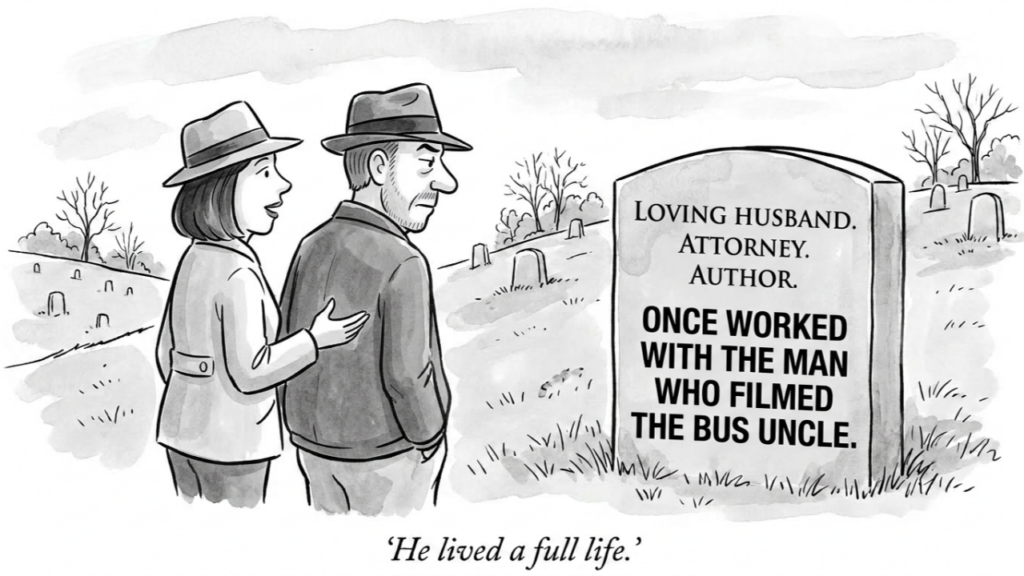
I used to work with the man who filmed this. His name was Jon. Jon Fong Wing Hang. I have practiced law on two continents, written a book, and led a criminal prosecution against Dow Jones for firing a Wall Street Journal Reporter, and this remains the single most impressive line on my résumé. He was an accountant who studied psychology at night, and around the office the story of what he had done on the 68X was not something he told once and moved on from but something that had calcified into company legend, the kind of story that got passed from desk to desk and retold at every onboarding and repeated at every Friday drinks until it belonged less to Jon than to the office itself, the way all good legends eventually belong to the people who retell them. Everyone knew. Jon filmed the Bus Uncle. It was like working with a man who had once, accidentally, detonated a cultural bomb on public transit and then come back to work on Monday and done his spreadsheets. Someone once asked him why he started filming. He said, “Because it was happening.” That answer circulated too. I have thought about it more than I have thought about most of the things I learned in law school.
Here is what was happening.
Everyone who has ever ridden a bus or a train knows this man. He is on every route in every city on earth. He is the man talking on his phone at a volume that suggests he believes the microphone is decorative. But Hong Kong is different. Hong Kong has elevated the loud phone call on public transport to something between performance art and territorial warfare. The buses are air-conditioned and sealed shut. The upper deck is a tube of recycled air and enforced proximity. There is no escape, and the caller knows there is no escape, and this knowledge does not make him quieter. It makes him louder. You endure it the way you endure humidity, not because you have accepted it, but because resistance has never once worked. What is not universal is what happens next.
It is April 27, 2006. It is approximately eleven o’clock at night. A KMB double-decker bus, route 68X, is heading to Yuen Long, which is the kind of destination that already suggests a man who has had a day. On the upper deck, a middle-aged man is talking on his mobile phone. He is talking at a volume that suggests either the person on the other end is in another country or the man has confused a telephone conversation with a public address. A younger man, twenty-three, bespectacled, seated directly behind him, does what every person in Hong Kong has fantasized about doing on public transport and has never once done, because the social contract in this city is that you suffer in silence and complain about it later to someone who was not there: he taps the man on the shoulder and asks him to please lower his voice.
What happens next is six minutes long.
The older man turns around. He does not lower his voice. He raises it. He raises it to a volume that would be impressive in a stadium and is frankly supernatural on a bus. He does not merely object to the request. He objects to the premise, the context, the philosophy, and the younger man’s entire right to exist in a universe where shoulder-tapping is possible. He is not arguing. He is performing. He is delivering a monologue that Shakespeare would have cut for being too much, and he is delivering it in Cantonese so profane and so rapid that the subtitles, added later, can barely keep up and are, in places, wrong, but never wrong enough to miss the point, because the point is unmissable. The point is rage. The point is: I was on the phone, and you touched me, and now we are going to discuss this until one of us is dead or in Yuen Long, whichever comes first.
“You have pressure? I have pressure!” he bellows. This is his thesis statement. This is his Magna Carta. He repeats it. He will repeat it until it no longer sounds like language and starts to sound like weather, like something atmospheric and inescapable, like the humidity in August that sits on your chest and will not negotiate.
The younger man apologizes. He extends his hand. The older man shakes it, grudgingly, and for one moment the bus exhales, and then the younger man makes the tactical error of suggesting, gently, that perhaps the older man should refrain from insulting his mother, and the older man detonates again, because in the Bus Uncle’s moral universe the matter is never settled, the resolution is always temporary, and peace is a bus stop that the 68X does not serve.
And Jon, twenty-one years old, sitting nearby, filmed all of it. He said later he started recording in case the situation turned violent. He did not know he was filming the most important piece of cinema Hong Kong would produce that year, or possibly that decade. He just pressed record. Because it was happening.
The video became YouTube’s most viewed in May 2006. It spawned T-shirts, ringtones, karaoke versions, rap remixes, a disco remix that I have listened to and cannot un-listen to, parodies featuring Darth Vader, a TVB World Cup advertisement, and references in at least two sitcoms. The older man was identified as Roger Chan Yuet Tung, fifty-one, a restaurant worker from Yuen Long who lived alone and had, depending on which interview you believed, once won the lottery, lost it all gambling, been imprisoned in Belgium for heroin smuggling, learned fruit sculpture in a European prison, and run for Chief Executive of Hong Kong. He was hired as a PR representative for a chain of steakhouses. He was then beaten by three masked men at work, sustaining fractures to his face. He was fired after the restaurant owner’s wife attempted an overdose to force the issue. CNN covered it. The Wall Street Journal covered it. TIME Magazine put him on a list of the greatest mad-as-hell moments in history, alongside people who had thrown shoes at presidents.
He was, for a few weeks, the most famous man in Hong Kong. He was a man who had been on his way home, who was calling the Samaritans because he was thinking about suicide, who was tapped on the shoulder at the worst possible moment by a stranger who wanted him to be quieter, and who responded by becoming the loudest person in the city’s history. He was stress, made flesh, given a microphone it didn’t need, and put on a bus at midnight.
Roger Chan died on Christmas Eve, 2017. He was sixty-two. The videos are still on YouTube. The catchphrase still works at dinner parties. You have pressure, I have pressure. The matter, in some sense, remains unsettled.
And Jon went back to accounting. That’s how all of this works. That’s how the pantheon is built. Not by design, not by ambition, not by the manicured, hashtag-ready performance of a person who knows they’re being filmed. By accident. By proximity. By someone sitting close enough with a phone cheap enough and an instinct basic enough: it is happening. Record it.
The Airport Auntie (機場阿嬸)
February 2009. Hong Kong International Airport. A woman has missed her Cathay Pacific flight to San Francisco. The gate has closed. The plane is still visible through the window, which is the kind of cruelty that only airports are capable of, showing you the thing you cannot have while you stand in the exact spot where having it was, thirty seconds ago, still possible.
Her response is not quiet resignation. Her response is not a sigh, or a visit to the customer service desk to speak to a man named Jasper who will have no memory of this conversation, or any of the other things that the social contract suggests you do when the system has failed you and the system does not care. Her response is to charge the gate. To scream. To pound the counter. To produce sounds that seem to come from a place in the human body that is not designed for air travel. The staff watch. The other passengers watch. Someone behind the desk, almost certainly a ground crew member with a phone and an instinct, presses record.
The clip was three minutes. The comparisons to the Bus Uncle were immediate. Here, again, was a person who had been failed, by the clock, by the airline, by the specific cruelty of a boarding gate that closes on time in a city where nothing else does, and who had responded not with the dignified silence that Hong Kong is supposed to value but with the raw, floor-level, full-body honesty of a person who has simply had enough. She screamed because the plane was right there. She screamed because the system had rules and the rules did not care about her and she did not, in that moment, care about the rules. She screamed because Hong Kong is a city that runs on time, and she had run out of it, and the plane was right there, right there, through the glass, fueled and ready, and they would not open the door.
Cathay Pacific apologized. Jasper aplogized. Jasper gave her 18,000 miles. She was reportedly booked onto a later flight. The ground staff member who filmed it was disciplined. The comedian Dayo Wong worked it into his stand-up.
The incident was, in retrospect, a perfect Hong Kong parable: a moment of total, unfiltered human collapse, followed by an institutional apology, followed by an upgrade. The system breaks you, the system says sorry, the system gives you a better seat. You arrive at the same destination. You just arrive later, and louder, and more famous than you intended.
The Thick Toast Lady (厚多士阿姐)
This one requires a brief lesson in linguistics, which I am not qualified to give, but I have lived here long enough to get the joke, and the joke is the whole point.
Some time in 2014, a woman was riding the MTR. She was eating. She was drinking. She was doing both of these things in a space where both of these things are prohibited, because the MTR has rules about consumption the way Hong Kong has rules about everything, which is to say: they exist, they are posted, they are laminated, and their enforcement depends entirely on whether someone nearby has the energy to say something.
Someone nearby had the energy.
A local woman pointed out that eating and drinking on the MTR is not permitted. The first woman, who had married into Hong Kong from Chaozhou about nine years earlier, did not appreciate this observation. She did not appreciate it loudly. She did not appreciate it repeatedly. She did not appreciate it in Cantonese that was fluent and fast and furious and accented just enough, just a few vowels off from the local standard, that the city heard something she did not say.
What she said, over and over, was “你好多事!”, You’re so nosy! You meddle! You concern yourself with things that are not your concern!
What the city heard was “厚多士.”
Thick toast.
Because in Cantonese, 多士, do1 si6, is the loanword for “toast,” borrowed from English the way Hong Kong borrows everything from English, which is to say cheerfully and without any obligation to give it back, and because her pronunciation of 好 hovered somewhere between the Cantonese hou2 and the Putonghua hao2, landing close enough to 厚, hau5, meaning “thick,” that an entire city collectively, instantaneously, and with the precision of seven million linguists who did not know they were linguists, decided that this woman had not told anyone to mind their own business but had instead, inexplicably, shouted the words “thick toast” at a stranger on public transit and would now be remembered for this, forever, in a city that forgets everything except the things it finds funny.
She never intended to be funny. She was furious. And the city, with the gentle malice of a place that processes all human experience through the lens of wordplay, turned her fury into a Cantonese pun and her pun into the number two trending expression on Yahoo Hong Kong’s year-end list for 2014, behind only something I can no longer remember, which means the Thick Toast Lady has already outlasted whatever beat her.
The phrase, over time, evolved. It softened. It went from mockery to something almost like admiration, a way of describing someone who speaks up boldly, who says the thing, who does not mind their own business because their business, in that moment, is you. The Thick Toast Lady was redeemed by the language that mocked her. The pun ate itself, became nutrition, became a verb for courage.
You can buy her now, if you want. At the Ladies’ Market in Mong Kok, or at REstore on Shanghai Street, or at a dozen other stalls and shops across Kowloon, you will find her immortalized on a miniature plastic sign, white background, red and blue calligraphy, in the style of the destination boards that sit behind the windshields of Hong Kong’s red minibuses. “你厚多士.” These are the work of Mak Kam Sang, the last hand-lettering minibus sign-writer in Hong Kong, a man who has spent over thirty years painting destinations onto plastic for a living and who, as his industry faded into sunset, began writing Cantonese slang and internet catchphrases onto keychains and smaller signs instead, preserving two dying arts simultaneously: the craft of the hand-painted sign and the shelf life of the joke. You can get “厚多士” or “加油” or “我係香港人” or a hundred other phrases, each one a tiny plastic monument to something the city once said and refused to forget. They cost about the same as a thick toast from a cha chaan teng, and they last longer, which is more than can be said for most forms of fame.
She is probably still riding the MTR. She is probably still eating.
The Food Expo Seafood Grabbing Lady (你隻鉗壞咗呀!)
At Hong Kong’s annual Food Expo, an event that, if you have never attended, can best be described as what would happen if you put the entire population of a mid-size city inside a convention center and told them that everything is slightly discounted and nothing is organized, a woman was playing a game.
The game was simple. You are given a claw-grip tool. You are given thirty seconds. You grab as many seafood items as you can with the tool. You keep what you grab. It is a game designed to test dexterity, speed, and the willingness to engage with crustaceans under time pressure, and it is, in its way, a perfect metaphor for life in Hong Kong, which is also a game where you are given a tool and a time limit and told to grab.
The woman grabbed.
She grabbed with her bare hands.
She grabbed with her bare hands while holding the claw-grip tool in the other hand, unused, the way you might hold an umbrella on a sunny day, technically present, functionally decorative. She grabbed shrimp and she grabbed lobster and she grabbed whatever else was in the tank with the focused, unselfconscious efficiency of a person who has looked at the rules, considered the rules, and decided that the rules are a suggestion and the seafood is a fact.
When confronted, and in Hong Kong, at the Food Expo, confrontation is inevitable because there are always witnesses and the witnesses always have phones, she delivered what I consider to be the single greatest line in the history of Hong Kong public excuse-making. She looked at the person confronting her. She looked at the claw in her hand. She looked back at the person. And she said:
“你隻鉗壞咗呀!”
Your claw is broken!
The claw was not broken. The claw was fine. The claw was performing exactly as designed. The claw simply had not been used, because the woman had decided, in the heat of the moment, under the fluorescent lights, with the clock ticking and the seafood right there, that hands were faster, and hands were better, and if anyone asked she would blame the claw, and the claw could not defend itself, because it was a claw.
It is, to this day, one of the most widely quoted phrases in Hong Kong meme culture. It is used to describe anyone who bends a rule and then blames the rule. It is used in offices and in group chats and at dinner tables when someone has done something transparently audacious and needs an excuse and the excuse does not need to be good, it just needs to exist, it just needs to fill the space between the act and the accountability, and “your claw is broken” fills that space perfectly, because it is an excuse that does not even pretend to be convincing, and that is what makes it great.
In 2026, Café de Coral and Dentsu Hong Kong created a social media campaign that recreated the moment, complete with the line, complete with the bare hands, complete with the lobster. The meme had become a marketing strategy. The lady who grabbed the seafood had become a brand. The claw, presumably, remains broken.
The Hot Air Balloon Mom (Dreamy Ho)
September 2025. A hot-air balloon festival in Hong Kong. If you have never attended a hot-air balloon festival in Hong Kong you should know that Hong Kong is not, historically or geographically or meteorologically, a place that lends itself to hot-air balloons, but the city will monetize any experience, including the experience of standing in a field and looking up at something that is not there.
Dreamy Ho, and that is her actual name, or at least the name she gave to the press, and I choose to believe it is real because no one invents a name like Dreamy Ho. This is Hong Kong, a city that produced sisters named Chlorophyll and Photosynthesis Yip, whose father was a botanist and who apparently believed that naming your children was a form of peer-reviewed publication. A name like Dreamy Ho is bestowed upon you by parents who did not anticipate that you would one day deliver a two-minute prosecutorial monologue at a balloon festival, Dreamy Ho, forty, single mother, production company owner, had paid more than HK$2,600 for five tickets. The tickets promised tethered balloon rides. The balloons were not tethered. The balloons, if I am understanding the situation correctly, were not doing anything that balloons are supposed to do. The festival had advertised an experience and delivered a field.
Dreamy Ho’s response was a masterpiece.
She spoke for two minutes. She did not use a single expletive. She was rapid-fire, precise, relentless, and devastating. She itemized the failures with the specificity of a forensic auditor. She demanded refunds. She identified the gap between what was promised and what was delivered with the clarity of someone who has spent her entire professional life producing events and who knows, with the certainty of a person who has built sets and hired vendors and managed budgets, when she is being scammed. She was furious, and articulate, and funny in the way that fury becomes funny when it is perfectly controlled and aimed at a target that deserves it.
The video went viral. She won. She got her refunds. The internet cheered. She told the South China Morning Post: “I have been told that having a crazy woman like me standing up has awoken the idea in some people that they can fight too.”
She said she was setting an example for her ten-year-old son. “Children mirror what they see,” she said. “If adults act a certain way, children follow suit.”
Dreamy Ho was a new kind of viral character. She was not stress or collapse or linguistic accident or shameless audacity. She was competence. She was a woman who knew her rights and exercised them on camera and won, and the city loved her for it, because the city is full of people who have been sold tethered balloon rides and received fields, and most of them said nothing, and Dreamy Ho said everything, and she said it without a single word she’d need to apologize for later.
What the Videos Mean, or Don’t
Here is what I have come to believe, after over a decade in this city, about what these people are and what they tell us.
They are not entertainment. They are not content. They are not the thing you watch on the MTR to pass the time between Admiralty and Wan Chai, though you do watch them there, and the time does pass. They are something else. They are a form of civic memory. They are the emotional release valve of a city that runs at a frequency that would kill a lesser organism, a city of seven million people in 1,100 square kilometers, a city where the average workweek exceeds fifty hours and the average apartment is smaller than a parking space and the average commute involves being pressed against strangers with an intimacy that in any other context would require at minimum an introduction and ideally a drink.
In a city like this, where the pressure is constant and the space is limited and the social contract requires that you absorb it all and keep walking and keep working and keep billing and keep climbing, these viral moments are the city telling itself something it cannot say any other way. The Bus Uncle was stress. He was the sound of a man who had been compressed past his tolerance and who, instead of imploding quietly the way Hong Kong expects you to implode, exploded outward, in public, in Cantonese, with profanity, and the city watched and laughed and recognized the feeling even if it had never made the sound. The Airport Auntie was despair. She was the moment when the system fails and a person collapses under the weight of a closed gate and a visible plane and the specific cruelty of being told that you are too late, in a city where being too late is the thing you fear most and prepare for constantly and cannot, despite everything, always prevent. The Thick Toast Lady was language, the beautiful chaos of what happens when a city speaks two languages and a half and the spaces between them produce accidental poetry that the speaker never intended and the audience will never forget. The Seafood Grabbing Lady was audacity, pure and joyful, the part of every person that looks at the rules and the claw and the lobster and decides, in the heat of the moment, that the hands are right there and the claw is, for the purposes of this exercise, broken. And Dreamy Ho was the corrective, the one who stood up and said no, clearly, articulately, without profanity, with receipts, and won.
Together, they are a portrait of everything Hong Kong feels and cannot say at dim sum. They are the pressure and the collapse and the pun and the audacity and the refusal. They are the city’s id, caught on camera phone, uploaded to YouTube, shared on WhatsApp groups, referenced in sitcoms, turned into ringtones, and then, because this is Hong Kong, absorbed. Digested. Moved past. The person goes back to their life. The video fades from the timeline. The catchphrase persists, detached from its origin, a piece of language that everyone uses and nobody remembers learning.
Roger Chan is dead. Dreamy Ho got her refunds and returned to private life. The Thick Toast Lady is, I assume, somewhere on the MTR, living a life that contains the strange and permanent fact of having once, inadvertently, said “thick toast” to a stranger. The Seafood Grabbing Lady’s catchphrase is now a corporate marketing campaign for a fast-food chain, which is either the most Hong Kong thing that has ever happened or the second-most Hong Kong thing, after the original act of grabbing the lobster with your bare hands. The Airport Auntie got her flight. Jon went back to accounting. I went back to defending people who steal with spreadsheets instead of claws, which is the same crime but with better formatting.
The city absorbs its heroes the way it absorbs everything else: quickly, efficiently, without ceremony, without a plaque, without a statue. There is no hall of fame. There is no museum. There is only YouTube, and YouTube is forever, or at least until the platform dies, and then there will be another platform, and someone will re-upload the Bus Uncle the way someone always re-uploads the Bus Uncle, because the city needs him, because the city needs all of them, because the videos are not just videos, they are proof. Proof that the city cracks. Proof that the people inside it are still people, still capable of rage and despair and accidental puns and brazen seafood theft and righteous, receipted fury. Proof that the pressure does not always win. Proof that sometimes you scream on a bus and the whole city hears you and the whole city says: yes. That. I know that feeling. I have felt that feeling. I have never made that sound. But I know it.
Mei Foo
I am on the MTR. It is evening. The train is crowded in the way that the MTR is always crowded at this hour, which is to say that I am standing close enough to a stranger to know what he had for lunch and far enough from the door to know that my exit will require the kind of tactical maneuvering that, in a less polite city, would be called violence and in Hong Kong is called Monday.
Across from me, a woman is arguing with someone on her phone. Her voice is rising. Not Bus Uncle rising. Not yet. But rising. The people around her are doing the thing that Hong Kong people do, which is to not look while absolutely looking, to angle their phones slightly in the direction of the sound while maintaining the posture of a person who is deeply absorbed in an article about nothing. The social contract holds. Nobody intervenes. Nobody taps her shoulder. We have all seen what happens when you tap a shoulder on public transport in this city, and none of us wants to become a meme, and all of us, somewhere in the back of our minds, are aware that we are one bad day, one closed gate, one broken claw, one missed flight, one overpriced balloon festival away from being the next video, the next catchphrase, the next entry in the pantheon.
She has not reached the threshold. She might not reach it. She might just hang up and go back to scrolling, and the train will arrive at the next station, and the doors will open, and the city will continue, and nothing will have happened, and this paragraph will not exist.
But for a moment, the possibility hangs in the air the way it always hangs in the air in this city, the possibility of the moment that someone is filming, the moment that someone is watching, the moment that tips from private frustration into public mythology, and I think about Jon, who pressed record because it was happening, and about Roger Chan, who did not know he was being filmed and who died alone and who is immortal now in a way he never wanted, and about Dreamy Ho, who knew exactly what she was doing and did it anyway, and about the woman with the thick toast who gave the city a pun it will never return.
I get off at Mei Foo. The doors close. The train moves on. The woman is still talking. She has not become a legend. Not tonight.
But somewhere, right now, on a bus or a train or at an airport gate or a balloon festival or a food expo, something is happening. Someone is filming. The claw is broken. The pressure is building. The flight is boarding. The toast is thick.
And by morning, we will have a new name, a new verb, a new catchphrase, a new piece of the city to share and then absorb, quickly, efficiently, the way Hong Kong absorbs everything, which is to say: completely, and without looking up from the phone.