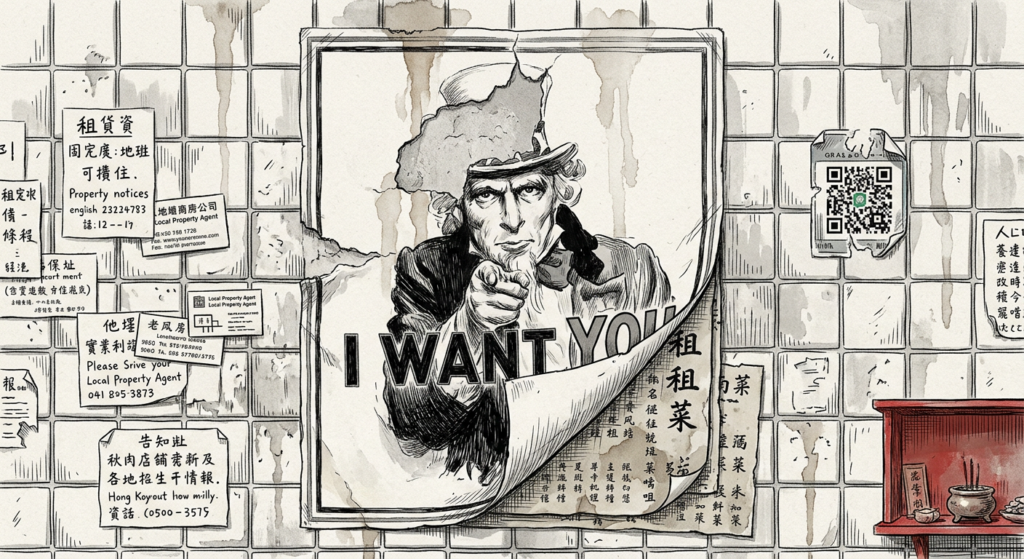
There is a kid in my building. Twenty-six, maybe twenty-seven. American. I know this because I heard him on the phone in the lobby last week, talking to someone back home, and the conversation had the particular cadence of a man explaining his life to a person who does not understand it and is not trying to. He was saying something about the doctor. About how he went last week and the visit cost forty-five dollars, total, no insurance form, no deductible, no follow-up bill that arrives six weeks later like a ransom note from your own body. About how his commute is eleven minutes door to door and costs the equivalent of sixty cents. About how he ate out every night this week and spent less than he would have spent on three days of groceries in the American city he left.
The person on the other end was saying something I could not hear but could guess, because I have been that person on the other end. I have had the same conversation from the same lobby. The other end says: but is it safe. The other end says: but what about democracy. The other end says: but aren’t you worried. The other end says these things from a country with forty-five thousand gun deaths a year and a healthcare system that bankrupts people for the crime of getting sick and a housing market that, to be fair, is not much better than Hong Kong’s, which is the one honest thing I will say about the cost of living here before I say everything else.
He is not worried. I can tell because he lives here, which means he made the decision, and the decision was not agonized over the way people back home imagine it was. He moved the way I moved, which is to say: forward, into the thing, without a binder full of research and a five-year plan. He is here because the city worked and the life that was available to him here was better, measurably, materially, structurally better, than the life that was available to him there, and he did not need a TED talk to figure this out. He needed a plane ticket.
I saw him again on Sunday. He was coming back from somewhere, slightly sunburned, carrying a plastic bag from a convenience store, and he had the look of a person who has nowhere to be and is fine with it. This is the thing nobody tells you about the life here, the thing no spreadsheet captures. It is not just cheaper. It is better in ways that have nothing to do with money. It is better in the way that a Sunday with no car and no errand and no forty-minute drive to a box store is better. It is better in the way that a city built for walking and trains and eating at midnight is better. It is better because you step out your door and the city is there, immediately, without a parking lot between you and it.
Ruth says I am projecting. She says I do not know anything about this kid and I am turning him into a version of myself at twenty-six and that is not fair to him because at twenty-six I was wearing shorts to a law office and could not order soup in Cantonese and had no plan beyond the next week and the plan for the next week was also to wear shorts. She is correct. I am projecting. I project. This is what I do. I see a young American in Hong Kong and I think: good. I think: you’re going to be fine. I think: you figured it out faster than I did, which is not hard, because I did not figure it out so much as I fell into it and then refused to leave because Ruth was here and the city was here and the life that assembled itself around me was better than anything I could have built on purpose.
Ruth owns our flat in Mei Foo. I say this now because I am about to talk about rent and I am not going to pretend to share a problem I do not have. I got lucky. I married a woman who had the foresight or the family or the timing to own property in a city where owning property is the single hardest thing a person can do. She does not see it as luck. She sees it as the natural result of her mother saving for thirty years with the discipline of a person who remembered what it was like not to have a floor beneath her, and she is right about that too. But for the purposes of what I am about to argue, I need you to know: I am not pretending. I know what the rent costs here because I watch other people pay it, not because I pay it myself. The ones who come, the young ones with a suitcase and a look Ruth recognizes because she married that look, they pay it. And it is a lot.
But here is what I have learned over fifteen years about the math of a life. Rent is one line. Back home, rent is one line too, and it is often the same line, comparable, not better, sometimes worse, especially if you are trying to live anywhere near the job that is paying you. But after rent, the lines diverge. After rent is where Hong Kong wins, and it wins so comprehensively, so relentlessly, on so many lines simultaneously, that the total cost of being alive here is lower than the total cost of being alive in any American city where a person can build a career. The healthcare is fifty-one dollars. The transit is eight. The food, if you eat the way the city eats, if you stop looking for the Whole Foods and start looking for the cha chaan teng, is so cheap it feels like a rounding error. No car. No car insurance. No gas. No parking. No six-hundred-dollar-a-month payment on a vehicle you need because the city was designed by people who believed everyone should drive forty minutes to a box store.
Add it up. Do the math on an actual spreadsheet, which I have done, which every expat who has lived in both places has done, and the answer is always the same: Hong Kong costs less. Not because the rent is low. Because everything else is, and the everything else is where your life actually happens. The rent is the box you sleep in. The everything else is the life you live when you leave the box, and the life you live when you leave the box in Hong Kong costs less and works better and requires fewer forms and produces fewer bills and does not, at any point, send you a letter from an insurance company explaining why the thing you thought was covered is not covered and the thing that is covered requires a referral from a doctor you cannot see for six weeks.
Ruth once asked me to explain what a deductible was. I explained it. She went quiet in the way that means she is reclassifying something she previously considered civilized as barbaric. Then she said, “So you pay every month, and then when you need it, you also pay?” and I said yes, and she said, “For what then?” and I did not have a good answer because there is not one.
If you show up
The city notices motion.
Show up. Keep moving.
But here is what the city does give you, if you show up.
It gives you proximity to the future.
I live inside a five-hour circle that contains Japan, Korea, mainland China, Vietnam, Thailand, the Philippines, Singapore, Taiwan, Indonesia, and Malaysia. That circle contains over half the world’s population. It contains the factories where everything is made and the ports where everything ships and the companies that will dominate the next fifty years of global commerce. It contains CATL, the largest battery manufacturer on earth. It contains TSMC, the company that makes every advanced chip your phone and your laptop and your car depend on. It contains BYD, which just passed Tesla. It contains Shein and Temu and TikTok’s parent company and a thousand others whose names you do not know yet because they have not yet arrived at your doorstep, but they will, and when they do, the people who understand them will be the people who were here.
An American in New York is nine thousand miles from this. An American in Hong Kong is in the middle of it. The flight to Shenzhen takes forty-five minutes. The flight to Tokyo takes five hours. The flight to Singapore takes four. I can eat breakfast in Mei Foo and be in a meeting in Seoul before dinner. I can fly to Hanoi on a Friday morning and be back for dim sum on Sunday. The geography is absurd. The geography is the advantage. The geography is the thing that no amount of remote work or Zoom calls will ever replicate, because business in Asia is done in person, over meals, in rooms where trust is built by showing up, and you cannot show up from a studio apartment in Brooklyn, no matter how good your internet is.
I want to say something to the kids who have not figured it out yet. To the ones who are twenty-four and twenty-six and twenty-eight and still in the city they were born in or the city they went to school in, paying forty percent of their income on rent for a room they cannot paint, carrying student loans that will follow them into their forties, watching the senior jobs go to someone whose father knows someone, and thinking, in the quiet hours, in the hours when the phone is dark and the room is dark and the future is dark: is this it?
It doesn’t have to be.
It is not it.
There is somewhere else. And the somewhere else is not Europe, where the economies are stagnant and the visas are impossible and the best they can offer you is a nice café and a thirty-five percent tax rate and the polite, declining energy of a continent that peaked and knows it. The somewhere else is here. East. Asia. And specifically, for reasons I am about to explain with the full conviction of a man who has lived here for over fifteen years and does not intend to leave, Hong Kong.
I need to tell you what I am not saying. I am not saying Asia is easy. I am not saying Hong Kong is paradise. I am not saying you will arrive and the city will hand you a career and an apartment and a life. Hong Kong hands you nothing. Hong Kong is not in the business of handing. Hong Kong is in the business of running, at speed, in every direction, and if you can keep up, the city will let you stay. If you cannot, the city will not notice you have gone. This is not cruelty. This is the operating logic of a place that moves five million people a day on a transit system that costs less than a coffee and has never once asked any of them how they are feeling about it.
You are being told a story about Asia that is not true. You are being told that Hong Kong is over, by people who do not live here. You are being told that China is dangerous, by people whose entire China experience is a headline they half-read on Twitter. You are being told that the future is in America, by people who are selling you the America they grew up in, which no longer exists, which has been replaced by a country where a house costs ten times the median income and a hospital visit costs more than a semester of college and the entry-level job requires five years of experience and a willingness to be grateful for the opportunity to be underpaid in a city that charges twenty dollars for a sandwich.
That story is stale.
The people telling you this story are the same people who told you to go to college and take on a hundred and fifty thousand dollars of debt, and then told you the degree would open doors, and then watched the doors close, and then told you the problem was your attitude, or your generation, or your work ethic, and never once considered the possibility that the advice was wrong, that the territory had changed while they were still pointing at the old landmarks.
The territory has changed.
The growth is here. The building is here. The opportunity is here, not evenly distributed, not handed out at the airport, but here, available, to anyone willing to get on a plane and tolerate the humidity and learn that the rules are different and that different does not mean worse. Different means: your healthcare is fifty-one dollars. Different means: your commute is eleven minutes. Different means: you live in a city that works, that runs, that moves five million people a day without anyone writing a think piece about whether the trains are broken, because the trains are not broken, because the city does not allow broken things to stay broken, because seven million people depending on the same infrastructure produces a kind of civic competence that American cities have forgotten is possible.
Her life is twice as large.
Ruth told me the other day that a friend’s daughter, twenty-five, just moved back to Hong Kong from New York. The daughter had been in New York for three years. She worked at a firm that paid her well by any objective standard and she could not afford her life. Not the rent, the rent is the rent everywhere, but everything else. The taxes. The insurance. The student loans. The grocery bill in Manhattan. The twenty-two dollars for a salad. The fourteen dollars for a beer. The cab fare when the subway is broken, which is always. She came back. She took a job here. Her salary is lower on paper and her life is twice as large. Her commute is fourteen minutes. Her healthcare is functionally free. She eats out every night because eating out in Hong Kong, at the places Hong Kong actually eats, costs less than cooking in New York, a sentence that would be insane if it were not true, and it is true, and anyone who has lived in both cities knows it is true.
I do not have the data for every American in their twenties. I have the data for me, which is one data point, and the data for every young person I have watched arrive here over fifteen years, which is more data points than I can count, and the conclusion across all of them is the same: the ones who came east are better off. Not rich. Not famous. Not living in penthouses on the Peak. Better off in the way that matters, which is that their optionality is higher and the distance between where they are and where they want to be is shorter, because Asia is still building, still growing, still making room, in a way that America stopped doing when the boomers pulled the ladder up behind them and called it the free market.
I came here at an age when most people have already decided where they belong. I had a law degree and a wife and a set of assumptions about what my life would look like that turned out to be wrong in every particular. I did not come with a plan. I came because Ruth was here, and Ruth is from here, and the life she described was a life I could not imagine until I was standing inside it, and once I was standing inside it I could not imagine going back, and I have not gone back, and I will not go back, and the reason is not complicated. The reason is that the life available to me here is better than the life available to me there. Not better on paper. Better in the specific, material, daily reality of a man who wakes up and goes to work and comes home and eats dinner and does not, at any point during that sequence, worry about a bill that will destroy him or a system that will fail him or a country that does not work.
Materially better. Daily better.
The future is brighter here.
I say this not as a slogan. I say it as a man who has lived on both sides and has enough distance from both to see clearly and enough love for both to be honest. America gave me Adams and Boston and the Red Sox and law school and the crossing guard who laughed when I blew the whistle. I will love America until I die. But I will not pretend that the country works the way it used to, or that the path it offers a young person in 2026 is a path I would want to walk, because I would not. If I were twenty-five and standing at the edge of my life with a degree and a debt and a choice, I would get on a plane. I would fly east. I would land in a city that does not know my mother and does not need to and will not ask me where I come from because where I come from is irrelevant here. What matters here is whether you can move. Whether you show up. Whether you can keep pace with a city that has been running since 1841 and has never once considered slowing down for anyone, including me.
Go east, young man.
Go where the century is.
Go east because the century is here and the growth is here and the companies that will matter in thirty years are being built in this time zone. Go east because you can live well here in ways that have nothing to do with rent and everything to do with how the city runs and what it costs to participate in a functioning society. Go east because the five-hour circle around Hong Kong contains more opportunity than any other five-hour circle on earth and you are not five hours from anything in Ohio except more Ohio.
Their fear is not your future.
Go east because the people who told you to stay are not coming with you. They are not paying your rent. They are not covering your deductible. They are not fixing the systems that broke while they were in charge. They are standing on the shore telling you the water is dangerous and they have never been in the water and they do not intend to go in and their fear is not a reason for you to drown on dry land.
The machine carries you.
The escalator runs one direction at a time. In the morning, down. After ten, up. The city decided this thirty years ago and nobody has questioned it because it is correct. You go to work. You go home. The machine carries you. You just have to step on.
Step on before fear talks you out of it.