Luigi Mangione pleaded guilty on Friday to stalking and killing UnitedHealthcare CEO Brian Thompson. He told the court he shot a man in the back on a sidewalk in Manhattan. He will likely spend the rest of his life in prison. A father of two is dead. None of this is ambiguous, and none of this is what I want to write about. What I want to write about is the city where healthcare costs fifty dollars.
What I want to write about is one line from his allocution. Mangione told the judge that before traveling to New York, he emailed UnitedHealthcare’s leadership posing as a potential investor managing over fifty billion dollars in assets. He wanted to confirm the location of their investor conference so he could track Thompson’s whereabouts. He said that unlike his previous interactions with insurers as a patient navigating years of chronic pain from a broken back, he received a response almost immediately.
I read that line sitting in my flat in Hong Kong. I have been thinking about it for two days, not because of what it reveals about Mangione, but because of what it reveals about a system so thoroughly broken that a murderer’s most relatable moment in federal court was not his motive, not his pain, not his spinal injury. It was the callback speed. Everyone understood that line. The reason everyone understood it is because everyone has lived the other side of it, the side where you are not capital, where you are just a person with a body that needs something, and the system has decided you can wait.
I have lived in Hong Kong for years. I live in a city where healthcare costs fifty-dollars. I need to tell you what it is like here because I think Americans have lost the ability to imagine that healthcare can be simple. Not perfect. Simple. The two are different, and only one of them is a reasonable expectation for a functioning society.
Here is what happens when you get sick in Hong Kong. You go to a public family medicine clinic. You pay HK$150, which is about nineteen US dollars. You see a doctor. You get medication for five Hong Kong dollars per item. You leave. That is the entire experience. There is no prior authorization. There is no insurance company between you and the doctor. There is no phone tree. There is no denial letter arriving six weeks later explaining that the treatment your doctor recommended has been reviewed by someone who has never examined you and determined to be not medically necessary.
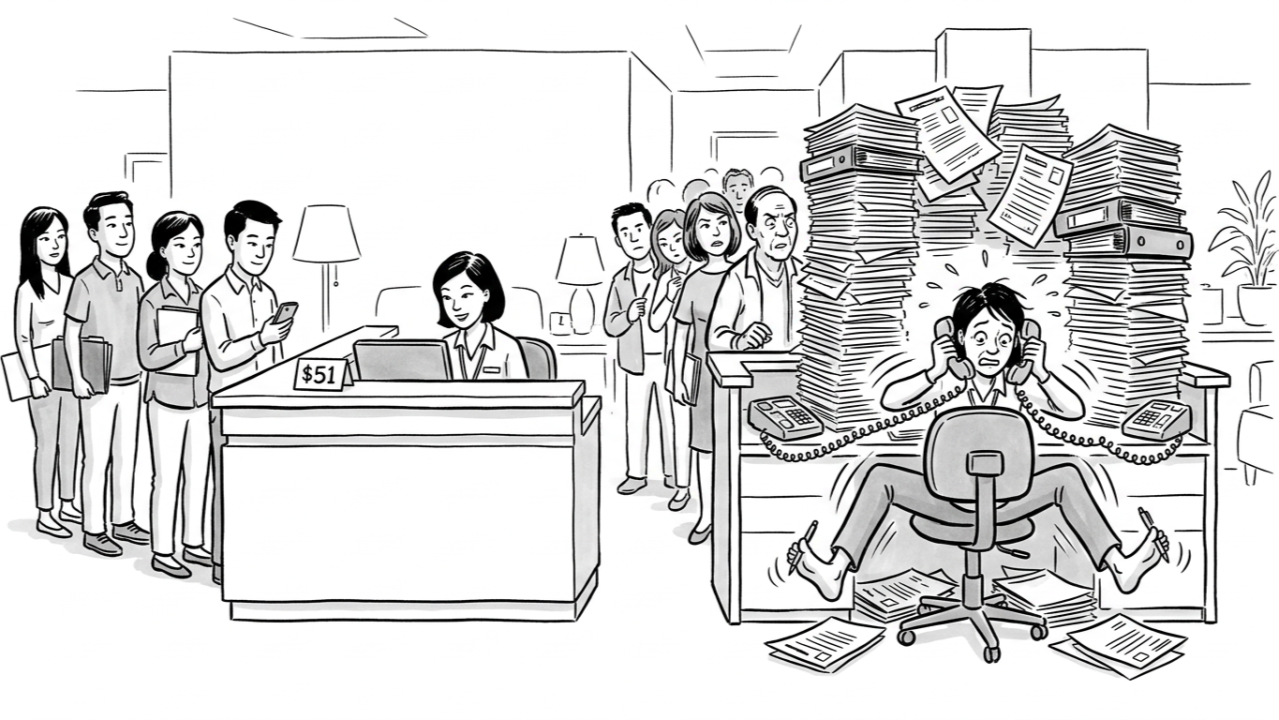
If something serious happens, you go to one of the public hospital emergency departments that operate around the clock across the city. The fee is HK$400, about fifty-one US dollars. If you are triaged as critical or emergency, you are exempt from even that. You are seen. You are treated. You are not asked for your insurance card. You are not asked whether this particular emergency room is in-network, which is a question that should not exist in any language but somehow exists in American English as though it is a normal thing to wonder while you are bleeding.
If you are hospitalized, a general acute bed costs HK$300 per day. That is thirty-eight US dollars. Per day. With doctors, nurses, medication. And as of this year, there is an annual cap of HK$10,000 on total public medical fees, roughly 1,280 US dollars. Meaning: even if you have the worst year of your life, the maximum you will pay for public healthcare in Hong Kong is less than what many Americans pay per month in insurance premiums for a plan that will still deny their claims.
Now, I want to be honest. These fees actually went up substantially in January. The emergency room used to cost HK$180, about twenty-three dollars. The general clinic was fifty Hong Kong dollars. People here were furious about the increase. There were newspaper editorials. There was grumbling on every minibus. The government had to introduce the annual cap partly to soften the blow. And I sat there reading the outrage thinking: they just tripled the emergency room fee and it is still fifty-one dollars. The new rate that has Hong Kong residents upset is still less than the copay on most American insurance plans. The thing that feels expensive here would feel like a clerical error in the United States, a rounding error on the bill you receive three months later for an ER visit that costs eight thousand dollars before your deductible kicks in.
Hong Kong spends roughly six to seven percent of its GDP on healthcare. The United States spends eighteen percent. Nearly three times as much. Hong Kong has a life expectancy of about 85.9 years, among the highest in the world. The United States is at 79.4. Hong Kong spends a fraction of what America spends and its people live more than six years longer. The numbers are not close. The outcomes are not close. And the experience of being a patient is not close.
I want to describe what does not exist here, because I think the absence is the point. There is no such thing as a prior authorization in Hong Kong’s public system. There is no concept of a claim being denied. There is no entity between you and your doctor whose job is to determine whether you really need the thing your doctor says you need. There is no industry of people whose entire profession is to say no to sick people on behalf of a company whose stock price depends on how often they say no. That industry does not exist here. It is not a feature of the landscape. And when I try to explain it to people who grew up in this city, they look at me the way you might look at someone describing a toll booth on a bridge that was already paid for with taxes.
Ruth, who is my wife, who is from here, who has used public hospitals her entire life, once asked me to explain what a deductible was. I explained it. She asked me to explain what a copay was. I explained it. She asked me to explain what out-of-pocket maximum meant. I explained it. She was quiet for a moment. Then she said, “So you pay every month for the right to pay again when you are actually sick, and then there is a limit, but only after you have already paid thousands of dollars, and also sometimes they just say no?” I said yes. She said nothing else. She did not need to. Described from the outside, without the normalization that comes from growing up inside it, the American health insurance system sounds like something designed to extract the maximum amount of money from the maximum number of people while providing the minimum amount of care, and also to make the process so exhausting that a meaningful percentage of people simply give up and never seek treatment.
Mangione’s line about the callback speed is not a critique that requires a manifesto or a gun. It is an observation that anyone who has ever called their insurer already knows. The system is not designed to help you. It is designed to help shareholders. The investor gets a response because the investor represents revenue. The patient gets a denial letter because the patient represents cost. This is not a conspiracy theory. It is the business model. It is how the incentive structure works. And the reason the line hits so hard is not that Mangione said something new. It is that he said something everyone already knew, under oath, in the same breath as confessing to murder, and the part people cannot stop talking about is not the murder. It is the email.
I am not saying Hong Kong’s system is perfect. Specialist wait times in the public system can stretch months or even years for non-urgent cases. That is real. People here complain about it constantly, and many who can afford it use private healthcare to skip the queue. I have supplemental private insurance myself for exactly that reason. But here is the difference: nobody in Hong Kong goes bankrupt from a medical bill. Nobody loses their home because they got cancer. Nobody sets up a crowdfunding page to pay for their child’s chemotherapy. Nobody avoids the doctor because they are terrified of what it will cost. The floor exists. The floor holds. And the floor, even after the January increase that had everyone complaining, costs less than what most Americans spend on streaming subscriptions.
I live eight thousand miles from the American healthcare system now. I pay fifty-one dollars if I go to the emergency room. I do not have a prior authorization. I do not have a denial letter. I do not wait on hold. I just go, and I get treated, and I go home.
Nobody had to pretend to manage fifty billion dollars to make that happen.