What He Missed
Stephen Roach honored me by name in his August 2 Substack piece (https://stephenroach.substack.com/p/social-media-and-the-character-of), placing my LinkedIn response alongside Virginia Lee and Michael Wong, Hong Kong’s Deputy Financial Secretary. He described all three as “especially impressive” and said our arguments “made him think about the main assumptions of his thesis.” That is generous, and I take it seriously. Roach is a former Chairman of Morgan Stanley Asia, a Yale senior fellow, one of the most cited economists writing about China in the world. He did not have to acknowledge anyone. He did not have to engage.
He values the marketplace of ideas.
But he did. And he said something in that piece that I believe completely. He values the marketplace of ideas. He wrote that his goal is to “stimulate and provoke feedback, engaging in and learning from the marketplace of ideas.” I have spent twenty-five years in courtrooms doing roughly the same thing, just with higher stakes and a judge keeping score. I respect anyone who submits their thinking to public scrutiny and means it.
So here is my scrutiny. Not as a personal attack, because I do not think Roach is operating in bad faith. He is operating with a missing piece. And the missing piece changes everything.
The Missing Piece
Professor Roach characterizes what happened in Hong Kong as “Beijing’s aggressive takeover in 2020 following massive public demonstrations.” He asks rhetorical questions about expat outflows, foreign judges resigning, bookstores closing, newspapers shutting down. He concludes that what looks like resilience is actually “forced capitulation.” He summarizes my argument, and Virginia Lee’s, as claiming that Hong Kong is “no different than other dynamic financial centers such as New York, London, or Singapore,” and that we argue Hong Kong is “just as much a part of China as New York is of the US.”
Fair enough as a summary of one layer of the argument. But there is a deeper layer that his piece does not engage, and it is the one that matters most. I wrote a book about it. I published an article about it. And I am going to say it plainly here, because it needs to be said plainly, and because I am writing this from my flat in Hong Kong, under my own name, and nothing is happening to me.
The Core Claim
I call the 2019 protests the anti-democracy protests.
I do not call them that to be provocative. I call them that because it is what they were. The people who claimed to be fighting for democracy are the ones who killed Hong Kong’s best chance at achieving it. That is not my opinion. That is a sequence of events anyone can verify.
On August 31, 2014, the Standing Committee of the National People’s Congress issued a decision on electoral reform for Hong Kong. The proposal was straightforward. Beginning in 2017, the Chief Executive would be elected by universal suffrage. Every eligible resident, approximately five million people, would cast a vote. Candidates would first be vetted by a nominating committee, which would select two or three individuals to appear on the ballot. This is exactly what the Basic Law provided for. Nothing more, nothing less.
This was not a perfect system. The nominating committee was structured in a way that favored pro-Beijing interests. Critics were not wrong about that. But the vote itself would have been real. Five million people choosing their leader, for the first time in Hong Kong’s history. Not the first time since 1997. The first time ever.
It is worth pausing on what that means. For a hundred and fifty-six years under British rule, Hong Kong never elected its leader. Not once. The Governor was appointed by the Crown, answerable to London, chosen without any input from the people he governed. The Legislative Council was entirely appointed until 1985, when indirect elections were introduced for a handful of seats. Direct elections did not arrive until 1991, six years before the handover, after Britain had already signed the Joint Declaration and knew it was leaving. Chris Patten’s democratic reforms in the final years were a parting gesture from a departing power that had spent a century and a half refusing to share governance with the people it ruled. The timing was not a coincidence. Democracy became important to London the moment London no longer had to live with the consequences.
When Britain ratified the International Covenant on Civil and Political Rights in 1976, it entered a specific reservation for Hong Kong, carving this city out of the article guaranteeing the right to vote in genuine elections. Britain looked at a treaty that said all people have the right to choose their government and said yes, we agree, except those people. That reservation remained in place until the day the British flag came down. The concern for Hong Kong’s democratic future arrived, with remarkable precision, the moment someone else was in charge.
On June 18, 2015, Hong Kong’s Legislative Council voted on the reform proposal. All twenty-seven pan-democratic legislators voted against it. Not a single one broke ranks. The proposal was rejected twenty-eight to eight. Universal suffrage was dead. The people who killed it were the people who had spent years demanding it.
They called it “fake democracy.” They said a vote among vetted candidates was not a real vote. I will return to that claim at the end, because it deserves to be the last thing anyone reads here.
The pan-democrats rejected universal suffrage because it was not their version of universal suffrage. They demanded everything and received nothing. And then they spent four years building toward 2019, escalating from focused protest to airport shutdowns to over a thousand Molotov cocktails thrown at police and businesses, to storming the Legislative Council, to raising colonial-era flags, to something that looked less like civil disobedience and more like an insurgency with a public relations department.
In September 2019, Joshua Wong sat in a Washington hearing room before the Congressional-Executive Commission on China, flanked by American flags, with Co-Chairman Marco Rubio presiding. The next day he appeared alongside Nancy Pelosi at a press conference on Capitol Hill promoting the Hong Kong Human Rights and Democracy Act. He asked a foreign legislature to sanction his own city. He asked a rival superpower to intervene in Hong Kong’s governance. And then everyone acts surprised that Beijing treated the movement as foreign-backed destabilization.
Try it in reverse. Fly to Beijing. Testify before the National People’s Congress. Ask them to impose sanctions on the United States. Pose for photographs with senior Chinese officials. Then come home and see what the Department of Justice has waiting for you. America imprisoned Maria Butina for less, for networking at conferences. The asymmetry is visible to everyone except those who benefit from it.
The Sequence
Professor Roach writes that “the timeline of a 50-year handover to China has basically been cut in half by Beijing’s aggressive takeover.” I understand why it looks that way from Connecticut. From Hong Kong, the sequence reads differently.
2003, Hong Kong attempts to fulfill its Article 23 obligation under the Basic Law to enact national security legislation. Protests force the bill’s withdrawal. No government tries again. For the next seventeen years, Hong Kong remains in open breach of its own constitution. 2014, Beijing offers universal suffrage. The pan-democrats reject it. 2016, elected legislators use their oath-taking ceremony to display banners reading “Hong Kong is not China” and insert obscenities before “People’s Republic of China.” Beijing intervenes. 2019, protesters shut down one of the world’s busiest airports, burn businesses, throw petrol bombs, storm the legislature, wave foreign flags, and testify before foreign governments calling for sanctions against their own home. 2020, Beijing imposes the National Security Law, the one Hong Kong was constitutionally required to pass itself and never did.
That is not a timeline of unprovoked aggression. That is a timeline of escalation, with identifiable decision points where different choices would have produced different outcomes. The maximalists chose confrontation at every turn. They chose it with funding flowing through the National Endowment for Democracy. They chose it with media training from American-affiliated organizations. They chose it with the applause of foreign politicians who would bear none of the costs.
And then the costs arrived.
Roach asks whether bookstores would have closed, whether newspapers would have been shut down, whether so-called dissidents would have been rounded up, had there not been “such a forced development.” I accept the question. Let me ask a different one. Would any of it have happened if the pan-democrats had accepted universal suffrage in 2015? Would any of it have happened if the movement had stopped when it won, when the extradition bill was formally withdrawn in September 2019? Would any of it have happened if the protesters had channeled their energy into electoral politics rather than into burning things down and begging Washington for help?
The answer to all three is almost certainly no. And the people who made those choices, the ones who rejected the vote and chose the fire, are the ones who killed democracy in Hong Kong. Not Beijing alone. Not by a distance.
Still Here
Now. Roach says the character of the city is “under assault.” He says “it’s not” the same place.
I published an essay recently making a point that bears repeating here, because the point keeps needing to be made. I wrote that I am a lawyer living in Hong Kong, writing openly about democracy and the Basic Law, under my own name, from my own flat. I wrote that my friends in America tell me this is impossible, that democracy is dead here, that I cannot speak. And I wrote that they are wrong.
I am going to borrow from that essay now, because I cannot say it better than I already said it.
Democracy in Hong Kong is not dead.
The Basic Law, the constitutional document that governs Hong Kong, contains Articles 45 and 68. The ultimate aim is the selection of both the Chief Executive and all members of the Legislative Council by universal suffrage. I stated what the law says. I am not whispering. I am not using a VPN. I am not encrypting this. I am a lawyer reading a legal document out loud, which is what lawyers do, and I am doing it from the city where I live, and nothing is happening to me.
Democracy in Hong Kong is not dead. It was sabotaged by the people who claimed to be fighting for it. The path was made narrower by their choices, not by some inevitable authoritarian tide. And the promise remains in the Basic Law, in writing, readable by anyone with eyes and a willingness to look past the headlines.
Is the political space narrower than it was in 2018? Yes. Are there constraints that did not exist before 2020? Yes. Did anyone want this outcome? I do not think Beijing wanted it. I think Beijing wanted the 2014 proposal to pass. The Basic Law still says what it says. Articles 45 and 68 still name universal suffrage as the ultimate aim. Nobody has amended those articles. Nobody has deleted them. The constitutional commitment remains, in writing, in a document that Beijing drafted and signed.
Think about why. Beijing’s single most important long-term objective is reunification with Taiwan. The only peaceful path to that objective runs directly through Hong Kong. If One Country, Two Systems produces a functional, prosperous city with genuine democratic participation, Taiwan has a model. Taiwan has proof that autonomy survives, that civil liberties survive, that a local government chosen by its own people can coexist with national sovereignty. That is Beijing’s best advertisement. Not aircraft carriers. Not missile tests. A working example, twenty-three million Taiwanese can observe in real time, of what reunification actually looks like.
A democratic Hong Kong is not a threat to Beijing. It is one of the most strategically valuable things Beijing could possess. The people who killed the 2015 vote did not just rob Hong Kong of self-governance. They robbed Beijing of its strongest argument for peaceful reunification. They handed Taiwan’s independence movement its best talking point. They made the hawk faction in Beijing stronger and the reformers weaker. And they did it while claiming to be on the side of freedom.
I respect Professor Roach. I respect his willingness to engage, his openness to challenge, his stated commitment to the marketplace of ideas. But his thesis rests on a missing piece. He sees the crackdown. He does not see what provoked it. He sees the narrowed space. He does not see who narrowed it first. He sees forced capitulation. He does not see the five million votes that were offered and refused.
I live here. I chose this city. I married a Hongkonger and built my life in this place, and at some point a choice you keep making every day stops being a choice and starts being a life. I am not performing residency for credibility. I am describing where I wake up, where I practice law, where I will grow old if I am lucky enough.
Hong Kong is not over. It is not a fallen city. It is a city that survived the people who claimed to be saving it, and is now doing what it has always done. Adapting. Rebuilding. Working. The MTR still runs. The courts still sit. The harbor still lights up at night. Seven million people still live here, and most of them are not waiting for permission from New Haven or London to feel at home.
The marketplace of ideas works both ways. I hope Professor Roach finds this as useful as I found his acknowledgment of my earlier piece. And I hope that the next time someone tells him Hong Kong is a place where you cannot speak, he remembers that an American lawyer just called the democracy movement anti-democratic, from Hong Kong, under his own name, and published it for the world to read.
One last point, because it is the one that should linger.
The Last Point
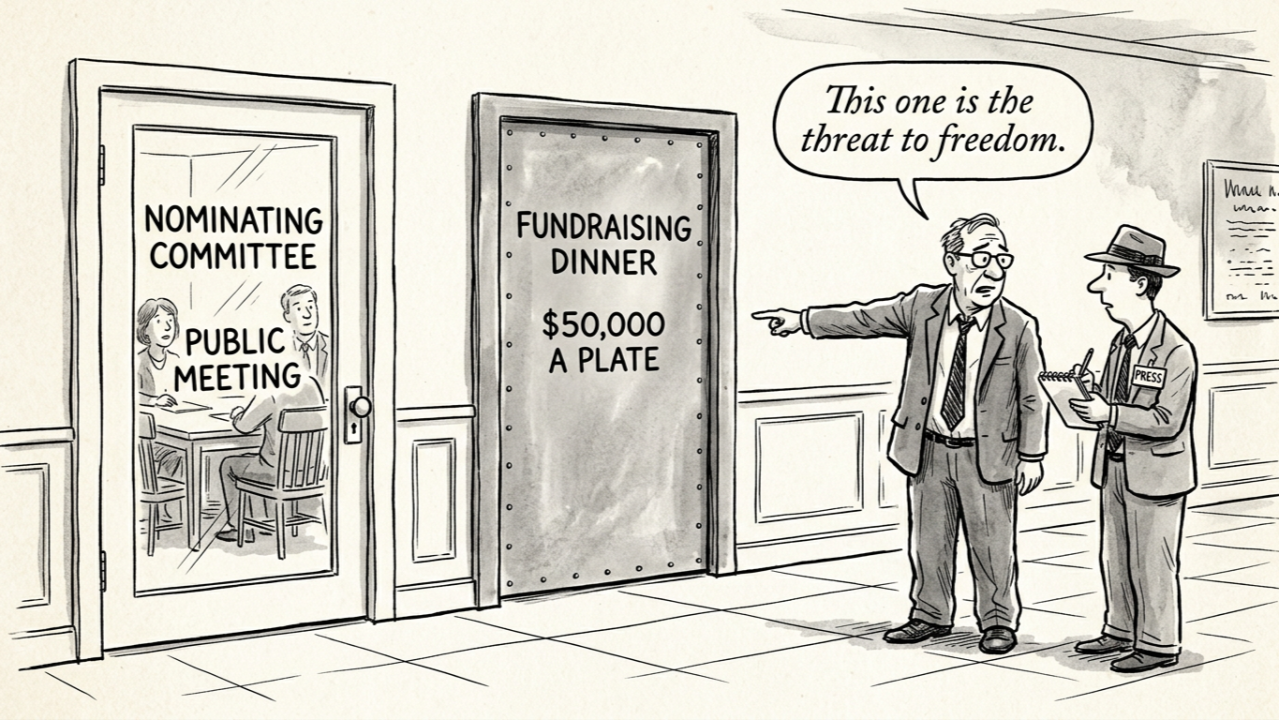
The 2014 proposal required candidates to be vetted by a nominating committee before appearing on the ballot. Critics called this fake democracy. But consider how presidential candidates are selected in the United States. Before a single primary vote is cast, a candidate must raise hundreds of millions of dollars from a donor class concentrated in a handful of zip codes. If you cannot secure that money, you do not appear on a debate stage. You do not receive media coverage. You do not exist.
That is a nominating committee. It operates in private dinners in Manhattan and Greenwich, Connecticut, in rooms the public never enters, among people whose names the public never learns, who expect returns on their investment and receive them regardless of which party wins. Professor Roach spent decades at the top of Morgan Stanley. He has been in those rooms. He knows exactly who sits at those tables and what is discussed before the public ever sees a candidate smile on television. The difference is that Hong Kong’s nominating committee was written into a public document, with named sectors and published membership. America runs the same filter but hides it behind a curtain and calls the result freedom. Hong Kong’s version was more transparent. It was rejected for being less democratic. Those two things cannot both be true.
The people who say this city is over have one thing in common. None of them are here.