Hong Kongers are not rude. They are efficient. And in this city, efficiency is the love language.
Hong Kongers are not rude. I need to say this up front because I live here, I married one, and if I get this wrong she will not correct me gently. She will look at me the way a cha chaan teng waiter looks at a tourist who has been staring at the menu for forty-five seconds. Which is to say: with the quiet, searing disappointment of someone whose time you are wasting.
Ruth is from Hong Kong. Ruth is, by any Western metric of social interaction, a warm and lovely person. Ruth also once told a waiter at a restaurant in the United States that his service was “very slow,” and when I told her that was perhaps not the gentlest feedback, she said, “I told him nicely. I smiled.” She had smiled. It did not help.
At Logan Airport, this is a war crime.
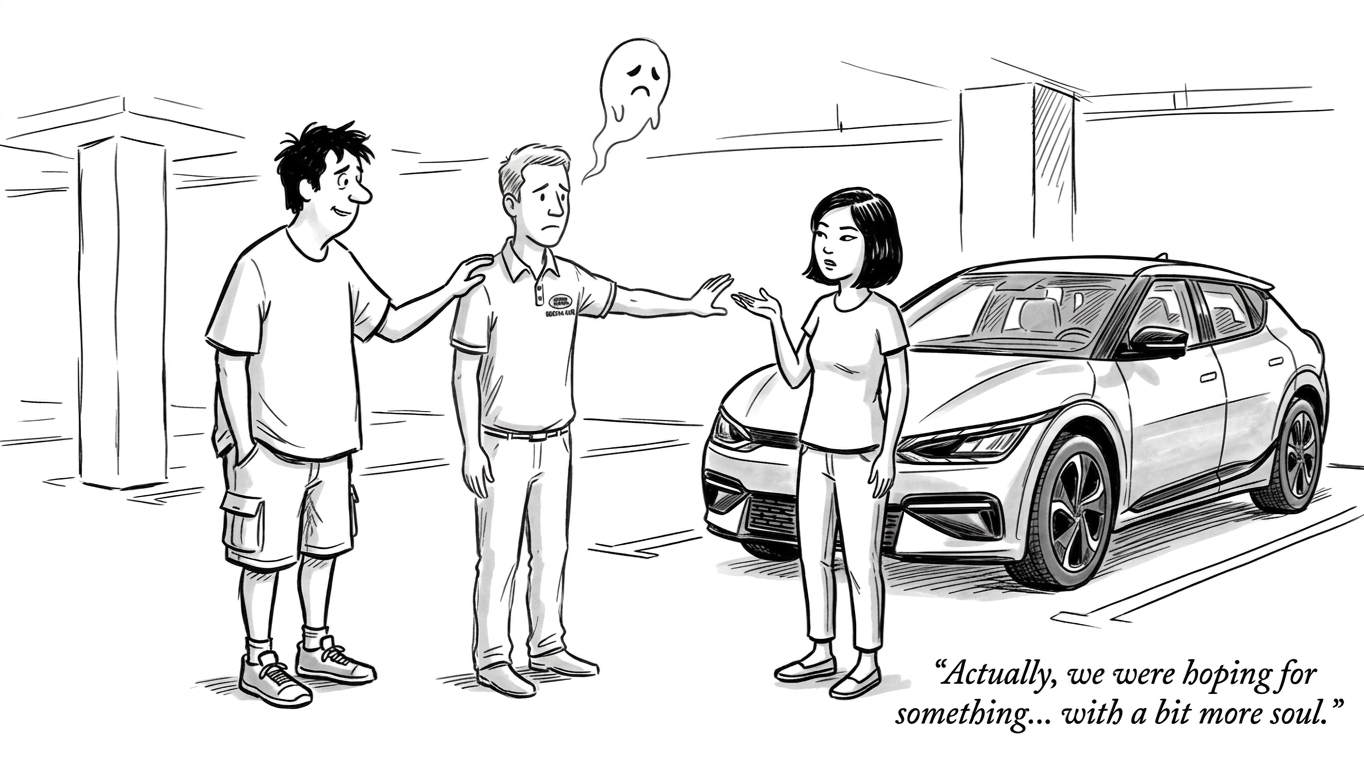
This directness is not something she reserves for waiters. We once landed at Logan Airport in Boston after sixteen hours of flying and were walking through the rental car garage with Kevin, our assigned rental agent, maybe 25, still bright-eyed, still believing in things. Kevin had just bought the same model he was about to show us. Same color, same trim. He was telling me about the heated seats, the panoramic sunroof, the weekend trip to Vermont with his girlfriend where they “really fell in love with the ride.” I was nodding along. Two men, appreciating engineering and sensible mid-range pricing. We round the corner. A gleaming Hyundai Tucson sits there, freshly washed. Kevin presents it with the quiet pride of a man showing you his firstborn.
Ruth, who had been walking behind us, well within earshot of every single word this young man had just said, took one look at it and announced, at a volume that echoed off the concrete: “I don’t want that piece of shit. Go rent another one.” Kevin’s hand froze mid-gesture. His face cycled through denial, anger, bargaining, depression, and acceptance in under three seconds. I put my hand on the kid’s shoulder and said, “Kevin, don’t ever get married.” We drove off in a Ford Explorer. Ruth approved. Kevin handed me the keys without making eye contact. I think about Kevin sometimes. I hope he’s doing okay. But here is the thing: Ruth was not being rude. Ruth was being efficient. She did not want the car. She said she did not want the car. She did not wrap it in four layers of social cushioning or pretend to consider it or say “oh that’s lovely but maybe something a little bigger?” She assessed, decided, and communicated. In Hong Kong, this is normal. At Logan Airport, this is a war crime.
Here is what people from outside Hong Kong experience when they arrive: a city of seven and a half million people who do not make eye contact on the MTR, do not say “excuse me” when they brush past you on the escalator, do not smile at you when you enter a shop, and will answer your question with the fewest syllables the Cantonese language allows, which is sometimes one, and sometimes just a hand gesture that means “over there.” They experience a taxi driver who does not say hello, a cashier who puts your change on the counter instead of in your hand, and a security guard who points at a sign instead of explaining the rule. They experience all of this and they think: these people are rude.
Efficiency is the love language
They are wrong. They are not rude. They are efficient. And in this city, efficiency is the love language.
I want to explain something about density that people from countries with lawns do not intuitively understand. Hong Kong has roughly 57,000 people per square mile in its urban areas. For comparison, New York City has about 28,000. London has about 14,000. If every single person in Hong Kong engaged in the North American social protocol of smiling at strangers, making small talk with cashiers, and saying “oh no, after you” at every doorway, the city would stop. Physically stop. The minibus system would collapse. The lunch rush at every cha chaan teng in Mong Kok would extend into dinner. The entire economic output of the city would fall because everyone was asking each other how their weekend was.
Hong Kongers solved this problem generations ago. The solution is: do not perform friendliness. Deliver it. A cha chaan teng waiter does not smile at you because smiling at you would take a half second and he has forty-three tables and your milk tea is already on its way. The milk tea arriving in under two minutes is the friendliness. The speed is the hospitality. The fact that your food appears almost before you have finished deciding what you want is not rudeness. It is a series of human beings operating at a level of coordination and attentiveness that a Michelin-starred restaurant in Paris would envy, except nobody is wearing a vest and nobody is going to describe your toast to you.
Ruth took me to a cha chaan teng in Sham Shui Po when we first started dating. I did not know what to order. I was looking at the menu. The waiter appeared. He stood there. I said “just a minute” in English. He continued standing there. Ruth ordered for both of us in Cantonese so fast that I caught maybe one word, which might have been “tea” or might have been “go.” The food arrived before I had taken my jacket off. I said “that felt aggressive.” Ruth said “that felt normal.” She was right. I was the problem. I was applying a social framework from a place where people have time and space to waste, to a city where people have neither.
Cold on the outside, warm on the inside.
There is a Cantonese expression (外剛內柔) that translates roughly to “cold on the outside, warm on the inside.” This is one of the most accurate descriptions of Hong Kong I have ever encountered. The same person who will not smile at you on the street will, if you drop something, pick it up and hand it to you without breaking stride. The same MTR car full of people staring at their phones will, if a child falls or an elderly person stumbles, produce four people helping simultaneously, as though they were waiting for something to actually matter before they deployed their attention. In 2023, a mainland Chinese mother wrote online after multiple strangers helped her eight-year-old daughter whose leg got stuck in the MTR platform gap: “In times of emergency they are not cold at all.” She was surprised. She should not have been. The warmth was always there. It is just not distributed across pleasantries. It is saved for when it counts.
And it is not just emergencies. Hong Kong is one of the highest-trust cities I have ever lived in. People leave phones on café tables to hold their spot while they order. Wallets get returned. Umbrellas left on the MTR somehow make it to lost and found instead of disappearing. I once dropped my AirPods case while running in the park and did not notice. A man who had been running in the opposite direction, who had already passed me, turned around and chased me for half a mile to return it. He did not smile. He did not want a thank you. He handed it to me, gave a short nod, turned around, and resumed his run in the other direction. Half a mile. In the opposite direction of where he was going. For a stranger’s plastic case. That is Hong Kong. That is what people miss when they count smiles and short-change the city because nobody said “have a nice day.” The man did not tell me to have a nice day. He made my day better by running a half mile to give me back something I didn’t know I’d lost. One of those things is a performance. The other is a choice.
I learned this the hard way in my own home. When we first moved in together, I asked Ruth why she never said “please” when she asked me to do things. She said, “I asked you. That is already polite. If I did not want to be polite I would just do it myself and be annoyed at you later.” I thought about this for a long time. She was not being rude. She was being direct in a way that assumed I was smart enough to not need cushioning. That is, in a strange way, more respectful. She was treating me like someone who could handle information without it being wrapped in four layers of social padding. I now understand this is how most of the city operates. When the 7-Eleven cashier does not say “have a nice day,” she is not wishing you a bad day. She is simply not narrating the interaction. You bought a thing. She facilitated it. You both have places to be. The transaction is complete. Adding words to it would be like applauding at the end of an elevator ride.
Western tourists want what I call “performance hospitality,” the visible theater of friendliness that confirms you are welcome. The greeter at the door. The “how are you folks doing today.” The waiter who introduces himself by name. Hong Kong does not do this, and the reason is not that Hong Kong is unfriendly. The reason is that Hong Kong considers it dishonest. Ruth once described American service culture as “a play where everyone pretends to be your friend and then you tip them for the performance.” I said that was harsh. She said “it is not harsh, it is accurate, and also I always tip because I know they need it, but I know it is a play.” She is not wrong. It is a play. Hong Kong simply does not perform that play. What you get instead is competence, speed, and the quiet assumption that you are an adult who does not need to be emotionally managed during a commercial transaction.
This is not to say Hong Kong has no warmth on the surface. It does. But you have to know where to look. The old woman at the fruit stall who gives you an extra orange because you are a regular. The security guard who starts nodding at you after a week because he has decided you live here. The taxi driver who tells you a faster route and charges you less because traffic was bad and he feels it was not your fault. The dim sum aunties who remember what you ordered last time. These are relationships built on repetition and proximity, not on performance. They are not immediate. They are earned. And once they exist, they are more real than any scripted greeting at a restaurant where your server has to pretend your arrival is the highlight of their shift.
The hierarchy of sins
Ruth says the rudest thing a person can do in Hong Kong is waste someone’s time. Not fail to smile. Not skip the small talk. Waste time. Be slow when others are waiting. Be indecisive when a line is forming. Be loud when others are trying to exist in a small space without going insane. The hierarchy of sins is completely different here. In the West, the sin is being cold. In Hong Kong, the sin is being inconsiderate of the collective. You can be as cold as you want as long as you are not making everyone else’s day harder. You can skip every greeting as long as you keep the flow moving. The entire social contract is different, and once you understand it, the city is not rude at all. The city is considerate in a way that does not announce itself.
I have lived here long enough now that going back to the United States feels strange. The first time I returned after a year in Hong Kong, I walked into a grocery store and the cashier asked me how my day was going. I almost answered honestly, which tells you something has shifted. I now find excessive friendliness from strangers mildly suspicious, which means Hong Kong has gotten into my operating system at a foundational level. Ruth says this means I am finally “not annoying in public.” She means it as a compliment. I have chosen to receive it as one.
The city is not rude. The city is honest. The city does not perform emotions it does not feel in order to make you comfortable. The city assumes you are an adult. The city will help you if you need help and leave you alone if you do not, and it will figure out which one applies in about half a second, because it has been doing this with seven and a half million people every day for decades and it has gotten very, very good at reading the room without saying a word.
And somewhere in Boston, Kevin is still thinking about that Tucson. I hope he kept it. I hope he knows Ruth didn’t mean it personally. She just didn’t want the car, and where she comes from, saying so is not an insult. It’s a courtesy. You asked. She answered. Move on. Get the Explorer. Everyone’s time is valuable.
That’s Hong Kong.