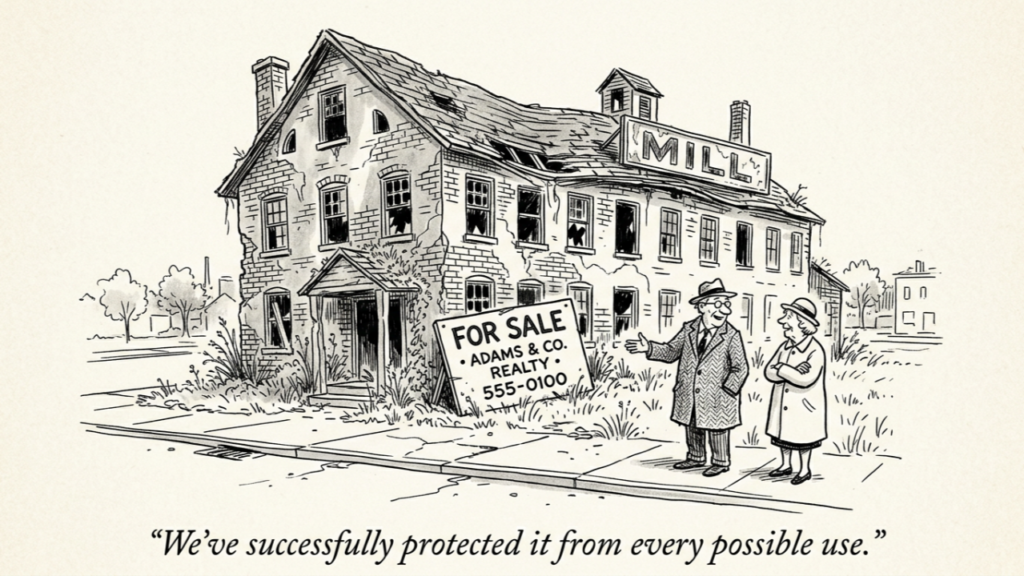
Or: How I Proposed a Data Center in Adams, Massachusetts, and Discovered That the Street Numbers Were Just the Beginning
I should have remembered the street numbers.
Years ago, someone proposed reorganizing the addresses in Adams. Not some of the addresses. All of the addresses. The whole town. Every house, every business, every mailbox on every street from the Hoosac Range to the Taconic Range. Streets would be consolidated. Names would change. Numbers would move. The address you’d had your entire life might suddenly belong to a different street. A perfectly rational, perfectly administrative, perfectly suicidal idea.
Adams lost its mind.
People came out of the woodwork. People who hadn’t attended a town meeting since the Carter administration showed up with the fury of the wronged. These were not people who had opinions about municipal planning. These were not people who had thoughts about address consolidation. These were people who had lived on Cherry Street their entire lives. Whose parents had lived on Cherry Street their entire lives. Whose grandparents had come from Kraków or Québec and settled on Cherry Street with their own hands, and that street meant something. It meant: I am here. I made it. This is mine.
The street name wasn’t a name. It was an identity. It was a birthright. It was a hill to die on, and Adams has plenty of hills.
My grandmother stood up at that meeting. I wrote about her briefly in The Trade Imbalance, but I didn’t tell the whole story, and the whole story deserves to be told, because my grandmother killed a municipal initiative with one question and a roomful of cheers, and if that isn’t Adams, Massachusetts, distilled into a single moment, I don’t know what is.
She had lived on Cherry Street her entire life. Under the new plan, her address would be moved to First Street. She asked one question.
“If I call the fire department, where will they go?”
The answer was First Street.
She looked at the man with the clipboard and said, “But I live on Cherry Street.”
The room erupted. Cheers. The kind of cheers you hear at Fenway when a ball clears the Green Monster, the kind of cheers that don’t just express agreement but declare, with full throat and absolute certainty, that the matter is settled and was never really in question. You don’t tell a woman from Cherry Street that she lives on First Street. You just don’t. Not in Adams, Massachusetts.
The renumbering plan did not happen. It never had a chance. It was dead before the man with the clipboard finished his presentation. My grandmother killed it with one question and a room full of her neighbors. You don’t change a woman’s street in Adams. You just don’t.
I should have remembered that. I really should have.
Because what I did, what I, a man who no longer lives on any of those streets, a man who lives in a housing estate with 99 towers and 40,000 neighbors and a bowling alley, a man who left, was write about it on LinkedIn. I’d been laying out the case in The Trade Imbalance, an essay about the mills and the machines and the particular way Adams sent its industry to Asia and got nothing back except two Hong Kongers who sell T-shirts and noodles. In that essay I called the Waverly Mill a building of possibility. I talked about data centers and cold air and server racks on floors that were built to hold looms. I carried the idea around like a pocketknife and then, because I am apparently a man who does not learn from his grandmother’s generation, I pulled it out in public.
I write on LinkedIn. That is where my stories live. That is where The Trade Imbalance lives. LinkedIn is not Adams. LinkedIn is a place where people in blazers post about synergy and tag each other in congratulatory comments about promotions. It is not the Adams Chatter Facebook page, which is where Adams lives online, which is the digital equivalent of the post office, the barber shop, and someone’s uncle all rolled into one feed. I did not post my story on Adams Chatter. Someone else did. Someone read what I wrote on LinkedIn, picked it up, carried it over to the Facebook page, and dropped it in front of the town like a man setting a casserole on a table without checking whether anyone was hungry. The town was not hungry. The town was furious.
This is how it works. You write something in one place. Someone shares it in another place. And suddenly you are not a man with an essay on LinkedIn. You are a man who has publicly suggested, in front of God and everyone’s mother, that the town consider putting a data center in the Waverly Mill. The fact that you didn’t post it there is immaterial. The fact that someone else brought it to the table is immaterial. The casserole is on the table. It has your name on it. And the room has opinions.
Waverly. The last mill to close in Adams, a 214,000-square-foot cathedral to an industry that packed up and moved to the Carolinas where labor was cheaper and unions were suggestions. A developer bought it over a decade ago with plans for workforce housing. As of today, no major construction has begun and the building is on the market for $2.85 million. A building so empty it echoes when you think about it too hard. Its days in the Industrial Revolution sun are long over.
I suggested giving it a new use.
Adams lost its mind. Again.
The Responses
Ann was first. Ann, who grew up in Adams, who sat in the Adams Theater, the one where she saw Bambi as a child, and was enveloped by the heartbeat of a masterfully played Steinway. Ann, who hiked Greylock with her children to scatter the ashes of her high school sweetheart because it was a place that gave him peace. Ann, who watches Stacy Schiff, a Pulitzer Prize-winning author born and raised in Adams, return to present her book about the town’s namesake, Samuel Adams, the man who helped set a revolution in motion. Ann told me my superiority complex was showing, counselor, and that I should tuck it back in.
She told me to enjoy my high-rise and thermostat battles. She said negativity like mine is all that has truly held Adams back. She pointed to the turnaround in North Adams and Great Barrington, two towns that were less than stellar when she was growing up, and suggested that as their stars fade, perhaps Adams’s will rise. She invoked what she called stereotypical Polish stubbornness, the underlying belief in what is possible, a rose is a rose. She meant it as a compliment to the town. She meant it as resilience. I’ll come back to that.
Then came Frank. Frank Levesque, whose surname alone is a reminder that Adams was built by two tribes, the Poles and the French-Canadians, people who came for the mills and stayed for the churches and the bars between the churches. Frank announced that the last thing any rural town needs is a data center, that it’s insanity, and that having a foreign billionaire investor build something so destructive in a place they couldn’t care less about is unconscionable. Frank, who has never in his entire lifetime seen so many people utilize the Glen. Frank, who used the word “leaches,” which, Frank, buddy, it’s leeches, the parasitic worm, not the chemical process by which minerals drain from soil, though I’ll grant you that both spellings work beautifully as metaphor. Frank wants the Glen managed and utilized properly. Frank does not want more leeches sucking the life out of our beautiful natural resources.
Ann told me I feel no connection to this place. Frank told me to stop fighting what already exists and just give it love.
Here’s the thing.
They sound exactly like the people who killed the renumbering plan. They sound like my grandmother, standing up at that meeting, except my grandmother was protecting something real, a street, a name, a fire truck that needed to find her house. Ann and Frank are protecting something that doesn’t exist yet and refusing to let something else exist in its place. And that, Ann and Frank, with all due respect and genuine affection, is the problem.
The Museum of Failed Plans
Adams has been chasing the promise of Greylock Glen for the better part of seventy years, and here is what it has to show for it: a rebar forest and some abandoned ski lift pylons.
Let’s take a walk, shall we?
In the early 1950s, the Tramway Authority unveiled plans for a $5.5 million tramway up the side of Mount Greylock, what would have been the largest tramway in the world. A tramway. Bolted to the side of the mountain that Hawthorne climbed, that Melville gazed at from his writing desk, that Thoreau slept on. Someone wanted to attach a mechanical conveyor to it so tourists could ride to the top in comfort and buy a hot dog at the summit. The tramway was eventually defeated in court by conservationists, killed before a single bolt touched rock.
Then came ELCO. In 1973, a developer bought up farms on the slope of the mountain and started building the Greylock Glen Resort: a 350-room convention center, a golf course, an alpine ski area, and, I want you to absorb this number, 740 condominiums. Seven hundred and forty condominiums on the side of Mount Greylock. The developer went broke, leaving behind ski lift pylons, support structures, light fixtures, and a field of rusted metal rods that locals now call the rebar forest. The ghosts of progress, rusting quietly in the woods.
Then, and I want you to sit down for this one, in 1980, MGM Grand Hotels expressed interest in Glen property, provided casino gambling became legal in Massachusetts. A casino. At the base of Mount Greylock. Slot machines in the shadow of the Veterans War Memorial Tower. Blackjack tables where the Thunderbolt ski trail meets the meadow. Roulette wheels spinning in the place where Ann scattered ashes because it gave someone she loved peace.
Then came the Heritage Project: a private development scheme that would have included a high-end golf course, cross-country ski trails, and 850 homes. Eight hundred and fifty homes. On the Glen.
A tramway bolted to a mountain. Seven hundred and forty condos. A casino. Eight hundred and fifty houses and a golf course. Every single one of these plans proposed defacing the side of Greylock, permanently altering a thousand acres of irreplaceable natural landscape, and turning the Glen into a parking lot with a view.
And I’m the one with the superiority complex for suggesting we put servers inside a building that already exists and is already empty and is already sitting there doing nothing while its roof sags inward like a soufflé of defeat?
Waverly Is Not the Glen
Frank. Frank, Frank, Frank. I love the Glen too. I agree with you about the Glen. The Glen should be managed and utilized properly. People are coming from all over the world to walk it, and that’s wonderful, and nobody should build anything destructive anywhere near it.
But the Waverly Mill is not the Glen. Waverly is a 214,000-square-foot brick building sitting on Hoosac Street with a disintegrating roof and no tenants and a price tag of $2.85 million that nobody has been willing to pay for anything useful in over three decades. It’s not a natural resource. It’s not a mountainside. It’s not a waterfall. It is a building. A very large, very empty, very sad building that has been waiting for someone to do something with it since George H.W. Bush was president.
A data center doesn’t go on the side of a mountain. It goes inside a building. Ideally a big one. Ideally one with existing infrastructure, thick walls, heavy floors, the kind of structural engineering that was built to hold looms and spinning frames and can certainly hold server racks. Ideally one that is, and I cannot stress this enough, already there.
You know what happened in Jay, Maine? A paper mill closed. The town cratered. Someone proposed converting it into a data center. Not on a mountain. Not in a forest. Inside the old mill. The existing structure. No new footprint. No trees felled. No leeches, or leaches, of any kind. Jobs where there had been no jobs. Tax revenue where there had been no tax revenue. A building with a purpose instead of a building with a memory and a slow leak.
You know what’s twenty miles down the road from Adams? A proposed data center campus in western Massachusetts where investments could total $4 billion. Four billion dollars. In our part of the state. Not in Boston. Not in Cambridge. In the Berkshires, where we’ve been told for fifty years that nobody wants to invest in anything.
And what did Governor Healey say? That Massachusetts needs data centers for the kind of innovation economy it wants to build. That the state needs to find a way to build out the infrastructure. Massachusetts even passed a sales tax exemption for qualified data centers, because the Commonwealth has figured out what Adams has not: that these buildings generate revenue, create jobs, and don’t require bolting anything to a mountain.
But sure. Let’s leave Waverly empty. That’s been working great for thirty-five years.
The Renumbering Principle, Revisited
Here is what Adams does. Here is what Adams has always done. Someone proposes something. Adams loses its mind. The proposal dies. The building stays empty. The population ticks down. The mills stay dark. And then, five years later, ten years later, thirty years later, everyone stands around wondering why North Adams got MASS MoCA and we got a rebar forest and a 214,000-square-foot monument to indecision.
You know what MASS MoCA is? It’s old mill buildings. Mill buildings that someone did something with. While Adams was telling everyone who proposed doing something with its mill buildings to enjoy their high-rises and thermostat battles. North Adams took its empty mills and filled them with art, and now it’s a destination. Adams took its empty mills and filled them with opinions about why nothing should change, and now it’s a cautionary tale.
Ann says negativity is all that has truly held Adams back. Ann is right about that part. But Ann, with the deepest respect, the negativity isn’t coming from the man proposing a use for an empty building. The negativity is coming from the people who hear “data center” and react exactly the way their grandparents reacted to “new street names.” It’s the reflex. It’s the flinch. It’s the deep, inherited conviction that Cherry Street must stay Cherry Street, even when the house on Cherry Street is empty and the woman who stood up to protect it has been gone for years.
Ann called it Polish stubbornness and meant it as praise. She’s right that it’s real. Adams was built by stubborn people, Poles and French-Canadians alike, people who crossed oceans and took mill jobs and put numbers on mailboxes and didn’t flinch. That stubbornness is a virtue when it keeps you standing after the mills close. It’s a virtue when it gets you through a Berkshire County winter. It’s a virtue when someone tries to take something from you. It’s a virtue when your grandmother stands up at a town meeting and asks where the fire truck will go, because that question saved a street and maybe saved a life. But stubbornness is not a virtue when it keeps you from accepting something new. At some point, stubbornness stops being resilience and starts being rigor mortis. A rose is a rose, Ann. But a dead rose is a dead rose.
My grandmother was right to fight the renumbering. She asked a practical question and got an answer that proved the plan was flawed. The fire truck would have gone to the wrong street. That’s not stubbornness. That’s sense. But Ann, you’re not asking where the fire truck will go. You’re not identifying a flaw in the plan. You’re just saying no. Frank, you’re not protecting the Glen from a data center. The data center would go inside a building on Hoosac Street. You’re protecting the Glen from a conversation about a building that has nothing to do with the Glen. There’s a difference between my grandmother’s no and your no. Hers had a fire truck behind it. Yours has nothing behind it but the habit of saying no.
I don’t want to bolt a tramway to Greylock. I don’t want to build 740 condos on the Glen. I don’t want to install a casino where people scatter ashes. I don’t want to deface a single square inch of mountain. I want to put computers inside a building that already has walls and a floor and most of a roof, and let it generate tax revenue and jobs and a reason for someone under thirty to stay in Adams instead of leaving for Springfield or Boston or, God help them, a high-rise in Kowloon with a bowling alley.
That’s not a renumbering plan. That’s reading the numbers that are already there and noticing that they add up to zero.
The Number on the Mailbox
Ann sat in the Adams Theater and listened to a Steinway. That’s beautiful. That’s real. Someone took the Adams Theater, an old building, a building with a past, a building where a little girl once watched Bambi, and gave it a new purpose. The town approved a special tax agreement, renovations are underway, and it’s becoming a year-round venue. That’s not negativity. That’s not a foreign billionaire. That’s someone saying: this building can be more than what it was.
Waverly can be more than what it was. It can be more than nostalgic weddings and a collapsing south wall and a listing on a real estate website that nobody clicks. It doesn’t have to be a data center. Maybe it’s something else. Maybe it’s workforce housing, or a maker space, or a vertical farm, or something nobody’s thought of yet. But it has to be something. And the town that fought a tramway, fought a casino, fought condos, fought a golf course, fought a housing development, fought a renumbering plan, and fought a data center cannot then stand around at the post office wondering why nothing ever changes.
Samuel Adams, the actual one, the man the town is named for, the man Stacy Schiff came home to write about, was the architect of the greatest act of civil disobedience in American history. He was a revolutionary. He understood that sometimes the number on the mailbox needs to change. Sometimes you dump the tea in the harbor. Sometimes you look at the way things have always been done and you say: No. We’re doing something new.
Adams, Massachusetts, is named after a man who changed everything. And it honors him by changing nothing.
Waverly is still empty. The Glen is still beautiful. Cherry Street is still Cherry Street. And I’m going back to my high-rise now, where the thermostat works fine, thank you, and where nobody has to explain to me why a 214,000-square-foot empty building is preferable to a 214,000-square-foot building with a purpose, because in Mei Foo we don’t keep things empty out of stubbornness. We don’t have the room.