There is a woman on the 72 bus. She is eighty if she is a day. She is four foot eleven. She is carrying two bags from the wet market, and the bags contain what I can only assume, from the smell and the structural integrity of the plastic, is an entire fish and someone’s grudge. She is wearing a t-shirt that says “I Got High and Forgot to Give a F*ck.”
She does not speak English. I am almost certain of this because she is currently yelling at a man who bumped her bags in Cantonese so fast and so fluent in its fury that I, a man who has lived here for over a decade, can only pick up every fourth word, and every fourth word is an insult.
She has no idea what her shirt says. She bought it because it was forty dollars at the Sham Shui Po market and it was purple and it fit, and those are the only three criteria that matter when you are eighty and you have fish to carry and a man to yell at.
This is a Hong Kong phenomenon that nobody warns you about and everyone who lives here cherishes in private. A small but statistically significant percentage of the population walks around wearing English-language t-shirts that they have selected with absolutely no regard for meaning, context, or the reaction of the native English speakers around them who are biting through their own lips trying not to laugh on public transport.
I have seen things.
I have seen a grandfather doing tai chi in Victoria Park at six in the morning, moving with the grace of a crane and the stillness of a monk, wearing a shirt that said “Blunts, Bongs & Good Vibes.” His form was impeccable. His shirt suggested he’d been hotboxing the pavilion.
I have seen a middle-aged woman at a temple, a temple, lighting incense, praying with genuine devotion, wearing “Roll One Up and Let God Sort It Out.” Which, honestly, as theology goes, is not the worst I’ve heard.
I have seen a man who appeared to be someone’s very respectable uncle at a dim sum restaurant, pouring tea for his family with the quiet dignity of a patriarch, wearing a shirt that said “I Put the STD in Stud, All I Need Is U.” His wife was next to him. His grandchildren were next to him. Nobody at the table could read it. I could read it. I read it while holding a siu mai six inches from my open mouth and I did not eat for thirty seconds because my body could not simultaneously process shrimp and the image of this man, this sixty-five-year-old man in orthopedic sandals, advertising himself as a sexual threat in a font designed for spring break.
Ruth saw one last month that she refuses to let me forget. A woman, easily seventy, queueing at the post office with the patience of a saint, wearing “Good Girls Go to Heaven, Bad Girls Go Everywhere.” Ruth elbowed me. I saw it. The woman looked like she had never gone anywhere more controversial than Sha Tin but her shirt suggested a past that would have made her ancestors file a formal complaint with the afterlife.
The promiscuity ones are my favorite. They are my favorite because there is no one on earth less likely to be broadcasting sexual availability than a Cantonese grandmother buying bok choy, and yet there she is, in the fluorescent hell of ParknShop, wearing “Your Boyfriend Called, He Wants His Good Time Back” and comparing the prices of two visually identical bags of rice with the focus of a forensic accountant.
I collect these. Mentally. The way birdwatchers collect sightings. A rare one gives me energy for the whole day. I once saw “I’m Not a Gynecologist But I’ll Take a Look” on a man who was easily seventy-eight and using a walking frame and I had to sit down on a bench and breathe.
But today.
Today I saw a shirt that stopped me.
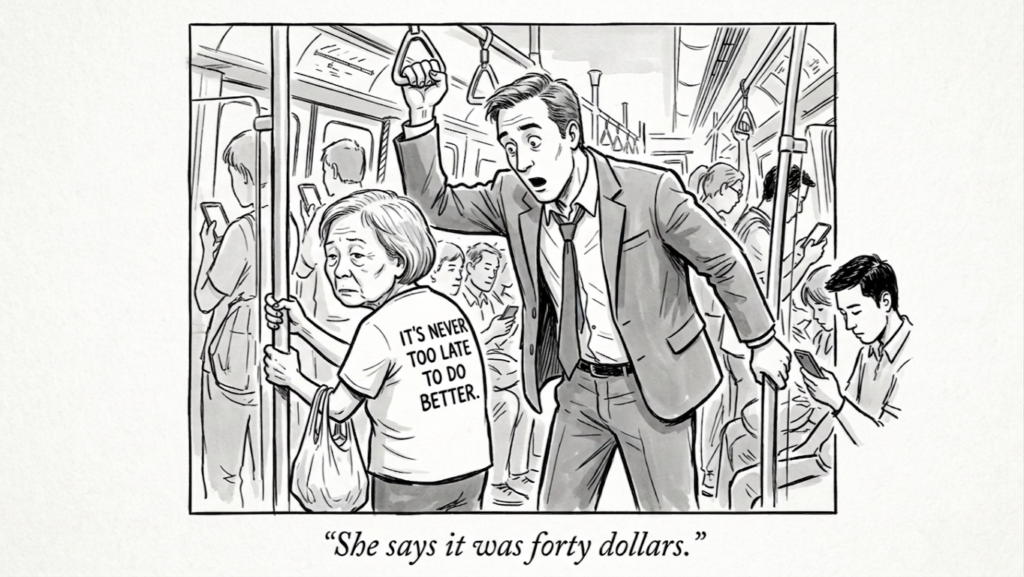
I was on the MTR. Island line. Somewhere between Admiralty and Wan Chai, which is approximately ninety seconds, which is approximately enough time for one thought and one thought only, and the thought was given to me by a woman. Seventy, maybe older. Small in the way that Hong Kong women of that generation are small, compressed by decades into something dense and unbreakable. She was holding the rail with one hand and a bag from Wellcome with the other and she was wearing a grey t-shirt with black text that said:
It’s Never Too Late to Do Better.
She did not know what it said. I am sure of this the way I am sure that the grandmother on the 72 bus did not know her shirt was about marijuana. This woman bought this shirt because it was grey and it fit and it was forty dollars. She was looking at nothing. She had the expression of a person who has taken this train ten thousand times and no longer sees it, who is already home in her mind, already putting the groceries away, already sitting down.
But I read it. And it sat in me the way certain things sit in you when you’re not ready for them, when you’re not braced, when you’re just standing on a train and a sentence arrives from the universe via polyester blend and you think: yes. That. Today. That one’s for me.
It’s never too late to do better.
And I stood there holding the rail and I thought about what that sentence means in this city. What “better” means. Who decides.
In Hong Kong, “do better” means one thing. It means up. It means the next rung. A better firm, a higher salary, a title with more words in it, a business card that makes your mother’s friends at dim sum produce that slight involuntary stiffening of the posture that passes for respect. “Do better” means the conveyor belt is working. “Do better” is what parents say when the grades come back and the grades are good but not best, and good does not justify the sacrifice. In this city, “do better” is a direction, and the direction is up, and it comes with a map, and the map has one road, and the road goes through the PCLL and the training contract and the firm whose name stiffens postures, and there is no exit, because the exit is failure, and failure is not an option because the sacrifice was not optional.
In Adams, Massachusetts, where I grew up, “do better” meant something else. Something that sounds the same but isn’t.
Every parent in Adams wanted their kid to do better. This is the universal wish. This is the thing that every parent in every mill town in every country has ever wanted, the wanting that crosses every culture and every language and every tax bracket: do better than me. Have more than I had. Suffer less than I suffered. Go further.
But in Adams, the wish had no instructions. The wish had no map. Your parents wanted you to do better but they did not tell you how, because they did not know how. They did not say: be a doctor. They did not say: be a lawyer. They did not stand on either side of a conveyor belt with the quiet intensity of people who had already selected the destination. They said: do better. That’s it. Do better than the mill. Do better than the bar. Do better than fine. But the how was yours. The direction was yours. The vehicle was yours, if you could find one, and nobody was going to find it for you, and nobody was going to be disappointed if the vehicle turned out to be a trade or a desk or a delivery truck or a life that looked nothing like a law degree, as long as the life was better. As long as you were not them. As long as the next generation cleared the bar that this generation set, which was low, which was survival, which was a job and a roof and the ability to look someone in the eye and say you were doing fine.
The wish is the same. Adams and Hong Kong, the wish is identical. Every parent wants their child to do better. The difference is that Adams gives you the wish and nothing else. Hong Kong gives you the wish and a conveyor belt and parents on either side and a map with one road and the road is paved with sacrifice and the sacrifice is not yours to refuse. Adams says: do better, we trust you. Hong Kong says: do better, we’ll show you. Adams gives you freedom without direction. Hong Kong gives you direction without freedom. And both of them, in their own way, produce people who arrive at thirty or forty or fifty and ask the same question:
Better than what? Better for whom? Better by whose measure?
In Adams, I never asked because nobody made me. The freedom was so total, the expectations so formless, that I drifted on momentum and called it a life. In Hong Kong, they never ask because nobody lets them. The direction is so specific, the map so detailed, that they climb and call it a life. And in both cases, the question goes unasked, and the unasked question is the same question, and the question is:
Is this what better looks like? Is this what the wish was for?
Robert Louis Stevenson, a man who was dying for most of his life and who used the dying to see what the living could not, wrote one sentence that I think about more than anything I learned in law school: There is no duty we so much underrate as the duty of being happy.
The duty of it. Not the reward. Not the thing that arrives after. The duty. The thing you owe. Now. The thing that both Adams and Hong Kong forgot to include in their definition of better. Adams said: better means more than us. Hong Kong said: better means up. And neither one said: better means happy. Better means present. Better means alive inside your own life, a participant, someone to whom things are happening rather than someone through whom things are passing.
The woman on the MTR does not know any of this. She knows her shirt is grey and it fits and the train is moving and she will be home soon.
But her shirt said the thing. The thing that nobody in Adams said because they didn’t have the language. The thing that nobody in Hong Kong says because the language they have points only up. The thing that sits between the wish every parent makes and the life every child builds:
It’s never too late to do better. But better is not up. Better is not the next rung. Better is the duty. The underrated one. The one that looks like inefficiency in a city that bills by the hour. The one that was missing from the wish in Adams and missing from the map in Hong Kong and that costs nothing to find except the willingness to stop, for one moment, on a train, between two stations, and ask yourself:
Better than what? Better for whom?
And if the answer you’ve been living is not the answer you’d choose, then the shirt is right, and it is not too late, and the asking is free, and it was forty dollars in Sham Shui Po, and it does not require a credential or a sacrifice or a stiffening at dim sum. It requires only that you notice it. On a Tuesday. On the MTR. In ninety seconds. On a woman who cannot read it but who wore it anyway, into the world, where it could find the person who needed it.
Today that person was me.
And somewhere on the 72 bus, a grandmother is still yelling at a man about her fish, and her shirt still says she got high and forgot to give a fuck, and she is, without knowing it, the most honest person in Hong Kong.