On September 9, a reporter from the People’s Daily asked the spokesman of Beijing’s Taiwan Affairs Office about an associate professor in Changhua. Li Ci-ze, who teaches at National Changhua University of Education, had just published three essays on a mainland WeChat blog setting out what Taiwan should ask for if it ever negotiated a “two systems” settlement. The spokesman, Chen Binhua, endorsed none of it. He said the specific form of a Taiwan plan “will fully take into account Taiwan’s actual circumstances, fully absorb opinions and suggestions from all sectors on both sides of the Strait,” and that Beijing was “pleased to see” Taiwan compatriots discussing its content.
By the standards of those press conferences, that is close to an open door on Taiwan reunification.
I have been writing about the question on the other side of that door for a year. Hong Kong Belongs to Hongkongers argued that Hong Kong was offered a vote for its leader in 2014 and threw it away in 2015. The Wound That Never Closed argued that Taiwan is running out of time to negotiate on good terms. In September I tried to put the whole position in one place in Common Sense for Hong Kong and Taiwan. When Professor Li’s essays appeared, I answered them in A Response to Dr. Li, because for the first time in years someone in Taiwan was arguing about terms instead of slogans.
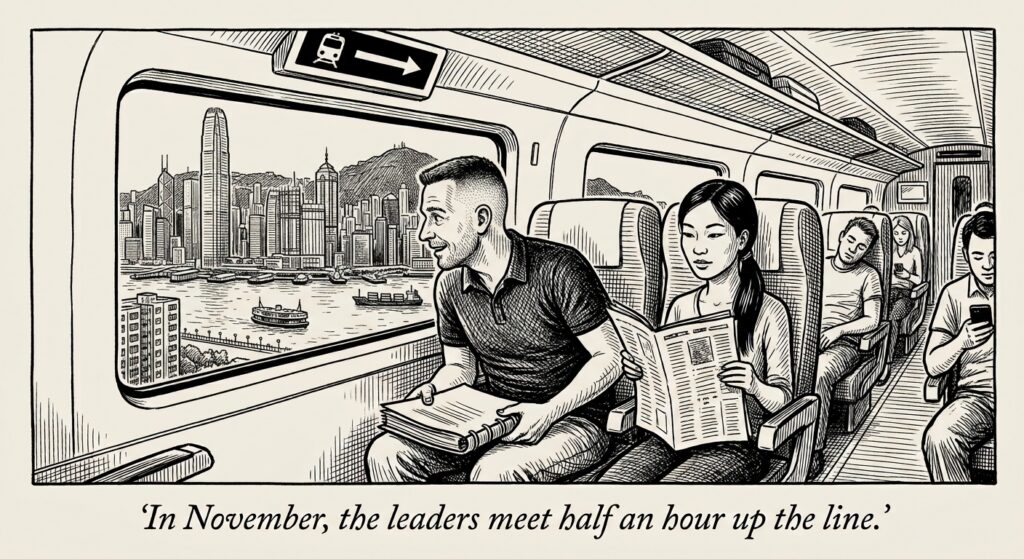
This essay goes one step further and lays out a framework for Taiwan reunification: a sequence by which Taiwan could move toward it at a pace it can live with, with Hong Kong setting that pace. The timing matters. Donald Trump is expected to meet Xi Jinping at the APEC 2026 summit in Shenzhen in November, half an hour by train from where I am writing.
I should say something first. I have no desire to lead the charge for political reform in Hong Kong. I said as much in the second edition of Hong Kong Belongs to Hongkongers, which will be published soon, and I meant it. Very few people here are pressing for reform, and I don’t know anyone who wants to march for it. The city has had a hard decade, from the street occupations of 2014 to the fire at Wang Fuk Court, and most of us would like to get on with our lives. Universal suffrage is still written into the Basic Law as the ultimate aim, and I still want it. I am in no hurry.
But I see an opportunity here. It runs through Taiwan, and Hong Kong is the only place it can start.
A Professor in Changhua
Li’s first essay ran on August 29 under a question for a title: “If Taiwan Is Really Going to Discuss a ‘One Country, Two Systems’ Solution, What Should It Ask For?” He answered with a list. Taiwan would keep a directly elected government and multi-party politics. Its courts would have the final word on cases arising in Taiwan. Existing rights would become a floor that could rise but never fall. Taiwan would keep the New Taiwan dollar, its own taxes and budget, and a defense force under its own command, and the People’s Liberation Army would not be permanently stationed on the island. In return, Taiwan would host no foreign bases, join no alliances and give up nuclear weapons and long-range strike weapons aimed at the mainland.
He proposed four legal “locks” to hold it in place: a cross-strait agreement, a chapter in the national constitution, a Basic Law for Taiwan enacted by the National People’s Congress, and a Charter of Autonomy approved by Taiwan’s voters. Any cut to the core protections would need three keys: an absolute majority in Taiwan’s legislature, a referendum in Taiwan and the approval of the National People’s Congress.
The essay drew nearly a thousand comments in a day. Li answered his critics the next day, and he conceded more than they expected. Taiwan’s autonomy, he wrote, would have to come from the national constitution and a grant by the National People’s Congress, not from any power Taiwan held in its own right. He replaced his open-ended reservation of powers with four lists: what Taiwan keeps, what the central government holds, what the two share, and what neither may do.
Taiwan’s Mainland Affairs Council dismissed the proposal. Beijing, as we have seen, did not.
The Clause Nobody Can Write
Li is a careful writer, and he named the weakness in his own proposal before his critics could. “If one party to an agreement holds the power to amend and interpret it, as well as to adjudicate alleged breaches,” he wrote, “then however carefully the agreement is drafted, it remains vulnerable to unilateral revision.”
He is right, and it is not a small point. Article 158 of Hong Kong’s Basic Law gives the Standing Committee of the National People’s Congress the power to interpret Hong Kong’s constitution, and any Basic Law for Taiwan would work the same way. Li’s fourth lock tries to discipline that power with procedure: advance notice, consultation, published reasoning, nothing retroactive. When I responded to him in September, I said that lock “will decide whether this whole framework is real or decorative.”
I have been a lawyer for more than twenty-five years, and I have never seen a clause that binds the party holding the pen. What binds a powerful party is reputation, built on a record the other side can watch. You don’t hire a contractor because of the warranty. You hire him because you walked through the last house he built.
Taiwan has already walked through a house. The problem is what it thinks it saw.
One Country, Two Systems Was Built as a Proof of Concept
One Country, Two Systems was not designed for Hong Kong. Deng Xiaoping proposed it in the early 1980s as a formula for Taiwan reunification, and Hong Kong’s return in 1997 was supposed to be the demonstration. As I wrote in The Wound That Never Closed: “If the arrangement could be demonstrated to work in Hong Kong … then the offer to Taiwan would gain credibility. Hong Kong was to be a proof of concept, an existence proof that Beijing could be trusted to keep its promises.”
For most of two decades the demonstration ran. The courts kept the common law. The press kept publishing, including the papers that attacked Beijing every morning. By 2004, half the Legislative Council was directly elected, something that never happened in 156 years of British rule. In December 2007 the Standing Committee decided that the 2017 Chief Executive election could be held by universal suffrage, and in August 2014 it put the offer on the table: a 1,200-member nominating committee, two or three candidates, and a vote for some five million people.
On June 18, 2015, the Legislative Council voted it down, 28 to 8, with the pan-democrats voting as a bloc. I have written about that day more than once. Hong Kong did not get its vote. Taiwan lost the demonstration.
Everything since has taught Taiwan the opposite lesson. When Taiwanese look across the water now, they see 2019, the National Security Law and an electoral system narrower than the one Hong Kong refused. Surveys in Taiwan after 2020 found more than 80 percent rejecting One Country, Two Systems. Hong Kong went from proof to warning, and it has stayed a warning ever since.
It doesn’t have to stay one. Articles 45 and 68 of the Basic Law still name universal suffrage as the ultimate aim, for the Chief Executive and for the whole Legislative Council. The National Security Law and the 2024 Article 23 ordinance are in force, so the security case that drove the 2021 changes has been answered. And Beijing, for the first time in years, is publicly inviting suggestions about what a Taiwan plan should contain.
If the 2014 Universal Suffrage Offer Was Wrong
I believe a real proposal was on the table in 2014, and that Hong Kong should have taken it. I made that case at length in Chapter Five of Hong Kong Belongs to Hongkongers, and I haven’t changed my mind.
But this framework asks Taiwan to watch Hong Kong, so it has to take Taiwan’s objections seriously. Assume, for the sake of argument, that the 2015 package was not acceptable. What was wrong with it?
A negotiator from Taipei would start with the nomination threshold. A candidate needed more than half the committee, at least 601 votes, to reach the ballot, and the committee’s majority came from sectors that reliably favored the establishment. Under the old system, a Chief Executive candidate needed only 150 nominations, one in eight. Raising the bar from one in eight to one in two is what let critics call the whole package a screen.
He would look next at who elected the committee: about a quarter of a million voters in sectoral constituencies, some of them companies rather than people. A body that decides who may face five million voters needs a broader base than that.
He would ask what “loves the country and loves Hong Kong” meant, since the Standing Committee’s decision repeated the phrase without defining it or saying who would apply it. He would ask why the field stopped at three. He would ask what came after 2017, because the package said nothing binding about how the system would open up, and the moderates who wanted to “pocket it now” had no written path to point to. He would ask what happened if Beijing declined to appoint the winner, since Article 45 leaves the appointment to the Central People’s Government. And he would point out that the package covered only the Chief Executive, with nothing for the Legislative Council.
Every one of those objections has a fix, and none of the fixes costs Beijing its sovereignty. Restore the one-in-eight rule and allow four or five candidates. On the 2016 results, when the pan-democrats won 325 of the committee’s seats, that rule would have put at least two of their candidates in front of the voters. Give every committee voter an individual vote. Write the eligibility test into law and publish the reasons for every decision. Fix the dates on which the system will be reviewed, and let it move only toward a wider franchise. Require the central government to appoint the winner within a set period unless it gives written reasons on grounds set out in advance. And publish the Legislative Council timetable at the same time.
There are lessons in this for everyone. Hong Kong’s democrats should have learned that an imperfect vote is worth more than none, and that a refusal can’t be taken back. Every objection on that list could have been pressed after 2017 by a Chief Executive with five million votes behind him. None of them could be pressed from Admiralty. Beijing should learn that an offer read as a trap will be refused even when it isn’t one; whatever is left unwritten gets filled in by the most suspicious reader. And Taiwan should learn to negotiate the details instead of rejecting the framework.
Taiwan Reunification, With Hong Kong Going First
Here is the idea. Taiwan reunification would proceed in stages, and each stage would open only after Hong Kong had reached a matching milestone. Beijing would prove its good faith in a city it already governs, under a constitution it already wrote, before Taiwan gave up anything it couldn’t take back.
I first floated this in the Afterword to the second edition of Hong Kong Belongs to Hongkongers: “the logical next step is to work out the offer here first. Let Hong Kong and Beijing agree on an electoral system that would also work for Taiwan … and put it into practice in Hong Kong.” A system that had run in Hong Kong for a few years would tell Taiwan more than any white paper could.
The framework turns that into a schedule with five phases, and Hong Kong moves first in each.
In the opening phase, Beijing would issue a new white paper restoring two pledges it made in 1993 and 2000 and dropped in 2022: that it would not station troops or administrative personnel in Taiwan, and that Taiwan would keep the power of final adjudication. Taiwan’s legislature would authorize exploratory talks without prejudging the outcome. And the Standing Committee would publish a timetable for universal suffrage in Hong Kong under Article 45.
In the second phase, Hong Kong would pass the electoral law for its first Chief Executive election by universal suffrage, built on the 2015 package with the fixes above. The test of the design is simple: would a Taiwanese voter recognize it as a real election? While Hong Kong legislated, Beijing and Taipei would sign an agreement formally ending the state of hostility, a subject Beijing’s own Anti-Secession Law lists for negotiation, and set up the military safeguards that should have existed decades ago: hotlines, advance notice of exercises, rules for encounters at sea and in the air. Taiwan would commit to Li’s list: no foreign bases, no alliances, no nuclear weapons and no long-range strike weapons aimed at the mainland.
In the third phase, Hong Kong would hold the election and the winner would take office. Only then would the two sides sign the agreement at the center of Li’s proposal, which he calls the Agreement on Peaceful Reunification and Taiwan’s High Degree of Autonomy. Taiwan would accept in writing that it is part of China, and Beijing would accept the autonomy terms. Taiwan would ratify through its own constitutional process, including a referendum, because its own law requires it.
In the fourth phase, Hong Kong would hold a second election on the same rules and publish a timetable for electing the whole Legislative Council by universal suffrage. Taiwan would adopt its Charter of Autonomy by referendum and begin transferring the agreed central powers in tranches. Formal diplomatic ties would give way to representative offices, and its armed forces would reorganize as a regional defense force. No tranche would move until the last one had been certified.
In the final phase, Taiwan’s system would be entrenched with no end date. In The Wound That Never Closed I suggested a term of “a hundred years, perhaps longer, perhaps permanent as a matter of fundamental law.” The framework takes the last option. And Hong Kong’s Legislative Council would be elected in full by universal suffrage, completing Article 68.
If a Hong Kong milestone slips, Taiwan’s clock stops, and Taiwan owes nothing further until the milestone is met. That is the whole mechanism. Beijing sets the pace, in public, with its own city as the measure.
Nothing here asks Beijing to accept a foreign condition on how it governs Hong Kong. Every Hong Kong milestone is a promise Beijing has already made, in a constitution the National People’s Congress adopted in 1990. Taiwan would simply be saying what it would take to convince it, which any party to a negotiation is entitled to say.
Who May Stand for Election
Beijing will insist on two further terms, and I think Taiwan should accept both.
The first is a screen. No one who advocates independence or “self-determination” for the region, or the overthrow of the Communist Party’s leadership or of the constitutional order, may stand for office or hold it. Every officeholder swears to uphold the region’s Basic Law and allegiance to the region as part of the People’s Republic, as Article 104 already requires in Hong Kong. As I argued in Common Sense, screening out an independence platform screens out something nobody has a legal right to pursue.
The screen has to be narrow to work. It targets advocacy of those two goals, shown by a candidate’s own words, platform or conduct. Criticism of the central or regional government, its policies or its officials is never grounds for disqualification. The disqualifying positions are written into law, every decision comes with published reasons, and in Taiwan a disqualified candidate can appeal to Taiwan’s Constitutional Court. Here I part company with Li, who asked for no political screening of candidates at all. I think a narrow screen, with reasons and an appeal to Taiwan’s own court, is where the two sides would end up, and I would rather say so now.
The second is a way to remove officeholders who abuse the office. Hong Kong already has the model in Article 73(9) of the Basic Law. A quarter of the Legislative Council can charge the Chief Executive with serious breach of law or dereliction of duty, the Chief Justice chairs an independent investigation, and the Council can impeach by a two-thirds vote. The framework adopts that structure for both regions and makes the grounds explicit: using the office to pursue independence, to subvert the constitutional order, or to paralyze government by abusing procedure. After the veto of 2015 and the attempt to block the budget in 2020, that last ground is not hypothetical.
In Hong Kong, as now, Beijing makes the final decision. In Taiwan, removal takes effect when Taiwan’s Constitutional Court upholds the legislature’s vote. Beijing can ask for a case to be referred. It cannot remove a Taiwan officeholder on its own.
No Certificate, No Transfer
A schedule is only as good as the machinery that decides when each step is done and what happens when the two sides disagree. Every lawyer who reads an agreement asks the same questions: who decides, on what evidence, and what happens next?
The framework answers with one rule: no certificate, no transfer. Nothing irreversible happens because a date has passed or because one side says it has performed. Every obligation is listed in a schedule with the evidence that will prove it, the body that will check it and the consequence if the check fails. A joint committee, six members from each side on the model of Hong Kong’s Basic Law Committee, certifies each milestone in writing and publishes its reasons. If the committee can’t agree, the milestone isn’t certified. Silence never counts as approval. Technical questions, such as weapons inventories and notice of exercises, go to a panel of independent experts drawn from a roster both sides approve in advance.
Disputes climb a ladder with a deadline on every rung: written notice, then mediation, then arbitration. This is where Hong Kong earns a second role. The International Organization for Mediation has had its headquarters here since 2025. The Hong Kong International Arbitration Centre is one of the busiest arbitral institutions in the world, and Hong Kong awards are enforced abroad, including by American courts. A tribunal seated in Hong Kong is inside China, so Beijing is not submitting to a foreign court, which Li rightly lists among the things Beijing will never accept. But it runs on the common law, before arbitrators neither side controls, and its rules already provide for emergency arbitrators when a step threatens harm that couldn’t be undone later.
When a joint body deadlocks, the default is the status quo. A breach lets the injured side suspend only the obligation paired with it, not the whole agreement, and completed steps stand. Walking away is available only for a short list of fundamental breaches defined in advance.
That leaves Li’s hardest question, interpretation. The Standing Committee would keep its constitutional power to interpret a Taiwan Basic Law, as it does for Hong Kong. The framework doesn’t ask it to give that up. It asks for three things. No interpretation without the published advice of the joint committee. No interpretation that reaches back; Article 158 of Hong Kong’s Basic Law already provides that “judgments previously rendered shall not be affected.” And compliance with the cross-strait agreement is decided by the tribunal, not by interpretation. If the tribunal finds that an interpretation took away something the agreement guaranteed, the interpretation remains national law, but the finding is a material breach, with everything that follows from it. Beijing keeps its sovereign authority. It just can’t use it for free.
The Hard Questions About One Country, Two Systems
Where does autonomy end and sovereignty begin? The four lists answer most of it. Anything they don’t cover belongs to the shared list until the parties agree otherwise, and no one can move a subject between lists by interpretation or administrative order.
Who has the last word in Taiwan’s courts? Taiwan’s highest court, for every case arising in Taiwan, including national security cases, which would be tried in Taiwan under Taiwan’s own law. No one is sent to the mainland for trial. Hong Kong’s crisis in 2019 began with an extradition bill. The lesson is to settle the surrender of suspects in the agreement itself, with judicial safeguards, before it can become a crisis.
Isn’t this a federation in disguise? A Global Times column on Li’s proposal objected to any suggestion that Taiwan holds original powers of its own, and Beijing will read every safeguard with that worry in mind. It needn’t. Taiwan accepts in writing that it is part of China, its powers come from a grant by the National People’s Congress, and it gives up diplomatic recognition, foreign bases and alliances. The safeguards govern how the grant is honored. They don’t make Taiwan a state.
Isn’t Taiwan giving up its leverage too early? Its courts, its currency and its defense force never leave its hands. Diplomacy and the other central powers move only in the fourth phase, after Hong Kong has held two elections and every earlier step has been certified. Taiwan negotiates early and commits late.
Won’t anyone who talks about terms be called a traitor or a separatist? In Taiwan, discussing terms can be read as endorsing Beijing’s formula. On the mainland, asking for safeguards can be read as separatism by other means. Every litigator knows the answer: talks are held without prejudice. Proposals made in negotiation bind no one and can’t be used against the side that made them. Both governments should say so before talks begin.
And what about the press? A weaker party needs journalists to expose broken promises, so the framework protects reporting, hostile reporting included. The line I drew in Narrative Immunity still holds. Journalism that tests a claim against the evidence is scrutiny. Coverage that strips the conditions out of a proposal, assigns motives without reading the clauses or treats talking as surrender is distortion. The cure for distortion is more primary evidence, so every certificate, finding and award would be published in full, in Chinese and English.
What Everyone Gets
Beijing gets Taiwan reunification without a war, Taiwan’s written acceptance that it is part of China, an island closed to foreign bases, and the demonstration Deng designed the formula to deliver. In return it accepts a public timetable it can’t quietly drop and a tribunal in its own city that can find it in breach.
Taiwan gets security, and elections, courts, a currency and rights guaranteed with no end date. It gets the mainland economy, and proof before commitment. It gives up its separate claim to statehood over time, its remaining formal diplomatic ties and its foreign military partnerships.
Hong Kong gets the vote it lost in 2015, in a better form. It gives up its quiet. The city becomes the test case, with the scrutiny that comes with it.
The United States gets a peaceful end to the most dangerous dispute in Asia and an off-ramp from a commitment it has never defined, and it loses its arms sales to Taiwan. In Hong Kong Belongs to Hongkongers I traced the pattern from Basra to Kabul to Kyiv: “America might use your courage, but it would not necessarily share your fate.” A settlement that depends on no outside guarantee can’t be abandoned by one.
APEC 2026: What Shenzhen Could Start
On November 18 and 19, the leaders of the Asia-Pacific Economic Cooperation forum meet in Shenzhen, and Trump is expected to sit down with Xi there, two months after Xi’s state visit to Washington. There is no better place for the conversation. Forty-six years ago, Shenzhen was a border county of farms and fishing villages across the river from the New Territories. In 1980 it became one of China’s first special economic zones, and it grew, on Hong Kong capital, Hong Kong factories and Hong Kong’s example, into a city of more than seventeen million people. The high-speed train from West Kowloon gets there in under half an hour. Shenzhen is what two systems can build when they work together instead of against each other.
Nobody should expect APEC 2026 to settle the Taiwan question, and it shouldn’t try. APEC is an economic forum, and Taiwan sits at its table as Chinese Taipei. But the two leaders could start the first phase of this framework without signing anything binding. Beijing could say it is ready to restore the pledges of 1993 and 2000 and to put a Hong Kong timetable under Article 45 on the table. Washington could say it would welcome cross-strait talks held without prejudice, and that it does not intend to be anyone’s guarantor. None of that costs either leader much, and all of it would give Taiwan something real to watch.
Trump has made no secret that he would like a Nobel Peace Prize. In the Afterword to Hong Kong Belongs to Hongkongers I suggested where he might find one: ask Xi for what the Basic Law already promises, an election for Hong Kong’s leader by Hong Kong’s voters, on terms Taiwan could also live with, and then let Taiwan watch it work. The road runs through Hong Kong, a short train ride from the summit.
Why Taiwan Reunification Can Still Offer Hope
In The Wound That Never Closed I wrote that Taiwan’s choice “is not between independence and reunification. It is between good reunification and bad reunification, between a future Taiwan shapes and a future Taiwan suffers.” This framework for Taiwan reunification is a road to the first kind, and the hope in it rests on evidence rather than assurances. For more than a decade Taiwan has watched Hong Kong and drawn one conclusion. The framework gives it new facts to watch, produced by Beijing’s own choices, before anything irreversible happens. If Beijing delivers, Taiwan has grounds for trust that no drafting could supply. If it doesn’t, Taiwan finds out early and has lost nothing.
The rewards are large on both sides of the strait. For Taiwan, an end to what I called “the constant background radiation of Taiwanese life,” the missiles across the water. For Beijing, something bigger than territory. A peaceful reunification “could be China’s greatest triumph since the founding of the People’s Republic,” and it would show a China that has “become strong enough to be generous.” Under this framework the world would see that first in Hong Kong.
Time still matters. Taiwan’s leverage shrinks every year as fabs rise in Arizona and the military balance shifts. A phased Taiwan reunification agreement lets Taiwan fix its terms while it still has leverage, and pace the handover of power to Beijing’s performance.
And Hong Kong gets its future back. I ended Hong Kong Belongs to Hongkongers with the city as “a bridge that both sides needed more than they knew,” and with a line I still believe: “The bridge is damaged. But bridges can be repaired.”
In September, Beijing said it wanted suggestions from both sides of the strait. In November, the leaders meet half an hour up the line.
This is mine.
Let Hong Kong go first.
Comments