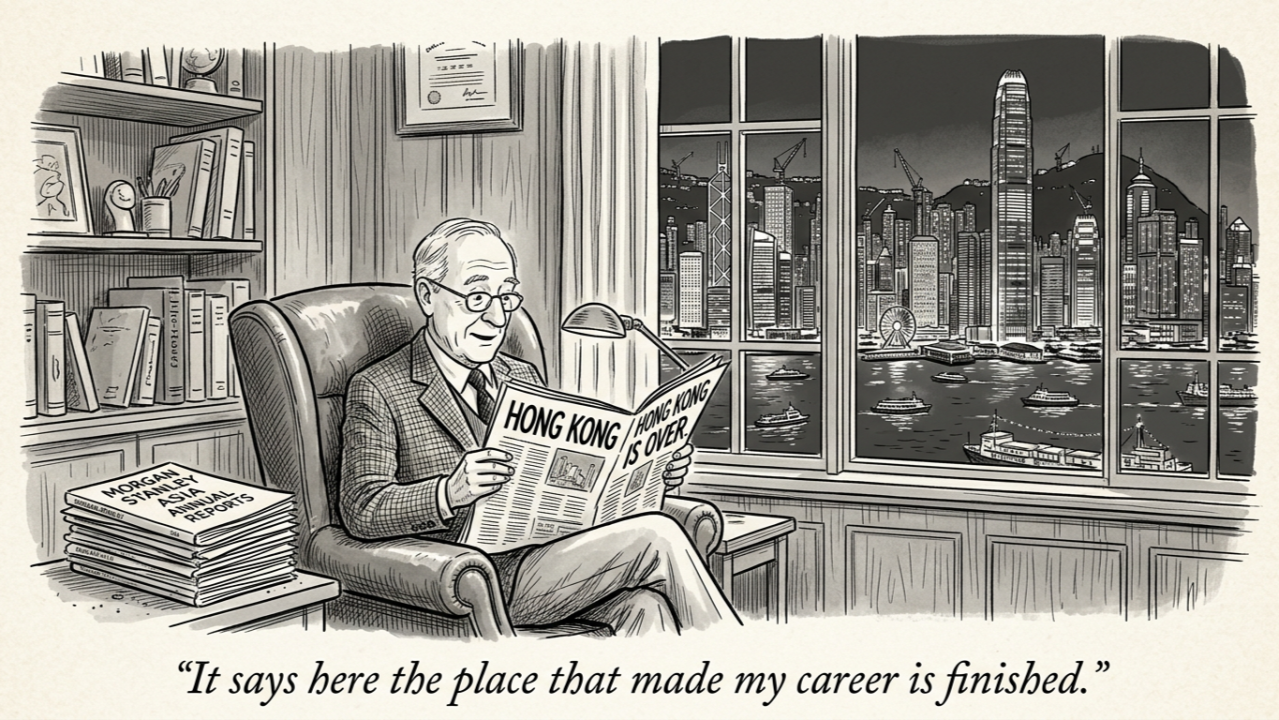
A Hong Kong rebuttal with receipts, impatience, and a very short memory for bad frameworks.
Stephen Roach just published another op-ed declaring Hong Kong “over.” (https://www.bangkokpost.com/opinion/opinion/3292009/yes-the-hong-kong-of-old-is-over).
For those unfamiliar, Roach spent three decades at Morgan Stanley, most of them as the firm’s chief economist, before moving to Hong Kong as Chairman of Morgan Stanley Asia. He left the bank in 2010 for a faculty position at Yale, where he has been ever since. His career at Morgan Stanley was built on Wall Street’s access to Asian growth markets. The firm’s Asia business, the one Roach chaired, exists because Hong Kong exists. The irony of the man who ran Morgan Stanley’s Asia platform from a Hong Kong office now declaring the city dead from a classroom in New Haven apparently escapes him.
He and his wife live in New Canaan, Connecticut.
Not in Hong Kong.
That tells you everything you need to know.
I live here. I work here. And I’m tired of Western academics writing eulogies for a city they visit once a year and think they understand.
In light of this, it is essential to scrutinize the implications of Stephen Roach Wrong Hong Kong on the future of the city.
Let me walk you through what Roach actually said, and why nearly every point collapses under the weight of reality on the ground.
Just another Chinese city?
“Hong Kong is just another big Chinese city.”
This is supposed to be an insult.
It’s not.
Hong Kong is the financial gateway to the second-largest economy on earth. It sits at the doorstep of the Greater Bay Area, a regional GDP bloc that rivals most G20 nations. It operates under common law. It has free capital movement. It has zero capital gains tax. It has the deepest pool of cross-border financial infrastructure in Asia.
Name another “big Chinese city” that does all of that.
You can’t.
Because Hong Kong isn’t “just another” anything. It is the only city on the planet that bridges Western capital markets and China’s domestic economy with full institutional scaffolding on both sides. That is not a weakness. That is the single most valuable geographic and regulatory position in global finance right now. Morgan Stanley understood that when it planted its Asia headquarters here. Roach understood it when he took the chairman’s seat. The fact that he now frames proximity to China as a liability is a remarkable revision of the thesis that built his own career.
Every CFO allocating capital into Asia sees Hong Kong’s position as the reason the city exists.
The IPO argument
“IPO leadership is just Chinese companies listing.”
Yes. And?
Roach says Hong Kong reclaimed the global IPO crown in 2025 but dismisses it because the issuers were mainland companies like CATL and Luxshare Precision. He frames this as evidence that Hong Kong is merely a “platform for Chinese issuers” rather than a “thriving global IPO market.”
Think about what he’s actually saying.
He’s saying the number one IPO venue in the world doesn’t count because its clients are from the wrong country.
CATL is the world’s largest battery manufacturer. Luxshare is a critical supplier to Apple. These are globally significant companies choosing to list here because Hong Kong offers something no other exchange can: international investor access with Chinese capital market depth.
When Roach was running Morgan Stanley Asia, the firm earned enormous fees underwriting exactly these kinds of deals. Chinese issuers listing in Hong Kong was the business model. It was the reason Morgan Stanley had a Hong Kong office, the reason Roach had a title, and the reason the firm’s Asia platform generated the revenues it did. Now that same pipeline is evidence that the city is “over”?
London’s IPO pipeline has been hollowed out for years. New York is drowning in regulatory complexity. Hong Kong is winning mandates. That is the scoreboard. You don’t get to dismiss the scoreboard because you don’t like who’s scoring.
Rule of law
“The rule of law has been severely compromised.”
This is the argument that gets the most traction in Western media and the least scrutiny.
Hong Kong went through a period in 2019 where the airport was shut down, the legislature was stormed, and the streets were on fire for months. Businesses couldn’t operate. Professionals couldn’t commute. The city was, by any operational definition, ungovernable.
The National Security Law restored order. You can agree or disagree with its scope, but the commercial reality is that the business community here largely moved on. Contracts are enforced. Courts function. International law firms have not packed up and left. They’ve expanded.
Roach cites the resignation of foreign judges from the Court of Final Appeal and quotes Jonathan Sumption. He does not mention what the international legal market is actually doing with Hong Kong’s courts.
Start with arbitration. In 2025, the HKIAC received 582 new cases, including 388 arbitrations, another record-breaking year. The total amount in dispute rose to US$16.2 billion. Almost 85% of all arbitrations were international in nature, with parties from 61 jurisdictions. The traditional users of HKIAC arbitration, the US, Singapore, the UK, BVI, and the Cayman Islands, all remain in the top ten.
That is not the profile of a jurisdiction where the rule of law has been “destroyed.” That is the profile of a jurisdiction where global capital continues to trust the legal infrastructure.
And it’s not just arbitration. US federal courts continue to recognize and enforce Hong Kong arbitral awards. In Estate of Zhengguang v. Yu, a US district court in Maryland enforced a Hong Kong arbitral award under the New York Convention, and the Fourth Circuit affirmed, finding no valid defense to enforcement. American courts are not in the habit of rubber-stamping awards from jurisdictions they consider legally compromised. They enforced this one because Hong Kong’s legal system produces outcomes that meet the standards of the most litigious jurisdiction on earth.
Meanwhile, on May 28, 2026, the Hong Kong Judiciary announced the establishment of a new Hong Kong International Commercial Court to hear complex, high-value international and cross-border commercial disputes. Local judges with substantial commercial experience will sit on the HKICC, and eminent senior judges and practitioners from other common law jurisdictions may be invited to sit on an ad hoc basis. Hong Kong is also now home to the International Organization for Mediation, the first intergovernmental organization dedicated to resolving international disputes through mediation, established pursuant to a convention signed in Hong Kong in 2025.
Litigation. Arbitration. Mediation. Hong Kong is not retreating from the rule of law. It is building new infrastructure to strengthen it.
If the rule of law were truly compromised, capital would flee. Instead, Hong Kong just led the world in IPOs, posted record arbitration caseloads, and launched an international commercial court. Money is not sentimental. It goes where the infrastructure works.
Who is leaving?
“Expats are leaving and being replaced by mainlanders.”
This framing reveals the real bias underneath the academic language.
Yes, some expats left after 2020. Some left during COVID. Some left because remote work made them realize they’d rather live in Portugal. People move. That is what professionals do.
What Roach frames as a demographic crisis, the people actually here experience as a talent rotation. Mainland professionals arriving in Hong Kong are not unskilled migrants displacing a local workforce. They are engineers, quants, fintech developers, AI researchers, and capital markets professionals. Many hold degrees from the same Western universities that Roach teaches at. They speak Mandarin, Cantonese, and English. They bring relationships with the fastest-growing companies in Asia.
Roach walks the streets and hears Mandarin and treats it as a sign of decline. Professionals here hear Mandarin and recognize it as the sound of their client base. When Roach was chairman of Morgan Stanley Asia, Mandarin-speaking clients were the ones generating the fees that justified his title. Now that same demographic showing up in greater numbers is supposedly a problem.
Hong Kong’s population has held at roughly 7.5 million. The city didn’t empty out. It evolved. If your definition of Hong Kong requires that it look and sound exactly like it did in 1997, then yes, that Hong Kong is over. But cities that refuse to evolve are the ones that actually die.
Correlation is the point
“Hong Kong’s economy is just correlated with China’s.”
Roach points to China’s GDP growth slipping to 4.3% in Q2 2026 as a headwind for Hong Kong.
A few things.
First, 4.3% growth in the world’s second-largest economy is not a crisis. It is a structural deceleration that every serious economist, including Roach himself during his Morgan Stanley years, has written about as both inevitable and manageable. Comparing it to a “target” that was always aspirational is a rhetorical device, not an analytical framework.
Second, yes, Hong Kong’s economy is correlated with China’s. Singapore’s economy is correlated with ASEAN’s. London’s is correlated with Europe’s. New York’s is correlated with the US federal funds rate. That is how financial centers work. They are leveraged to their hinterland. Hong Kong’s hinterland happens to be the largest trading nation on earth. That is not a vulnerability. It is a competitive moat.
Morgan Stanley’s entire Asia strategy was built on this correlation. The firm bet billions in capital and decades of institutional investment on the thesis that proximity to China’s growth was the most valuable position in Asian finance. Roach oversaw that bet. Now he calls it a weakness.
The planning sneer
“The five-year plan won’t work.”
Roach mocks Hong Kong for launching its first five-year plan, saying China is “painfully learning” that such plans “over-promise and under-deliver.”
China’s five-year plans built the world’s largest high-speed rail network, the world’s largest renewable energy infrastructure, and a semiconductor industry that is now a front-page national security concern for the United States. Whether you like the model or not, dismissing it as inherently dysfunctional is intellectually lazy.
Hong Kong adopting elements of strategic economic planning does not make it a command economy. It means the government is aligning its fiscal and industrial priorities with its largest economic partner. Every serious financial center does some version of this. They just don’t call it a five-year plan, so it doesn’t trigger the same reflexive Western anxiety.
The real issue
Roach’s argument has never really been about economics. It’s about identity.
He wants Hong Kong to be what it was in the 1990s: a Western-facing entrepôt with British legal DNA, an expat-heavy professional class, and an arm’s-length relationship with Beijing. That city served a purpose in a particular geopolitical moment. That moment is over.
The Hong Kong of 2026 is a Chinese global financial center. It runs on common law, free capital flows, and the deepest renminbi liquidity pool outside the mainland. It is the listing venue of choice for the companies building the industries of the next two decades: batteries, EVs, AI, advanced manufacturing. It is home to 7.5 million people who show up to work every day in one of the most operationally efficient cities on the planet.
If that’s “over,” I’d love to see what Roach considers alive.
I’ve been here through SARS, the GFC, Occupy, the 2019 unrest, COVID, and now the post-NSL era. Hong Kong adapts. It always has.
The people writing its obituary are never the ones who stayed.
Come visit, Stephen. Walk the streets. Talk to the people building businesses here. You might find that the city you declared dead has simply outgrown the version of it you were comfortable with.
Hong Kong isn’t over. Your framework is.