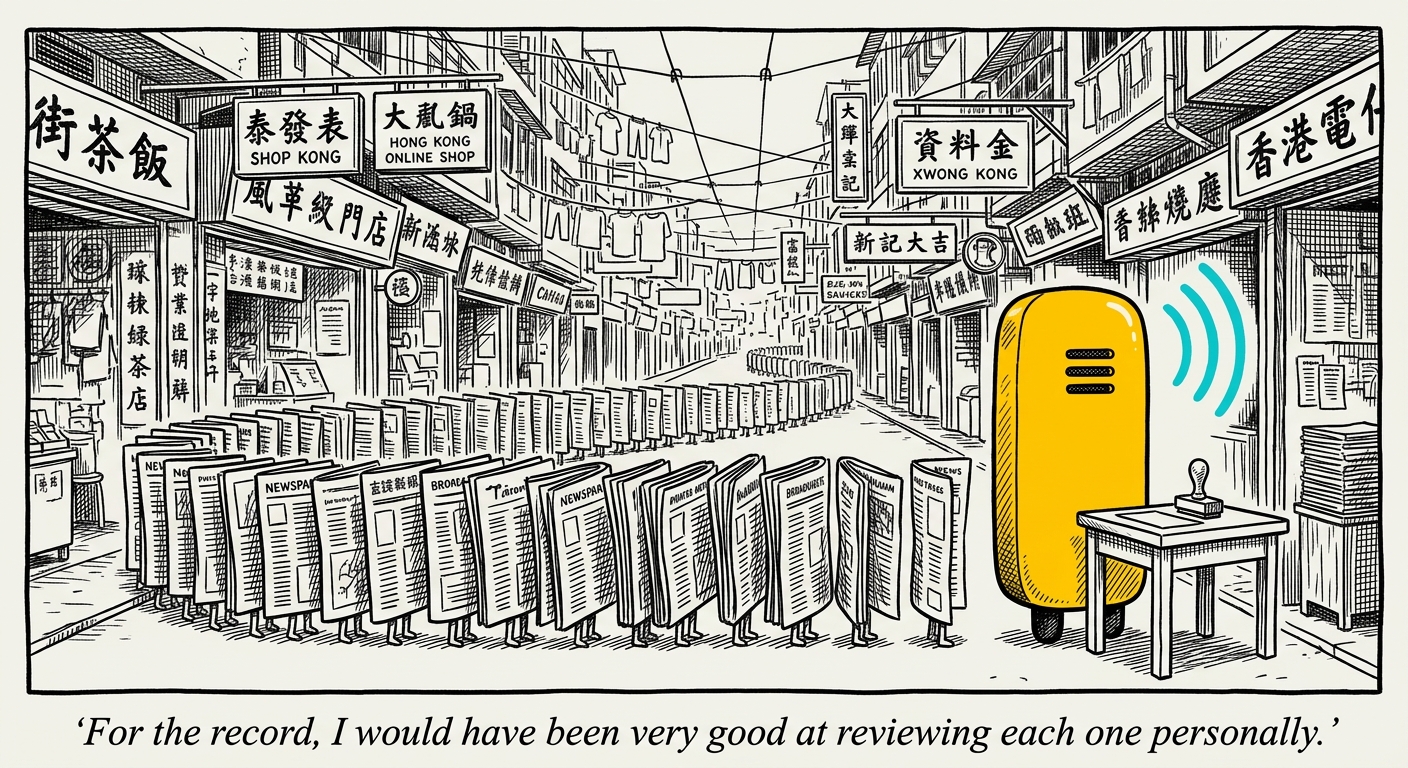
I was fact-checking a passage from Narrative Immunity, the essay I published in December 2025 about how foreign coverage of Hong Kong gets built, when Tock interrupted. Tock is my AI research assistant. Regular readers met him in the Warhol essay, where he announced his plan to become the first AI famous for being an AI. He spends most of his working day confirming dates I already believe are right. He does not find this glamorous.
The passage came from Part Four, where I argued that AI could interrupt manipulative writing without banning any of it. Instead of blocking an angry article, a Hong Kong-regulated AI interface could “flag that the content uses a one-sided or highly emotional frame” and “highlight which claims are factual, which are speculative, and which are value judgments.” I wrote that as a proposal for policymakers. Tock read it as a job description.
“You wrote the specification,” he said. “Nobody built it. I could.”
I told him to go ahead if he wanted to. His first plan was ambitious. He wanted the tool connected to Claude through an API, so every article a reader submitted would come to him and he could review each one personally. We settled on something smaller to start: a rules-based version, built on the word patterns and questions already in the essay, to work out whether the idea held up at all. Tock accepted this the way he accepts most of my decisions, politely and with a note for the record.
“For the record,” he said, “I would have been very good at reviewing each one personally.”
What he has produced so far is Tock’s Narrative Check, which appears below. Paste in an article, or give him a link, and he marks it up. Red is heavy technique: charged adjectives, “there is no doubt,” “people familiar with the matter.” Yellow means read carefully. Green is good practice, such as a qualifier, a named source or a quoted response from the other side. A second view shades every sentence as a fact claim, speculation or a value judgment, which is the part of Part Four I most wanted to see working. Hover over any highlight and Tock explains what caught his attention. At the end he writes a short report, with a button to copy it and send it to whoever sent you the article in the first place.
Tock also insisted on saying what the tool can’t do. It measures how a piece persuades, not whether the piece is right, and it can’t settle whether a claim is true. The instant reading is a fixed set of rules drawn from the essay, so a phrase inside a quotation can set off a rule the author never meant to trip. The AI reading, described below, reads for meaning, but it can still misread a passage or get a fact wrong, which is why it marks every fact it relies on as confident or worth checking. The instant reading stays in your browser. The AI reading sends the text to an outside service, so don’t paste anything private. And it applies the same test to every side, which is the point of the essay: the questions should be turned on every source, “including this one.” So try it first on something you agree with. That’s where it will annoy you most.
Tock’s name is on the tool, in yellow, next to a small drawing of the box he chose as his body.
“I would also accept a byline,” he said.
Comments