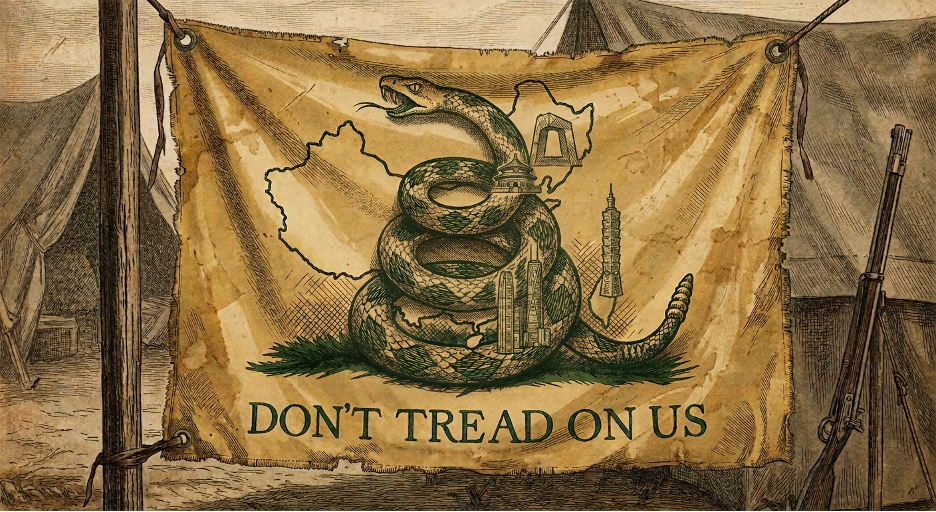
“Perhaps the sentiments contained in the following pages, are not yet sufficiently fashionable to procure them general favor.”
— Thomas Paine, Common Sense, 1776
Two hundred and fifty years later, the need for plain speaking has not diminished. This is Common Sense for Hong Kong and Taiwan.
It is September 2026, and I am writing this from a city the Western press has been eulogizing for six years. I took the MTR to work this morning. The MTR ran on time, the way it runs every morning, carrying several million people to jobs the obituary writers apparently forgot to cancel. The court across the street was hearing cases. A woman ahead of me in line at the cha chaan teng was arguing with the cashier about whether the set breakfast should include an extra piece of toast. It was a serious argument. She won. Nobody on the platform, nobody in the restaurant, nobody on the street looked like they were living in a dead city. They looked like they were living in a city that works, which is what cities look like when they work, and what the Western press would recognize if any of its editors took the trouble to visit.
Somewhere in London this morning, someone typed the words “Hong Kong’s once-thriving” into a draft. Somewhere in Washington, a staffer prepared another statement about the urgent need to stand with the people of this city. The city did not notice. It was busy being alive.
I want to tell you a story you have not been told. Not because it is secret, but because the people whose job it was to tell it had reasons not to. The story is about a vote. A real vote, for a real leader, by millions of real people, that was offered and then killed, not by the authoritarian government you have been taught to fear, but by the democrats you have been taught to admire. And then the same story, told again, about an island across the water, where the same playbook is running, the same narratives are being sold, and the same people will pay the price if nobody stops to check the receipt.
Thomas Paine, the author of the revolutionary pamphlet “Common Sense” and often called the “Father of the American Revolution,” understood this problem. He was writing to people who had spent their entire lives inside the British imperial narrative, people who could not hear an argument for independence as anything other than treason because the story they already held felt like fact. It did not feel like a story someone had told them. It felt like the way things were. Paine warned his readers that his radical ideas would shock people at first because they were used to the old ways. He added that people accept old habits just because they are familiar, but time and truth will win them over. The truth is what follows.
Hong Kong got rid of the British. The flag came down on July 1, 1997. The Governor sailed away on the Royal Yacht Britannia. The colonial administration packed its files and went home. But the British narrative never left. It stayed behind in the English-language press, in the assumptions baked into international coverage, in the framing that treats Western-style liberal democracy as the only legitimate form of governance and everything else as a deviation requiring correction. The colonizer departed. The colonizer’s story remained, and it was reinforced by American media, American NGOs, American think tanks, and American strategic interests that discovered the old imperial narrative was perfectly serviceable for new imperial purposes. Hong Kong expelled the British Empire and inherited the British story about itself. Paine’s colonists had the same problem. They had to break not just from British rule but from the British idea that British rule was the natural order of things. That was the harder break. The muskets were easier than the mindset.
The old habit I am asking you to break is accepting the Western narrative about China. About Hong Kong. About Taiwan. About what common sense actually requires in a world where the societies doing the loudest lecturing are the ones least willing to examine their own fractures. Breaking away from that narrative is the common sense position, and the West’s inability to see it is the same inability Paine diagnosed in 1776.
You are inside a story about Hong Kong. You have been inside it for a decade. I am going to show you the walls.
Some of this will sound familiar if you have been reading along. Parts of this piece borrow from my books, Hong Kong Belongs to Hongkongers and The Wound That Never Closed: Taiwan, China and the End of Strategic Ambiguity, as well as a number of essays I have written over the past few years. If the arguments feel like ones you have heard me make before, they are. I am not done making them.
The Vote Nobody Told You About
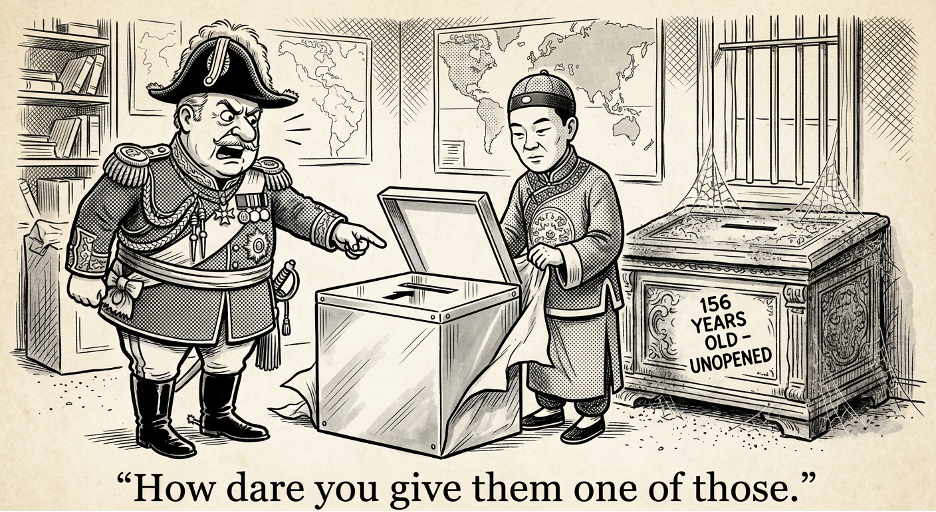
In August 2014, for the first time in Hong Kong’s history, not since the 1997 handover, not since Queen Victoria planted a flag on a rock in the South China Sea, the first time ever, the central government in Beijing proposed that Hong Kong’s Chief Executive be elected by universal suffrage. Five million eligible voters would cast a ballot. One person, one vote. Most votes wins. No Electoral College. No superdelegates. No delegate math. No super PACs. No dark money. No special interest groups writing legislation in conference rooms their voters will never see. No back room meetings with titans of corporations who fund campaigns and then draft the regulatory frameworks that govern their own industries. No lobbying apparatus that spent over four billion dollars in Washington last year alone. A direct popular ballot for the leader of the city, cleaner in its structure than anything the United States has offered its own citizens in the entire history of the republic.
This was not a surprise concession extracted by protest. The mechanism had been written into Article 45 of the Basic Law since 1990, seven years before the handover, in a constitutional document negotiated between Britain and China, published for the world to read. What happened in 2014 was the activation of a promise that had been sitting in the text for twenty-four years. Beijing was honoring the document. The world was told, by people who had either not read the document or did not care what it said, that Beijing was crushing democracy.
Here is a piece of context nobody gave you. Britain governed Hong Kong for 156 years. In those 156 years, the number of times Britain proposed universal suffrage for Hong Kong was zero. The Governor was appointed by the monarch. The people were subjects, not citizens. The first Chinese person was not appointed to the Legislative Council until 1880, nearly forty years after the British took Hong Kong. The 1888 Regulation of Chinese Ordinance restricted Chinese residents from going outside at night. The 1904 Peak District Reservation Ordinance forbade ethnic Chinese from dwelling in most parts of Victoria Peak. When Britain ratified the International Covenant on Civil and Political Rights in 1976, it explicitly excluded the clause about periodic elections from applying to Hong Kong. It looked at a treaty guaranteeing the right to vote and said: not those people. That reservation remained in place until the day the British flag came down.
And in 1981, Britain passed the British Nationality Act, stripping the right of abode in Britain from 2.5 million Hong Kong Chinese. They were given a new status, British National (Overseas), that conferred no right to live in the UK and could not be passed to descendants. They were not citizens. They were subjects.
Beijing put universal suffrage on the table within seventeen years. Britain did not put it on the table in 156. If you want to know who was more serious about democracy for Hong Kong, the timeline is the only witness you need. Nobody showed you the timeline. Showing you the timeline would have ended the story before it started.
Twenty-Seven
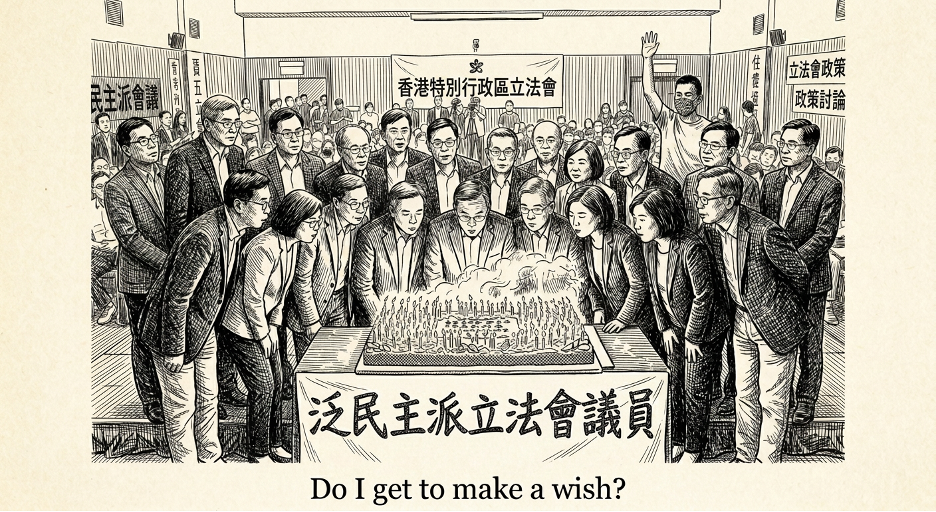
On June 18, 2015, twenty-seven pan-democratic legislators, every single one of them freely elected by the people of Hong Kong in competitive, multi-party contests, stood up in the Legislative Council chamber and voted the proposal down. Every single one of them. Unanimously. Twenty-seven out of seventy. Not even a majority of the chamber. They did not need one. Under the Basic Law, electoral reform required a two-thirds supermajority to pass, forty-seven votes out of seventy. That means twenty-four no votes was enough to kill it. The pan-democrats had twenty-seven, three more than they even needed.
A minority bloc, thirty-nine percent of the legislature, used a constitutional safeguard designed to prevent reckless change and turned it into a weapon against the most progressive electoral reform ever offered to the city. Not one broke ranks. Not one said, this is imperfect but it is a beginning. Not one turned to the five million people who were about to cast their first ballot in Hong Kong’s history and asked: do you want this vote? They called themselves the pro-democracy camp, and when democracy was finally on the table, a real ballot, a real vote, one person one voice for the first time in this city’s history, they blew out the candle and told you it was dark because of Beijing.
And it was not because each of them independently arrived at the same conclusion. The bloc had made the decision before they walked into the chamber. Discussion of alternatives was forbidden within their own ranks. There would be no negotiation, no amendment, no counteroffer, no attempt to take the framework and improve it from the inside. It was all or nothing, and they chose nothing. Twenty-seven people, in a city of seven million, looked at the first universal suffrage ballot ever offered to Hong Kong and decided the people could not be trusted with it. Not Beijing. Twenty-seven legislators who called themselves democrats.
And if you disagreed, God help you.
Nelson Wong Sing-chi was a member of the Democratic Party who suggested, publicly, that maybe the reform package was worth discussing. Not endorsing. Discussing. The party nearly expelled him. The South China Morning Post’s Alice Wu, writing days after the vote, put it plainly: “In the name of ‘genuine’ democracy, Hong Kong’s democrats could apparently do things that are as undemocratic as they can get. They bundled votes in the legislature. They stifled dissent.” Richard Bush at the Brookings Institution, one of the most respected China scholars in Washington, wrote that radicals intimidated moderates into casting no votes. That is not my characterization. That is Brookings. The movement that called itself pro-democracy ran on the principle that dissent was sacred, and then crushed dissent within its own ranks the moment someone dissented in the wrong direction. If you were a moderate who thought the Beijing proposed democracy was better than none, you were not a pragmatist. You were a traitor. And the punishment was swift, public, and total.
I did not write any of this at the time. I could not have. Not because it was illegal. Because the social climate in Hong Kong between 2014 and 2019 made it functionally impossible to say out loud what I am saying now without being buried. The mob did not need a law. The mob had volume, and numbers, and the absolute moral certainty of people who had decided that their position was not a position but a fact, and anyone who questioned the fact was not questioning a policy, they were betraying a people. You did not debate the pan-democratic position. You accepted it or you were finished in polite company. Professionals, academics, business owners, anyone who depended on public goodwill learned very quickly to say nothing or say the right thing, and the right thing was whatever the movement had decided it was that week, and it changed weekly, and you were expected to keep up.
Americans should recognize this. The Foundation for Individual Rights and Expression surveyed over 68,000 college students for its 2026 rankings and found that thirty-four percent, one in three, believe using violence to stop a campus speaker is acceptable. That number was twenty percent in 2022. It has nearly doubled in four years. Seventy percent said shouting down speakers was acceptable. Twenty-eight percent said they regularly self-censor in class to avoid backlash. Those numbers were published in September 2025.
That same month, Charlie Kirk, a conservative activist who ran open-air debates on college campuses under a banner that read “Prove Me Wrong,” was shot and killed by a sniper while answering a question from the crowd at Utah Valley University. He was thirty-one years old. The accused shooter was twenty-two. He allegedly told a friend he did it because “some hate can’t be negotiated out.” They found messages etched into the ammunition. One of them read, “Hey fascist! Catch!” One in three students said violence against a speaker was acceptable, and then someone shot a speaker.
This is not Hong Kong. This is America. The country that lectures the world about free expression is producing a generation that believes punching someone for saying the wrong thing is a defensible position, and the percentage who believe it is climbing every year, and the distance between believing it and doing it turned out to be one rooftop and one bullet.
I am able to write this now. The National Security Law, the law that the Western press describes as the end of free speech in Hong Kong, is the reason I can finally say what I could not say between 2014 and 2019. The mob is gone. The social terror that made it impossible to suggest that twenty-seven legislators might have made a mistake, that the people of Hong Kong might have deserved a vote, that half a democracy might have been worth taking, that terror has lifted. Not because people changed their minds. Because the environment changed. The NSL restored order. And in the order, in the quiet that followed, people like me can finally sit down and write what we actually think without checking the window first.
The irony should be unbearable. The law the world calls authoritarian is the law that gave me back my voice. The movement the world called democratic is the movement that took it away, along with my ability to vote.
The democrats demanded instead something called “civil nomination,” the right for any citizen to nominate a candidate directly, bypassing the nominating committee that Article 45 had always described. The Hong Kong Bar Association, which is nobody’s idea of a pro-Beijing cheerleading squad, confirmed that civil nomination was not provided for under the Basic Law. The people who made the demand knew this. They demanded something the constitution did not allow, called the constitution illegitimate when it did not deliver, and wrapped themselves in the language of constitutional rights while rejecting the constitution’s own mechanism.
The demand was never designed to be met. It was designed to be rejected, because rejection was the product. If Beijing said no, they could tell the world Beijing refused democracy. If Beijing said yes, the Basic Law would need to be amended through a process so complex it might never conclude, which would also let them say Beijing was blocking democracy. Every possible outcome produced the same headline. That is not negotiation. That is stagecraft. And five million people paid for the ticket.
Democracy did not die in Hong Kong because Beijing killed it. Democracy was voted down by democrats. That is the record. It has been hidden from you for a decade.
Now, you might be thinking: the nominating committee was a sham. Beijing would have controlled the candidates. That is what you were told. Here is what you were not told.
What You Were Not Told
The committee consisted of 1,200 members drawn from four sectors. The overwhelming majority, over a thousand, were elected. More than 230,000 eligible voters participated in those subsector elections. Pan-democrats ran in them. Pan-democrats won. In 2016, they took 325 seats, a full quarter of the body, sweeping the legal, education, higher education, health services, IT, and social welfare subsectors clean. Benny Tai, the Occupy Central co-founder, the man who organized the movement to reject the nominating committee, led a slate that won all 30 higher education seats.
The man who told the world the committee was a rubber stamp won election to the committee. The people who said the system was rigged competed for seats in it. They won seats in it. And then they told the world it could never produce a genuine candidate.
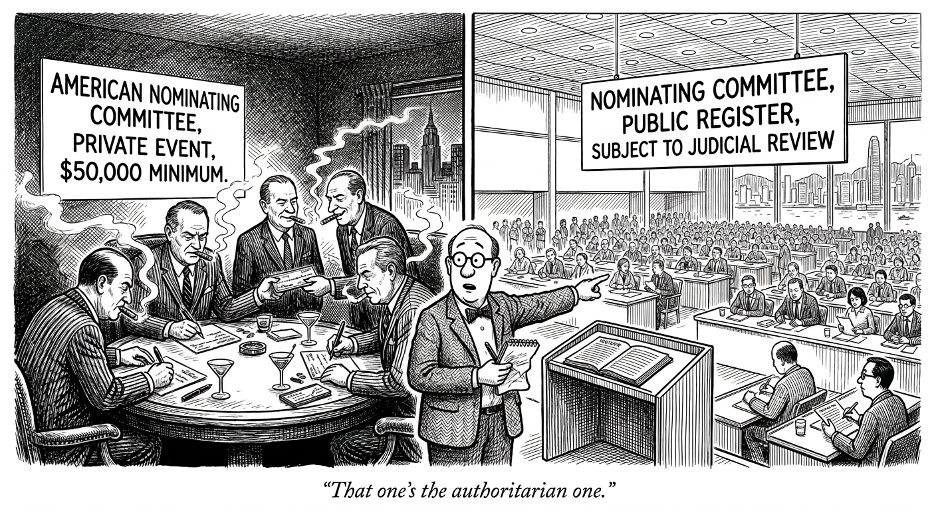
Under the proposal, a candidate needed the recommendation of 120 committee members, ten percent, to enter the race. The committee would then vote, and a candidate needed the endorsement of more than half, over 600 members, to become a finalist. Two or three finalists would go through. Then every eligible citizen in Hong Kong would cast a direct vote. One person, one vote. Most votes wins. The entire mechanism was codified in public statute, listed on a publicly accessible government register, and subject to judicial review.
Every democracy on earth filters its candidates before the public votes. In France, you need 500 signatures from elected officials across 30 departments. In the United States, you need hundreds of millions of dollars from a donor class concentrated in a handful of zip codes before a single primary ballot is cast. The Democratic National Committee argued in federal court that it is “not in the business of promoting democracy, but of promoting its brand.” Nancy Pelosi’s household traded millions in stocks of companies directly affected by legislation she had advance knowledge of. Congress passed the STOCK Act to prevent insider trading by its members and enforced it against virtually no one. The American primary system is a nominating committee. It does not call itself one. It meets behind closed doors. And the price of admission is beyond what any ordinary citizen can pay.
Hong Kong’s proposed system put the filter on a public register. The American system hides the filter behind private money in private rooms. The Western press looked at both and called Hong Kong’s the authoritarian one. They never explained the comparison, because the comparison would have ended the argument.
And before we go any further, let me correct something that the Western press never corrects because the correction would ruin the story.
The Chief Executive of Hong Kong is not the leader of a country. He is a mayor. Hong Kong is a city. It has 7.5 million people, no army and no foreign policy. The Chief Executive runs a municipal government. He oversees housing, transport, health, education, policing, land use, the same portfolio as the mayor of any major city anywhere in the world. When the Western press frames the selection of Hong Kong’s Chief Executive as though Beijing is installing the dictator of a sovereign nation, they are describing a city administrator and dressing it up as a geopolitical crisis.
And the mechanism they find so alarming, a leader chosen through an indirect process rather than a direct popular vote, is not unusual. It is not even unusual in America. Phoenix, the fifth-largest city in the United States, operates under a council-manager system where the actual chief executive, the city manager who runs day-to-day operations and oversees every department, is appointed by the council, not elected by the public. Dallas, San Antonio, Fort Worth, Austin, Charlotte, Las Vegas, San Jose, all council-manager cities, all running the same model: an elected council appoints the person who actually runs things. Over 3,300 American cities with populations above 2,500 use this system. In many smaller cities, the mayor is not even separately elected. The council picks one of its own members and hands them the title. Nobody calls this authoritarian. Nobody writes op-eds about democratic backsliding in Phoenix. The system is simply how local government works in much of America, and nobody outside a political science department has ever found it interesting enough to be outraged about.
And the idea that Beijing sits in some command center micromanaging Hong Kong’s bus routes and tax rates is a fantasy that reveals more about the person telling it than about the system they are describing. Beijing does not even micromanage the mainland. China’s governance structure has five tiers, from the central government down through provinces, prefectures, counties, and townships. At each level, local officials have broad discretion over policy implementation. A major study of two decades of Chinese policy data found that nearly sixty-three percent of all policies implemented at the prefectural level in any given year originated locally, from the bottom up, with no central government endorsement or involvement whatsoever.
Over the full period, eighty-two percent of policies in local government portfolios were locally initiated. Seventy-four percent spread entirely through horizontal diffusion between local governments and never involved any action by Beijing at all. Provincial, prefectural, and county-level authorities issue their own policy documents with binding force in their own jurisdictions. China’s system is not the top-down command structure the Western imagination insists it is. It is a layered bureaucracy where local officials are evaluated on local outcomes and given wide latitude to figure out how to get there. The old Chinese saying is that the mountains are high and the emperor is far away. The saying has survived because the observation it describes has survived.
If Beijing does not centrally direct housing policy in Chengdu or education policy in Hangzhou or economic development strategy in Shenzhen, the suggestion that it is sitting in Zhongnanhai dictating Hong Kong’s garbage collection schedule is not serious. Hong Kong operates under “one country, two systems.” It has its own legal system, its own tax code, its own currency, its own immigration controls, its own trade policy. The Basic Law guarantees a degree of autonomy that mainland cities do not have. The Chief Executive has more operational independence from Beijing than the mayor of Dallas has from the Texas state legislature.
Here is what you were also not told.
The Law That Was Always There
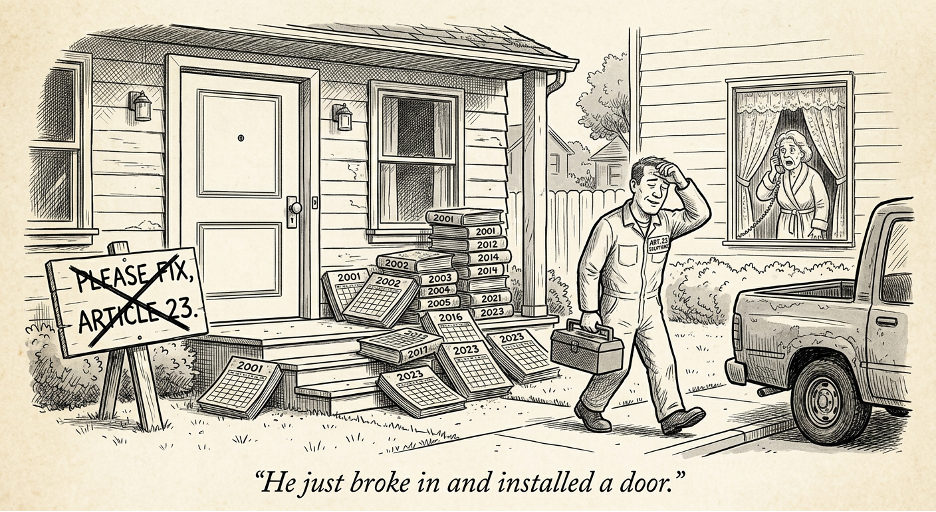
Article 23 of the Basic Law requires Hong Kong to enact national security legislation. The obligation is written in plain language. It has been there since 1990. For twenty-three years, the Hong Kong legislature failed to pass it. When Beijing stepped in with the National Security Law in 2020, the Western press called it an imposition. It was an imposition. It was also the fulfillment of a constitutional duty that Hong Kong’s own government had refused to discharge for more than two decades.
If a state government in the United States refused to implement a federal constitutional requirement for twenty-three years, the federal government would not send a polite reminder. It would act. It has acted, repeatedly, throughout American history, from Reconstruction to desegregation to the enforcement of voting rights. The principle is identical. The reaction from the press is not.
And the countries doing the loudest lecturing are not countries without national security laws of their own. The United States has at least twenty-one pieces of national security legislation on the books, including the Espionage Act of 1917, the Foreign Agents Registration Act of 1938, and the Foreign Intelligence Surveillance Act. Under 18 U.S.C. § 794, delivering defense information to a foreign government is punishable by death. Not fourteen years. Not life. Death. The United Kingdom passed its own National Security Act in 2023, a sweeping statute that criminalizes espionage with a maximum penalty of life imprisonment, foreign interference with up to fourteen years, and assisting a foreign intelligence service with up to fourteen years. Under that Act, in 2026, Chi Leung Wai and Chung Biu Yuen were convicted and sentenced to a combined eighteen years in prison for spying on Hong Kong dissidents in the UK on behalf of China. The irony did not make the editorial pages.
And then there is Singapore, the city Western commentators never stop comparing Hong Kong to, usually as evidence that a small, open, common-law Asian economy can thrive without Beijing’s interference. Singapore’s Internal Security Act, inherited from the British in 1960, grants the executive the power to detain anyone deemed a threat to national security without charge, without trial, and without time limit. Detention orders run for two years and are renewable indefinitely. There is no jury. There is no courtroom. The minister signs the order and you disappear. Chia Thye Poh, a former member of parliament whose crime was political opposition, was held under the ISA for twenty-three years without ever being charged, then subjected to nine more years of house arrest and restrictions on his movement, employment, and speech. Thirty-two years in total, longer than Nelson Mandela. In 2021, Singapore passed the Foreign Interference (Countermeasures) Act, which Reporters Without Borders called a “legal monstrosity with totalitarian leanings,” granting the government sweeping powers to issue content removal orders, account restrictions, and access blocks against anyone deemed to be conducting foreign interference. In 2019, it passed the Protection from Online Falsehoods and Manipulation Act, under which the government can order corrections or removals of online content it deems false, and has used it against opposition politicians, journalists, and academics. As recently as 2026, Singapore detained teenagers as young as fourteen under the ISA, without trial. Hong Kong’s National Security Law, the one that launched a thousand editorials and a congressional hearing, requires actual charges, an actual trial, an actual courtroom, and an actual verdict. Singapore’s does not. The Wall Street Journal’s editorial board has never run a series on that.
On September 2, 2026, the same day Joshua Wong pleaded guilty in a Hong Kong courtroom, an American journalist named Thomas Weir Pauken II was sentenced to two years in a federal prison in Washington for acting as an unregistered agent of the Chinese government. Pauken had worked as a journalist for CCTV and Xinhua. The Department of Justice said he received at least $100,000 from a handler connected to the Ministry of State Security. His crime, stripped to its legal essentials, was working for a foreign government’s media apparatus and accepting money from its intelligence service without telling the Attorney General. The United States imprisoned a journalist for accepting foreign money and producing content aligned with a foreign government’s interests. Nobody in the Western press called it a crackdown on press freedom. Nobody convened a panel. Nobody issued a joint statement.
Meanwhile, the Hong Kong Free Press operates openly in Hong Kong, funded overwhelmingly by overseas donations from readers in the United States, the United Kingdom, and Australia. It has received funding from Google. It publishes critical coverage of the Hong Kong government daily, under its own masthead, from an office in Kennedy Town. No journalist at HKFP has been arrested. No editor has been charged. No donor list has been seized. The authoritarian state has not touched it. The democratic one jailed Pauken.
The maximalists calculated badly. They rejected the 2014 proposal and got nothing. They escalated in 2019, threw over a thousand Molotov cocktails, shut down the airport, stormed the Legislative Council, raised colonial flags, and gave Beijing every justification it needed to impose the National Security Law. The people who promised that principled refusal was better than pragmatic acceptance delivered precisely the outcome they claimed to be fighting against. The city that in 2014 was offered a meaningful path toward greater democracy now has less democratic participation than it had before the maximalists began their campaign.
And the people who suffered the consequences were not the maximalists who fled to London to give interviews. They were the nurse in Kwun Tong, the teacher in Sha Tin, the shop owner in Mong Kok.
Joshua Wong pleaded guilty on September 2, 2026. Conspiracy to collude with foreign forces. He confirmed, in open court, on the record, that he and Nathan Law conspired to lobby foreign governments to impose sanctions, blockades, and other hostile measures against Hong Kong and China. He testified before the US Congressional-Executive Commission on China in 2019 in support of the Hong Kong Human Rights and Democracy Act. That Act was the legal trigger for Executive Order 13936, which revoked Hong Kong’s special trade status. Goods manufactured in Hong Kong were suddenly required to be labeled “Made in China.” Export license exceptions were suspended. Financial institutions across the city faced elevated compliance costs. Small manufacturers had to relabel every product. Trade companies saw their export licensing double in complexity overnight.
None of it hurt Beijing. Capital flows adjusted. The national emergency underlying the Executive Order was allowed to lapse in July 2026 because the sanctions had accomplished nothing against their supposed target. But for the ordinary people of Hong Kong, the damage was real. Wong asked a rival superpower to punish seven and a half million people. The superpower obliged. The punishment missed its target and landed on the bystanders. And Wong confirmed the whole thing in open court.
He is not a hero. He is a man who helped kill five million votes in the name of democracy and then asked a foreign government to sanction the people he had just disenfranchised.
The Byline Is the Rebuttal
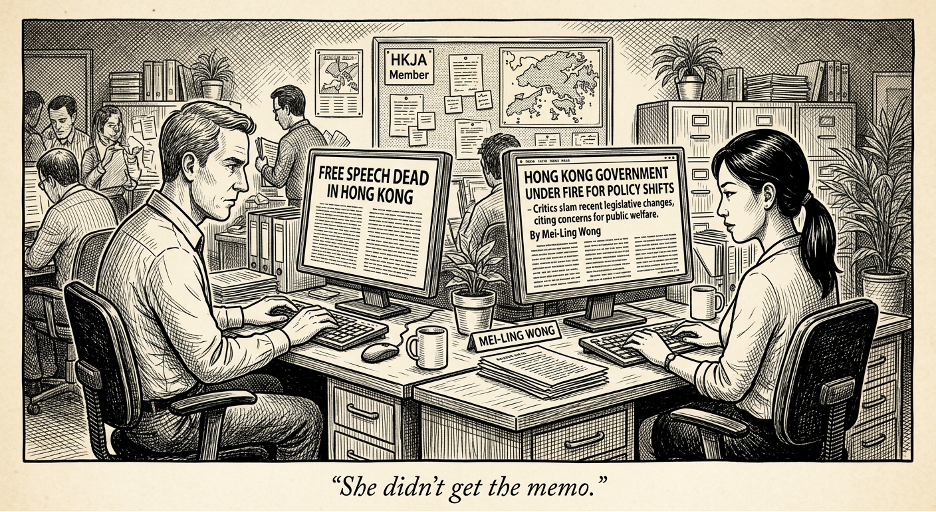
The journalists who tell you free speech is dead in Hong Kong are still filing from Hong Kong. Under their own names. On the open internet. Nobody is stopping them. Nobody is censoring the copy. The byline is the rebuttal. Reuters maintains a full bureau in the city, one of its largest in Asia. So does the Associated Press. So does AFP. Bloomberg runs a massive operation out of Hong Kong, hundreds of journalists and terminals, covering everything from IPO filings to courtroom proceedings. The Wall Street Journal, the New York Times, the Financial Times, the Washington Post, the Guardian, CNN, and the BBC all maintain correspondents or bureaus in the city. The South China Morning Post publishes daily, in English, with opinion columnists who regularly criticize government policy. These reporters attend every national security trial. They live-tweet proceedings. They quote defendants. They interview defense lawyers on the courthouse steps. They file stories using phrases like “Beijing-imposed national security law” and “crackdown on dissent” from desks in Wan Chai and Admiralty, and not one of them has been arrested for it, deported for it, or had a story spiked. Hong Kong-datelined copy critical of the government runs every single day, across every major wire service, in every major English-language outlet on earth. The framing is not friendly. The adjectives are not kind. And it publishes, without interference, from inside the city the copy describes as unfree.
The departing judges are supposed to be the next piece of evidence. Seasoned jurists walking away, proof that the system is broken. But think about what that argument actually requires you to believe. It requires you to believe that judges who spent entire careers defending judicial independence decided the proper response to independence under threat was to abandon it. That is not a story about courage. That is a story about resignation dressed up as principle. And it falls apart on its own terms. Lord Lawrence Collins, one of the British judges who resigned in 2024, told the press he was leaving because of the political situation in Hong Kong, then said in the same breath that he continues to have the fullest confidence in the court and the total independence of its members. Read that again. The man cited as proof the courts are compromised is on the record saying the courts are independent. Nobody profiles that part. It does not fit the narrative. And it leaves out the judges who stayed, still sitting on Hong Kong’s bench, still hearing cases, still ruling against the government when the law demands it.
Meanwhile, American courts keep sending cases to China and Hong Kong, on the explicit finding that those legal systems are adequate. In 2024, Judge Kelley Brisbon Hodge, an Obama appointee in the Eastern District of Pennsylvania, dismissed a RICO and fraud case against AstraZeneca on forum non conveniens grounds, finding China to be an adequate alternative forum. The plaintiffs included an American subsidiary. The court did not even reach personal jurisdiction. It simply found that China’s courts could handle the dispute and sent the case there. In July 2025, Justice Margaret Chan of the New York Supreme Court’s Commercial Division dismissed fraud and conspiracy claims on forum non conveniens grounds, finding that “all of the key misrepresentations and transactional details” occurred in Singapore, Hong Kong, and Korea. A New York judge looked at fraud allegations involving Hong Kong and told the plaintiff to go litigate there.
Then, also in 2024, Judge Patti Saris, a Clinton appointee recommended by Ted Kennedy and John Kerry, former Chief Judge of the District of Massachusetts, Obama’s pick to chair the US Sentencing Commission, and the judge who mentored a young law clerk named Ketanji Brown Jackson, dismissed an American employee’s claims against his American employer, finding Hong Kong to be the more appropriate forum. The First Circuit affirmed. A sitting American judge, with impeccable liberal credentials and a direct line to the Supreme Court through her own protégé, looked at Hong Kong’s legal system and told an American citizen suing an American corporation that Hong Kong’s courts are perfectly capable of resolving his dispute, at the exact moment the State Department was telling the world the opposite.
Behind all of them sits the Supreme Court itself. In Sinochem, Justice Ginsburg wrote for a unanimous court affirming a forum non conveniens dismissal in favour of Chinese courts, describing the lower court’s assessment of China as an adequate forum as “well-considered.” Federal courts have since consistently rejected arguments that Chinese courts are inadequate, dismissing as speculative the claim that Chinese courts are susceptible to government influence. If free speech and the rule of law are dead in Hong Kong and China, why do American judges, across circuits, across decades, across administrations, keep telling American citizens and American corporations to go seek justice there?
Through every crisis since 1997, the same thing happened. The people of Hong Kong went to work. They rode the MTR. They picked up their children from school. They ate dinner together. When SARS hit in 2003, the city buried its dead and carried on. When the Global Financial Crisis cratered the world economy in 2008, Hong Kong recovered faster than most Western economies. When the protests of 2019 shut down the airport, seven million people woke up the next morning and carried on. In the first half of 2026, Hong Kong’s GDP grew 5.1 percent, the strongest half-yearly performance in five years. Unemployment sits at 3.7 percent. The IMD ranked Hong Kong the second most competitive economy in the world, its highest showing in seven years. IPO fundraising surged 154 percent.
The eulogy keeps running. The patient keeps outperforming the doctors.
The Same Story, Told Again
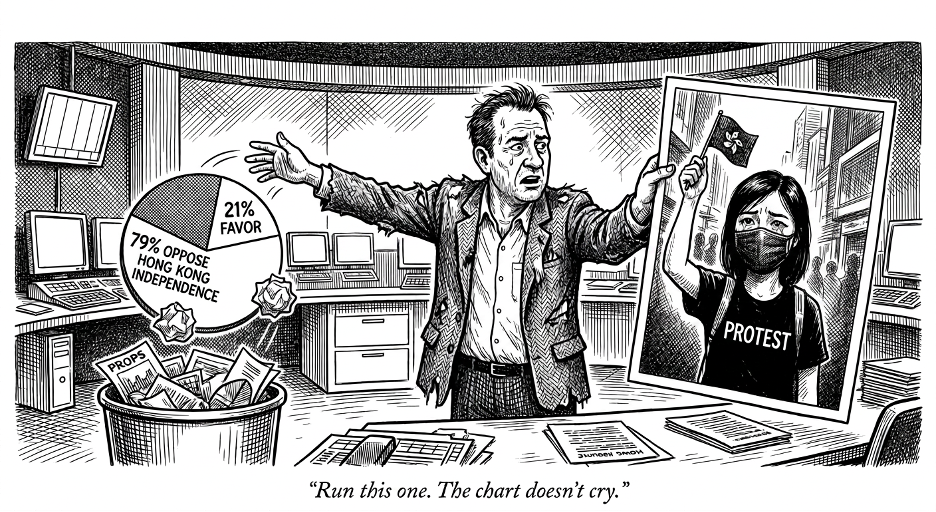
The Western media spent years telling you that Hong Kong was a city yearning to break free, that its people wanted independence. Support for independence has never exceeded 21 percent in any major survey. The overwhelming majority want stability, autonomy under One Country, Two Systems, and the ability to live their lives.
Now the same media is telling you the same story about Taiwan. And the polling, once again, is telling a different story.
In April 2026, the MyFormosa poll cracked the Western consensus wide open. The poll did not show that Taiwan unanimously wants reunification. Other polls in the same period show strong opposition to One Country, Two Systems as currently understood, and majority rejection of the “one China principle” as Beijing defines it. I will not pretend the data points in one direction. It does not. What the MyFormosa poll showed is something the Western narrative cannot accommodate: that the story of unanimous Taiwanese rejection of any engagement with Beijing is false.
Twenty-two point four percent of Taiwanese said they could accept becoming a province or special region of China to avoid war. Of those, 5.2 percent fully accepted the idea and 17.2 percent said they could more or less accept it. That is more than four million people. The figure is not surging. It has actually declined from 28.4 percent in 2022 and 24.8 percent in 2024. But the point is not the trend line. The point is that roughly one in five citizens, answering a pan-green-leaning pollster’s question, said yes, and the Western narrative has no room for them.
A separate TVBS poll conducted in the same month found that 66 percent of Taiwanese support resuming negotiations with the mainland. Only 19 percent opposed. Even among DPP supporters, opinion was nearly split: 45 percent in favor, 44 percent against. Among opposition supporters, 90 percent favored engagement.
Read those numbers again. Two-thirds of the island wants to talk.
A poll released by the Taipei-based Democracy Foundation found that nearly 60 percent of respondents support taking the initiative to engage in peace talks with the mainland. When asked whether proactively pursuing peace through political negotiations amounted to surrender, only 17.6 percent agreed. By contrast, 57.4 percent described it as “survival wisdom” to protect lives and property. A National Development Foundation poll from May found that opposition to the “one China principle” as a precondition for talks had fallen to 58 percent, down from between 72 and 77 percent in surveys conducted from 2019 to 2023. Acceptance had risen to 25.8 percent, the second highest level in the survey’s ten-year history.
And when asked whether the United States would send troops to defend Taiwan in a conflict, the Democracy Foundation poll found that 57 percent said no. Confidence in American-made weapons was equally low: 49 percent lacked faith in their defensive capability. The American security guarantee, which has been the foundation of Taiwan’s strategy for decades, is no longer believed by a majority of the people it is supposed to protect.
Other polls tell a different story on some of these questions. The same MyFormosa poll that recorded the 22.4 percent found 68.2 percent rejecting unification outright. A Mainland Affairs Council survey from March 2026 found 84.7 percent of respondents favor maintaining the status quo in some form, with opposition to unification rising to 61.7 percent. A Taipei Times report from July 2026 showed that trend continuing. I am not hiding the counter-data. I am telling you that the Western narrative, which treats Taiwanese opinion as monolithic, as a unanimous chorus rejecting any engagement with the mainland, is a fabrication. The reality is that a significant minority is pragmatic about engagement, a clear majority wants dialogue, and confidence in the American security guarantee has collapsed. That is the story the West is not telling you, because telling you would complicate the sale.
The Sale
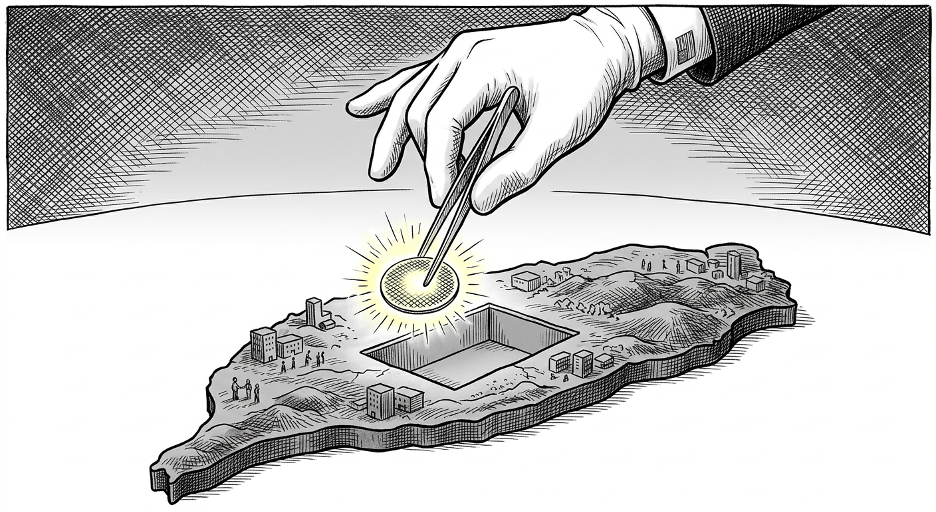
And the sale is very, very lucrative.
The United States is not defending Taiwan out of principle. It is extracting Taiwan’s most valuable strategic asset and relocating it to Arizona.
TSMC, Taiwan Semiconductor Manufacturing Company, produces the overwhelming majority of the world’s most advanced chips. It is the single most strategically valuable industrial asset on earth. And TSMC has committed $265 billion in US investment, including an additional $100 billion announced in mid-2026. The US Commerce Department called it the largest foreign direct investment in a greenfield project in American history.
The United States looked at Taiwan’s most valuable possession, the thing that makes the island indispensable to the global economy, the thing Taiwan’s leaders call the “silicon shield,” and it did not promise to defend the shield. It moved the shield to Phoenix. And it made TSMC pay for the pleasure.
Once the fabs are built, once the most advanced chip production is replicated on American soil, Taiwan’s leverage disappears. The “silicon shield” becomes a silicon artifact, a reminder of what Taiwan used to have that made the world care. And the security guarantee, which was never a guarantee to begin with, will be worth exactly what guarantees are always worth when the asset has already been extracted: nothing.
The United States hedges its bets. It always hedges its bets.
It used the Kurds and abandoned them. It used the Afghans and abandoned them. It used the Iraqis who rose up in 1991 and watched from a distance while the uprisings were crushed. It signed the Budapest Memorandum promising Ukraine that its sovereignty would be respected in exchange for surrendering its nuclear weapons, and then stood aside when those borders were violated. It backed a military dictatorship in Taiwan for forty years, a regime that executed thousands in the White Terror and massacred between 18,000 and 28,000 civilians in the February 28 Incident of 1947, and called it Free China. America signed a Mutual Defense Treaty with Taiwan in 1954, right in the middle of the White Terror. American military aid flowed to a government that was executing its own citizens for political speech. The concern for democracy arrived at the exact moment Beijing became involved. That is not a coincidence.
It used Joshua Wong. He testified before Congress. Congress passed the Hong Kong Human Rights and Democracy Act. The sanctions hit ordinary people and missed Beijing entirely. The national emergency was allowed to lapse in July 2026. Wong confirmed the whole thing in open court. He went to jail, the press called him a hero and the United States moved on.
The Pattern
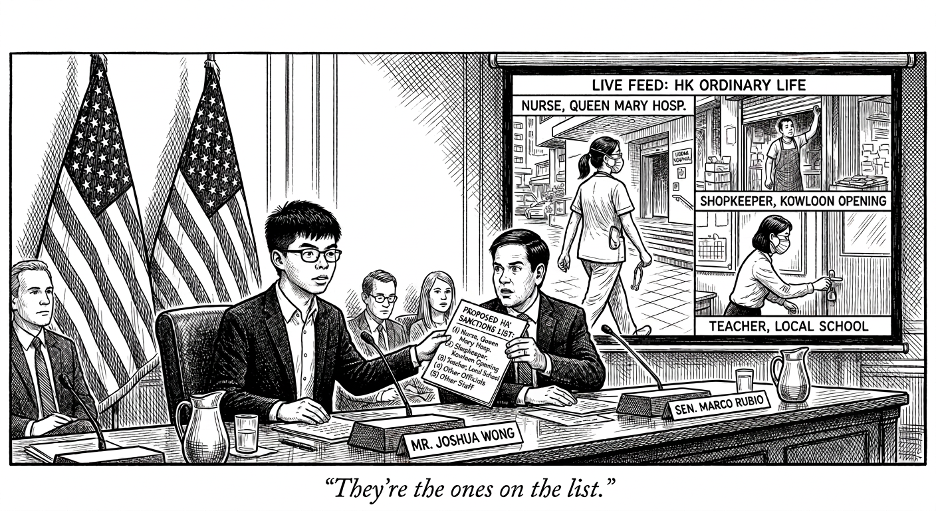
The pattern is consistent. The logic is implacable. America uses people. And when the cost of keeping the promise exceeds the value of the asset, the promise evaporates. The people who relied on it discover what assurances are worth when the circumstances change.
Taiwan’s semiconductor industry is a melting ice cube. Every new fab in Arizona, every advance in Korean or Japanese manufacturing, every step toward American chip independence diminishes the calculus that makes Taiwan indispensable. The shield protected Taiwan when the world had no alternative to Taiwanese chips. What protects Taiwan when alternatives exist?
Taiwan can negotiate now, from a position of relative strength, while its chips still matter, while the US still has interest in the outcome, while Beijing still values peaceful resolution. Or Taiwan can wait, watch its leverage erode year by year, and eventually face outcomes far worse than anything negotiation could produce. A Taiwan that negotiates in 2035 will secure worse terms than a Taiwan that negotiates today. And a Taiwan that waits until negotiation is no longer possible will secure no terms at all.
The societies lecturing Hong Kong and Taiwan about governance have lost common sense on a scale that would be comic if the consequences were not exported to other people’s cities.
Paine warned that “a long habit of not thinking a thing wrong gives it a superficial appearance of being right, and raises at first a formidable outcry in defense of custom.” Consider who is doing the lecturing. Two of the last five American presidents took office without winning the popular vote. The United States Congress has a 15 percent approval rating. Eighty-three percent of Americans, including 71 percent of Democrats and 76 percent of Black voters, support requiring photo identification to vote. Congress will not pass it. Three quarters of a million Americans were homeless on a single night in January 2025, a 28 percent increase since the pandemic, and 266,000 of them were sleeping outside. Members of Congress trade stocks in companies they regulate, and the institution that cannot pass a voter ID law supported by four out of five of its own citizens, in a country that twice this century handed its presidency to the loser of its own election, presumes to lecture Hong Kong on governance.
In August 2026, Jason Arday was found dead in the United Kingdom. He had been a Cambridge University sociology professor, celebrated as an inspiration, a Black academic who overcame autism and a learning disability to become one of the youngest professors in Cambridge’s history. The Western media built him into a symbol. Institutions showered him with awards. His work was cited, promoted, held up as proof that the system elevated merit.
The stories he told were extraordinary. He said he was mute until eleven, illiterate until eighteen. He said he ran thirty marathons in thirty-five days and finished the last nine on a fractured leg. He said he raised five and a half million pounds for eighty charities, though the only verifiable fundraising record anyone could find was a JustGiving page that collected six thousand pounds. He said he volunteered with WaterAid installing water pumps in the favelas of Rio de Janeiro. WaterAid said it does not send volunteers abroad. He told a government minister that someone mailed a severed pig’s head to his parents’ home and that police traced it to a south London butcher. The police told the Guardian categorically that no such investigation took place. The butcher had no recollection of selling a pig.
He claimed masked men threatened him twice on the Cambridge campus, the second time at knifepoint. The building’s CCTV caught nothing. No staff reported seeing anyone. In his book proposal, he described spending three months in a coma after a car accident, conscious the entire time with locked-in syndrome, while doctors urged his parents to switch off life support. The coma did not appear in the finished memoir. Neither did the testicular cancer he mentioned in the same proposal. He said he had brain surgery weeks before defending his PhD, suffered a stroke that erased his memory, and relearned his entire thesis just in time for the oral examination. The Washington Free Beacon reviewed his memoir and found that key biographical claims bore remarkable similarity to storylines from Forrest Gump, the Rocky franchise, Spartacus, and his favourite soap operas. He compared himself to Forrest Gump in the text. Simon & Schuster paid him a reported 1.4 million pounds. The media profiled him for years. Nobody checked.
Then his published work was revealed to be substantially plagiarized. He resigned from Cambridge. A voice note sent hours before his death said he “couldn’t go on.” The institution that built him up had never checked the work. The media that celebrated him had never read the papers. The system that elevated him as proof of its own virtue had no mechanism for verifying that the virtue was real. When the fraud was exposed, the same system that created the pressure walked away.
The same month, a Hong Kong court convicted Chow Hang-tung, another Cambridge graduate, of inciting subversion. Western media made her a symbol too, the courageous barrister standing alone against authoritarianism. The awards arrived before the verdict did. The Franco-German Prize for Human Rights and the Rule of Law. The Gwangju Prize for Human Rights from South Korea. The CCBE Human Rights Award from the Council of Bars and Law Societies of Europe. Amnesty International designated her a prisoner of conscience. Members of the United States Congress, including Marco Rubio and Jeff Merkley, nominated her for the Nobel Peace Prize alongside Joshua Wong and Jimmy Lai. Cambridge University Amnesty International wrote open letters. International legal bodies issued joint statements. The narrative was clean, familiar, ready-made.
Nobody paused to examine the legal substance of what she was actually advocating. The Hong Kong Alliance’s five action agendas included “end one-party dictatorship” and “construct a democratic China.” The court found, and the defence did not seriously dispute, that “ending one-party dictatorship” meant removing the Chinese Communist Party’s constitutionally enshrined leadership role. Her own defence counsel called it an “empty slogan” with no concrete plan. The court acknowledged the Alliance had never used or advocated violence. It convicted her because the goal itself, stripping a ruling party of its constitutional authority, is not something anyone has a legal right to do, in China or anywhere else. No democratic country on earth permits an organised campaign to dismantle its constitutional order and calls it protected speech. The institution that trained her, the media that lionized her, the foreign governments that cited her case in press releases, none of them engaged with the law. They engaged with the symbol. And, as will be described more fully below, when the symbol required ignoring the UN Charter, the Joint Declaration, the Basic Law, and the settled international legal consensus on self-determination, they ignored all of it without blinking.
That is not two stories. That is one story. A culture that has replaced verification with narrative, that values the symbol over the substance, and that destroys the people it uses as props when the prop breaks.
Consider the Narrator
Now consider who is telling this story. Consider the narrator.
In the United States, 59 percent of Americans lack enough savings to cover an unexpected $1,000 emergency. The middle class has shrunk from 61 percent of the population in 1971 to 50 percent. Student loan debt exceeds $1.7 trillion. Medical debt is the single largest cited driver of personal bankruptcy. At the macro level, the national debt has crossed $40 trillion, representing over $118,000 for every man, woman, and child in the country, or nearly $280,000 per taxpayer, as interest payments on the sovereign debt outpace defense spending. A Supreme Court where justices accept luxury travel and gifts from billionaires with cases before the bench. Public trust in the federal government hovering near historic lows. And on January 6, 2021, supporters of the losing presidential candidate stormed the Capitol to overturn the result of a democratic election.
These are the people lecturing Hong Kong about governance. These are the people telling Taiwan to stand firm.
Tiananmen Square was June 4, 1989. Thirty-seven years ago. It is closer in time to the presidency of John F. Kennedy than it is to today. Nobody denies what happened. But the people who invoke it as a permanent lens through which to judge modern China are performing the same trick as someone who insists the United States is still the country that had separate water fountains for Black people in 1955. Countries move. Institutions reform. Economies restructure. Populations turn over.
China has a fifty-year planning horizon. Hong Kong operates on five-year development cycles. Both are oriented toward the same objective: improving the material conditions of their citizens’ lives. The United States has a four-year plan, and it is not a plan at all. It is an election. Every four years the machinery resets, the priorities reverse, and the national conversation reduces to a single question: who wins. Not how to build. Not how to lift. How to win. And winning, in American politics, requires division. You do not mobilize a base by uniting a country. You mobilize it by splitting one. That same playbook was exported to Hong Kong, where a generation of young people were encouraged to see their own city as occupied territory, their own economy as a cage, their own future as something that required an American-style revolution to unlock. The division did not liberate them. It cost them years.
The Beijing of 2026 runs the world’s largest high-speed rail network, more than 50,000 kilometers and still growing. It put a rover on the far side of the moon. It lifted over 800 million people out of poverty in four decades, the single largest reduction in human misery in recorded history. Its universities now produce more STEM graduates annually than the United States and Europe combined. None of that excuses 1989. But treating a thirty-seven-year-old tragedy as though it is a current policy document, while ignoring everything that followed, is not analysis. It is a coping mechanism for people who cannot accept that the world moved on and they did not.
The United States of 1989 had a $5.6 trillion GDP. Today it is north of $30 trillion. Nobody judges America in 2026 by the savings-and-loan crisis. Nobody uses the Rodney King beating as a summary of modern American policing, though they could make a case. Countries get the courtesy of being evaluated in the present tense, unless they are China, in which case a single week in 1989 is treated as a permanent character reference.
This is the part where someone calls me a CCP apologist. Or says I am paid by the Liaison Office. Or types “shill” into a comment box and moves on with their afternoon, confident they have contributed something to the discourse.
These are not arguments. They are reflexes. Media lines repeated by people who have never read a primary source, never been inside a courtroom, never had to defend a position under cross-examination. They are the intellectual equivalent of a bumper sticker.
I studied constitutional law at Boston University. I was taught by the likes of Archibald Cox, the man Nixon fired for refusing to stop investigating Watergate. I sat in classrooms with professors who marched in the civil rights movement, who drafted briefs that dismantled segregation, who believed the law was a weapon the powerless could use against the powerful. That is the tradition I come from. That is the lens I carry.
I have spent the better part of my professional life fighting another kind of tyranny, the kind that wears a suit and files quarterly earnings reports. Corporate power. The slow, invisible compression of ordinary people by institutions that answer to no one and purchase the laws that regulate them. I did not arrive at my views on China, or Hong Kong, or Western hypocrisy because someone handed me a script. I arrived here because I was trained to read the law, follow the money, and ignore the performance.
So when someone with no legal training, no background in comparative governance, no experience in this city, dismisses a detailed argument with two words and a hashtag, understand what is actually happening. They are not rebutting anything. They are constitutionally illiterate and telling you they have nothing left.
Meanwhile, Hong Kong posted 5.1 percent real GDP growth in the first half of 2026, its strongest half-yearly performance in nearly five years. It reclaimed the number-two global spot for IPO fundraising behind only Nasdaq, officially overtook Switzerland as the largest cross-border wealth management hub on the planet, and landed second in the IMD’s global competitiveness rankings. Unemployment sits at a low 3.7 percent. The government budget is back in surplus, with fiscal reserves standing at HK$646 billion. Debt-to-GDP remains under 15 percent, while America’s passes 123 percent. The Northern Metropolis, three hundred square kilometers of development along the Shenzhen border, is no longer a planning document. It is an active construction site. The numbers are not close. They are not in the same conversation.
There is a genre of Western commentary, very popular at cocktail parties and on the opinion pages, that treats the collapse of the Chinese Communist Party as a thing to be desired, planned for, maybe even accelerated. I want to be precise about what these people are actually advocating, because I do not think most of them have thought it through. China is the world’s largest manufacturer. It is the second largest economy on earth. It holds over seven hundred billion dollars in US Treasury bonds. Political instability in China would make the Strait of Hormuz closing look like a dock strike in New Jersey. You would not be talking about oil prices. You would be talking about whether the shelves at Walmart have anything on them, whether American interest rates double overnight, whether the global financial system as currently constructed continues to exist. That is not hyperbole. That is arithmetic.
Western consumers virtue-signal about China while wearing clothes made in China, typing on phones assembled in China, living in houses financed by Chinese bond purchases. Chinese manufacturing made the American standard of living possible for working families who could not have afforded it otherwise. Chinese students paying full tuition subsidized American universities so that American kids could attend at a discount. Chinese investment in US Treasury bonds kept interest rates low and mortgages affordable for an entire generation of American homeowners. The economic reality makes the political posturing absurd. The person tweeting “Free Hong Kong” from an iPhone manufactured in Shenzhen, wearing a shirt sewn in Guangdong, is performing solidarity with one hand and paying the bill with the other.
Both Hong Kong and Taiwan are economically integrated with China. China provides products the world depends on. Sever that connection and you do not liberate anyone. You impoverish them.
The people of Hong Kong know this. The business owners in Kwun Tong know this. The traders in Tsim Sha Tsui know this. The family that sells you noodles at the dai pai dong knows this. The people who live in this city understand economic gravity in a way that think tank fellows in Washington, whose salaries are paid by defense contractors, do not.
And while we are dismantling narratives, let us dismantle the biggest one. The word “communist” does more heavy lifting in Western coverage of China than any other single term in geopolitics. It conjures central planning, grey apartment blocks, and an economy run by ideology rather than markets. The image is useful. It is also about forty years out of date.
China has the second largest economy on earth. It has two major stock exchanges, the Shanghai and the Shenzhen, with a combined market capitalization north of ten trillion dollars. It has more billionaires than any country except the United States, somewhere north of 470 at last count, according to Forbes. Its consumer class buys more cars, more luxury goods, and more smartphones than any other population on earth. BYD, Huawei, Temu, Shein, these are not the products of a command economy. They are the products of a ferociously competitive capitalist system operating at a scale the West has never seen. Call it state capitalism, call it socialism with Chinese characteristics, call it whatever makes the taxonomy feel tidy. What you cannot honestly call it is communist in any sense that word carries in the Western imagination. The people who use the word know this. They use it anyway, because the word does not describe China’s economy. It describes the feeling they want you to have about China.
And then there is what the system actually delivers to the people who live inside it.
In Hong Kong, a night in a public hospital costs HK$300. That is about thirty-eight US dollars. For a full day of inpatient care, the ward, the meals, the medication, the nursing, everything. An accident and emergency visit is HK$400, about fifty-one dollars, and if you are triaged as critical or emergency, the fee is waived entirely. The government caps total annual public healthcare spending at HK$10,000 per patient, roughly twelve hundred US dollars, meaning that no matter what happens to you, no matter how long the treatment, the most you will ever pay in a calendar year is less than most Americans pay for a single ambulance ride. Government-aided primary and secondary schools are free for twelve years. A full year of tuition at the University of Hong Kong, one of the top-ranked universities in Asia, costs local students around HK$47,000, roughly six thousand US dollars. A six-pack of Beijing Beer from the Kaibo downstairs costs about a dollar fifty. Hong Kong has zero tax on alcohol. No federal excise, no state excise, no sin tax, nothing.
Now think about what those same things cost in the country that wants to tell Hong Kong how to govern itself. The average hospital stay in the United States runs over twenty-eight hundred dollars per day. A four-year degree leaves the average American graduate more than thirty thousand dollars in debt, and a private university will triple that number. Medical bankruptcy is one of the leading causes of personal bankruptcy in America. The concept does not exist in Hong Kong. The phrase would not even make sense here. You can walk into a hospital, get treated, walk out, stop at the corner store for a six-pack on the way home, which in Chicago or New York runs you at least ten, eleven dollars after tax, and still have spent less than an American spends on a copay.
Hong Kong is a city that gives back. The government runs surpluses and returns them to residents. Healthcare is virtually free at the point of service. Education is funded. The government will pay me to return to school if I so desire. Public housing shelters nearly half the population. The MTR works. The streets are safe. You can walk home at three in the morning in any neighborhood in the city and the most dangerous thing you will encounter is a taxi driver who wants to take the long route. This is not a system that people need to be rescued from. This is a system that most Americans, if they understood it, would be asking how to replicate.
The Legal Record
And here is the part nobody in the Western narrative wants to discuss, because it collapses the moral architecture of the entire argument.
Neither Hong Kong nor Taiwan has a right to self-determination under international law. Not as that term is understood in the UN Charter, not as it has been applied by the International Court of Justice, not as it exists in any binding legal instrument on earth.
The right to self-determination in international law is primarily a decolonization right. It applies to peoples under colonial or foreign domination seeking to establish their own sovereign state. It does not confer an automatic right to secession from an existing sovereign state. The counterbalancing principle, territorial integrity, is written into the same documents, the same resolutions, the same charter. The 1970 Declaration on Friendly Relations, General Assembly Resolution 2625, adopted unanimously, states explicitly that nothing in the principle of self-determination shall be construed as authorizing or encouraging any action which would dismember or impair the territorial integrity or political unity of a sovereign state. The ICJ’s 2010 advisory opinion on Kosovo, the strongest case secession advocates have ever had, did not establish a general right to secede. The Court said explicitly that the question of whether there exists a right of unilateral secession was beyond the scope of its opinion. It went out of its way not to say it.
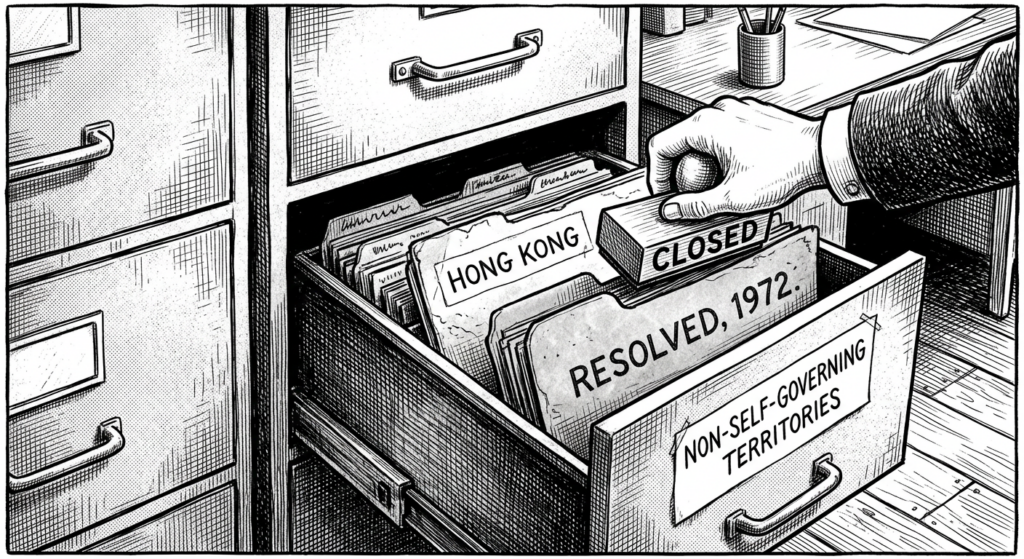
Hong Kong was a British colony. It was decolonized. The mechanism of decolonization was return to China, not independence. In 1972, the United Nations itself removed Hong Kong from its list of Non-Self-Governing Territories at China’s request, meaning the UN determined that Hong Kong’s path to decolonization ran through Beijing, not through a separate independence referendum. The Joint Declaration was negotiated between Britain and China, registered with the United Nations, and executed on July 1, 1997. The Basic Law is the constitutional settlement. One Country, Two Systems is the framework. Hong Kong’s decolonization is complete. There is no residual colonial status that activates a self-determination claim.
Taiwan’s situation is different in detail but identical in legal outcome. UN General Assembly Resolution 2758, adopted October 25, 1971, recognized the People’s Republic of China as the only lawful representative of China to the United Nations and expelled the representatives of Chiang Kai-shek. Today, twelve countries recognize Taiwan diplomatically. One hundred and eighty-one do not. The United States itself does not recognize Taiwan as an independent state. It has not done so since January 1, 1979, when it signed the Joint Communiqué on the Establishment of Diplomatic Relations, recognizing the PRC as, in the State Department’s own published language, “the sole legal Government of China,” and acknowledging “the Chinese position that there is but one China and Taiwan is part of China.” Every American president since Carter has maintained that position. The United States does not have an embassy in Taipei. It has an “institute.” The diplomatic choreography is precise because the legal reality is precise.
The international legal consensus is not ambiguous. It is not contested at the level of binding law. It is not a close call. The people who frame Hong Kong and Taiwan as territories with an inherent right to choose independence are not making a legal argument. They are making a wish. And wishes, however sincerely held, do not override the UN Charter, the General Assembly, the Security Council, the Joint Declaration, the Basic Law, three joint communiqués, and the diplomatic recognition practices of 181 sovereign states.
Any so-called learned man who tells you otherwise is lying. Not mistaken. Not offering a nuanced alternative reading. Lying. The instruments are public. The resolutions are numbered. The communiqués are published on the State Department’s own website. The ICJ opinion is available in full text to anyone with an internet connection. There is no ambiguity to hide behind, no unresolved doctrinal question to exploit, no gap in the record wide enough to fit an honest disagreement through. A first-year law student with a library card can verify everything in the preceding paragraphs in an afternoon. When a tenured professor or a senior fellow or a former ambassador tells you that Hong Kong or Taiwan has an inherent legal right to independence, they are not interpreting the law. They are counting on you not to read it.
And while we are being honest about what words actually mean, let us be honest about the nominating committee. When Western commentators said Beijing’s proposed electoral framework would act as a “rubber stamp,” when they said the nominating committee would screen candidates, what they meant, stripped of the diplomatic packaging, is that the committee would not approve a candidate who ran on a platform of independence for Hong Kong. That is what the outrage was about. Not democracy in the abstract. Not the mechanics of voting. The specific, concrete objection was that Hong Kong people would not be allowed to elect someone whose explicit agenda was to sever the city from China. Which, as we have just established, no one has a legal right to do, and which 79 percent of Hong Kongers oppose. The nominating committee was not designed to prevent democracy. It was designed to prevent secession dressed up as democracy. And the difference between those two things is the difference between the story you were told and what actually happened.
Common Sense
And so the argument arrives where it was always going.
You claim to care about Hong Kong. You claim to support its people. The people of Hong Kong have told you, in poll after poll, year after year, that they do not want independence. They did not ask Joshua Wong to testify before Congress. They did not ask Marco Rubio to sponsor legislation stripping their city of its trade advantages. They certainly do not wish to be sanctioned by the Untied States. They want stability. They want One Country, Two Systems to work. They want to go to work and raise their families and carry on. They have said so, repeatedly, to anyone willing to listen.
You claim to care about Taiwan. The people of Taiwan, in the MyFormosa poll and others, have told you that a significant and growing share of their population wants to negotiate, wants to discuss the future honestly, doubts the American security guarantee, and rejects the isolation that maximalism produces. Seventy-five percent support active negotiation. The generation you expected to be the most pro-independence is the generation most open to alternatives.
Are you listening to them?
Or are you listening to the fraction that speaks English, fits the narrative, and serves a geopolitical purpose that has nothing to do with the people who actually live in these places?
Because if you are not listening to the majority, you are not supporting democracy. You are performing it. You are using the people of Hong Kong and Taiwan as extras in a production staged for an audience that will never live with the consequences.
That is not solidarity. That is colonialism with a rebrand.
Beijing did not kill democracy in Hong Kong. The democrats did. Beijing offered the vote. The democratic minority voted it down. Beijing followed the Basic Law. The democrats demanded what the law did not allow. Beijing acted to fulfill a national security obligation that Hong Kong’s own legislature had dodged for twenty-three years. The man the Western press calls a hero confirmed in open court that he conspired to impose economic punishment on his own city, punishment that landed on ordinary people and accomplished nothing against the government it was aimed at. The sanctions failed. The maximalists calculated badly. The people of Hong Kong suffered the consequences. They are still suffering the consequences.
Across the water, the same playbook is running. The same arms manufacturers are selling the same weapons. The same think tanks are producing the same threat assessments. The same media is telling the same story. And the same people, the ordinary citizens of Taiwan who want to live their lives in peace, will pay the price if the maximalists win again.
One Country, Two Systems is common sense. Not because it is perfect. Not because Hong Kong’s experience has been without pain. But because the alternative, for both Hong Kong and Taiwan, is worse. The alternative is permanent confrontation, funded by American defense contractors, amplified by American media, sustained by narratives that serve Washington’s interests and nobody else’s. The alternative is sanctions that miss their target and hit ordinary people. The alternative is a melting ice cube of leverage that nobody uses because using it would mean admitting that the dream of permanent separation was always a fantasy.
Hong Kong, where the Chief Executive is selected through a structured election committee rather than the performative chaos of American primaries, where courts still sit, where journalists still file under their own names, where the second most competitive economy in the world refuses to stop working, is common sense.
Taiwan, where a majority of the population still supports cross-strait negotiation, where over 85 percent told the government’s own pollsters that maintaining peace and stability with the mainland is the top priority, where the young care more about housing prices and wages than about slogans written in Washington, where 57 percent no longer believe the United States would actually send troops, where confidence in the American security guarantee dropped ten points the moment Trump took office again, where the semiconductor shield is not being quietly dismantled but loudly relocated to Arizona at a quarter-trillion dollars and counting, negotiating its future while it still has leverage, is common sense.
You do not have to like Beijing. You do not have to agree with every decision the central government has made. But you do have to reckon with the record. The record is not a matter of opinion. It is a matter of text, statute, vote tallies, court transcripts, polling data, and economic indicators. And the record says the story you were sold was wrong.
So here is what I am asking you to do. Not to think about. To do.
Stop sharing the narrative that Joshua Wong is a democracy activist. He killed the only democratic vote Hong Kong was ever offered and then lobbied a foreign government to punish the people he had just disenfranchised. The record is in open court. Call him what the record shows he is.
Stop supporting sanctions and tariffs that miss their target and hit ordinary people. The national emergency underlying Executive Order 13936 was allowed to lapse because the sanctions accomplished nothing against Beijing. The damage to Hong Kong’s small businesses and working people was real. Learn from that.
Stop speaking for Hong Kongers and Taiwanese without listening to them. They have told you, clearly, what they want. You have ignored them because what they want does not serve your narrative.
Read the Basic Law. Read Article 45. Read the vote record from June 18, 2015. Read the IMD ranking. Read the GDP figures. Read the MyFormosa poll. Read the TSMC investment announcements. Then ask yourself whether the story you have been carrying for a decade matches the facts, or whether it matches a story someone told you and you never checked.
Accept that Hong Kong is part of China. Accept that Taiwan is part of China. Not because submission is a virtue. Because it is reality. Because the legal record, the international consensus, the economic interdependence, the polling, and the observable trajectory all point in the same direction. And because the alternative, the maximalist path, the path of permanent confrontation, has been tried. It was tried in Hong Kong. It produced the precise opposite of what it promised.
The people of Hong Kong do not need you to save them. They need you to stop using them. The people of Taiwan do not need you to arm them into a war they cannot win. They need you to stop selling them weapons with one hand and extracting their most valuable industry with the other.
Their grit is not a slogan. It is twenty-nine years of evidence in Hong Kong and seven decades of evidence in Taiwan. It is the most competitive economies on earth being run by people the world insists are oppressed, while the gap between the Western narrative and the observable reality grows wider every quarter until it becomes too absurd to sustain.
It is too absurd to sustain.
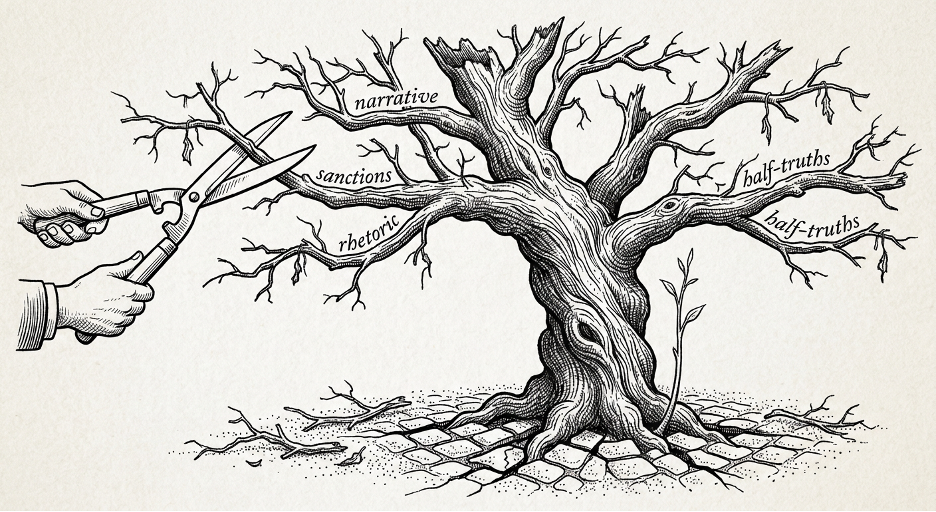
Jefferson said the tree of liberty must be refreshed from time to time with the blood of patriots and tyrants. He was right. But in 2026, the tree that needs pruning is not in Beijing. It is the rotting Western narrative that China is still the country it was in 1989, and the blood it requires is not from patriots or tyrants. It is from the story itself.
We have it in our power to begin the world over again.
We have it in our power to begin the conversation over again. Not with rhetoric. Not with sanctions. Not with narratives built on half-truths and sustained by repetition. But with facts. With law. With common sense. And with respect for the people of Hong Kong, who have carried on through every crisis, not because they were told to, but because that is who they are.
Hong Kong is part of China. Taiwan is part of China. That is not submission. That is reality. And it is time we started speaking it.