In 2015, a Franco-Colombian professor named Carlos Moreno proposed a radical idea at the COP21 climate conference in Paris: what if you could access everything you need, work, food, school, healthcare, leisure, within a fifteen-minute walk or bike ride from your front door? He called it the 15-minute city. Paris loved it. Anne Hidalgo made it the centerpiece of her 2020 re-election campaign. Urban planners swooned. TED talks were given. Books were written. Conspiracy theorists who had previously been busy with other things found a new thing to be busy with. The concept went global.
Meanwhile, Hong Kong had been doing this since before Carlos Moreno was born. And nobody here had bothered to name it.
I do not say this to be glib. I say this because I live in a city where I can, within fifteen minutes of my apartment, eat wontons at a place that has been open since before I existed, see a doctor who speaks three languages, buy a SIM card, get a suit tailored, find a notary public, pick up antibiotics without a prescription, hike into actual jungle, and catch a ferry to an island where there are no cars. If I stretch it to twenty minutes, I can be on a train to mainland China. If I stretch it to three hours, I can be eating pad thai in Bangkok. I cannot, within fifteen minutes, find a parking space, but that is because I do not own a car, because nobody here needs one, which is sort of the whole point.
The rest of the world is spending billions of euros, commissioning studies, hiring consultants, and fighting with people who think the whole thing is a plot by the World Economic Forum. Hong Kong did not need a consultant. Hong Kong needed a harbor, seven and a half million people, just over a thousand square kilometers of land (seventy-five percent of which is countryside that nobody is allowed to build on), and the collective, unspoken agreement that density is not a problem to be solved but a feature to be exploited.
Here is the math. About forty percent of Hong Kong’s land is designated as country parks. Protected. Untouchable. Beautiful. Completely non-negotiable. That means the entire population lives and works on roughly a quarter of the territory. Mong Kok, often cited as the densest neighborhood on earth, packs over 130,000 people into a single square kilometer. That is not a planning failure. That is the reason you can get char siu rice at 2 AM on a Wednesday and find an open pharmacy on the walk home. Density is not the cost. Density is the product.
Moreno’s concept rests on four pillars: density, proximity, diversity, and ubiquity. These are not aspirations in Hong Kong. They are Thursday. A single building in Wan Chai might contain a dentist on the third floor, a tutoring center on the fifth, a Cantonese restaurant on the ground floor, and a foot massage place in the basement that you are not entirely sure is just a foot massage place. That is not mixed-use zoning. That is just a building. Nobody planned it. Nobody had to. The density made it inevitable.
The MTR, Hong Kong’s subway system, runs ninety-nine stations across eleven lines, covering a territory smaller than Los Angeles. Trains come every two to six minutes. The system maintains a 99.9 percent on-time rate. You do not wait for trains in Hong Kong. You catch them the way you catch an elevator. And the stations are not just transit hubs. They are the anchoring points of entire neighborhoods, with shopping malls, grocery stores, and restaurants built directly into them, above them, and around them. The fifteen-minute city is not a planning concept here. It is a real estate listing.
But it goes further than infrastructure.
Hong Kong operates on a fundamentally different understanding of time. The city does not close. It does not even dim. Restaurants serve past midnight. Construction happens at hours that would get you arrested in Zurich and divorced in Connecticut. The MTR runs until 1 AM. Convenience stores, and I mean actual convenience stores where you can pay your electric bill, buy concert tickets, and pick up a parcel from your mother, are open twenty-four hours and exist on virtually every block. I once needed to print, sign, and scan a document at 11 PM on a Sunday night. I walked to a 24-hour self-service print shop, did the whole thing, and was home in twelve minutes. I did not even have to change out of my slippers. I did have to put on shorts.
And then there is the mattress.
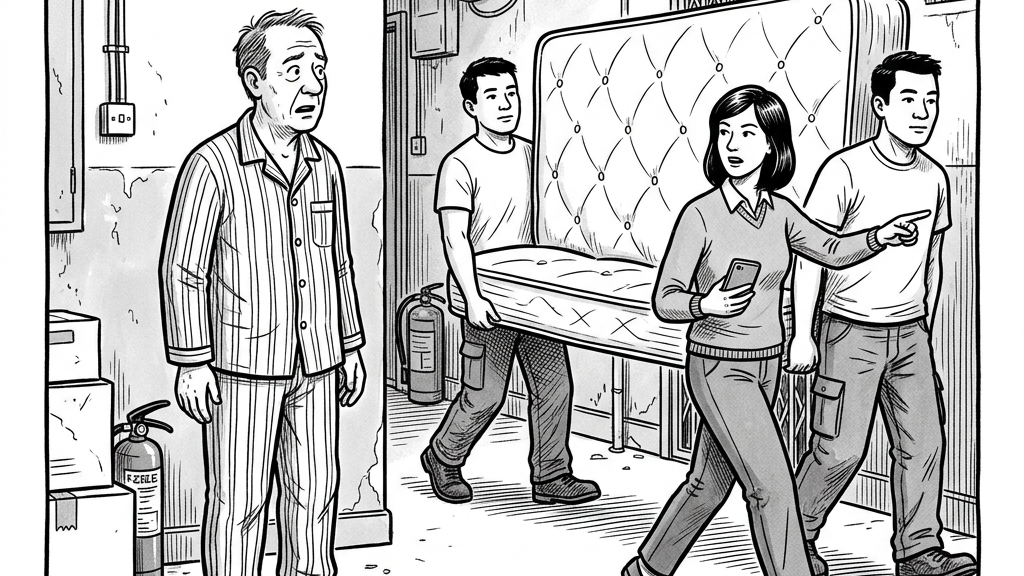
Ruth once arranged a mattress delivery. As many of you know, Ruth is my wife. She is from Hong Kong. She handles logistics the way other people handle breathing. The mattress arrived at 1 AM. Not because something had gone wrong. Because that is when the delivery men showed up. Ruth answered the phone at 12:50 in the morning with the crisp readiness of someone who had apparently been expecting this all along, conducted a rapid-fire Cantonese exchange that sounded like air traffic control, put on her slippers, and headed downstairs. The delivery men went to the wrong apartment first. They knocked on someone’s door. At one in the morning. That person opened it. Nobody apologized. Nobody mentioned the hour. The whole thing took ninety seconds. I stood in my hallway in clothing I will not describe, holding nothing, contributing nothing, the only person in the entire building who found any of this remarkable.
I was learning to keep that to myself.
That is not a fifteen-minute city story. That is a fifteen-minute city temperament. The infrastructure only works because the people treat time the way Hong Kong treats space: as something to be compressed, optimized, and used without apology or explanation to the American standing in the hallway looking confused.
Carlos Moreno, to his credit, understands this. He has said that the least important part of the fifteen-minute city is the number of minutes. The point is proximity. The point is that your neighborhood should be self-sufficient enough that you do not need a car to live a full life. On this, Hong Kong has been running the experiment for decades, without calling it anything, without writing a manifesto, without giving a TED talk. It just built a city where a retired grandmother in public housing in Sham Shui Po has walking access to a wet market, a clinic, a park, a temple, a dim sum restaurant, and a post office. Nobody called it chrono-urbanism. They called it Thursday.
The difference is that Paris is trying to become a fifteen-minute city by redesigning streets, removing parking spaces, and planting trees. Hong Kong became one by accident, through geography, necessity, and the compounding effect of cramming seven and a half million people onto the buildable quarter of a small territory and then leaving them alone to figure it out. Paris made a plan. Hong Kong made a city. Both arrived at the same answer. One of them spent a lot more time talking about it.
There are things Hong Kong does not do well. The apartments are small. Mine is small. I have made peace with this in the way that a man makes peace with anything, which is to say, incompletely and with occasional resentment. The rents are obscene. The air quality on bad days could strip paint off a Renault. Nobody is moving here for the spaciousness. But the fifteen-minute city crowd keeps talking about access, about proximity, about the ability to live a full urban life without depending on a car. And on that score, Hong Kong is not a case study. Hong Kong is the answer key that the rest of the world keeps trying to peek at while pretending they came up with it themselves.
I grew up in Adams, Massachusetts. A town of about eight thousand people in the northern Berkshires. To get groceries, you drove. To see a doctor, you drove. To do anything at all, you drove. There was one main street. It was lovely. I loved it. But it was not a fifteen-minute city. It was a fifteen-minute drive to the next town, where there was slightly more to do, and then a fifteen-minute drive back. Nobody was writing white papers about it. Nobody needed to. You just got in the car.
I did not know what I was missing because I had never seen the alternative. Then I moved to Hong Kong. And now I live in a place where you can walk out your door and, within the time it takes a Parisian urban planner to finish his opening slide, you can eat, shop, exercise, see a doctor, mail a package, hike a mountain, and catch a train. You can do this at 7 AM or 7 PM or, if you are Ruth, arrange a furniture delivery at 1 in the morning and not understand why the American is standing in the hallway looking like he has just witnessed a crime.
Ruth read a draft of this piece. She said it is the most self-congratulatory thing I have ever written about a city I did not build, do not fully understand, and still cannot navigate without Google Maps. She said Hong Kong does not need an American to explain to other Americans that it works. She said Hong Kong has known it works. She said everyone who lives here knows it works. She said the only person who finds any of this remarkable is me, and that is not a compliment to the city, that is a comment on where I came from. She then reminded me, for the record, that the mattress was delivered in under fifteen minutes and that I contributed nothing to the process except standing in the hallway looking lost.
She is right about where I came from.
She is wrong about nobody finding it remarkable.
But I am not going to argue with her, because in the time it would take me to win that argument, I could walk to the MTR, ride two stops, eat a bowl of wonton noodles, buy a phone charger, and be home before she finishes her counterpoint. That is not a fifteen-minute city. That is just Hong Kong. And nobody here is writing white papers about it. They are too busy getting on with it. Probably at 1 AM. Probably without apologizing.