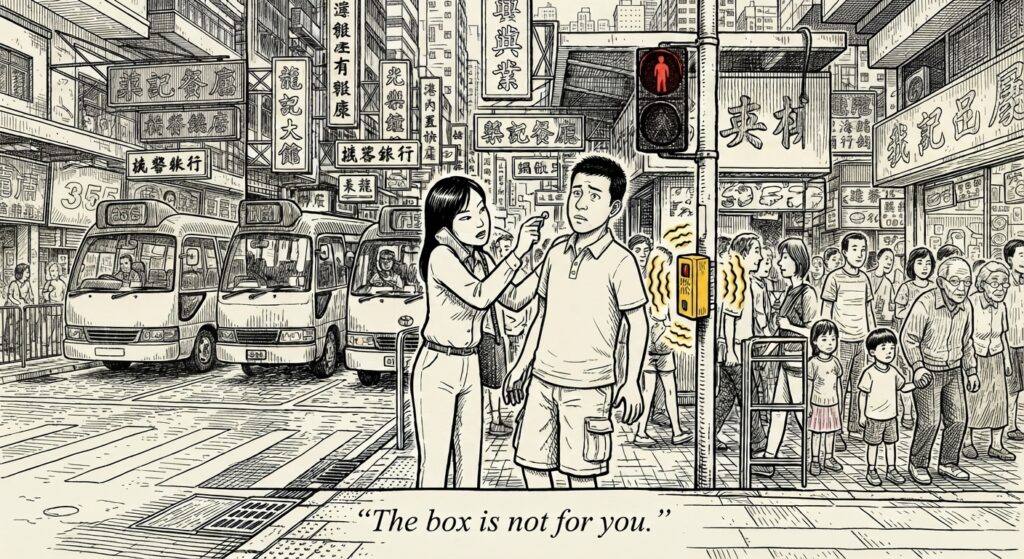
The ticking starts before I can see the crossing at the traffic lights. Tock. Tock. Tock. It’s a slow, patient knock, like someone at the door who knows you’re home. Then the little green man lights up and the box loses its composure completely. Tick-tick-tick-tick-tick, a woodpecker on its third espresso, and everyone at the junction steps off the curb at once as if the sound itself had shoved them into the road.
For years I assumed the box was talking to me. It’s yellow, it’s bolted to a pole at chest height, it has an arrow on it, and it won’t stop. I’m an American lawyer. When something bolted to government property speaks to me in a firm voice, I assume a regulation is involved and I’m already in breach of it.
In my case that assumption was usually correct, because I learned to cross streets in Boston. At Boston University I crossed Commonwealth Avenue the way everyone there does. The red hand is an opening bid, the Green Line trolley is a suggestion, and a driver who stops for you is either lost or from out of state. Boston pedestrians don’t wait for permission. They wait for a gap, and if one doesn’t come they make one with eye contact and a briefcase.
Hong Kong cured me of that in about a week. My first lesson came on a weeknight in Wan Chai, well past midnight, at a crossing with no car in sight for what looked like a full kilometer. Eleven people stood at the curb waiting for the green man. Nobody was talking to anyone. A man in a delivery jacket was eating fish balls off a skewer. A woman had a pomelo in a plastic bag. I did what any Bostonian would and stepped off. I got maybe three strides in before an auntie behind me made a sound I can only spell as “tsk,” but with extra consonants. I stopped in the middle of the empty road, turned around, walked back to the curb and waited with everyone else. The fish-ball man didn’t even look up. That was the moment I became a resident.
What I learned over the years after is that Hong Kong’s crossings have their own rules, and the written ones are the least of them. There is the flashing green man, which for most of my time here meant “run.” You’ve seen it, and if you’ve lived here you’ve done it: grown men in suits, lawyers from my old firm among them, breaking into a clumsy gallop across Des Voeux Road with a laptop bag banging against one hip, because somehow thirty seconds matters enormously in a city where the next green is ninety seconds away. There is the elderly lady with the shopping trolley who steps off on the final flash and reaches the far side three full seconds into the red, and every taxi waits for her without a single horn, because every taxi driver in Hong Kong has a mother. And there is the phone crowd, forty people at the Mong Kok crossings with heads down, reading, scrolling, watching drama serials, who all look up and walk at the exact instant the box starts ticking. Nobody checks the light. The box is the light.
That flashing green sprint is now expensive. In March, a video from outside Kwai Fong MTR station went viral showing police writing up pedestrian after pedestrian, some of them for stepping onto a crossing while the green man was flashing. The Transport Department’s guidance says, and has said for longer than most of us realized, that “pedestrians must not start to cross when the green signal is flashing.” Police followed with a citywide enforcement operation from March 17 to 31. The fixed penalty is HK$2,000. That’s not a traffic fine, that’s a very good omakase. Police also had a reason. There were 96 traffic deaths in Hong Kong in 2025, and 52 of them were pedestrians. I’ve since noticed a new species at Hong Kong crossings: the man who sees the flash from twenty meters out, starts to run, remembers, and turns the run into a sort of brisk, ashamed stroll, like a dog pretending it wasn’t about to chase the pigeon.
This city’s relationship with the crossing runs deep enough to include the longest jaywalking trial in history. In April 2016 a Nepali woman named Thapa Kamala was hit by a taxi on Tai Tam Road and spent nearly two months in hospital. She was then prosecuted for negligently endangering her own safety as a pedestrian. The trial was scheduled for two days. It ran 91, spread over nearly two years, before she was acquitted in 2019. In 2022 the Court of Appeal described the way the trial “meandered sluggishly to its eventual conclusion” as “unseen in the long and combined experience of this court,” and said the magistrate should probably have stopped it after day three. Last year her two lawyers sued the magistrate, the prosecuting barrister and the Secretary for Justice for HK$21.4 million. I’ve practiced law on two continents, and I’ve sat through some slow hearings. Nothing I’ve seen comes within 88 days of that one. That story deserves an essay of its own, and I’m writing it.
Which brings me back to the box, and to the war.
A while ago I bought AirPods with noise cancellation. Noise cancellation listens to the world, plays it back upside down, and the two cancel out. On a Hong Kong street this is witchcraft. The minibus idling at the stop fades away. So does the air conditioner dripping on my head from four floors up, and the drill going somewhere behind a green construction net. So does the MTR’s escalator voice, which for years has asked me to hold the handrail and not keep my eyes only on my mobile phone. I walked through Mong Kok like a man inside an aquarium, serene and slightly smug, watching the city move its mouth with no sound coming out.
Except the box. The AirPods ate the traffic whole, but that sharp little tick came straight through the foam tips as if it had been built to get through things. It turns out it was. I escalated. I turned up the volume. I switched to podcasts with more shouting in them. The box ticked straight through a man explaining interest rates at the top of his lungs. Apple has thousands of engineers in California. The Transport Department has a yellow box and all the time in the world.
The decisive battle came at a crossing on an ordinary weekday evening. The red man was still up. Inside my aquarium I heard nothing, saw a gap in the traffic and felt the old Commonwealth Avenue instinct come back. I stepped off. A hand closed on my collar and pulled me back onto the curb. Ruth hadn’t even stopped her phone call. She reached up, took one AirPod out of my ear, held it in front of my face like an exhibit at trial and dropped it into her handbag.
“The box is fine,” she said. “You’re the one on mute.” Then she went back to her call.
She had a point, and so, it turns out, did the box. It had never been talking to me at all. Last week the Transport Department explained who it was talking to. The yellow boxes, officially electronic audible traffic signals, are there for visually impaired pedestrians, and the new generation turns itself down by up to five decibels at night, because the neighbors complained. More than 800 crossings already have them, about 40 percent of the city’s 2,000 or so, and the rest are due by the end of 2027. The government is also handing out 15,000 remote controls to visually impaired residents, plus a phone app, so they can turn the box back up. The remote has two buttons. Press “1” and the box gets louder once. Press “O” and it stays louder for more than 20 minutes, long enough to get across a junction with tram tracks and a bus lane and a man selling durian on the corner.
I read this at breakfast and felt the balance of power shift. Anywhere else, 15,000 handheld devices issued to one side of a conflict would be called an arms shipment. Sham Shui Po and Kwun Tong got theirs first, since those districts have more visually impaired residents. The rest of us were never consulted, which is how you know it’s serious.
Now picture the whole arrangement at once. A man in a flat above a crossing in Sham Shui Po lies awake at two in the morning, listening to tock, tock, tock, and writes a complaint. In Adams, Massachusetts, where I grew up, the answer would have come at the next town meeting, after two hours of argument, and it would have been to rip the box out. Hong Kong did something else entirely. It taught the box to lower its voice after dark and gave the blind pedestrian on the street below a button to override it. Gordon Kwok, a chief engineer at the department, called it a “win-win.” I’ve spent a career watching people settle disputes, and I’ve never seen a settlement where both sides walked away holding a remote control.
Five decibels isn’t much. It’s the box leaning in slightly, like a man in a cha chaan teng who notices the next table is listening to his divorce. I explained the whole thing to Ruth that night with some enthusiasm: the decibels, the two buttons, the arms-race angle, and my theory that the flashing green fine and the volume remote are the same policy seen from two sides of the road.
“Five decibels,” she said, not looking up from her phone. “That’s how much I turn you down after ten.”
I take the AirPods out at crossings now. I wait for the green. I don’t run on the flash, partly out of civic virtue and mostly because of the HK$2,000. On my way home last week the box was a few decibels into its night shift, ticking softly. Tock. Tock. Next to me an older man with a white cane stood with a small remote in his palm, the way you’d hold a car key. He didn’t press it. The green man came on, the box broke into its woodpecker ticking, and the two of us crossed together, the only people on that street listening to the same thing.
Comments