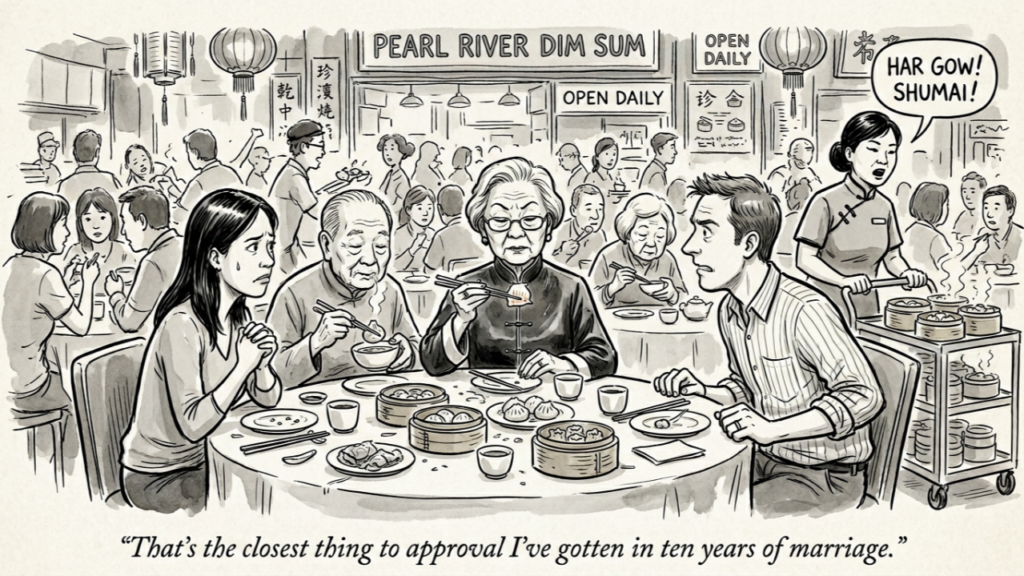
There is a church I attend every Sunday in Hong Kong, though it has no steeple and no hymns. The sermon is delivered on bamboo steamers, the communion wine is chrysanthemum tea, and the congregation, a magnificent, noisy, elbow-throwing congregation, fights over the last har gow like it contains the meaning of life. This is yum cha, and it’s where I experience the joy of Hong Kong yum cha. It is, without exaggeration, the thing I look forward to most every week, and I will fight you for the last siu mai.
But to understand why a middle-aged white man weeps at the sight of a properly pleated dumpling, you need to understand where I come from.
I grew up in Adams, Massachusetts. Adams is a former mill town in the northern Berkshires with a population that hovers somewhere between “small” and “did everyone leave?” It is a place of tremendous natural beauty, genuine community spirit, and catastrophically limited culinary ambition. The restaurants of Adams operate on a simple philosophy: if you can’t fry it, bread it first, then fry it. If that fails, melt cheese on it.
The Chinese food of my youth was the pu pu platter. For those fortunate enough never to have encountered one, a pu pu platter is a Lazy Susan of sadness, a revolving tray featuring spare ribs lacquered in fluorescent red sauce, egg rolls with structural integrity comparable to wet cardboard, chicken fingers that owe nothing to any recognizable Chinese culinary tradition, beef teriyaki skewers (Japanese, but nobody in Adams was keeping score), and fried shrimp. In the center, a small flame burns beneath a wire rack, serving no apparent cooking purpose but providing the aesthetic suggestion that something ceremonial is happening. The entire affair arrives on a wooden platter and is consumed by a table of people who believe this is what Beijing tastes like.
You could not find a pu pu platter in Hong Kong if you searched every restaurant in every district from Kennedy Town to Sai Kung. You could walk into the most tourist-corrupted establishment on Nathan Road, the kind of place with laminated menus in fourteen languages and photographs of every dish, and the staff would stare at you with genuine confusion if you asked for one. It does not exist here. It has never existed here. It is a magnificent American invention, like ranch dressing and the designated hitter, and it should be studied by anthropologists.
The cutting edge of Adams gastronomy was AJ’s, a establishment where the most exciting culinary event of any given year was the changing of the fryer oil. This did not happen on any discernible schedule. There was no annual oil-changing ceremony. No one rang a bell. It occurred when the oil achieved a color and viscosity that suggested it had become a different substance entirely, something closer to roofing tar than a cooking medium. The day after an oil change, regulars would remark that the fries tasted “different,” the way a person emerging from a cave after forty years might remark that the sun seemed “bright.” Within a week the oil would begin its inevitable journey back toward opacity and all would be normal again.
This was my culinary foundation. This was the palate I brought with me to law school.
I arrived at law school in Boston knowing approximately nothing about food and was introduced to dim sum by someone, I cannot remember who, at China Pearl in Chinatown. It was a revelation. I do not use that word lightly. I had spent my entire life eating food that was essentially a delivery mechanism for salt, grease, and the color beige. And now here was a room, an enormous, cacophonous, overwhelmingly alive room, full of bamboo steamers containing things I had never seen, never imagined, never knew food could be.
China Pearl was the real thing. It was old-style Cantonese dim sum done the way it is meant to be done: women pushing metal carts through the dining room, weaving between tables with the precision of Formula One drivers and the temperament of drill sergeants. You did not order from a menu. You did not browse. A cart appeared at the end of your table. The woman lifted a lid. Steam rose. You pointed. She stamped your card. The cart moved on. Another appeared. More lids. More steam. More pointing. This happened continuously, relentlessly, like waves against a shore. You ate until your shirt felt adversarial.
The room was absolutely packed at all times. There were no empty tables. There was no quiet corner. Every chair was occupied, every table covered in steamers stacked three and four high, teapots being waved in the air by old men signaling for refills, children crawling under tables, grandmothers dispensing instructions in Cantonese at a volume that suggested the instructions were also intended for neighboring buildings. It was chaos. It was beautiful. I loved it immediately and without reservation.
I brought my friend Seth there once, a former professional wrestler, a very large man with very large hands and a very limited frame of reference for Cantonese cuisine. He had grown up in a world even more gastronomically constrained than Adams, if such a thing is possible. He approached dim sum with the caution of a man defusing a bomb. When the first round of char siu bao arrived, those magnificent, cloudlike steamed pork buns, he picked one up, turned it over with scholarly deliberation, and ate the entire thing, including the small circle of parchment paper stuck to the bottom. He chewed thoughtfully. He said it was good. He picked up another. He ate the paper on that one too. I watched him consume the paper on three pork buns before I intervened. He looked at me with the confused expression of a man who has just been told that the packaging is not part of the meal. He looked at the bun. He looked at the paper. He looked back at me. “That explains the texture,” he said, and continued eating, this time, paperless.
Years later, after I’d married Ruth and was living in Hong Kong, I brought her mother to China Pearl on one of our visits to Boston.
I need to pause here and discuss Chinese mothers-in-law, because the Western world does not fully appreciate what it is dealing with.
Every culture has its mother-in-law comedy. The overbearing Italian mamma. The passive-aggressive WASP matriarch. The Jewish mother who expresses love through guilt and brisket. These are amusing archetypes, and they are all, with respect, amateurs.
The Chinese mother-in-law operates on a different plane entirely. She is not merely opinionated. She is a living, breathing quality-assurance department, a one-woman regulatory agency with jurisdiction over your cooking, your housekeeping, your career decisions, your parenting, your posture, and, should you be foolish enough to venture an opinion about food in her presence, your palate. She has standards. The standards are non-negotiable. They were developed over decades of lived experience in a culture that treats food not as sustenance but as identity, as love language, as the metric by which all human competence is ultimately measured. She has been eating Cantonese food since before you were born. Her mother was eating Cantonese food before your parents were born. She carries within her a generational database of culinary knowledge so vast and so deeply internalized that she can tell you what’s wrong with a bowl of congee from across the room before she’s tasted it.
Pleasing a Chinese mother-in-law is, under the best circumstances, an act of sustained diplomacy that would test a career ambassador. You do not win her approval. You earn it, incrementally, over years, through a series of small demonstrations of competence that she will acknowledge with a slight nod, or, on your very best day, the absence of criticism, which in the Chinese mother-in-law lexicon is the equivalent of a standing ovation.
Now. Into this dynamic, introduce me, a white man from Adams, Massachusetts, a town whose culinary apex is a deep fryer with biannual oil changes, and imagine me telling this woman, this Cantonese woman who was raised in Hong Kong, who has eaten dim sum at restaurants I will never be worthy of entering, that the dim sum in Boston is better than what she can get at home.
These are fighting words. I cannot stress this enough. Suggesting to a Chinese mother-in-law that anything in America is superior to what can be found in Hong Kong is not merely bold. It is not merely audacious. It is an act of provocation so profound that in certain families it would be grounds for a formal review of the marriage. You might as well tell a French mother-in-law that Olive Garden has better breadsticks than the boulangerie her grandmother apprenticed at. You might as well tell a Japanese mother-in-law that the sushi at an airport Grab-and-Go is comparable to Tsukiji. You are challenging not just her personal taste but the entire culinary heritage of her homeland, the accumulated achievement of generations of Cantonese chefs, the very foundation of a food culture that was producing exquisite dim sum when Adams, Massachusetts was still arguing about whether to pave the roads.
Hong Kong people, and I say this with the full love of a man who married one, are not casual about food superiority. Hong Kong does not believe it has good food. Hong Kong believes it has the best food, full stop, end of discussion, and any suggestion to the contrary is received not as a difference of opinion but as evidence of a deficiency in the person making the suggestion. To tell a Hong Kong mother-in-law that a restaurant in Boston, in America, the land of the pu pu platter and the boneless buffalo wing, is serving dim sum that surpasses what can be found in the city that invented the form, is to say something so outlandish, so cosmically impertinent, that the only appropriate response is the look.
She gave me the look.
Every person who has married into a Chinese family knows the look. It is not anger. It is not even surprise. It is something more devastating than either, a brief, comprehensive audit of your entire being, conducted in about two seconds, that communicates simultaneously a certain grudging affection for your enthusiasm and the absolute certainty that you are about to be proven wrong in a way that will be discussed at family dinners for the next decade. The look says: I love you, or at least I tolerate you, because my daughter chose you and I respect her judgment in most things, but in this particular matter you are so far out of your depth that light from the surface cannot reach you.
I held firm. I told her the dim sum at China Pearl was better than Hong Kong. I said it in the dining room, loud enough for the strangers sharing our table, an elderly couple who had been eating in silence with the focused efficiency of people who had done this a thousand times, to glance up briefly, recognize that a gweilo was about to be publicly corrected by a Chinese auntie, and return to their siu mai with the quiet satisfaction of people who know they’re about to witness something good.
But she tried it. And she agreed.
Not grudgingly. Not with qualifications. Not with the diplomatic evasions of a woman trying to keep peace in the family. She genuinely agreed. The har gow were excellent, the wrappers thin and translucent, the shrimp bouncy and sweet. The siu mai were excellent. The cheung fun was excellent, the rice noodle sheets silky and light, draped over shrimp and doused in sweet soy. She said so, and she meant it, and I watched the look on her face shift from skeptical tolerance to something I had almost never seen directed at me from that particular quarter: impressed.
It was, without exaggeration, one of the great victories of my marriage. I had done something that sons-in-law of Chinese mothers spend entire lifetimes attempting without success. I had taken her to a place, in America, and she had admitted it was good. Not just good, as good as home. I wanted to have the moment notarized. I wanted a plaque. I wanted to call Ruth and tell her what had happened, except Ruth would have simply said, “Yes, the food is good, why are you being dramatic,” because Ruth does not fully appreciate the geopolitical significance of her mother conceding a point about food to a white man from the Berkshires.
The reason, her mother explained, was simple: many of the chefs at China Pearl had come directly from Hong Kong. They had trained in Hong Kong kitchens, apprenticed under Hong Kong masters, learned to pleat a har gow with exactly the right number of folds, and then immigrated to America, bringing every technique and every standard with them intact. Boston’s Chinatown, in those years, was a direct culinary pipeline from Hong Kong. The hands making the food were the same hands that would have been making it in Mong Kok or Sham Shui Po. The geography had changed. The skill had not.
China Pearl, in its prime, was proof that authenticity travels, that it lives in the hands of the people making the food, not in the latitude and longitude of the kitchen.
That was then.
I went back to China Pearl on a recent visit to Boston. I walked in expecting the noise, the carts, the chaos, the stacked steamers, the women yelling, the old men waving teapots. What I found was a restaurant I did not recognize.
The carts are gone. The dining room has been modernized, clean lines, contemporary fixtures, the aesthetic language of a place that wants to appear on someone’s Instagram story. You sit down. You receive a menu. You order from the menu. A waiter brings your food. It arrives plated, arranged, civilized. Quiet. Controlled. Completely devoid of soul.
It looked like a tourist trap. It felt like a tourist trap. The food was fine, technically competent, reasonably flavored, adequately presented. But “fine” is a devastating word for a restaurant that was once magnificent. Fine is what you say about a hospital meal when you don’t want to upset the nurse. China Pearl was not supposed to be fine. It was supposed to be extraordinary and loud and chaotic and alive, and now it is fine, and that is a tragedy that I cannot adequately express.
This is happening everywhere. In Boston, the old family-owned Cantonese restaurants, the places where the grandmother ran the front, the grandfather ran the kitchen, the children bused the tables, and the food was made the same way it had been made for three generations, are disappearing. They are being replaced by modern concepts, fusion experiments, fast-casual formats, and the relentless, homogenizing machinery of commercial real estate that cannot tolerate a family paying below-market rent to serve authentic food to a loyal community. The children go to college. The grandparents retire or die. The lease expires. A boba tea shop opens. The cycle completes.
And the same thing is happening in Hong Kong.
The great old dai pai dongs are mostly gone. The cha chaan tengs are thinning. The family dim sum houses where three generations worked the kitchen are closing, one by one, replaced by chains and franchises and restaurants designed by consultants who have studied what tourists expect a Chinese restaurant to look like. The rent is too high. The hours are too long. The children want to work in finance. The knowledge, the particular, irreplaceable, handed-down knowledge of how long to steam a dumpling, how thin to roll the rice noodle, how much shrimp paste to fold into the filling, walks out the door with the last generation willing to stand over a wok at five in the morning for not very much money, and it does not come back.
It is the same story in Boston. It is the same story in Hong Kong. It is the same story everywhere that authentic, family-made food is slowly losing a war of attrition against modernity, economics, and the brutal indifference of a world that does not understand what it is losing until it is gone.
But on Sunday mornings in Hong Kong, it is not yet gone.
I go to yum cha every Sunday. I go early, because the good tables fill fast, and because the best items come out first, and because there is a particular pleasure in being seated in a dim sum restaurant at half past nine with a pot of bo lei and the entire morning stretching ahead with no obligation other than eating.
The comedy of being a white man at yum cha in Hong Kong is a reliable source of entertainment, and I include myself in the joke. You can spot the expatriate dim sum novices from across the room. They travel in groups of four to six. They are armed with phones displaying TripAdvisor recommendations. They order har gow, siu mai, char siu bao, and egg tarts, the four safe corners of the dim sum universe, the dishes that require no explanation and pose no psychological challenge. They eat these items. They declare them delicious. They take photographs. They leave. They have experienced approximately four percent of what is available to them.
They do not order the chicken feet. Nobody orders the chicken feet on their first visit, or their fifth, and frankly most of them never will, because a chicken foot looks exactly like what it is, and for a person raised on boneless skinless chicken breasts from a Styrofoam tray, the idea of putting an entire foot in your mouth and navigating the cartilage with your teeth is a bridge too far. They do not order the tripe. They do not order the beef tendon. They do not order the congee with preserved egg and pork, because preserved egg, century egg, pei dan, is black and translucent and looks like something recovered from an archaeological dig, and explaining that it is actually creamy and rich and magnificent does not help when the visual presentation is actively hostile to the Western eye.
They especially do not order the steamed pork blood curd. They do not order it because they do not know it exists, and if they did know it existed they would not order it because it is called pork blood curd, and that is a name that does exactly zero marketing work among people who grew up eating pu pu platters.
I order all of it. I order the chicken feet and I work them with the enthusiasm of a man who has discovered religion. I order the tripe in ginger and scallion. I order the turnip cake, pan-fried until the edges are crisp and the inside is soft and loaded with dried shrimp and Chinese sausage. I order the wu gok, taro dumplings, deep-fried so the exterior shatters into a thousand lacy filaments while the inside remains dense and savory. I order the cheung fun with prawns, slippery and delicate, doused in sweet soy. I order the lo mai gai, sticky rice in lotus leaf, unwrapping it like a present. I order the dan tat, the egg tarts, still warm, the custard barely set, trembling when you lift them. I order things I cannot identify from the menu and discover what they are when they arrive, which is the correct way to eat dim sum and possibly the correct way to live.
I order too much. I always order too much. The table disappears under bamboo steamers and small plates and sauce dishes and the teapot and the bill card and the crumpled napkins and the small pile of bones from the chicken feet, and I sit there in the middle of all of it, overfed and profoundly happy, watching the room do what dim sum rooms have always done, grandparents feeding grandchildren, businessmen arguing over tea, couples eating in companionable silence, tourists cautiously navigating their four safe dishes while an entire universe of flavor sits on the next table, three feet away and completely unexplored.
This is my Sunday. This is my religion. And every week, sitting in that room, surrounded by noise and steam and the clatter of ceramic and the bark of Cantonese from the next table, I think about Adams, Massachusetts, and the pu pu platter, and the fryer oil at AJ’s, and I think about how far a person can travel, not just in miles, but in the capacity to experience pleasure, and I am grateful for every dumpling, every foot, every trembling egg tart, every Sunday morning in a city that still knows, for now at least, how to eat.