On Chinese funerals, casseroles, and the woman who fed me without a shared word between us.
I have lived in Hong Kong for over a decade. I have navigated the MTR transfer at Admiralty during rush hour without losing a shoe. I have learned the tissue-pack system, in which a packet of tissues placed on a table at a crowded restaurant constitutes a legally binding reservation enforceable by social contract and the disapproving gaze of every auntie within a thirty-meter radius. I have survived the thermostat war with Ruth, a conflict with no armistice and no neutral territory, in which I am always too hot and she is always too cold and the air conditioning unit in our flat has become a proxy battlefield for two civilizations’ incompatible relationships with ambient temperature. I can use chopsticks. I can navigate the bridging calendar. I can order in a cha chaan teng without pointing at the laminated photographs like a tourist, though I still point at the laminated photographs like a tourist, because the laminated photographs are right there and I am not above assistance.
But I cannot do Hong Kong funerals.
This is surprising, because I come from a town that did funerals the way other towns did Little League. In Adams, Massachusetts, death was a civic activity. It had a schedule, a dress code, a venue, and a social hierarchy as rigid as anything the British left behind in Hong Kong. Calling hours were held at the funeral homes on Summer Street or Hoosac Street, divided into two sessions, 2 to 4 in the afternoon and 5 to 7 in the evening, with a gap in between for the family to eat and for the town to regroup before returning. If you were Catholic and French-Canadian, which in Adams was not a demographic but a condition of existence, you attended at least one session. You did not decide whether to attend. You attended the way you attended mass, which is to say automatically, without discussion, because the alternative was not attending, and not attending meant that people would notice, and people noticing was worse than death itself, which was, after all, the reason everyone was there in the first place.
Nobody stayed for the full session. That is the thing people from outside small towns do not understand about calling hours. You were not there for the duration. You were not camping out from 2 to 4 with a folding chair and a sandwich. You went in. You signed the book. You stood in line. You knelt at the casket. You said your condolences to the family, both hands, firm grip, eye contact, I’m sorry for your loss. And you left. Fifteen minutes. Twenty if the line was long. Thirty if someone cornered you near the guest book and wanted to talk about the deceased’s gallbladder surgery from 1987. You did the thing and you moved on, because lingering was for family, and you were not family, you were the town, and the town’s job was to show up, show its face, and go home.
My grandmother never missed one. Not a single calling hour in forty years. We called her 2 to 4 and 5 to 7, because she attended both sessions of every single one, not in and out in fifteen minutes like everyone else, but for the full duration, from the moment the doors opened to the moment they closed, twice, once in the afternoon and once in the evening, as though a single session might be insufficient, as though the dead required the full weight of her presence for the complete allotted time. Every death in Adams, every death in North Adams, every death in Cheshire if she knew them from church.
And she knew them. That was the thing. She would not go to a funeral for a stranger. She was not collecting appearances, not checking boxes, not performing civic duty for its own sake. She went because she knew the person, and she knew everyone, because she had lived in that town for sixty years and had never once failed to pay attention to the people in it. She knew them from church, from the grocery store, from the bakery, from forty years of calling hours where she had met their families and remembered their names. She was there, in her dress, with her purse, signed into the guest book, kneeling at the casket, for every minute the funeral home would allow her.
She had a frenemy. I do not know what else to call this woman. A woman from the parish who existed in a state of permanent, low-grade warfare with my grandmother, a relationship sustained entirely by mutual attendance at calling hours and the friction generated therein. This woman’s primary weapon was a single question, deployed with surgical precision at the exact moment my grandmother arrived at the funeral home, delivered with the innocence of a person making casual conversation and the intent of a person detonating an explosive:
“Didn’t you wear that dress to the last one?”
That was it. That was all it took. My grandmother would be going for the rest of the evening. The dress was not the same dress. Or it was the same dress but it was appropriate. Or it was a different dress entirely and this woman needed her eyes checked. Or, and this was the version that came out after the 5 to 7, in the car, at volume, that woman wore the same black cardigan to every funeral since 1974 and had some nerve, some absolute nerve, questioning anyone else’s wardrobe when she looked like she got dressed in the dark in a closet that hadn’t been updated since Vatican II. The frenemy knew exactly what she was doing. My grandmother knew exactly what the frenemy was doing. And yet it worked every single time, because some conflicts are not meant to be resolved, they are meant to be maintained, and this one was maintained with the precision of a Swiss watch and the ferocity of a border dispute.
I knew death. I knew the kneeling and the holy water and the guest book and the line past the casket. I knew the handshake. I knew what to wear. I knew the casserole, which arrived at the house within hours, in Pyrex, covered in foil, tuna noodle or scalloped potatoes or something beige and warm that said I am here, I am sorry, I do not know what else to do, so I baked. I knew death in Adams the way a native speaker knows grammar, without thinking, without rules, because the rules were in my body before I knew they were rules.
None of it transferred. Not a single piece of it. I arrived in Hong Kong fluent in the wrong funeral.
I wore a dark suit to the first Chinese funeral I attended in Hong Kong. I wore it because I wear shorts to work, in a jurisdiction where barristers wear horsehair wigs and solicitors wear three-piece suits, and every other professional in this city dresses as though they are attending a funeral at all times, which means that when an actual funeral arrives, the dress code differential between their workday and their grief is essentially zero. Same suit. Different venue.
I, on the other hand, needed to go from shorts to solemnity, and I overcorrected. I arrived at the funeral parlor in my full dark suit and found that many of the mourners were wearing what I can only describe as somber casual. Dark jeans. Dark polo shirts. Dark sneakers. Comfortable dark fabrics that suggested grief without suggesting a board meeting. I had managed to overdress for a funeral in the same city where I underdress for court, which is a statistical achievement so precise in its wrongness that it deserves its own category.
At that same funeral, an older man was wearing athletic shorts. Not dark athletic shorts. Athletic shorts. The kind with a stripe down the side and an elastic waistband and the general suggestion that their owner had been on his way to a morning walk when death intervened and rerouted him without time to change. I do not know if this man was right or wrong. I stared at him the way a law student stares at an ambiguous statute, searching for the principle, finding none, suspecting that anyone who claims to know the answer is lying. In Adams, my grandmother’s frenemy would have had material for a decade. In Hong Kong, Ruth said it was fine. Ruth says many things are fine that are not fine, and many things are not fine that are fine, and I have learned that “fine” in Ruth’s vocabulary is not an assessment of correctness but a signal that the topic is closed.
But the suit was only the beginning. I shook hands the way my father taught me at every wake on Summer Street, both hands, firm grip, eye contact, when the protocol in Hong Kong is a nod, a bow, a system of physical acknowledgment that does not involve gripping a grieving person as though you are trying to pull them back from the edge of something. I said “thank you” when I should have said 有心, which means roughly “you have heart,” and which is not a transaction but a recognition. I brought a white envelope with cash, which is correct, except that I put an even number in it, because I am a man who respects round numbers and divisibility, and the custom is odd numbers, because even numbers are for happy occasions and odd numbers are for death. I had managed to bring a celebratory envelope to a funeral. Ruth caught it in the car and corrected it by removing one bill and putting it in her wallet with the efficiency of a woman who has been intercepting my cultural errors for so long that she has developed a system.
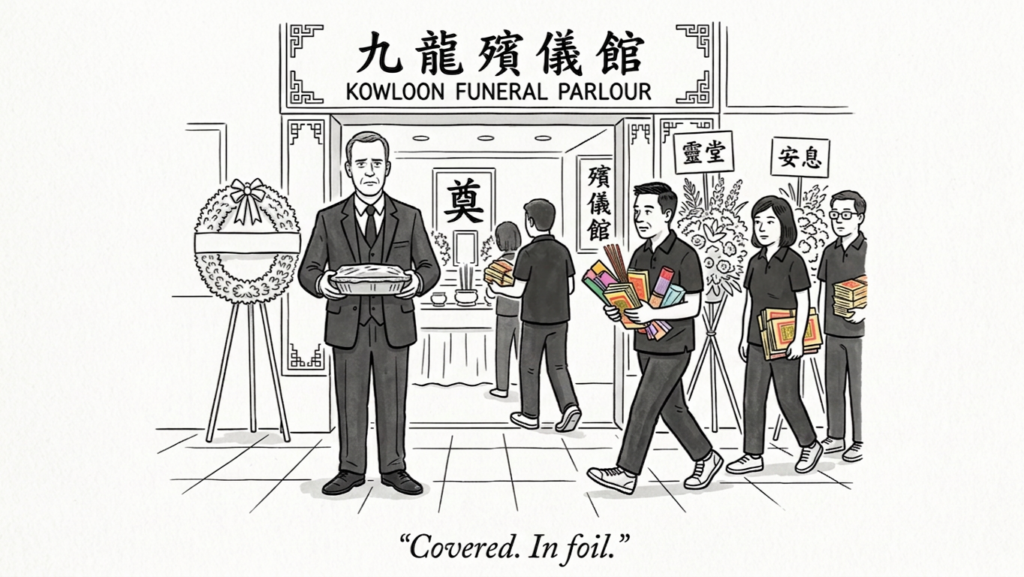
I once tried to offer a casserole. In Adams, when someone dies, you bring food. This is not optional. Someone dies, you make a casserole, you bring it to the house, you put it on the counter with the other casseroles, and the bereaved family eats beige food out of Pyrex for two weeks. The casserole says I am here, I am sorry, I cannot fix this, so I baked instead. In Hong Kong, you bring paper. Paper money, paper clothes, paper objects, offerings meant to be burned so that the dead might receive them in the next world. In Adams, you feed the living. In Hong Kong, you feed the dead. I did not understand this yet. I only knew casseroles.
I suggested one to Ruth before her colleague’s father’s funeral. I said I would make something. I said I would bring something. I said I would cover it in aluminum foil and carry it to the funeral parlor.
Ruth looked at me as though I had suggested we bring a live animal.
“A casserole,” she said.
“A casserole.”
“To a funeral.”
“It’s what we do.”
“You are not in Adams.”
“I am aware.”
“You are going to carry a glass dish of food to a Chinese funeral parlor.”
“Covered. In foil.”
The silence that followed was not the silence of consideration. It was the silence of a woman recalculating whether she had made a catastrophic error in her twenties that was only now revealing its full dimensions. The casserole did not come.
And the colors. White for the closest family. Blue for certain relatives. Black for the general mourners. Or is it the other way. Or does it depend on the generation of the deceased, or the region, or whether the funeral is Buddhist or Taoist or Christian. Every explanation I have received has ended with “but it depends,” which is the three-word phrase that has defined my entire experience of Chinese cultural protocol. I have learned enough to know that whatever I am wearing is probably sending a signal I did not intend. In Adams, my grandmother’s frenemy tracked the dress. In Hong Kong, the dress tracks you, and you do not even know what it is saying.
Ruth’s grandmother died on a Tuesday.
I know it was a Tuesday because Ruth called me at the office and I was in a meeting and I did not pick up, and when I called her back she told me in the voice she uses when she has already processed the information and is now delivering it to me pre-digested, the voice that contains the grief but does not perform it, the voice of a woman who has decided she will cry later, in private, and right now there are logistics.
I wore the dark suit. I wore it because by this point I did not trust myself to calibrate the casual, and Ruth had other things to think about that morning, and the last thing she needed was a man standing in front of a closet asking what to wear to her grandmother’s funeral. I put on the suit. I tied the tie. I looked like a man attending a funeral in 1987 in Adams. This was the best I could do.
Ruth’s grandmother was a woman I could not speak to.
I want to be precise about this. The easy version is that we had a language barrier, as though the barrier were a temporary obstruction that might be removed with effort or education or time. It was not temporary. It was permanent. She spoke Cantonese. I speak English. Not the kind of English that bends toward Cantonese after a decade of proximity, not the kind that picks up tones and phrases. I speak the English of a man from Adams, Massachusetts, who took French in high school because his family was French-Canadian and who has lived in a Cantonese-speaking city for over a decade and still cannot order a coffee in the language of the city he calls home. She could not speak to me. I could not speak to her. This was the permanent condition of our relationship, from the first lunch to the last, and it never changed, and it was never a problem, which is the part that still surprises me, because I am a man who makes his living with words, and the most meaningful relationship I have ever had with a woman of her generation required none.
We had lunch. Regularly. Not every week. But regularly, in the way that things become regular in Hong Kong when an older woman decides they will be, when the decision is not a request but a schedule, and the schedule is not negotiable, and the man will show up because the woman has decided he will show up, and that is how things work in families where the matriarch sets the calendar and the calendar is law.
She would pick the restaurant. She would order. The ordering was done entirely without my input, which was appropriate, because my input would have been useless. She could not read. I want to be clear about this, because it changes the picture. She would hold the menu, a menu I could not read, printed in characters I could not parse, describing dishes I could not identify, and she could not read it either. She ordered from memory, or from instinct, or from sixty years of eating in restaurants like this one, pointing at things and nodding at the waiter with the authority of a woman who has never needed a menu to know what she wants. The waiter would nod back, and food would arrive, and I would eat it. Two people at a table, neither of them able to read the menu, one of them entirely in command of the situation and the other entirely at her mercy. I ate things I could not name. I ate things I could not identify by sight or smell or texture. I ate things that may have been organs of animals I had never considered eating, prepared in ways I had never imagined food could be prepared, and she would watch me eat and smile the way a grandmother smiles when a child finishes his plate, which is to say with satisfaction and the quiet authority of a woman who has fed people for sixty years and knows what she is doing.
She never asked if I liked it. Or if she did, she asked in Cantonese, and I did not understand, and she did not wait for an answer. The answer was irrelevant. The eating was the thing. The presence at the table was the thing. She could not say I accept you, so instead she said eat this, and eat this was enough, and the food arrived without explanation the way love arrives without explanation, and I ate it all, every time, because that was my only vocabulary with her, the only word I could offer back. Yes. I am here. I will eat what you give me.
In Adams, casseroles fed the living because the living needed to be fed and the feeding was the language of grief. In that restaurant in Kowloon, food fed me because a woman could not speak to me and chose to nourish me instead, and the nourishment was the language of acceptance. I did not see the connection at the time. I see it now.
She died, and I stood at her funeral in my dark suit, and I did not know what to do.
I did not know when to bow. I did not know how deep. I have a history of not bowing. I did not know the order of things, the sequence of rituals that the other mourners seemed to know the way I know the order of a Catholic mass, without thinking, without consulting a program, because the knowledge is in the body, put there by repetition and years and a childhood spent inside the ritual until the ritual became automatic. Their knowledge was not in my body. I stood where Ruth put me and moved when Ruth moved and bowed when Ruth bowed and hoped that my suit was not saying something terrible, because I did not know what it was saying, and no one was going to tell me, because this was not the time for corrections. In Adams, I would have known. I would have gone in, signed the book, knelt at the casket, shaken the hand, said the words, and left. Fifteen minutes. The whole grammar of grief, automatic and fluent. Here I had no grammar. Here I was mute. Here I stood in someone else’s ritual the way I had sat at her table, surrounded by a language I could not read, trusting that my presence was enough because my presence was all I had.
At Chinese funerals, there is a furnace. A metal furnace, sometimes outside the hall, sometimes in a courtyard, where the paper offerings are burned. The paper money and paper clothes and paper objects I had first learned about when I tried to bring a casserole, the things you bring to a Chinese funeral instead of food, the things that are not for the living but for the dead. You feed them to the fire, and the fire converts them to smoke, and the smoke carries them forward, and the dead receive what the living send. The theology is complex and varies and I will not pretend to understand it fully. But I understand the furnace. I understand the act of feeding something to something. I understand the offering that cannot be acknowledged, the gift given without knowing whether it arrives, the act of sending something into a silence and trusting that the silence receives it.
I watched the family feed the furnace. I watched the paper curl and blacken and rise. I watched the smoke climb into the Hong Kong sky, up past the buildings, up past the scaffolding and the cranes, up past the laundry hanging from the windows of the estates, up into the haze that sits over Kowloon on every humid afternoon, the haze that swallows everything eventually, that takes the smoke and the grief and incorporates it into the general atmosphere of a city that has seen ten thousand funerals this week and will see ten thousand more next week and does not pause for any of them.
I thought about the lunches. The pointing. The dishes arriving and the silence between us that was never uncomfortable, that was never a failure, that was its own kind of language. The language of food placed in front of a person by someone who cannot say I accept you but can say eat this. I thought about the trust required to put something in your mouth that a woman has chosen for you when you cannot ask what it is, the small act of faith that eating becomes when you have no information and only the evidence of a smile across the table to tell you that the thing is good and the woman is kind and the meal is a form of love that does not require a single word in any language. She had fed me for years without ever knowing if I understood what she was giving me. The family was feeding her now, paper into fire, smoke into sky, without ever knowing if she received what they were sending.
The smoke rose into the haze over Kowloon, and I watched it go, and I did not know the words for what I felt, in either language.