How Hong Kong Will Train You for Free While America Asks You to Go Into Debt. The Educational Gap.
I graduated from law school in 1998. I am still paying for it. Twenty-eight years later, the monthly debit still hits, still real, still carrying the compound weight of a decision I made when Bill Clinton was president and the internet ran on a phone line. I do not think about it often anymore. It is like a scar you stop noticing until someone touches it. But it is there. It has always been there. It will be there when I am sixty, which is not far off, and possibly when I am sixty-five, depending on which repayment plan the servicer shuffled me into without asking this time.
I bring this up because I have now lived in Hong Kong for fifteen years, and in those fifteen years I have watched the government here do something that still, after all this time, strikes me as so plainly rational that I cannot understand why it is not the default everywhere. They pay you to learn.
The Continuing Education Fund is not glamorous. It does not have a mascot. Nobody has made a prestige documentary about it. It is a government program that gives Hong Kong adults up to twenty-five thousand Hong Kong dollars, about thirty-two hundred US, to take approved courses. There are thousands of them, offered by more than a hundred training providers. Languages. IT. Finance. Logistics. Aviation. Mixology.
I mention that last one because HKU SPACE offers a CEF-reimbursable course called “Cocktail Appreciation and the Craft of Mixology,” thirty hours of instruction including a bar visit to a working hotel bar, and I have had my eye on it for months. Ruth likes wine. Ruth more than likes wine. Ruth has opinions about wine that she will share with you whether or not you have asked, and she has told me more than once that if I am going to take a cocktail course, I should at least come home capable of selecting a proper pairing for dinner.
I have always envisioned myself as Isaac, the friendly and courteous bartender from the hit seventies show The Love Boat, minus the cruise ship and the leisure suits but with the same energy, the same warmth, the same ability to pour a drink while making a passenger feel like the most interesting person aboard. Ruth says this is delusional. Ruth says I would last one shift before complaining about my knees. Ruth also said I come from a town that serves screw top champagne, I have no business pouring for a city that sends wine back. Ruth is probably right. But the government will pay for me to find out, and that is the point.
The eligibility requirements are: be eighteen. Be a Hong Kong resident. That is the whole list. No income test. No means test. No consideration of your family background or your secondary school results or whether your parents donated a library wing. You sign up. You take the course. You finish it. You get reimbursed. The government does not care who you are. It cares that you showed up and did the work.
But the adult education fund is almost beside the point when you look at the undergraduate picture. Because the real gap, the one that determines whether a twenty-two-year-old walks into adulthood free or shackled, starts with the bachelor’s degree.
In Hong Kong, annual tuition at any of the government-funded universities is forty-four thousand five hundred Hong Kong dollars. That is about fifty-seven hundred US dollars per year. For a four-year degree, you are looking at roughly twenty-three thousand American dollars total. Not per year. Total. And these are not community colleges. These are not regional schools that nobody outside the province has heard of. The University of Hong Kong is ranked eleventh in the world on the latest QS rankings. The Chinese University of Hong Kong is eighteenth. Hong Kong University of Science and Technology is thirty-third. Hong Kong Polytechnic is fiftieth. City University is fifty-second. Five Hong Kong universities sit in the global top sixty. Five. In a city of seven and a half million people on a rock in the South China Sea. A student here can attend a top-fifteen world university for the price of a single semester at a middling American state school.
And housing does not destroy them either. Hong Kong is a compact city threaded together by the MTR, and a significant number of local undergraduates simply live at home and commute. The train ride from Sha Tin to Chinese University takes minutes. The ride from Kowloon Tong to City University is one stop. Even students who choose to live in university halls pay somewhere around fourteen to twenty-two thousand Hong Kong dollars per year, roughly eighteen hundred to twenty-eight hundred US for a shared room. That is the annual cost. For housing. At a top-sixty global university.
Now compare. In the United States, room and board alone at a private four-year college averages over seventeen thousand dollars per year. That means the American student is paying more for the dormitory alone than the Hong Kong student pays for tuition, housing, and everything else combined across the entire degree. Add tuition on top of that and the numbers become grotesque.
The College Board’s latest data puts total annual cost of attendance, tuition, fees, room and board, books, transportation, at about thirty-one thousand for in-state public students and sixty-five thousand for the average private school. But that average includes hundreds of small colleges ranked nowhere near HKU. The schools actually comparable in global standing, the Stanfords and Columbias and Cornells, now run ninety-five to one hundred thousand dollars per year all in. Cornell’s published cost of attendance for 2026-27 is ninety-nine thousand seven hundred thirty-four dollars. For one year. A four-year degree at the American universities ranked alongside HKU and Chinese University now costs somewhere between three hundred fifty and four hundred thousand dollars before interest, before fees, before the specific financial violence of compounding debt on a twenty-two-year-old who was told this was the only path.
I want to pause on that number for a moment. Four hundred thousand dollars. That is not an abstraction. That is a specific weight placed on a specific person at the specific moment they are least equipped to carry it. The human mind is not built to evaluate that kind of commitment at eighteen. Behavioral economists have a term for what happens: hyperbolic discounting, the inability to feel future costs as real costs. The loan officer knows this. The university knows this. The marketing department that produced the glossy brochure with the autumn leaves and the diverse friend group laughing on the quad knows this. They are not selling an education. They are selling a feeling, and billing for it later, when the feeling is gone and the invoice remains.
A student at the University of Hong Kong, ranked eleventh in the world, pays fifty-seven hundred dollars a year in tuition and commutes from home on a train that costs the equivalent of a dollar. A student at the University of Michigan, ranked fifty-first, forty places lower, pays about nineteen thousand in-state or sixty-seven thousand out-of-state in tuition and fees, plus seventeen thousand for living expenses, plus books, plus the campus meal plan that charges eleven dollars for a bowl of pasta you could make for two. The Hong Kong student attends a higher-ranked university and pays less in four years than the Michigan student pays in a single semester. The Hong Kong student graduates debt-free. The American student graduates with a mortgage on a house they do not own.
And here is the part that should make Americans angriest, though it rarely does because they have been trained to accept it as normal. That training has a name too. Psychologists call it system justification, the well-documented tendency of people to defend and rationalize the structures that govern their lives, even when those structures actively harm them. The student who took on two hundred thousand in debt must believe the system is fair, because if it is not fair, then they are not a savvy investor in their own future. They are a mark. Nobody wants to be a mark. So they defend the system, share the brochure, tell the next generation it is worth it, and the cycle continues. The American student who pays five or ten or fifteen times more than the Hong Kong student is not even guaranteed admission on merit. They are competing inside a system that spent decades deciding who gets in based on factors that have nothing to do with whether they can do the work.
In Hong Kong, university admissions run through JUPAS, the Joint University Programs Admissions System. You take the DSE, the Diploma of Secondary Education examination. Your scores determine what you qualify for. You rank your preferred programs. The universities make offers based on your results. That is the main path. There is no box for your race. There is no legacy preference. There is no essay about overcoming adversity. For most applicants, you are your scores and your scores are you. Some competitive programs, medicine, architecture, social work, conduct interviews, and there are separate admission schemes for elite athletes and special talents, but for the overwhelming majority of students, the path is blunt, narrow, and honest. It does not pretend to be measuring your soul. It measures what you know. If you know enough, you get in. If you do not, you do not.
In America, the system spent decades punishing Asian students for being Asian.
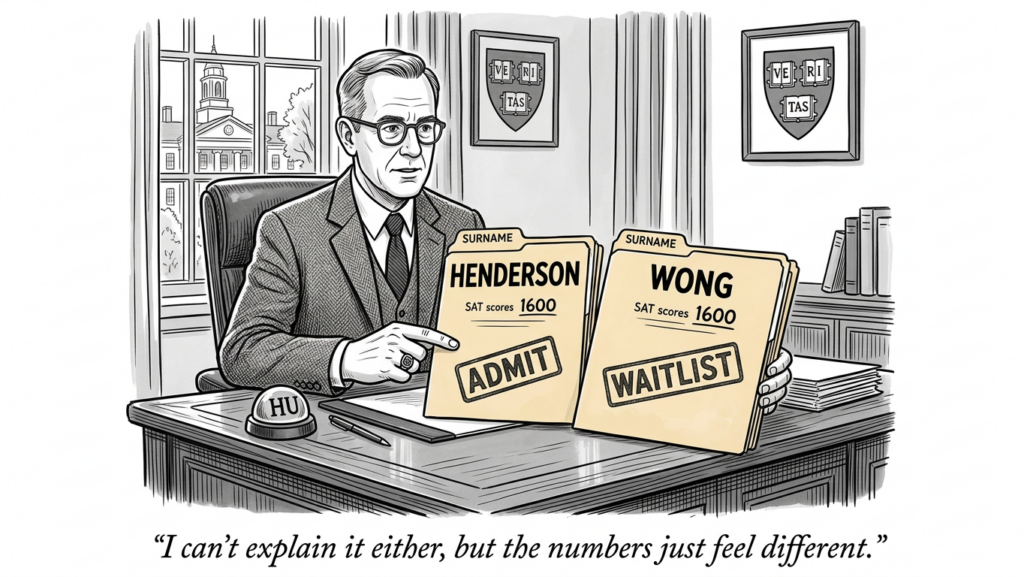
This is not hyperbole. This is what the data showed. When Students for Fair Admissions sued Harvard, the discovery process cracked open the admissions files and what spilled out was exactly what everyone suspected but nobody could prove until a court forced the documents into the light. Harvard’s admissions officers consistently rated Asian American applicants lower than every other racial group on “positive personality traits,” things like likability, courage, and kindness. Asian American students scored higher than any other group on academics, on extracurriculars, on every quantifiable metric. Alumni interviewers who actually met the applicants in person rated their personalities comparably to white students.
But the admissions officers in Cambridge, the ones who never met these kids, who read their files and made decisions from behind a desk, gave them the lowest personal ratings of any racial group. The message was clear if unspoken: you are smart, but we have decided you are not interesting. You are qualified, but we have decided you are not likable. You have done everything we asked, but we have decided you are not enough.
The numbers from researchers at Duke made it blunter. An Asian American applicant needed to score approximately 140 points higher on the SAT than a white applicant to have the same chance of admission at selective schools. Two hundred and seventy points higher than a Hispanic applicant. Four hundred and fifty points higher than a Black applicant. That is not a thumb on the scale. That is a system that looked at one group of students and said: you will work harder, score higher, achieve more, and still be held to a standard we apply to no one else, because the demographic math requires your exclusion.
What makes this psychologically devastating, beyond the obvious injustice, is what it teaches the students who experience it. It teaches them that effort does not reliably produce reward. It teaches them that the rules are not the real rules. It teaches them that a system can smile at you and sabotage you simultaneously, and that the smile is the point, because it prevents you from naming what is happening. Social psychologists call this a double bind: a situation in which every available response is punished. Score higher and you are penalized for being a stereotype. Score lower and you do not get in. There is no correct answer. There is only the system’s need, and you are raw material for it.
Harvard’s admissions files showed that Asian American enrollment had peaked at over twenty percent in the early nineteen-nineties and then inexplicably plateaued, hovering in a suspiciously narrow band for decades even as the Asian American population doubled and the number of qualified applicants surged. Meanwhile, Caltech, which admits purely on academic merit without considering race, saw its Asian American enrollment rise naturally with the applicant pool. The comparison was damning. One school measured what students knew. The other measured what it wanted its brochure to look like.
The Supreme Court struck down race-conscious admissions in 2023, and you might think that settled things. It did not settle anything. The Department of Justice found in 2025 that George Washington University’s medical school was still doing it, using essay prompts designed to elicit racial information after the checkbox was banned, giving Black applicants significantly higher interview scores and admitting them over white and Asian applicants with stronger credentials. The system did not stop discriminating. It just got more creative about how it discriminated.
And the race question is only one axis of the fraud. Legacy admissions remain untouched at most elite private schools, a system that overwhelmingly benefits white and wealthy applicants and that no administration, left or right, has shown any interest in dismantling. Athletic recruitment continues to funnel students with mediocre academic records into schools they could not otherwise access, provided they play the right sport, which is to say the sports played primarily at expensive private high schools with boathouses and equestrian centers and fencing programs that cost more per year than Hong Kong charges for an entire university degree.
The result is that an American eighteen-year-old applying to a selective university is not simply being evaluated on what they know. They are being evaluated on who they are, who their parents are, what their skin color is, what story they can tell, and whether the institution needs what they represent for its own demographic arithmetic. The system is not meritocratic. It has never been meritocratic. It claims to be “holistic,” which is a word that means: we will decide, using criteria we will not fully disclose, and you will accept the outcome because you have no alternative.
And you will accept it. That is the part that makes the psychology so effective. When everyone around you is doing the same thing, when your parents did it, when your guidance counselor tells you to do it, when the alternative is framed as failure, the individual human mind does not rebel. It conforms. It calls the debt an investment. It calls the admissions process competitive rather than arbitrary. It calls the outcome fair because the alternative, admitting you were processed rather than chosen, is too disorienting to hold. The system does not need to convince you it is good. It only needs to convince you it is normal.
In Hong Kong, the system says: here is the exam. Study for it. Your score is your score. We do not care what your parents do. We do not care what color you are. We do not care whether your grandfather went here. We care whether you can do the work. If you can, welcome. If you cannot, there are other paths, and the government will fund those too.
Ruth, when I explained the American student loan system to her years ago, did not react the way I expected. She did not express outrage or sympathy. She expressed confusion. The kind of confusion you see on a person’s face when you describe a machine that appears designed to do the opposite of what it claims to do. She asked me to explain what a subsidized loan was. I explained it. She asked me to explain what an unsubsidized loan was. I explained it. She asked what the difference was. I said one accrues interest while you are still in school and the other does not. She said, “So the good one just does not rob you while you are still learning, and that is the good one?” I said yes. She picked up her phone and went back to whatever she was doing. The conversation was over. She had heard enough.
She was right to stop listening. The American system does not reward close examination. Under the One Big Beautiful Bill Act, which passed in 2025, Congress eliminated Grad PLUS loans for new borrowers entirely and capped Parent PLUS loans at twenty thousand dollars per year. The SAVE repayment plan, which was supposed to make monthly payments manageable for lower earners, was killed by a court order. The Public Service Loan Forgiveness program, which was supposed to reward people who took lower-paying government and nonprofit jobs, has been so catastrophically mismanaged that most applicants are rejected. The average borrower takes twenty years to pay off their loans. Some take twenty-five. Some take longer. Some, like me, are still paying nearly three decades later because the servicer changed, the plan changed, the terms changed, and at some point you stop fighting the river and just let it carry you.
In Hong Kong, you take a course in data analytics, you finish it, you submit your receipt, and the government sends you a check. The entire process takes less emotional energy than ordering a complicated coffee. There is no loan officer. There is no interest rate. There is no servicer sending you letters with different numbers every month depending on which repayment plan you were auto-enrolled into without your knowledge. There is just: you learned something, here is money, go learn something else if you want. You want to learn mixology and pretend you are Isaac from The Love Boat, here is your cocktail instruction, the government will reimburse most of it, go practice your pour and your small talk and your ability to ask a stranger how their day was without actually needing to know the answer.
And the undergraduate student at HKU or CUHK or HKUST simply pays their tuition, a number that would not cover two months of a dormitory at most American campuses, commutes from home on a train that runs every three minutes, and walks out with a degree from a university that outranks all but a handful of schools in the United States. No debt. No twenty-year repayment timeline. No monthly reminder that education in America is not an investment in people but a transaction against them. And they got in because of what they scored on an exam, not because of what they wrote in an essay about their grandmother’s immigration story or what sport their parents could afford to let them play at fourteen or what race a committee decided it needed more or less of that particular year.
Ruth said something once that I have not been able to shake. We were talking about a colleague’s daughter who was starting university in the States, and I was explaining the FAFSA and the expected family contribution and the difference between need-based and merit-based aid, and somewhere around minute six of this explanation Ruth put her hand up, not rudely, just the way you stop someone who is describing a car accident in too much detail. She said, “In Hong Kong the government pays you to become more useful. In America the government charges you to become more obedient.” I told her that was reductive. She said, “Is it wrong?” I did not answer because I was still paying for a degree I earned in 1998 and I did not have a good rebuttal and she knew it.
The numbers make the philosophy visible. Hong Kong has five universities in the global top sixty. Tuition for local students is fifty-seven hundred US per year. Most students live at home and ride the MTR to campus. There are no student loans in the American sense. The Continuing Education Fund covers skills training for any adult who wants it. Admissions are based on examination results. Nobody has ever been denied a place at HKU because the university decided it had too many students who looked like them. The system is simple, cheap, meritocratic in the most literal sense of the word, and built on the assumption that an educated population is a public good worth funding.
The United States has many of the best universities in the world. It also has one point seven trillion dollars in outstanding student loan debt. It has a system where the total cost of attendance at an elite private school now approaches one hundred thousand a year and the “discount” of financial aid still leaves families financing a decade of repayment. It has schools ranked below Hong Kong Polytechnic charging five or six times what HKU charges and then requiring another seventeen thousand a year for the privilege of sleeping in a cinder-block dormitory with a shared bathroom. It has an admissions process so tangled in litigation, ideology, and institutional self-interest that a student’s race, parents, and extracurricular pedigree matter as much or more than what they actually know. It spent decades telling Asian American kids that their perfect scores were not enough because their personality ratings, assigned by people who never met them, were too low. It calls this system the best in the world with a straight face.
I graduated in 1998. Ruth and I have been married for almost twenty years. In that time we have lived in one of the most expensive cities on earth, traveled freely, saved aggressively, and built a life that works. And every month, some small portion of what I earn still flows backward, still services a debt I took on when I was young enough to believe the math would work out quickly. It did not work out quickly. It worked out slowly, the way a long illness works out, not because the treatment was good but because the body endured.
In Hong Kong, a twenty-two-year-old can graduate from a top-fifteen global university, admitted on the strength of an exam score and nothing else, walk to the MTR, ride home to the apartment where they have lived with their family for free the entire time, and start their working life at zero. Not in debt. Not behind. Zero. No one asked them to check a box. No one rated their personality from behind a desk. No one charged them seventeen thousand dollars a year to sleep in a room the size of a parking space. That is not a small difference. That is the difference between a society that invests in its young and a society that monetizes them.
Ruth tells me Hong Kong is a city that knows what it wants. It wants its people educated. It wants its economy to grow. It wants its citizens productive. And it is willing to pay for that, not lavishly, not extravagantly, but enough. Enough that nobody starts their adult life in a hole. Enough that learning something new at forty or fifty-six does not require a loan application, even if what you want to learn is how to pour a Negroni with the genial confidence of a fictional bartender on a cruise ship that went off the air in 1986. Enough that admission to the best university in the city depends on what you know, not who you know or what you look like or how your face made an admissions officer feel on a Tuesday afternoon in Cambridge. Enough that the system does what a system is supposed to do, which is work.
I am fifty-six years old. I have a law degree from a country that charged me for it in 1998 and has not stopped charging me for it. I live in a city that pays me to go to school and learn how to pair wine for Ruth. A city where a world-class education costs less than a used car. You get in by earning it. You live at home while you do it. When you are done you owe nothing to anyone. The gap is not subtle. It is structural. And the longer I live on this side of it, the harder it becomes to explain the other side as anything other than what it is.