The first time I ate a Hong Kong egg tart, I thought of Boston cream pie.
Not because they taste the same. They don’t. A Boston cream pie is a sponge cake with custard filling and a chocolate glaze, invented by a French chef at the Parker House Hotel in 1856, a dessert so beloved that Massachusetts declared it the official state dessert in 1996, which is exactly the kind of thing Massachusetts would do, legislate pastry. The Parker House is the longest continuously operating hotel in the United States, and its kitchen has produced more history per square foot than most countries, but I will get to that. The egg tart is something else entirely. Smaller. Humbler. A palm-sized shell of pastry, either flaky or crumbly depending on who made it, filled with a smooth egg custard that has the color and warmth of late afternoon light. No chocolate. No glaze. No sponge. Just crust and custard and the particular satisfaction of eating something that does not need to be more than it is.
But I thought of Boston cream pie anyway, because both of them are the same trick. Both of them are what happens when custard crosses a border.
The Boston cream pie is a French chef’s custard reimagined in an American hotel kitchen, turned into something that is no longer French and not quite anything else, just Boston. The Hong Kong egg tart is the same story, running in a different direction, through different kitchens, across a different ocean. And standing in a cha chaan teng in Mong Kok at three in the afternoon, eating one of these things still warm from the oven, I thought: I know what this is. I married this. This is what my whole life looks like now, the place where one thing meets another thing and becomes a third thing that belongs to neither and could not exist without both.
Which leads me to the story of the egg tart. The real story. Not the version you get from a food blog with a recipe at the bottom and a pop-up asking for your email. The version that starts in Guangzhou in the 1920s, detours through Lisbon and the Berkshires, and ends with me, a man from Adams, Massachusetts, eating a pastry in Mei Foo that contains the entire history of why this city is what it is.
Guangzhou, then called Canton, was in the 1920s the only Chinese port open to European traders. The British were there. They brought their customs. And among those customs was the English custard tart, a medieval dessert you can trace back to the fourteenth century, when they called it a daryol and served it at coronation banquets and used crusts so thick they were basically serving bowls. The British brought this to Guangzhou the way the British brought everything to everywhere, with complete confidence that the locals would appreciate it as-is.
The locals did not appreciate it as-is.
Pastry chefs at the big Western-style department stores in Guangzhou, competing for foot traffic, were under pressure to invent something new every week. They looked at the English custard tart and saw the bones of something good, but the execution was wrong. The crust was too heavy. The filling was too sweet in the wrong way. So they adapted. They swapped butter for lard, because butter was expensive and lard was what they had. They replaced the English custard with something closer to a steamed egg pudding, lighter, silkier, less aggressive. They used the laminated puff pastry they already knew from dim sum. And by 1927, at Zhen Guang Restaurant in Guangzhou, something had emerged that was no longer English and not yet Hong Kong, but was on its way.
It arrived in the 1940s. After the war, wealthy Cantonese migrated south, and the egg tart came with them. At first it was an afternoon tea item for the fashionable set, something you ate in a Western-style restaurant while pretending you were somewhere else. Then, in the 1960s, the cha chaan tengs got hold of it. The tea restaurants, the working-class cafes that took Western food and made it affordable and fast and theirs. Hong Kong-style milk tea, condensed milk on toast, instant noodles with Spam, and now egg tarts. The tart dropped from the upper floors to the street level. It stopped being aspirational and became ordinary. It stopped being a luxury and became a staple. It became Hong Kong.
Even the name carries the crossing. Dan tat. Dan is Cantonese for egg. Tat is a loanword, borrowed straight from the English “tart.” The thing is named in two languages at once. It cannot say its own name without being both.
Meanwhile, forty miles west, in Macau, a different egg tart was developing. Macau was Portuguese. Had been since the 1550s. And the Portuguese had their own custard pastry, the pastel de nata, which traces back to the monks and nuns of Jerónimos Monastery in Lisbon, who used egg whites to starch their habits and needed something to do with all the leftover yolks, so they made custard tarts, because the Portuguese solution to surplus egg yolks was, apparently, dessert. The pastel de nata came to Macau the way the English custard tart came to Guangzhou, through colonial proximity, through the slow bleed of one culture into another. And in Macau it darkened, caramelized, developed the blistered top and the deep amber custard that distinguishes it from the paler, gentler Hong Kong version. Two tarts. Two colonial inheritances. Forty miles apart.
Now here is where it gets personal.
I grew up in Adams, Massachusetts. Population roughly eight thousand, depending on who you count and how generously you define “living.” Adams is in the Berkshires, in the western part of the state, and it is not Boston, and it wants you to know this. But it is still Massachusetts, and in Massachusetts, the Boston cream pie is heritage. Not in the way that people discuss heritage at fundraising dinners. In the way that it is simply present, in every diner and every bakery case, the way a mountain is present if you live next to a mountain. The Parker House Hotel created it. A French chef filled a sponge cake with custard and glazed it with chocolate and called it a pie because in 1856 nobody in Boston could agree on what to call anything, and the name stuck, and in 1996 the state legislature made it official, and I grew up eating it without ever thinking about where it came from or what it meant, because that is how you experience the things you grow up with. You eat them. You don’t analyze them. The analysis comes later, when you’re standing in a cha chaan teng on the other side of the planet eating a different custard pastry and thinking, huh.
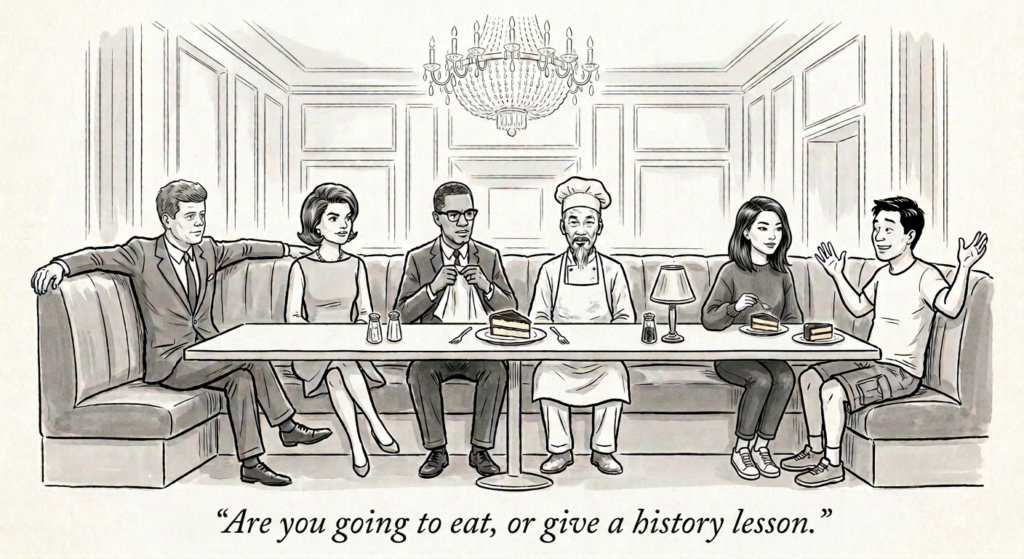
Ruth and I ate at the Parker House. Years ago, before Hong Kong, when we were still in that stretch of the relationship where you do things like eat at historic hotels because you are in love and love makes you willing to pay forty-five dollars for a piece of cake in the city where the cake was invented. The waitress seated us and told us, with the practiced gravity of a woman who had delivered this line four thousand times and still believed it, that we were sitting in the booth where John F. Kennedy proposed to Jacqueline Bouvier. Table 40. Summer of 1953. The hotel has a plaque. Whether it actually happened there or at Martin’s Tavern in Washington is a debate that has outlived Kennedy himself, but the Parker House has the plaque and in Boston, possession of the plaque is nine-tenths of the history.
I told Ruth the other Parker House story, the one the waitress did not mention, the one about the kitchen. Around 1913, a young Vietnamese man named Nguyen Sinh Cung worked the bakery downstairs. Made pastry. Rolled dough. Left Boston, went to London, then Paris, then Moscow, then Guangzhou, then home, where he became Ho Chi Minh, founded a nation, and fought the longest war of the twentieth century against the country whose hotel kitchen had once employed him. Malcolm X bussed tables there in the 1940s. The same building that invented Boston cream pie trained a revolutionary and employed a future civil rights leader. And the senator who proposed at Table 40 would, less than a decade later, take a war that Eisenhower had kept to advisors and expand it to over sixteen thousand American troops, aimed directly at the country led by the man who had once made pastry one floor below his booth.
Ho Chi Minh rolled dough at the Parker House. Kennedy proposed at the Parker House. And then Kennedy sent men to fight Ho Chi Minh’s army in the jungles of Vietnam, where the Viet Cong built the Cu Chi tunnels, which my wife, Ruth, once suggested we visit because she heard “Cu Chi” and her brain autocorrected it to “Gucci.” She walked into those tunnels wearing an American flag shirt so unambiguous it could have been spotted from low orbit, while a tour guide explained, with cheerful specificity, the various traps designed to catch the soldiers that the man at Table 40 had sent to catch the man in the basement. She emerged sweating, grinning, and asked if there was a gift shop.
Ruth looked at me across the table at the Parker House while I explained all of this. She looked at her plate. She looked back at me. ‘Are you going to eat, or give a history lesson?’ She picked up her fork and ate her Boston cream pie in the booth where a future president proposed to a future first lady, in a hotel where a future revolutionary rolled dough and a future civil rights leader cleared plates, and she said, ‘This is good,’ and that was the entire review.
The Parker House is a building that does not know what it contains. It just puts people in rooms and makes pastry and lets history unspool. Which, now that I think about it, is exactly what a kitchen does. Which is exactly what Hong Kong does.
Massachusetts also has a Portuguese community, and this matters. Fall River and New Bedford, down on the South Coast, two hours from Adams but part of the same state, the same cultural orbit. Portuguese from the Azores started arriving when New Bedford was the whaling capital of the world, then stayed and filled the textile mills after the whales ran out. Nearly fifty thousand Portuguese immigrants live in Massachusetts today. Another quarter million claim Portuguese ancestry. They are the sixth-largest national origin group in the state, after the Irish, the Italians, the English, the Germans, and the Polish, and the Polish I can speak to personally because Adams was built by French-Canadian and Polish mill workers whose surnames were designed by people who did not believe in vowels.
In Fall River, at Barcelos Bakery, and at Europa Pastries, and in New Bedford at Goulart Square Bakery, they make pastéis de nata. The real ones. Family recipes brought over from the Azores or inherited with the bakery lease. Flaky crust, caramelized custard, the blistered top, the whole thing served warm in a paper cup for a couple of dollars. These are the same pastries that traveled from Lisbon to Macau and became the Macanese egg tart, which exists forty miles from the Hong Kong egg tart, which was born from the English custard tart, which arrived via Guangzhou, which was the only port the British could use, which is how the whole thing started.
I did not connect any of this until I moved to Hong Kong. I did not realize that the Portuguese custard tart I could have driven two hours to eat in Fall River was a cousin of the egg tart I was now eating three times a week in Mong Kok. I did not realize that the Boston cream pie, the official dessert of the state I come from, was built on the same principle, custard inside pastry, cultures crossing inside a crust. I did not realize that my entire gustatory biography had been quietly preparing me for this city, this marriage, this life, the one where nothing is purely one thing, where everything is a blend, where the best version of anything is usually the version that let more than one tradition into the kitchen.
Ruth, my wife, does not share my reverence for the egg tart’s origin story. Ruth is from Hong Kong. Ruth has eaten egg tarts since before she had opinions about anything else, which was early, because Ruth has opinions, constantly. To Ruth, the egg tart is not a symbol. It is not a metaphor. It is not a cross-cultural miracle of culinary migration. It is a thing you eat at three in the afternoon with milk tea, and if you want to keep talking about the history of custard you can do that alone because she has errands.
She does, however, have a ranking. Ruth has a ranking for everything. Dim sum restaurants. Hiking trails. Weird English names adopted by locals, such as Kinky. Neighbors I am not allowed to disparage. And egg tarts. Her egg tart ranking is non-negotiable, internally consistent, and governed by laws I have never been shown but am expected to follow.
Tai Cheong Bakery is on the list. It has to be. Tai Cheong makes the classic shortcrust style, the cookie-crust version, buttery and crumbly with a smooth, glossy custard that sets just firm enough to hold its shape when you bite through the shell. Chris Patten, the last British governor of Hong Kong, the man who oversaw the handover in 1997, used to eat there. They called him Fat Pang. He loved the egg tarts so much that the bakery became famous partly on the strength of his appetite. Patten came back years later and reportedly had to turn down the egg tarts because his wife Lavender put him on a diet, and every newspaper in the city covered the fact that the last governor of Hong Kong could no longer eat his favorite snack, which tells you everything you need to know about what this city considers newsworthy.
Then there is Honolulu Coffee Shop in Wan Chai which had been open since the 1940s and recently closed. It made the other kind, the puff pastry version, dozens of flaky layers that shattered when you bit into them and left crumbs on your shirt that you found hours later and ate without shame because you were on the MTR and nobody was watching and the crumb still tasted good. There is Kam Wah Cafe in Mong Kok, which does the puff pastry with a crispness that borders on architectural. Ruth has opinions about all of them. I am informed of these opinions. I am not consulted.
And then there is Bakehouse.
Bakehouse is what happened when a Swiss chef named Grégoire Michaud, who had been living in Hong Kong for over two decades, looked at the egg tart and thought: I can do something with this. He started Bakehouse in 2013 as a wholesale operation, opened his first storefront in Wan Chai in 2018, and created a sourdough egg tart that uses leftover croissant dough, laminated and fermented and baked into something that is flaky in a way that the traditional versions are not, with a custard that sits somewhere between a classic dan tat and a crème brûlée. People line up for it. In the rain. In August heat that feels like being slowly digested by the atmosphere. He now has eight locations across the city and people buy the tarts and resell them across the border in mainland China, which is either a testament to how good they are or a sign that the egg tart economy has gone completely off the rails, and possibly both.
A Swiss man, in a Chinese city, making a sourdough version of a Cantonese pastry that was adapted from an English custard tart that was influenced by medieval French baking, and the whole thing is now being resold at a markup in Shenzhen. The egg tart does not stay still. It has never stayed still. It crosses every border it meets.
This is Hong Kong. This is why I live here. This is the thing I cannot explain to people at dinner parties in Singapore or London when they say “oh, Hong Kong, I’ve heard it’s changed,” and I do not engage because I am fifty-six years old and I do not have the evening to spare. The city has changed. Of course it has changed. Everything changes. But the thing underneath has not changed, the thing that makes this place unlike any other place, which is that Hong Kong is what happens when you put East and West in a kitchen together and refuse to let either one leave until they’ve made something new.
The egg tart is that. The cha chaan teng is that. The whole city is that. Milk tea made with an old stocking. French toast with peanut butter and condensed milk. A transit system that runs with Swiss precision underneath streets where a woman is yelling at a fishmonger in Cantonese so fast that I, after fifteen years, can only pick up every fourth word, and every fourth word is a price she refuses to pay. A city that looked at a steep hill and built the longest outdoor escalator system in the world because the alternative was walking and walking was inefficient. A city where I walk home at three in the morning through any neighborhood without a thought, not without a second thought, without a first thought, where children ride the MTR to school alone and nobody calls it negligence because nobody calls it anything, it is simply Tuesday.
I come from a town where people left their doors unlocked and their keys in their cars and every adult on every porch knew my name. That was trust built on knowing. Everyone knew everyone. The web of acquaintance was the lock. Hong Kong’s trust is different. Nobody in my building knows my name. My barber of ten years does not know my name. The trust here is structural, anonymous, built not on the density of knowing but on a collective agreement that the system works and we will all operate within it. You return the wallet because returning the wallet is what is done. You do not touch the bag on the chair because the bag on the chair is not yours.
Adams and Hong Kong. A town of eight thousand and a city of eight million. They should have nothing in common. They have the one thing in common that matters, which is that both of them are places where trust is ambient, where safety is not a calculation but a climate, where you can be a kid on a train with a backpack or a kid at a lunch counter with a dollar and the world will hold you.
Ruth is the bridge. Ruth is the egg tart. Ruth is the thing that happened when one tradition met another tradition and the result was something that could not have existed without both and does not fully belong to either. A woman from a city of eight million who married a man from a town of eight thousand, who thought the Cu Chi tunnels were a Gucci outlet, who once got a jackfruit seized by a federal agent with a .357 Magnum, who navigated me to a medical complex instead of a department store, who has carried me across every border I have ever crossed including the ones I did not know I was crossing, who sits across from me in a cha chaan teng in Mong Kok on a Tuesday afternoon eating an egg tart with the focus and efficiency of a woman who has done this ten thousand times and will do it ten thousand more.
She eats the cookie crust version. I eat the puff pastry. We have never agreed on this. We have never agreed on anything that involves crust, temperature, the appropriate number of blankets on a bed, or the correct volume at which to discuss egg tart rankings in public. We agree on the custard. The custard is the middle.
There is no other city in the world where a pastry could contain this much. Where a three-inch tart could hold the English and the Portuguese and the Cantonese and the Swiss and a man from the Berkshires who once ate Boston cream pie without thinking about it and now eats egg tarts every week thinking about all of it. No other city could produce this particular object, this small warm thing that tastes like what happens when you stop trying to keep traditions separate and just let them cook.
I have lived here for fifteen years. I have eaten thousands of these. I will eat thousands more. And every single one of them, still warm, crumbs on my shirt, custard the color of late afternoon, will taste the way this city tastes to me, which is the way home tastes when home is a place you chose and a place that chose you back and a place that cannot be explained to anyone who has not stood inside it and bitten through the crust and found out what was underneath.
East and west. Cookie crust and puff pastry. Adams and Hong Kong. Ruth and me.
The custard doesn’t pick sides.