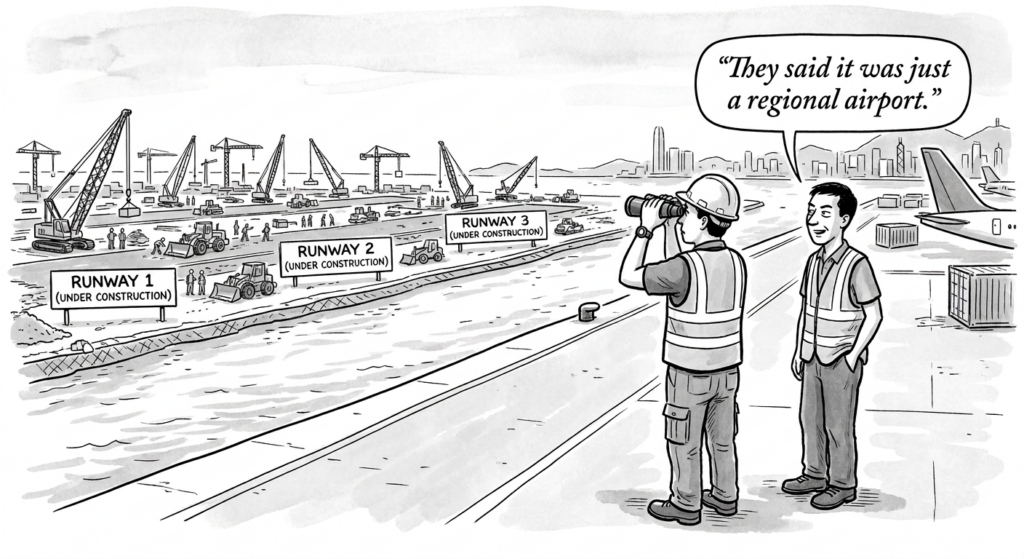
The Greater Bay Area’s airport building spree is creating world-class cargo capacity faster than the freight to fill it. The question is whose volumes it cannibalises first.
When Shenzhen Airport broke ground on its North Cargo Area on 23 August, alongside the Terminal 2 complex, the press release confined itself to the language of national planning: 14th Five-Year Plan, regional gateway, strong support for Guangdong-Hong Kong-Macao Greater Bay Area development. The numbers, however, said something sharper.
The facility, situated between the new Terminal 2 and the airport’s third runway, which began operations on 29 November, covers 804,000 square metres of site area with 570,600 square metres of floor space. Once operational, the North Cargo Area is expected to add more than 1.8 million tonnes of annual cargo and mail handling capacity. For context, that single facility’s design capacity is equivalent to roughly 36% of Hong Kong International Airport’s entire 2025 throughput of 5.07 million tonnes.
It is not the only concrete being poured.
An infrastructure arms race with 11 runways
Exactly one month before Shenzhen’s third runway opened, Guangzhou Baiyun International Airport inaugurated its fifth runway and Terminal 3, completing a CNY53.77 billion Phase III expansion. Baiyun became the first civil airport in China to operate five commercial runways, lifting its design capacity to 120 million passengers and 3.8 million tonnes of cargo.
Meanwhile, HKIA’s own three-runway system reached full operation in the second half of 2025. Across the three airports, the Greater Bay Area now operates 11 commercial runways. By the time Shenzhen’s North Cargo Area is complete, creating what the airport calls a “3+3+3+1” configuration of three terminal areas, three cargo areas, three runways and one satellite hall, the GBA’s combined designed cargo capacity will comfortably exceed 10 million tonnes a year.
The region’s combined actual throughput in 2025, however, was roughly 9.5 million tonnes: HKIA at 5.07 million, Guangzhou at 2.44 million and Shenzhen at 2.05 million. That leaves a question hanging over every steel beam being welded in the Pearl River Delta: is the GBA building infrastructure for a future freight boom, or for a zero-sum reallocation of existing flows?
The proximity play
Shenzhen’s pitch to shippers is brutally simple: skip the border. The airport sits inside mainland China’s customs territory, adjacent to the electronics manufacturing heartland that stretches from Bao’an through Dongguan. For export cargo that currently trucks to HKIA, crossing a border, clearing customs, and absorbing the costs of Hong Kong handling, Shenzhen offers a shorter, cheaper, single-jurisdiction alternative.
The numbers suggest that argument is already landing. Shenzhen’s cargo throughput hit 2.05 million tonnes in 2025, up 9% year on year, with international and regional cargo exceeding one million tonnes for the first time, making it only the third mainland airport to clear that bar. SF Airlines, the freight arm of SF Express and Shenzhen’s anchor cargo carrier, now operates freighter services to Los Angeles, Chennai, Bengaluru and across Southeast Asia. UPS maintains an Asia-Pacific cargo hub at the airport. New international cargo routes to Miami, Delhi and Jakarta were added in 2025 alone.
When the North Cargo Area comes online, alongside a third runway capable of handling the largest widebody freighters, Shenzhen will have the physical infrastructure to handle 4.5 million tonnes annually. That is not a feeder airport’s ambition. It is a direct competitor’s.
HKIA’s network moat
Hong Kong is not standing still, and its defenders would argue proximity to the factory is only half the equation. The other half is the network, and HKIA’s remains hard to match: roughly 140 airlines connecting to more than 220 destinations worldwide, deep freighter frequency, a free-port customs regime, and pre-arrival clearance that no mainland airport can replicate.
HKIA’s most creative counter-move is the Dongguan Logistics Park, a sea-air intermodal facility where GBA export cargo can be security-screened, palletised and accepted by airlines in Dongguan before being shipped by vessel directly to HKIA’s airside. Since the pilot launched in early 2023, the facility has handled cargo valued at over RMB57 billion, with 30 airlines and 144 agents now participating. Its Phase 1 permanent facility, targeting annual capacity beyond one million tonnes, is expected to be fully operational in 2027. UPS, for its part, began construction of a new HKIA hub in March 2026, capable of handling nearly one million tonnes annually by 2028.
That is a clever answer. Essentially, Hong Kong is trying to extend its customs territory to the factory door rather than waiting for the factory to choose Shenzhen’s. But it adds a layer of intermodal complexity that a direct truck-to-tarmac route at Shenzhen does not require.
Winners, losers and unanswered questions
The clearest winners in the near term are shippers and forwarders operating in the GBA, who will have real optionality: three world-class airports within 150 kilometres of each other, all fighting on rates, handling speed and connectivity. Forwarders adept at arbitraging between the three gateways will find new margins.
The losers are harder to identify before the music stops. If air cargo volumes in the GBA continue growing at high single digits, fuelled by cross-border e-commerce, semiconductor exports and the broader reshoring of manufacturing closer to Southeast Asian demand, there may well be enough freight to keep all three airports busy. Shenzhen’s cross-border e-commerce air volumes alone grew 65% in 2024.
But if growth slows, or if tariff headwinds deepen, the infrastructure surplus could become a rate war. And in a rate war fought on handling costs, Hong Kong, with the most expensive real estate and labour in the delta, starts at a disadvantage.
The unanswered question is whether HKIA’s network density is a lasting advantage or a shrinking one. Every new freighter route Shenzhen adds, and it is adding them quickly, narrows the connectivity gap. If a shipper can get a direct freighter to Los Angeles or Frankfurt from Shenzhen at a lower all-in cost, the question “why route via Hong Kong?” becomes harder to answer with “because we have more destinations.”
The GBA is building enough cargo infrastructure for two global hubs. It already has one. The next five years will determine whether it gets a second, or whether 1.8 million tonnes of new capacity simply redistributes what Hong Kong used to consider its own.