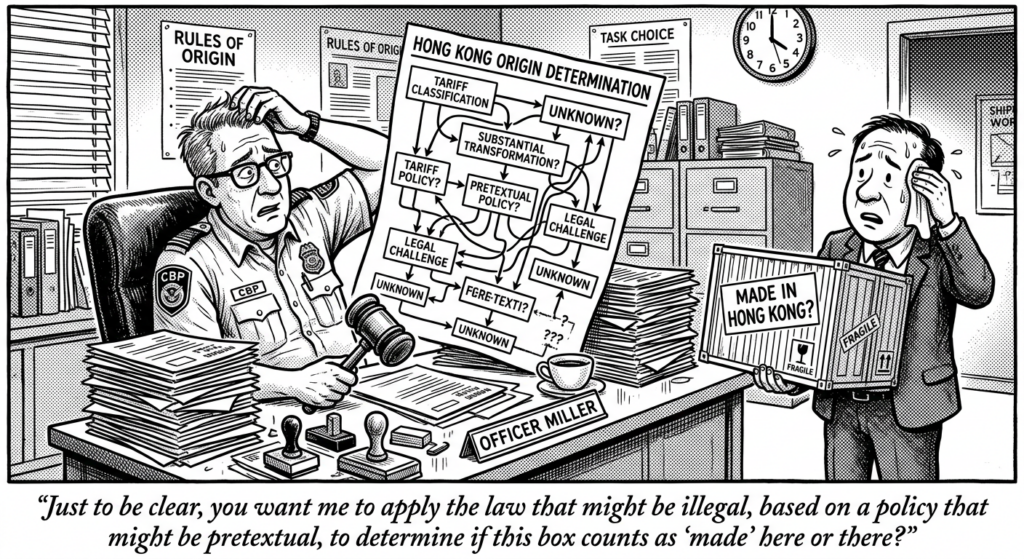
The 12.5 percent Section 301 duty is live and collecting. But a fast-tracked court challenge argues it was never really about forced labor at all, and the logistics consequences of the legal limbo are already mounting.
Twenty-five US states are now Suing to Kill the Tariff that treats Hong Kong like a forced-labor economy.
When the Office of the US Trade Representative imposed a 12.5 percent tariff on Hong Kong-origin goods on July 24, it did so under a rationale that would have struck most trade lawyers as novel even by 2026 standards: that Hong Kong has failed to ban imports produced with forced labor. The territory was placed in the higher penalty tier, at 12.5 percent, alongside mainland China, Brazil, Australia, New Zealand, Singapore, Norway, and Israel, among others, all deemed not to have enacted a forced labor import prohibition. Economies that had adopted or committed to adopt such a prohibition, a group that includes the EU and Canada, received a lower rate structure capped at 10 percent.
The tariff is collecting. CBP began assessing the duty on all Hong Kong-origin goods entered for consumption from that date.
But if the legal theory is unusual, the political response has been fierce. On August 3, a coalition of 25 US states, co-led by Oregon Attorney General Dan Rayfield, Arizona Attorney General Kris Mayes, and California Attorney General Rob Bonta, filed suit in the US Court of International Trade seeking to block the tariffs entirely. Their argument is blunt: the forced labor investigations, opened on March 12 and concluded just over four months later with tariffs on 60 economies, were not a genuine exercise in trade policy. They were a rushed workaround to replace the IEEPA tariffs that the Supreme Court had already struck down.
The states’ case
The coalition’s complaint uses the administration’s own timeline against it. The Section 301 statute contemplates investigation periods of up to 12 or 18 months. These investigations covered 60 economies in roughly 130 days from initiation to imposition, with a comment process that multiple state attorneys general described as perfunctory. The Nevada AG’s comment letter, submitted during that window, argued the tariffs would function as a consumer tax with no meaningful connection to forced labor enforcement.
The states also point to a damning sequence. The Supreme Court struck down the IEEPA tariffs on February 20. The administration imposed a 10 percent global tariff under Section 122 the same week. Three weeks later, on March 12, it initiated the Section 301 forced labor investigations, covering virtually every US trading partner. The CIT then struck down the Section 122 tariffs on May 7 as exceeding presidential authority. And on July 23, with the Section 122 duties set to expire the next day, the administration finalized the Section 301 tariffs at rates that closely mirrored the duties courts had already invalidated. As one trade law analysis put it, the complaint effectively accuses USTR of using officials’ own words against them to show that the forced labor rationale was reverse-engineered from a revenue target.
The legal challenge is not purely a states’ affair. Multiple importers filed parallel suits in late July, and the CIT has consolidated them, selecting Learning Resources, a US toy company, as the sample case. A summary judgment hearing is scheduled for September 30 in New York. That is extraordinarily fast for trade litigation, and it signals the court recognizes the stakes.
Why Hong Kong is the odd case out
Hong Kong’s inclusion in the 12.5 percent tier deserves specific scrutiny, though perhaps not for the reasons most commentators assume. The 12.5 percent rate does not designate the worst labor-governance regimes on earth. It applies to every investigated economy that has not enacted a specific forced labor import ban, and that list includes Australia, New Zealand, Norway, Israel, and Singapore. The distinction is legislative, not moral. But the practical effect, for Hong Kong, is that its tariff rate is now identical to mainland China’s, and the optics of that equivalence carry weight well beyond the 2.5 percentage point difference between the two tiers.
The US historically ran a significant trade surplus with Hong Kong, one of its largest globally. Hong Kong’s domestic exports to the United States are modest. The territory’s role in US-bound trade has been overwhelmingly as a transshipment, re-export, and services hub rather than a manufacturing base. The volume of genuinely Hong Kong-origin goods entering the US is a fraction of what flows through the city.
That makes the practical tariff bite smaller than the headline rate suggests, but the symbolic and procedural damage is significant. By placing Hong Kong in the same tier as mainland China, the administration has effectively erased any tariff distinction between the two. The Bureau of Industry and Security already treats Hong Kong identically to mainland China for export controls. The Section 301 action now extends that equivalence to the tariff side.
For logistics operators, the signal is contradictory. Washington has, in other contexts, signaled flexibility toward Hong Kong. But it has simultaneously imposed a tariff that treats the territory as having the same forced labor import framework as economies that have simply never enacted a prohibition, a group that, again, includes some of the most governed economies on the planet. Compliance teams working HK-origin shipments now face a duty that their own government may invalidate within months.
The limbo problem
That is the operational reality that matters most to forwarders and importers routing goods through or from Hong Kong. The tariff is live. CBP is collecting. But a court hearing four weeks away could produce a ruling that puts the entire legal basis in jeopardy.
Importers face the classic tariff-limbo calculus. Pay the 12.5 percent, file for refunds later if the court strikes it down, and absorb the cash-flow hit in the meantime. Reclassify origin to avoid the duty, risking a CBP audit if the reclassification looks aggressive. Or reroute entirely, abandoning Hong Kong as an origin or consolidation point for US-bound goods.
None of those options is free. And the uncertainty is compounded by the fact that the CIT has not yet granted the states’ request for an immediate stay on collection, meaning the duty continues to accrue even as the legal challenge proceeds.
What to watch
The September 30 hearing is the inflection point. If the CIT rules that the forced labor rationale was pretextual, as the states argue and as the court’s prior skepticism of this administration’s tariff authorities suggests it might, the 12.5 percent rate on Hong Kong could be vacated entirely, with refunds owed to every importer who paid it.
If the tariff survives, it cements a new reality: Hong Kong, for US trade purposes, is mainland China. The already-thin volume of HK-origin goods entering the US will get thinner. And the city’s remaining utility as a trade facilitation hub, separate customs territory, distinct regulatory environment, free port, takes another hit.
Twenty-five American states are betting, with their attorneys general’s signatures and their taxpayers’ legal budgets, that this tariff is illegal. Hong Kong’s logistics community should be paying very close attention to who wins.