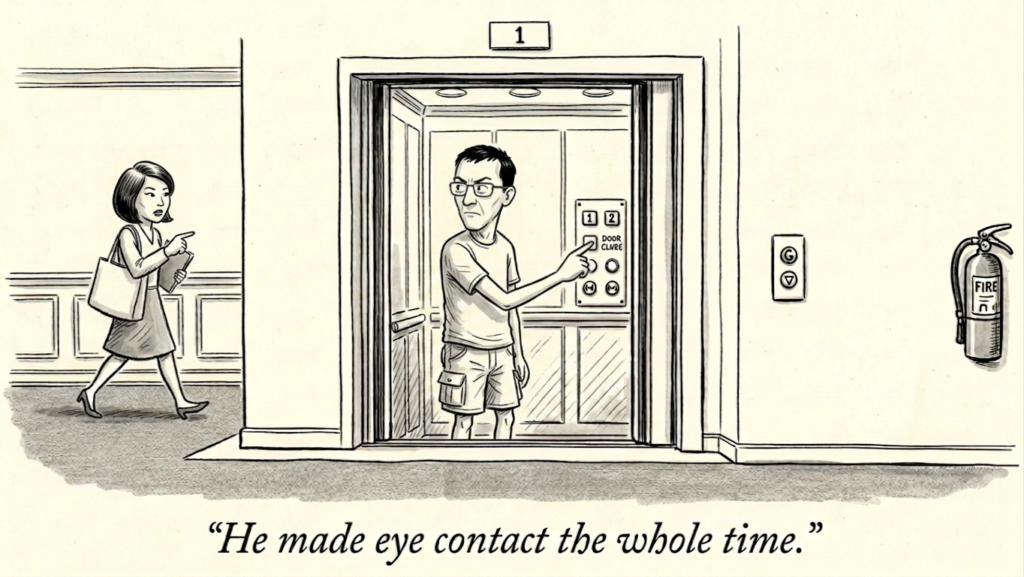
On doors that close, doors that don’t open, and why a man from a town where everyone holds everything for everyone has learned to lead with his shoulder.
There is an elevator in our building in Mei Foo that I ride every day, and every day it teaches me something about the city I live in, and every day the lesson is the same lesson, and every day I do not learn it.
The lesson is this: in Hong Kong, the door is not a shared resource. The door is a competitive event.
Here is what happens. The elevator arrives at the ground floor. The doors open. I am inside the elevator. I am standing in the elevator with the reasonable expectation, developed over a lifetime of riding elevators in countries where the basic Newtonian physics of human bodies are respected, that the people waiting outside will allow me to exit before they enter, because I am a physical object occupying a space that they wish to occupy, and two physical objects cannot occupy the same space at the same time, and this is not a philosophical position, this is not a cultural preference, this is a law of the universe that predates Hong Kong, that predates elevators, that predates the concept of ground floors, and yet.
The doors open and they come in.
Not after I leave. Not as I leave. Before. The doors part and the people outside begin moving inward with the focused, unhesitating momentum of a liquid filling a container, and I am the thing in the container that has not yet been poured out, and the liquid does not care. The liquid does not see me. The liquid sees the space behind me and has decided that the space is available and that my continued presence in it is a temporary logistical inconvenience that will resolve itself through the application of sufficient pressure.
I am a large man. I am not a small object that can be displaced by a stiff breeze. I am a man from Adams, Massachusetts, where my grandfather worked in the mills and my frame reflects several generations of people who did not leave food on the plate. And yet I have been moved, bodily, backward, back into the elevator I was trying to leave, by a woman who weighed approximately ninety pounds and was carrying two bags of groceries and a folded umbrella and did not break stride. She flowed past me the way water flows past a rock in a stream. She did not make eye contact. She did not adjust her trajectory. I was an obstacle. She was physics. Physics won.
Ruth says I am being dramatic. Ruth says this is how elevators work in Hong Kong. Ruth says that if I want to exit an elevator in this city I need to commit, that the problem is not the people coming in but my hesitation, that I pause at the threshold the way a man from Massachusetts pauses, which is to say I wait for the implicit social negotiation in which both parties acknowledge each other’s existence and agree, through a microsecond of eye contact and a slight adjustment of angle, on who goes first.
That negotiation does not exist here. There is no microsecond. There is no eye contact. There is no implicit agreement. There is the door, and the door is open, and the open door is an invitation, and the invitation is accepted immediately, from all directions, by everyone, simultaneously, and if you are inside the elevator when the invitation is accepted you have approximately one-third of a second to establish forward momentum or you will be living in that elevator now.
And if you are outside the elevator, if you are approaching the elevator, if you are walking toward the elevator at any pace that communicates intent, if you are fifteen feet away and your eyes have met the eyes of the person inside and there has been a moment, a clear and unmistakable moment, in which both parties have acknowledged that a human being is approaching and would like to ride in the elevator, the person inside will press the close button. Not the open button. The close button. They will press it with the calm, deliberate focus of a person launching a missile, and the doors will begin to close, and you will watch them close, and the last thing you will see through the narrowing gap is the face of a person who has looked at you, seen you, understood you, and decided that your arrival at your floor is not worth the four seconds it would cost them to hold the door. I have watched a woman make eye contact with me from inside an elevator, hold that eye contact, and press the close button while still holding it, the way a villain in a film holds eye contact with the hero as the blast doors shut between them. There was no malice in it. There was no guilt. There was a calculation, a small, instantaneous, perfectly Hong Kong calculation that determined the cost of waiting for me was greater than the cost of not waiting for me, and the cost of not waiting for me was zero, because I am a stranger, and in Hong Kong, a stranger’s time is not your problem, and a stranger’s floor is not your floor, and a stranger’s elevator is not your elevator even when you are both standing in it.
I have done this to people. I need to admit this. I have become the villain in the blast doors. There is an elderly woman in our building, she is eighty-something, she is five feet tall, she is lovely, and she wants to know my life story every time we are in the elevator together. Not a different chapter each time. The same life story. The whole thing. From the beginning. Where are you from, what do you do, how long have you been in Hong Kong, do you like Hong Kong, is your wife Chinese, do you have children. I have answered these questions twenty times. I have answered them with patience and warmth and the full conversational commitment of a man from Adams where you do not rush an elderly person and you do not cut a conversation short and you stand there and you answer because that is what you do. And she has forgotten every answer every time, because she is eighty-something and the elevator ride is thirty-five seconds and her memory resets between floors the way a goldfish’s memory resets between laps of the bowl, and every ride is our first ride, and every conversation is our first conversation, and I cannot do it again. I cannot tell her I am from Massachusetts again. I cannot explain where Massachusetts is again. So when I see her in the lobby, approaching, moving at the pace of a woman who has nowhere to be and all day to get there, I press the close button. I press it the way the woman pressed it on me. I press it with eye contact and without guilt and the doors close and I ride up alone in the silence and I am not proud of this but I am not sorry either, because Hong Kong has taught me something that Adams never did, which is that the close button is there for a reason, and the reason is the thirty-five-second autobiography you cannot survive a twenty-first time.
In Adams, a door is a social contract. A door is a test of character. A door is the simplest, smallest, most fundamental unit of human decency available to a person in public life, and in Adams, you hold it. You hold the door for the person behind you. You hold it if they are ten feet away. You hold it if they are twenty feet away and now they have to do that awkward half-jog to close the distance because you committed to holding it from too far away but you are not going to let go now because letting go would mean you are the kind of person who gives up on a door and in Adams that kind of person does not exist. You hold the door at the post office. You hold the door at the Bounti Fare even though the Bounti Fare has not earned the gesture since the Carter administration. You hold the door for old women and young women and men and children and people you like and people you don’t like and people you have never seen before and will never see again and the whole thing takes two seconds and costs nothing and confirms, in those two seconds, that you are a human being who has noticed that another human being is behind you and has decided, freely and without expectation of reward, to make their passage through the world one door easier.
I have held exactly four doors in Hong Kong that were acknowledged.
Four. In over a decade. Four doors held, four nods received. I remember all four the way you remember compliments in a marriage: vividly, specifically, and with the knowledge that the intervals between them are long enough to make a person question whether the gesture has any value at all in this jurisdiction. Every other door I have held has passed through the hand of the person behind me with the awareness of a person walking through air. The door is open. The door is held. The person walks through. The person does not look at me. The person does not nod. The person does not slow down. The person walks through the held door the way the person walks through the automatic doors at the MTR station, as though the door opened on its own, as though doors simply open in the presence of their magnificence, as though I am a sensor and they have triggered me and the transaction is complete and no human being was involved.
Ruth says I need to stop holding doors. Ruth says that holding a door for a stranger in Hong Kong communicates nothing because the cultural expectation is that the door is everyone’s problem and no one’s gift. Ruth says I am applying Massachusetts firmware to Hong Kong hardware and the system is not compatible and I need to update.
I have not updated. I hold the door. Every time. I hold it and the person walks through without looking and I stand there like a man in a tuxedo greeting guests at a party that nobody told him was cancelled, and then the next person walks through, and the next, and I have now been holding this door for forty-five seconds and six people have passed and I am no longer a man holding a door, I am a doorman, I am an unpaid employee of this building, and the seventh person sees me and does not slow down and the eighth person sees me and does not slow down and finally I let go and the door closes and nobody noticed it was open and nobody will notice it is closed and I walk away with the particular, quiet indignation of a man whose courtesy has been absorbed into the infrastructure and rendered invisible.
The MTR is worse.
The MTR is the elevator problem at scale, multiplied by seven million people and compressed into a steel tube that arrives every three minutes during rush hour and every two minutes during peak and the doors open for approximately twelve seconds and in those twelve seconds an entire civilization reveals itself.
I take the Tsuen Wan line from Mei Foo to Central most mornings. The train pulls in. The doors open. I am on the platform. There are people inside the train who wish to exit. I know this because I can see them. I can see them standing at the door, positioned, ready, waiting for the doors to part so they can step out onto the platform and continue their lives. I can see them and I understand their intention and I have stepped to the side, the way the yellow line and the announcements and the basic architecture of every mass transit system ever designed suggest that I should, and I am waiting.
Nobody else is waiting.
The doors open and the platform surges forward. Not the whole platform. The people on the platform. They move toward the open doors the way water moves toward a drain, with gravitational inevitability, and the people inside the train who are trying to exit are now trying to exit against the current, against a tide of incoming humanity that has looked at the open door and seen not an exit but an entrance and has committed to that interpretation with the full force of a population that has been optimizing movement through small spaces for longer than most countries have had trains.
The result is a collision. Not a violent collision. Not an angry collision. A collision conducted with the bland, impersonal efficiency of molecules in a gas, bodies pressing against bodies, shoulders meeting shoulders, bags meeting bags, and nobody is upset, nobody is angry, nobody is outraged, because outrage would require the belief that what is happening is wrong, and nobody here believes it is wrong, because this is how it works, this is how it has always worked, this is the system, and the system is: the door opens and you go.
In Adams, if you tried to board a bus before the people inside had gotten off, the driver would look at you. That’s all. He would look at you. One look. And in that look would be the entire social history of a town where people wait their turn because turning is waiting and waiting is turning and the whole thing has been sorted out since before the bus existed. You would step back. You would wait. The people inside would exit. You would board. The driver would nod. Order would be maintained. Civilization would endure.
On the MTR, civilization has been replaced by fluid dynamics.
And it is not just the train. The escalator. The escalator has rules. The rules are simple. The rules are known. The rules have been communicated through signage and announcement and the accumulated institutional memory of a city that moves more people per day through more escalators than any other city on earth. Stand on the right. Walk on the left. Two rules. Two sides. A binary system so clean, so elegant, so fundamentally intuitive that a child could follow it, and children do follow it, and tourists follow it, and businessmen in suits follow it, and then, once every three escalator rides, a person stands on the left.
They stand on the left the way a boulder sits in a river. They do not know they are on the left or they do not care they are on the left or they have decided that the left is where they wish to be and the wishes of the four hundred people stacking up behind them are not their concern. The line builds. The pressure builds. Nobody says anything. This is Hong Kong. Nobody says anything. In Adams, someone would say something. In Adams, someone would say “excuse me” or “on your left” or, if sufficient time had passed, simply relocate you with one hand the way you’d move a trash can that was blocking the driveway, and then nod at you at Mass the next morning as though nothing had happened, because nothing had happened, because in Adams, moving a person who is in the way is not a confrontation, it is a public service. In Hong Kong, the silence holds. The silence is the sound of a city that has decided that confronting a stranger on an escalator is worse than being late to work, and the city has made its choice, and the choice is lateness.
I have said something. Once. I said “excuse me” to a man standing on the left of the escalator at Central station during morning rush hour. He turned around. He looked at me. He did not move. He looked at me the way you look at a television that has made an unexpected sound, with mild curiosity and no intention of doing anything about it. He turned back around. He continued standing. I continued standing behind him. We rode the escalator together in silence, two men with fundamentally different understandings of what the left side of an escalator is for, and when we reached the top he walked away and I walked away and nothing had changed and nothing would ever change and I understood, in that moment, that I was not going to win this one.
There is a food court near our building in Mei Foo that I visit more often than a man with a wife who cooks should admit to, because Ruth cooks on weekends and Ruth is a good cook and the food at home is better than the food court by every objective measure, but the food court has something that home does not, which is the spectacle, the theatre, the weekly confirmation that I am living in a city whose relationship with shared space operates on principles I was not taught and cannot learn and will never stop finding magnificent. The food court has tables. The tables are shared. This is Hong Kong. Everything is shared. The tables are shared the way the elevator is shared and the MTR is shared and the escalator is shared, which is to say: competitively.
You cannot get a table by arriving at a table. You get a table by placing a tissue pack on a table.
I need you to understand the tissue pack system because the tissue pack system is the most Hong Kong thing I have ever encountered and I have encountered the spreadsheet and the bridging calendar and the prawn audit and the Centurion Card point-harvesting operation and none of them are as perfectly, as elegantly, as maddeningly Hong Kong as the tissue pack system.
A tissue pack is a small plastic packet of tissues that costs four dollars at 7-Eleven and is carried by every person in Hong Kong at all times, not because every person in Hong Kong has allergies but because every person in Hong Kong needs to be able to claim a table at a food court at a moment’s notice. The tissue pack is placed on a chair. The tissue pack on the chair means: this seat is taken. The person who placed it is not at the table. The person who placed it may be across the food court ordering noodles. The person who placed it may be in the bathroom. The person who placed it may have left the building entirely. It does not matter. The tissue pack is there, and the tissue pack has authority, and the authority of the tissue pack is absolute.
Nobody touches it. Nobody moves it. Nobody sits in the chair with the tissue pack on it. A four-dollar packet of tissues on an empty chair in a crowded food court has more jurisdictional authority than a parking meter, more deterrent power than a traffic cone, more legal standing than most contracts I have drafted in my career as a licensed attorney. I have seen food courts at Sunday lunch where every table has a tissue pack on it and nobody is sitting at any of them and the entire room is a ghost town of claimed-but-unoccupied seats while fifty people stand along the walls holding trays of food with nowhere to sit because every seat has been reserved by a small packet of tissues and the social contract says the tissues are sovereign.
In Adams, if you put a tissue pack on a chair and walked away, someone would throw it out. They would assume it was garbage. They would throw it out and sit down and eat and if you came back and said “that was my seat, I put a tissue pack on it” they would look at you the way I looked at the man on the escalator, with mild curiosity and no intention of doing anything about it, and then they would eat your food too, because in Adams, an unattended seat is an empty seat and an empty seat is an invitation and if you wanted the seat you should have been sitting in it.
And then there is the sound.
The sound is a video playing on a phone on the MTR without headphones. The sound is someone else’s TikTok, or someone else’s drama, or someone else’s video call conducted at full volume in a metal tube where the acoustics turn every conversation into a performance. The sound is the thing that made me understand, finally, viscerally, that the concept of shared space in Hong Kong and the concept of shared space in Adams are not the same concept. In Adams, shared space is quiet space. You modulate. You muffle. You are aware that the air between you and the stranger next to you is a commons, and you do not pollute it. In Hong Kong, shared space is just space, and the air is already full, full of announcements and train sounds and the mechanical symphony of a city that never stops making noise, and one more video played at full volume is not a disturbance. It is a drop in an ocean. Nobody flinches. Nobody looks. The man playing the video does not think he is being rude because the concept of rude requires the concept of quiet and the concept of quiet requires a baseline that does not exist here.
I sit on the MTR with my airpods on, listening to nothing, just wearing them as a shield, and I watch the man play his video and I watch the people around him not react and I think about the morning quiet of Park Street in Adams, the early Sunday silence before Mass when the only sound is a car starting and the only movement is a man walking to church in shoes that may or may not have been spray-painted, and I think about how far I am from that silence, and I think about whether I miss it, and the answer is complicated, because the silence of Adams was also the silence of a town that was too small and too known and too tight, a silence that held you in place the way the tissue pack holds the chair, and the noise of Hong Kong is also the noise of a city that does not care who you are or where you came from or whether you hold the door, a noise that lets you disappear, that lets you be nobody, that lets you ride an elevator without being recognized by every person in it, and that freedom, the freedom of being unheld, is the trade you make for the door that nobody holds and the elevator that nobody waits for and the escalator that nobody walks on and the food court seat that a tissue pack owns more securely than you ever will.
I still hold the door. Every time. Ruth walks through it without looking, because Ruth is from here, and then she turns around and sees me holding it for a stranger who also walks through without looking, and Ruth gives me the look, the Ruth look, the look that says you are applying Massachusetts to Hong Kong again and it is not going to work and it has never worked and you have been doing this for over a decade and you still have not learned.
She is right. I have not learned. I hold the door. I step to the side of the elevator. I stand on the right. I do not put a tissue pack on a chair because I cannot bring myself to believe that a tissue pack has legal standing.
And every morning I ride the elevator down and the doors open and they come in before I get out and I do the little sideways dance, the shuffle, the two-step of a man who has not accepted the local physics and probably never will, and I make it out, every time, eventually, and I walk through the lobby and I hold the door and nobody nods and the morning starts and the city does what it does, which is everything, all at once, without waiting, without holding, without pausing to see if the person inside the elevator would like to leave before the next wave arrives.
Ruth calls it efficiency. I call it chaos. The truth is somewhere in the gap between those two words, in the space between a door held and a door ignored, in the distance between a man from Adams who was raised to wait and a city of seven million people who were raised to move, and I have lived in that gap for over a decade now, and I am not on one side or the other, I am in the gap itself, holding a door that nobody asked me to hold, and I am not letting go.
Not because it changes anything. Because it’s mine.