Every January, seven million people sit down and perform the same calculation. It is not about money. It’s about the art of the Long Weekend.
I want to tell you about the morning I discovered that my wife had been running a small logistics operation from our dining table and I had not noticed.
It was the first week of January. I was drinking coffee, French Market, the New Orleans brand with chicory, which I have shipped to Hong Kong at a cost per ounce that would make a reasonable person switch to tea. French Market has been roasting coffee with chicory since 1890, which means it has been in operation longer than Hong Kong has had electricity, and I have been drinking it since college, which means it is one of approximately three decisions from that period of my life that I have not reversed.
Chicory coffee is a Louisiana thing, an old thing, dating back to the Civil War when Union blockades cut off coffee imports and someone in New Orleans decided that the root of a roadside weed, roasted and ground, was a reasonable substitute. It was not. But they mixed it with what coffee they had left and discovered that the combination, bitter and dark and slightly earthy, was better than either ingredient alone, the way some mistakes improve the original recipe by refusing to apologize for what they are. I order it by the case. My wife considers this one of my more manageable eccentricities, which tells you something about the others.
She was at her laptop with her phone beside it and the expression of a general planning a spring offensive. She had not spoken in twenty minutes. I assumed she was doing something for work. I assumed wrong.
On her screen was a color-coded spreadsheet. Rows, columns, tabs running January through December, each one populated in green, yellow, and a shade of red that I would come to understand meant something had gone terribly wrong at the calendar level. It looked like the project management timeline for a mid-sized construction firm. It was, in fact, next year’s public holidays, cross-referenced against both our annual leave balances, the school calendar, airline pricing trends, and what appeared to be the lunar cycle, though I may have been misreading that tab.
It was January second. We were, she informed me without looking up, already behind.
In Hong Kong, a public holiday is not a day. A public holiday is a unit of strategic currency in an annual optimization problem that seven million people attempt to solve simultaneously, and the winners book Hokkaido in October while the losers are still refreshing Skyscanner for flights to Chiang Mai that cost more than their rent.
I did not know this. Where I come from, a long weekend means you might drive to the Cape and sit in traffic for four hours and eat a lobster roll and drive home. You do not plan it. You do not optimize it. You certainly do not open a spreadsheet in the first week of January and map it against blackout dates your company pretends are suggestions but are not suggestions.
My wife does all of this before most people have taken down their Christmas decorations.
I should say here that the spreadsheet, in Hong Kong, is not merely a planning tool. It is a cultural document. It is the Swiss Army knife of daily life, deployed in contexts that would strike most Westerners as either impressive or certifiably insane, depending on temperament. I learned this in stages, and the first lesson came before I had even moved here.
This was before we were married. Before I lived in Hong Kong. I had come to visit Ruth, and she took me to lunch to meet her friends. A dim sum place, a good one, the kind where the tables are round and the food arrives in a continuous stream and you eat until you hate yourself and then someone orders more.
I should pause here to explain the Yahoo Visa card. Yes, Yahoo had a branded credit card. Yes, I carried it. This was the early 2000s, a time when Yahoo was still a company that people respected, or at least a company that existed with confidence, and they had partnered with a bank to offer a Visa card that rewarded you with Yahoo points, redeemable for items in the Yahoo rewards catalog, which was a collection of products that gave the impression of having been curated by someone who had once walked past a SkyMall magazine and thought, “We can do worse.” I was approximately one hundred points away from an AM/FM shower radio. I mention this so you understand where I was in life.
The meal ended. I reached for my wallet. I produced the Yahoo Visa card, which was purple, because of course it was, and I prepared to do what I understood to be the socially appropriate thing, which was to offer to pay for the table because I was the visitor, because Ruth’s friends had been welcoming, and because I had been raised in a town where if someone feeds you, you reach for the check, and if they resist, you resist harder, and the whole thing is a small, performative wrestling match that ends with someone paying and everyone feeling good about the effort.
I did not get to wrestle. One of Ruth’s friends, and I will not say which one, because she is still Ruth’s friend and I would like to continue being Ruth’s husband, looked at my Yahoo Visa card, looked at me, and said, with the calm authority of a person who has made a decision that is not open for discussion, “No, no. It’s okay. I’ll get it.”
She produced an American Express Centurion Card.
For those unfamiliar, the American Express Centurion Card, known colloquially as the Black Card, is not a credit card you apply for. It is a credit card that applies for you. American Express selects its holders by invitation only, generally after you have demonstrated a sustained annual spending pattern in the range of several hundred thousand dollars, not Hong Kong dollars, U.S. dollars, at which point they extend the invitation and you pay an initiation fee of somewhere around ten thousand dollars for the privilege of then paying an annual fee of five thousand dollars for the privilege of owning a card made of titanium, actual titanium, the metal they use in jet engines and hip replacements, because the Black Card is too important to be made of plastic like the Yahoo Visa card of a man who is one hundred points away from a shower radio.
She put the Black Card down. The waiter took it. The bill was paid. I put my purple Yahoo card back in my wallet and felt the way a man feels when he has brought a water pistol to a naval engagement. I briefly considered spray-painting my card black, which would have been on brand for my family. My grandfather once spray-painted his shoes white before church because he could not afford new ones and believed, with the unshakeable confidence of a man from Adams, Massachusetts, that if something looks right from a distance, it is right, and that God does not check the soles. I come from a long line of people who solve problems with hardware store products. But even spray paint has its limits, and I suspected the waiter would notice that my titanium card was bleeding purple at the edges and smelled like a garage.
I assumed she had treated us. This is what “I’ll get it” means in Massachusetts. “I’ll get it” means “I am paying for this meal, and you will get the next one, and we both understand this, and nobody will produce a spreadsheet.”
I was wrong.
Two days later, Ruth mentioned, casually, in the way that a person mentions something that is not casual at all, that I owed her friend for my share of the lunch. Her friend had not treated us. Her friend had paid the bill, on her titanium card, and was now expecting reimbursement from every person at the table, calculated to the dish, because of course it was calculated to the dish, because this is Hong Kong, and in Hong Kong “I’ll get it” does not mean “I’ll get it.” It means “I will process the transaction using a payment method that maximizes my rewards points, and you will reimburse me in full, because I did not become the kind of person who carries a Centurion Card by buying lunch for men with Yahoo Visas.”
She had not treated me. She had swindled me. She had swindled me out of my loyalty points. I was one hundred points from the shower radio. One hundred points. A single lunch would have put me over the top, and instead those points, my points, points I had earned through months of purchasing gas station coffee and online books with a purple credit card that I now understood was a symbol of everything I did not yet comprehend about this city, those points went to a woman who already owned a card made of the same material as a fighter jet.
I never got the shower radio. I think about it sometimes, in the shower, listening to nothing.
The second lesson came years later, after I had moved to Hong Kong, at a birthday party in Tsim Sha Tsui. A friend of a friend, about fifteen people, his apartment. No mention of payment had been made. Had it been, I would not have gone. Multiple courses, wine, the kind of night where the table gets loud and someone orders a second round of prawns because the evening is going well. The party was not good. I was still new enough to assume this was a normal gathering where the host feeds you and you bring a bottle of wine and that is the end of the transaction, the way it works in every other place I have lived.
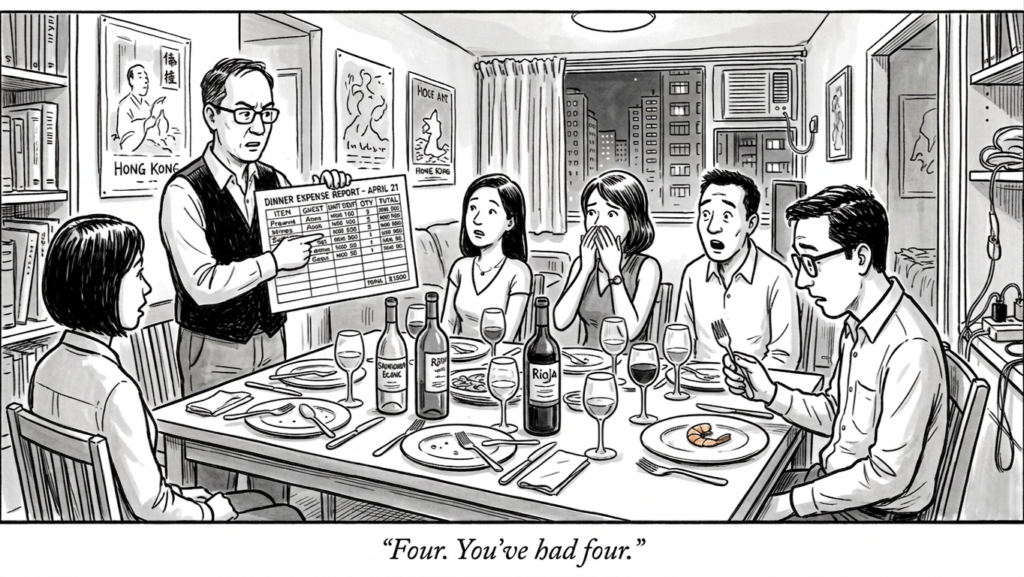
At the end of the meal, the host produced a spreadsheet.
Not a napkin with some numbers on it. A spreadsheet. Printed. With columns. Every dish was listed. Every person’s name ran across the top. Checkmarks indicated who had eaten what. The prawns, the second round of prawns that someone had ordered because the evening was going well, were allocated with a specificity that would have impressed a forensic accountant. If you had eaten three, you paid for three. If you had eaten two, you paid for two. The fish was divided not by portion but by observed consumption. Someone had been watching. Someone had been taking notes. Someone had, while the rest of us were laughing and drinking and having what I had naively understood to be a social occasion, been building a dataset.
I looked at the spreadsheet. I looked at the column with my name on it. I looked at the prawn line, which indicated that I had eaten four, which was correct, and which meant someone at that table had been counting my prawns while I ate them.
In America, if you presented a spreadsheet at the end of a dinner party, people would assume you were joking. And then they would assume you were not joking. And then they would never invite you to dinner again. In the Netherlands, famously, they split the bill to the cent, and the Dutch have been the butt of European jokes about it for centuries. Hong Kong makes the Dutch look reckless. The Dutch split evenly. Hong Kong allocates by unit consumption with documentation. I have since learned that this is not unusual. It is not even considered remarkable. It is considered fair, which it is, and efficient, which it is, and it is also the moment I understood that the spreadsheet in Hong Kong is not a tool. It is a worldview.
I have also since learned the fastest way to make friends in Hong Kong, and it is this: pay for the meal. Not your share. The meal. The whole thing. Just pay. Watch the faces. You will see confusion first, a brief, involuntary spasm of incomprehension, the way a computer looks when you feed it an equation that should not resolve, followed by recalculation, followed by something that can only be described as warmth. You have broken the system. You have declined to participate in the optimization. You have left points on the table, literally, and in doing so you have done something so unusual, so disorienting, so profoundly un-Hong Kong, that people do not know how to categorize you, and in the absence of a category, they default to friendship. I am not saying you can buy friends in Hong Kong. I am saying that if you pick up a dinner tab without being asked and without producing a spreadsheet, you will be remembered with a fondness that borders on reverence, because you have done something that nobody in this city does voluntarily, and the rarity of the gesture is what gives it power. I do this now. Not often, because I am not wealthy, but strategically, because I have learned that in a city where every transaction is tracked, an untracked act of generosity is the most disruptive thing you can do.
The holiday spreadsheet is that same instinct applied to time.
Hong Kong gets seventeen public holidays a year. Seventeen. This sounds generous, and it is generous, until you understand that generosity in Hong Kong is not received with gratitude. It is received with a calculator. Because the question is never how many holidays you get. The question is how many fall on a weekday, and of those, how many are adjacent to a weekend, and of those, how many can be turned into four- or five-day weekends by sacrificing a single day of annual leave.
This is called bridging. I did not know it was called bridging. I did not know it had a name. I did not know that an entire population could look at a Thursday public holiday and a Saturday and see the Friday between them not as a workday but as a structural weakness to be exploited.
My wife showed me the math once. Easter: take one day, get five. Buddha’s Birthday: depending on placement, take one day, get four. Dragon Boat on a Monday: free. No leave required. A gift from the calendar gods. The October cluster, National Day plus the day after Mid-Autumn, can, in a good year, produce a stretch so long it almost feels irresponsible, a week or more of freedom built from two days of leave, a magic trick performed annually by an entire population.
A colleague of mine, a woman in her mid-thirties who works in compliance and speaks about regulatory frameworks with the enthusiasm of someone describing wallpaper, transforms completely in January. She becomes an architect. She maps the year the way a chess player maps a board, not for what it shows but for what it makes possible. I once heard her describe a Tuesday-Wednesday Lunar New Year break, combined with a Monday leave day, as “structurally perfect,” which is not a phrase I had previously associated with statutory holidays, but which she delivered with the quiet satisfaction of someone who had solved an equation the rest of us were still reading.
Seven days of annual leave. Thirty-four days off. She told me this in the way an architect reveals a building everyone thought was impossible. I stood there holding my coffee, a man who had used four days of leave to achieve four days off, and felt the way a person feels when they realize they have been playing checkers in a city of chess grandmasters.
The dark side of the calculation is the Saturday. A public holiday that falls on a Saturday is, in Hong Kong, a tragedy of the highest order. Sundays get a replacement holiday on Monday. This is the law, and the law is just. But Saturdays get nothing. A Saturday holiday simply vanishes, consumed by a day you were already free, offering no additional rest, no bridge opportunity, no nothing. It is the T8 that hits on a Sunday. It is the typhoon that wastes itself on a day that didn’t need saving.
When the government publishes the following year’s calendar, the first thing every person in Hong Kong does, before reading the dates, before checking the festivals, before anything, is count the Saturdays. If three or four holidays land on Saturdays, the collective mood shifts. People talk about it the way other cultures talk about a poor harvest. The year has been diminished. The spreadsheet, no matter how aggressively optimized, cannot recover what the calendar has taken.
A good year, holidays falling on Tuesdays and Thursdays, bridge opportunities across multiple months, produces a different energy entirely. Group chats light up. Travel agents brace themselves. The January spreadsheet practically builds itself, a cascade of green and yellow stretching from Lunar New Year through Christmas.
The purpose of a long weekend in Hong Kong is not to rest. Rest is what you do on a regular weekend. A long weekend is for leaving. Three days or more means the airport, and the airport during a Hong Kong long weekend exodus is an experience I was not prepared for and that no amount of preparation would have made adequate.
I learned this on my first Easter weekend. Good Friday and Easter Monday are both public holidays, which means the bridge is built in, four days without touching your leave, and if you sacrifice the Tuesday you get five, and if you sacrifice the Tuesday and the Wednesday you get nine, which is not a long weekend but a short life in another country. It is the crown jewel of the bridging calendar. It is also, for exactly that reason, a bloodbath.
My wife had booked flights to Osaka in November. Five months before a three-night trip. I expressed what I thought was reasonable surprise. She expressed what I now recognize was reasonable concern that she had married someone who did not understand how any of this worked.
I opened Skyscanner out of curiosity and the cheapest available flight was four times what she had paid. The mid-range options had been vaporized. What remained were the punishment flights, the ones that departed at four in the morning or routed through Taipei with an eight-hour layover, the flights that existed not to transport you but to penalize you for your lack of foresight. I tried Korea. I tried Taiwan. I tried Thailand, Vietnam, and, in a moment of genuine desperation, the Philippines. Everything was booked or priced at levels that would require selling furniture.
The problem was not unique to us. Every popular destination within a five-hour flight radius of Hong Kong knows when Hong Kong has a long weekend. They know because the hotels fill up, the restaurant bookings double, and the local businesses experience a surge of Cantonese-speaking tourists who arrive on Thursday night and leave on Sunday afternoon and spend the intervening time eating with an intensity that suggests they are not on vacation but on assignment.
Japan knows. Korea knows. Taiwan knows. Bali knows. Da Nang didn’t used to know but it knows now, because someone posted about it in a Facebook group and within six months every direct flight was sold out during peak weekends and there was a cha chaan teng serving milk tea on An Thượng Street.
The airport itself, during one of these weekends, is a sociology thesis. The queue for check-in is not a queue. It is an ecosystem with its own social hierarchy and weather patterns. Families with children occupy the middle, having arrived earliest, their luggage forming defensive perimeters. Couples without children weave through the gaps with the agility of people unburdened by strollers. Solo travelers, the special forces of the long weekend, move through the terminal with a single carry-on and the serene confidence of people who have done this twelve times before.
Getting to the airport is itself an act of faith. Cathay Pacific, if you are lucky enough to be flying Cathay Pacific, may or may not have assigned you to an aircraft where the seat controls work and the cabin does not smell like an electrical fault that three departments promised to investigate and a man named Jasper has no memory of. But you will get there. You will get to Osaka or Seoul or Taipei, and you will join several hundred thousand other Hong Kongers who all solved the same equation and arrived at the same answer, which is why the ramen shop in Dotonbori has a two-hour wait and the staff have learned to say “how many?” in Cantonese.
The wait for any restaurant with a reputation is two hours. The wait for any restaurant without one is forty-five minutes. The wait for the restaurant my wife identified and bookmarked months in advance was ninety minutes, because she had made a reservation, in November, but the restaurant was running behind on account of the fact that it, too, had underestimated what happens when Hong Kong gets a bridge.
A friend who runs a travel agency once told me that her entire annual revenue model is built around six weekends. Not the summer. Not Christmas, though Christmas matters. Six long weekends between March and October, each one a predictable surge of demand so intense that she hires temporary staff in January and trains them on the only thing that matters: speed. The bookings that come in during the first seventy-two hours after the government publishes the holiday calendar determine whether her year is profitable. Everything after that is leftovers. The economy seats are gone. The good hotels are gone. What remains is the scraps, the flights with layovers, the hotels a forty-minute taxi from the beach, the restaurants without reservations because they don’t take reservations because they don’t need to, Hong Kong is coming regardless.
I have since learned the system. Not mastered it, my wife maintains that I lack the instinct, that I approach annual leave the way some people approach chess, with enthusiasm and no strategy, but I have learned enough to participate. I open the government’s holiday schedule the day it is released, usually in May, which in Hong Kong is not planning ahead but catching up. I sit with the spreadsheet. I identify the bridges. I accept my wife’s judgment about which destinations are feasible and which have already been claimed by people faster and more organized than me, which is everyone.
I have learned that a Tuesday-Wednesday Lunar New Year break, combined with a Monday leave day, creates a five-day window that should be deployed to somewhere cold, because Hong Kong in February is not cold enough to justify a winter coat but too cold to enjoy a beach, putting you in a climatic no-man’s-land that can only be resolved by committing fully to a season.
I have learned never to book anything during Golden Week. Not because I can’t. Because everyone else already has, and the person who booked the last affordable room in Kyoto did so in September of the previous year, and they are not sorry.
I have learned, most importantly, that the spreadsheet is never finished. It is a living document, updated as circumstances change, as new flight deals emerge, as a colleague mentions that she found availability in Okinawa because someone else’s leave was rejected and a seat opened up and she was refreshing the app at the exact moment it happened, which is not luck but preparedness, which in Hong Kong is the same thing.
Last December, the new spreadsheet opened. Three holidays on Saturdays, a loss reported to me with the composure of a doctor delivering a prognosis, honest but not hopeful. The Easter bridge was intact. Dragon Boat fell on a Friday, a freebie. The October cluster looked promising. The year, on balance, was viable.
Somewhere in that grid, seventeen public holidays were being leveraged and transformed into something much larger, the way a banker turns capital into returns, except the capital was days and the returns were ramen in Fukuoka.
I thought about the version of myself that had arrived in Hong Kong with no spreadsheet, no system, no understanding that a calendar could be read as a board of possibilities. The man who had once called himself spontaneous and now had flights booked for a holiday seven months away. The man who had once reached for a purple Yahoo Visa card to pay for a dim sum lunch and learned, in the space of forty-eight hours, that he was living in a city where generosity is a transaction and a transaction is a spreadsheet and a spreadsheet is a way of life.
I did not feel the loss of spontaneity. I felt the gain of something else, something this city teaches you whether you want to learn it or not.
Everything here is optimized. The MTR. The escalator up the mountain. The Octopus card. The dinner party where someone counted your prawns. The dim sum lunch where someone counted your points. But the deepest optimization, the one that does not appear in any guidebook, is what the people of this city do with their time. Not their work time. Their free time. Their precious, limited, seventeen-holidays-minus-Saturdays free time.
The spreadsheet is not about travel. It is not about cheap flights or hotel deals. It is about the same thing the T8 is about. The same thing the off switch is about.
Permission. To stop. To leave. To step off the treadmill this city runs on and go somewhere, anywhere, where nobody can schedule a meeting for Monday because Monday does not exist, because it was eliminated in January with a single day of annual leave and a flight booked before you had finished your Christmas shopping.
I check the spreadsheet every Sunday now. Not because anything has changed. Because looking at it, the green and yellow blocks, the bridges and clusters, the architecture of a year designed to give you the most life for the least leave, makes me feel something I did not expect.
Hope. For a Thursday public holiday. For a well-placed bridge. For the next long weekend that will send me to an airport full of people who planned better than me, to a city full of tourists who booked earlier than me, to a restaurant where my wife has a reservation because she made it before I knew the restaurant existed.
I used to be spontaneous. Now I have a spreadsheet. And somewhere in Tsim Sha Tsui, someone is counting my prawns. And somewhere in a drawer in Adams, Massachusetts, there is no AM/FM shower radio.