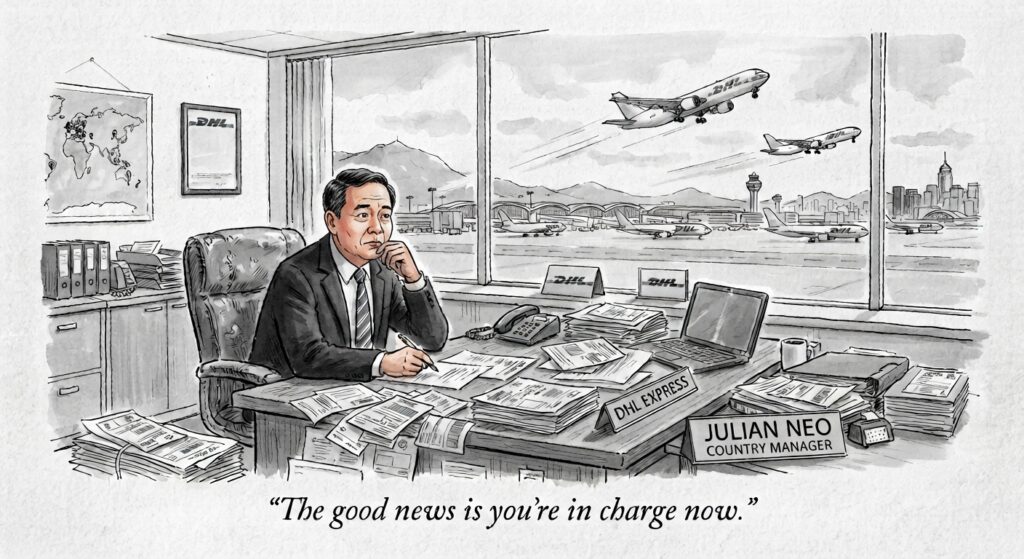
Julian Neo takes the helm from Andy Chiang as Hong Kong’s air cargo picture turns patchy, with European lanes cratering and automation bets still to pay off.
DHL Express has appointed Julian Neo as Managing Director for Hong Kong and Macau, effective October 1, 2026. He succeeds Andy Chiang, who will retire from DHL Group on January 1, 2027. On paper, it is the sort of orderly succession that large logistics companies love to announce: the incoming leader is a 25-year DHL veteran; the outgoing one departs on schedule after a smooth handover period. But the market Neo inherits is considerably less orderly than the press release suggests.
Neo’s most recent role was Managing Director of DHL Express Malaysia and Brunei, a position he held since 2019. In that post he delivered sustained revenue and EBIT growth and earned the operation Great Place to Work certification for seven consecutive years, a detail DHL is keen to highlight. Before Malaysia, he served as Vice President for Global Multinational Customers across Asia Pacific, managing strategic relationships with large shippers in diverse markets. He knows the DHL machine well.
The question is whether knowing the machine is enough for what Hong Kong’s air cargo market is now throwing at express operators.
A market sending mixed signals
Hong Kong International Airport remains the world’s busiest cargo gateway. It claimed the title for the 15th time since 2010 in its FY2025/26 annual report, handling 5.1 million tonnes. But the current calendar year tells a more complicated story. The first half of 2026 saw cargo throughput rise 4.1% year on year to 2.5 million tonnes, a respectable number. Then August hit: volumes slipped 1.2% year on year to 422,000 tonnes, with exports dropping 8.8%, only partially offset by an 18.2% surge in transshipments.
The lane-level picture is more troubling still. Southeast Asia and mainland China volumes remain solid, but European traffic has softened hard. WorldACD Market Data reported that Hong Kong-to-Europe cargo volumes fell 30% year on year in August, a plunge tied in part to the EU’s new de minimis import duties that took effect on July 1. Middle Eastern lanes, meanwhile, remain disrupted by the regional conflict. For an express carrier that depends on predictable, high-yield time-definite flows, this kind of lane-by-lane volatility is a headache.
The automation card
Neo does inherit some real infrastructure advantages. DHL opened its HK$1.5 billion Hong Kong West Service Center in Tuen Mun in April 2024, a fully automated facility capable of handling more than 50,000 shipments per day with inline X-ray screening, reweighing and dimensioning. That sits alongside the expanded Central Asia Hub at HKIA, which received a total investment of €562 million and can process 125,000 shipments per hour at peak, following a major expansion completed in late 2023.
Together, these assets give DHL Express Hong Kong a sortation and processing footprint that rivals struggle to match. But automated capacity only pays off if there is volume to fill it, and if that volume comes at yields that justify the capital expenditure. With spot rates from Asia Pacific origins down roughly 10% between April and August 2026, according to WorldACD, the margin math is tighter than it was when those investments were green-lit.
Continuity as strategy
Chiang’s tenure as Hong Kong MD was notably brief. He was appointed in January 2024, having spent the prior three decades in DHL finance roles, including Country CFO in China and Head of Global Strategic Finance. His quick retirement after less than three years in the seat raises the question of whether DHL views the Hong Kong MD role as a capstone posting for loyal veterans rather than a transformational brief.
Neo, by contrast, arrives with deep commercial and operational credentials and is presumably expected to stay longer. DHL’s Ken Lee, CEO for Asia Pacific, pointed to growing intra-Asia trade and SME internationalization as the key opportunities, along with newer offerings like Heavyweight Express services designed to capture shipments that previously moved as traditional freight.
What to watch
For shippers and forwarders who depend on DHL Express for time-definite air services through Hong Kong, the leadership change is unlikely to produce immediate operational disruption. The network, the aircraft leases and the customer contracts are locked. The longer-term test is whether Neo can maintain yield discipline in a market where competitors are cutting price to fill their bellies, while simultaneously dealing with the fallout from European trade policy shifts that are reshaping e-commerce flows in real time.
Hong Kong’s position as Asia’s premier cargo hub is not in question. The infrastructure, the connectivity, the airspace access are all intact. But the economics of running an express operation through it are getting harder to read by the month. Neo’s job is to read them better than the other side.
Comments