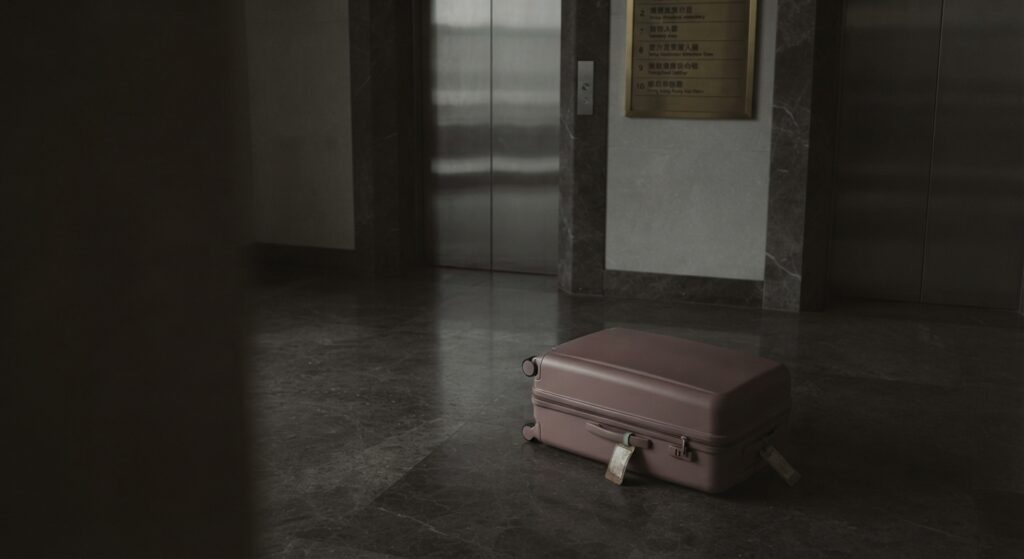
Last week a little girl in my building rolled a pink suitcase out of the lift. She was six, maybe. The suitcase was nearly as tall as she was, hard shell, a rabbit sticker on the lid, and she pulled it with both hands and her whole face, the way a child pulls something she has been told is hers. Her father held the door. Her mother counted passports out loud. The girl was concentrating on getting her luggage across the threshold, which, at six, is a sufficiently important job to require all the concentration you have.
There was something reassuring about the arrangement. The adults had divided the responsibilities, and the child had been given one she could just about manage, provided nobody was in a hurry. Somewhere ahead of them was a trip. For the moment, getting out of the lift would do.
Nobody in the lobby looked twice.
I looked twice.
My wife, Ruth, saw me looking. She knew which suitcase I was thinking about. That is one of the things a marriage accumulates: explanations you no longer have to give. A color, an object, a moment of hesitation where there should have been none, and the other person understands why you have stopped paying attention to the thing in front of you.
The girl’s suitcase wobbled across the threshold on one wheel. Ruth held the door with her foot until it was clear. We waited for the next lift.
I wish I had seen only what the girl saw. Something pink that belonged to her. Somewhere to put her things. The satisfying evidence that she was going along and had luggage of her own to prove it. There was no reason to burden that small, determined person with an association she had done nothing to acquire. She was entitled to her suitcase and her rabbit sticker and a holiday that began with the considerable business of getting downstairs.
But the association was already there. Memory can be embarrassingly indifferent to what you would prefer to think about. You can pass the anniversary of something terrible without noticing, then lose your place in an ordinary morning because somebody wheels a piece of luggage through a door.

Her name was Poon Hiu-wing.
She was twenty and pregnant. In February 2018 she went to Taiwan on holiday with her boyfriend, Chan Tong-kai. On February 16, the two of them bought a pink suitcase at a night market. The hotel cameras recorded them returning after midnight. Later that morning, he came out alone, pulling it behind him. He flew home to Hong Kong. Her body was subsequently found in bushes near Zhuwei MRT station.
The sequence is familiar. It has appeared in so many accounts of what followed that it can be read almost automatically, a short passage of background before the writer gets to the important part. I am troubled by how easy it is to write that sentence. Before the important part. As though a young woman leaving a hotel inside a suitcase could ever be the preliminary material.
There is another detail in the court judgment. In the early hours of February 17, she sent her mother a WhatsApp message saying she would return to Hong Kong later that night.
It is an ordinary message, the sort that makes it possible for someone at home to get on with the day. You have heard from the person who is away. You know roughly when to expect her. There will be a journey from the airport and, eventually, the familiar business of somebody coming through the door with a bag. The message belongs to that world, in which a return flight usually results in a return, and the people you love can go somewhere without your having to imagine every way they might fail to come back.
The message is also a small reminder of how little the public record tells us about a life. There are detailed accounts of the killing. The ordinary years before it, the things her family knew, scarcely enter the story. She was twenty years old. Even a full account of what happened in that hotel would describe only the end of her life.
Chan told Hong Kong police he had killed her. But Hong Kong’s authorities said they could not prosecute the killing under the existing law: it had happened in Taiwan, beyond the jurisdiction of Hong Kong’s courts. The two places also had no applicable arrangement for surrendering him. What proceeded in Hong Kong was a prosecution on four counts of money laundering, involving her money and possessions, including withdrawals using her ATM card. He received a sentence of twenty-nine months.
The killing itself remained untried.
There are reasons a court cannot simply reach for an offense outside its jurisdiction because the facts are appalling. Those limits matter. So does the distinction between an admission recorded by the police and a conviction following a trial. A legal system that abandons its rules whenever a case provokes enough anger would be a frightening place to seek justice.
Understanding the distinction does not make the result easier to absorb. A young woman was dead. The man who had admitted killing her was being punished for dealing with her money and belongings. The part of the case the law could reach was what he had taken after taking her life. You could explain the legal position carefully, accurately, at whatever length was required, and still arrive at a mother waiting for the prosecution that had not happened.
The gap was real. The government was right to say it existed. Its proposed solution, however, extended well beyond this one case. The bill would have allowed transfers to places with which Hong Kong had no standing extradition agreement, including mainland China. People asked why a case in Taiwan required changes with such a wide reach, and whether a narrower solution could be found. The prospect of surrender to the mainland brought fears about legal protections and the treatment of people sent there.
Those questions deserved answers. A bereaved family’s need for justice could not settle every question about legislation affecting the rest of the city. Nor did the existence of serious objections to that legislation make the family’s need disappear. It should have been possible to keep both thoughts in mind long enough to do something useful with them.
You remember what followed. By the time the argument had become the story through which much of the world understood Hong Kong, it had acquired a scale that seemed to leave little room for the person at its beginning. Every development required explanation. Every explanation required a position. There were urgent questions about the bill, the protests, the government’s response, and what would happen to the city. Poon could be fitted into a sentence explaining how it had started. Then the account moved on.
I do not mean that nobody cared about her. Her parents cared. Reporters continued to cover the case. People continued to ask why the man who had admitted killing her had not faced trial for it. To say she was literally forgotten would erase those efforts and replace one convenient version of events with another.
What bothers me is the ease with which she became background. Her death could be mentioned repeatedly while the young woman herself receded. A reader could become fluent in the controversy and retain almost nothing about her. The phrase “the Taiwan murder case” did its work efficiently. It supplied a place and an offense, then made room for the next paragraph.
The official explanations distinguish responsibilities, explain constraints, correct the other government’s version, and set out what somebody else needs to do. Some of those distinctions are necessary. Taken together, they can still leave you with the strange experience of learning more and more about why something has not happened. Each account brings you further into the dispute over the procedure. The question of when the trial will happen remains unanswered.
On October 23, 2019, Chan walked out of prison after completing his term for the money-laundering offenses. The government formally withdrew the extradition bill that same day. The proposal justified in part by the need to bring him to justice was gone. He had yet to face a trial for Poon’s killing.
He said he was willing to surrender in Taiwan. The authorities disputed how that should happen. Taiwan wanted arrangements for taking him into custody and obtaining the evidence. Hong Kong rejected the proposed role of Taiwanese officers in Hong Kong and said he could travel voluntarily and be arrested on arrival. The arguments continued. He did not go.
For a mother, I imagine, there is little comfort in learning which authority considers the next step somebody else’s responsibility. I can put this down. I can finish a paragraph and go and do something else. Her mother has no comparable way of finishing with what happened.
She kept asking him to take responsibility. And at Christmas in 2020, she bought a pink suitcase.
The same type. The same color. The same size.
On Christmas Day she took it to St John’s Cathedral, hoping the Reverend Peter Koon, who had been passing messages to Chan, would hand it on. She was unable to meet him that day, so she sent the suitcase with a letter. Koon later confirmed that he had received it on December 29 and told Chan about it. Her intention was to make Chan look at it, remember her daughter, and go to Taiwan to answer for what had happened.
I find it difficult to get past the buying of it.
Somewhere, she had to look at another suitcase and recognize that it matched. The same kind of ordinary object other people bought for journeys. I do not know where she found it, or what passed between her and the person who sold it. She sought out the object that recalled the disposal of her daughter’s body, paid for it, and tried to make the man who had admitted killing her look at it.
A photograph could have been put aside. A letter could have been answered. The suitcase occupied space. It had to be received and placed somewhere. In a case that had generated so much language, her choice brought the attention back to something a person had to pick up.
I have read many government statements about that year. None said as much as that suitcase.
She was the mother. She had already lost her daughter. Asking for a prosecution had become work she had to keep doing, and now part of that work involved finding a matching piece of luggage and trying to get it to the man who had admitted the killing.
There is a temptation, when a parent persists like this, to turn persistence itself into the consoling part of the story. We can admire it. We can call it courage. Both may be deserved, but neither changes what she was asking for. Admiration is easy for those of us who are allowed to stop reading. She was trying to get something done.
The years have continued to accumulate. In a May 2026 interview with HK01, Koon was still discussing the failure to arrange Chan’s surrender to Taiwan. More than eight years after Poon’s death, it remained something to be arranged.
I think about how differently those years can be counted. For someone writing a retrospective, they make a period with a beginning and a set of consequences. For the officials involved, they contain changes of personnel and further correspondence. For her family, they are years in which she has continued to be absent. The case can grow old without the loss becoming any less particular.
I do not want to give the mother another assignment. She should not have to produce a more affecting letter or find an object more impossible to disregard. She should not have to compete with everything else that has happened since 2018 for another brief interval of public attention. The fact that so much followed her daughter’s death is part of the history. It cannot be allowed to become the explanation for why the death itself slips out of view.
That was what came back to me in the lobby. A child and a piece of luggage, and then a woman whose name had become easier to omit than the argument that followed it. The two suitcases had nothing to do with each other. I knew that. I was glad of it. I wanted the little girl to reach wherever her family was going, to pull the thing around until an adult finally had to take over, and to come back with the rabbit sticker a little less firmly attached.
Above all, I wanted her mother to have the ordinary inconvenience of counting the passports again on the way home.
Ruth and I were still waiting for the lift. She had seen where my attention had gone. There was no need for me to rehearse the history to her, and no need for her to give me a history in return.
“Put her name in the piece,” she said.
“It’s in there.”
“Put it at the end too.”
There was very little to add to that. I had been thinking about legislation and jurisdiction and the way a person can disappear inside an account of what happened to her. Ruth had given me an instruction I could follow.
The lift came. We got in.
A pink suitcase is an easy thing in Hong Kong not to notice. It belongs to the daily movement of people going somewhere and expecting to come back. For a little girl in my building, it was still exactly that, and I hope it remains so.
For another mother, it was the thing she bought so that somebody would have to look again.
Her name was Poon Hiu-wing. She was twenty.
Comments