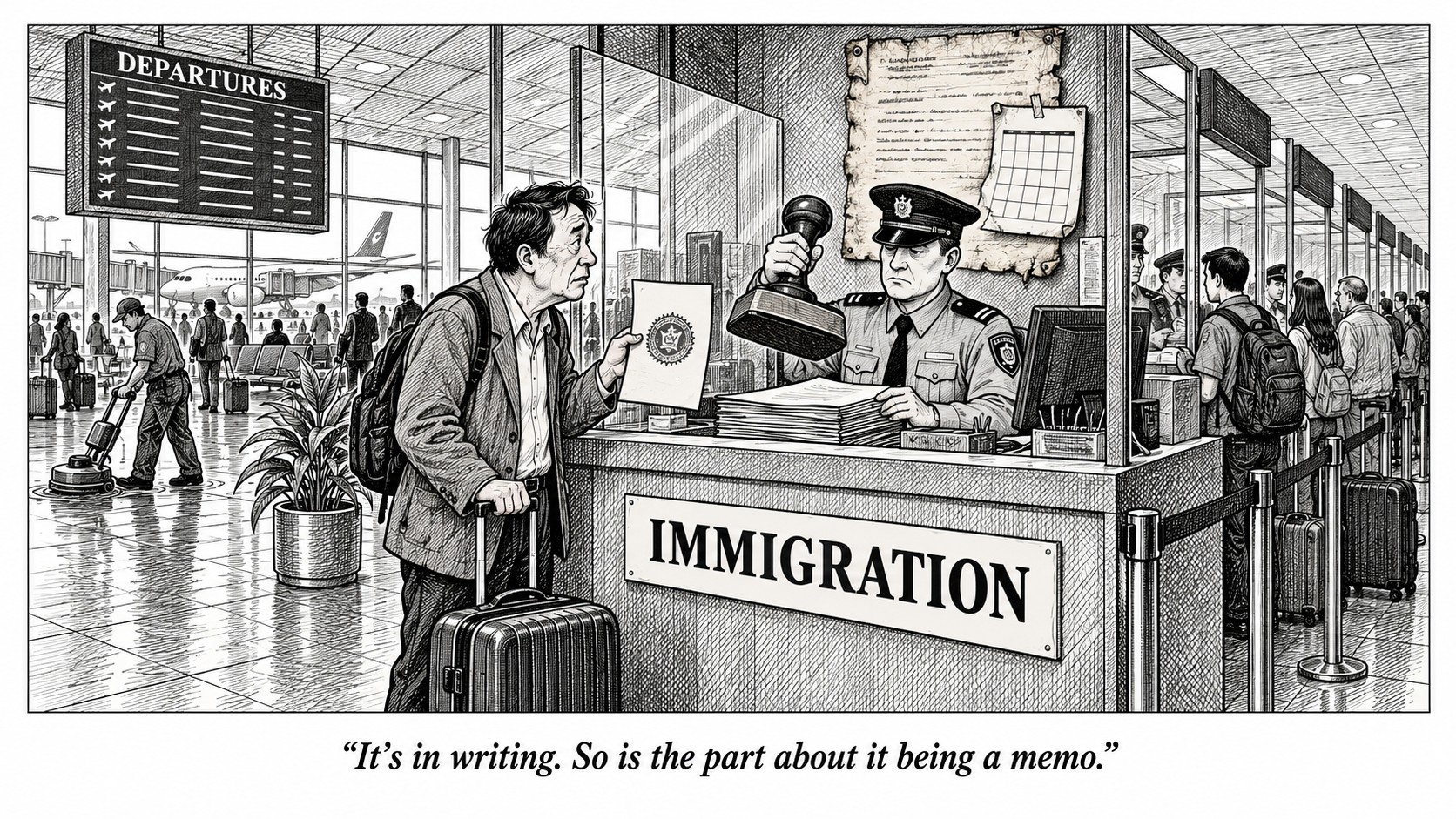
On September 17, immigration agents picked up Ho Yin Mo at Harry Reid International Airport in Las Vegas. Mo is a field representative for Catherine Stefani, a California Assemblymember from San Francisco, and before that he anchored prime-time news on KTSF, the Bay Area’s Chinese-language station. The Department of Homeland Security explained the arrest with the kind of sentence that fits on a form: he entered the country lawfully on January 13, 2020, and failed to depart by May 15, 2020.
I read that statement twice, because it is accurate in the way a parking ticket is accurate. What it leaves out is that since August 2021, the President of the United States has been telling people in Mo’s position that they do not have to depart. Immigration experts and friends told Mission Local he was very likely covered by that protection. An immigration judge granted him bond on September 30, and he was released on October 2. He still faces deportation proceedings.
The protection is called Deferred Enforced Departure, and it is an odd legal animal. It is not a visa and it is not a statute. It is a memorandum. Joe Biden signed the first one for Hong Kongers on August 5, 2021, extended it on January 26, 2023, and extended it again on January 15, 2025, five days before he left office, this time through February 5, 2027. No law requires anyone to renew it, and it offers no route to staying for good. The government page that explains it now begins, “On Jan. 15, 2025, former President Joseph Biden announced,” and that one added word tells you most of what you need to know about the shelf life of a memo.
The current administration did not tear it up, though. In April 2025, the Department of Homeland Security published a Federal Register notice telling eligible Hong Kongers how to apply for DED work permits. Jonathan Stivers of the Committee for Freedom in Hong Kong Foundation described the program this week as “granted by a Democratic administration and implemented by a Republican one.” Hong Kong Watch says that around June of this year, ICE began arresting people covered by it anyway, that the arrests have continued, and that immigration judges and federal courts have ordered some of them released. The same government that mailed these people their work permits is now sending agents to the airport to collect them.
Representative Jim McGovern made the obvious point in his own statement: “Providing refuge to Hong Kongers used to have bipartisan support, including from then-Senator Marco Rubio.” Rubio is now Secretary of State.
This is where I should say what I think, because regular readers know it is not what the press releases think. In The People Who Left, I wrote about families who sold flats in Sha Tin and Tseung Kwan O and flew to Manchester because a media environment told them every day that their home was finished, and because Western governments were generous with press conferences and thin on everything that came after. I don’t share the description of Hong Kong in Senator Jeff Merkley’s statement. I live here and publish this site from here, and the city he describes is not the one outside my window.
None of that matters to the question in front of ICE. Washington made a promise in writing, and the people who relied on it did nothing wrong by believing it. Whether they left because of the National Security Law, a cable news segment, or a better job offer in Oakland, they did what the United States government told them they were allowed to do. A country that spent years lecturing Hong Kong about the rule of law is detaining people its own president’s memoranda protect, then describing them in press statements as overstayers. When Americans tell Hong Kong how to govern itself, I usually point to the shadows at home. This one isn’t in a mill town in Massachusetts. It’s at an airport in Nevada.
I made the same argument when Trump banned three newsrooms from the White House grounds. I’m no fan of those newsrooms. I still thought the ban should lose in court, and a federal judge blocked it within days. Liking the people involved was never the test. The government has to follow its own rules, and the rule that matters here is older than either party’s current mood: when the state puts in writing that you are safe, you are entitled to plan your life around it.
The other lifeboats are pulling up their ladders too, only more politely. Canada’s two permanent residence pathways for Hong Kongers stopped accepting applications on August 31. By the end of June, Immigration, Refugees and Citizenship Canada had received about 30,315 applications covering 48,560 people and approved more than 8,600 of them. Ottawa’s closing notice opened with the line “Canada stands with the people of Hong Kong and supports their human rights and freedoms.”
Ruth was peeling an orange at the counter when I read it to her. “So they stand with us until August 31,” she said, and handed me half.
Which brings me to the bill. Merkley and McGovern, the ranking members of the Congressional-Executive Commission on China, unveiled the Hong Konger Promise of Refuge Act on October 6, as H.R.10685 in the House and S.5606 in the Senate. It would let people granted DED under any of the three Biden memoranda adjust to permanent residence, provided they have lived in the United States continuously since January 15, 2025, have not returned to Hong Kong or mainland China since then, and have not been convicted of a felony or two misdemeanors. Hong Kong Watch says applicants would get one year from enactment to apply and could not be removed while their applications were pending. McGovern says he would rather President Trump simply extend DED, and wants the bill passed if he doesn’t.
The model is a law signed thirty-four years ago today. On October 9, 1992, George H. W. Bush signed the Chinese Student Protection Act, which let Chinese nationals who had been in the United States in the months after June 4, 1989 become permanent residents. Bush had already shielded them by executive order in April 1990, the same kind of stopgap Biden used. Congress then closed the loop with a fixed group and a single window. Hong Kong Watch says this bill copies that design, covers only people already in the country, and changes nothing about who can come in the future.
So I’d vote for it, in the narrow form it’s written, while disagreeing with most of the adjectives in the announcements. I’d also point out that the condition about never going back means a woman who flew home to bury her father would have written herself out of the bill. A refuge you can’t leave even for a funeral is a cramped kind of welcome. It still beats a detention center in Nevada.
Deferred Enforced Departure runs out on February 5, 2027.
Mo says he is excited to get back to serving San Franciscans. His removal case is still open.
The memo hasn’t changed. Somebody just stopped reading it.
Comments