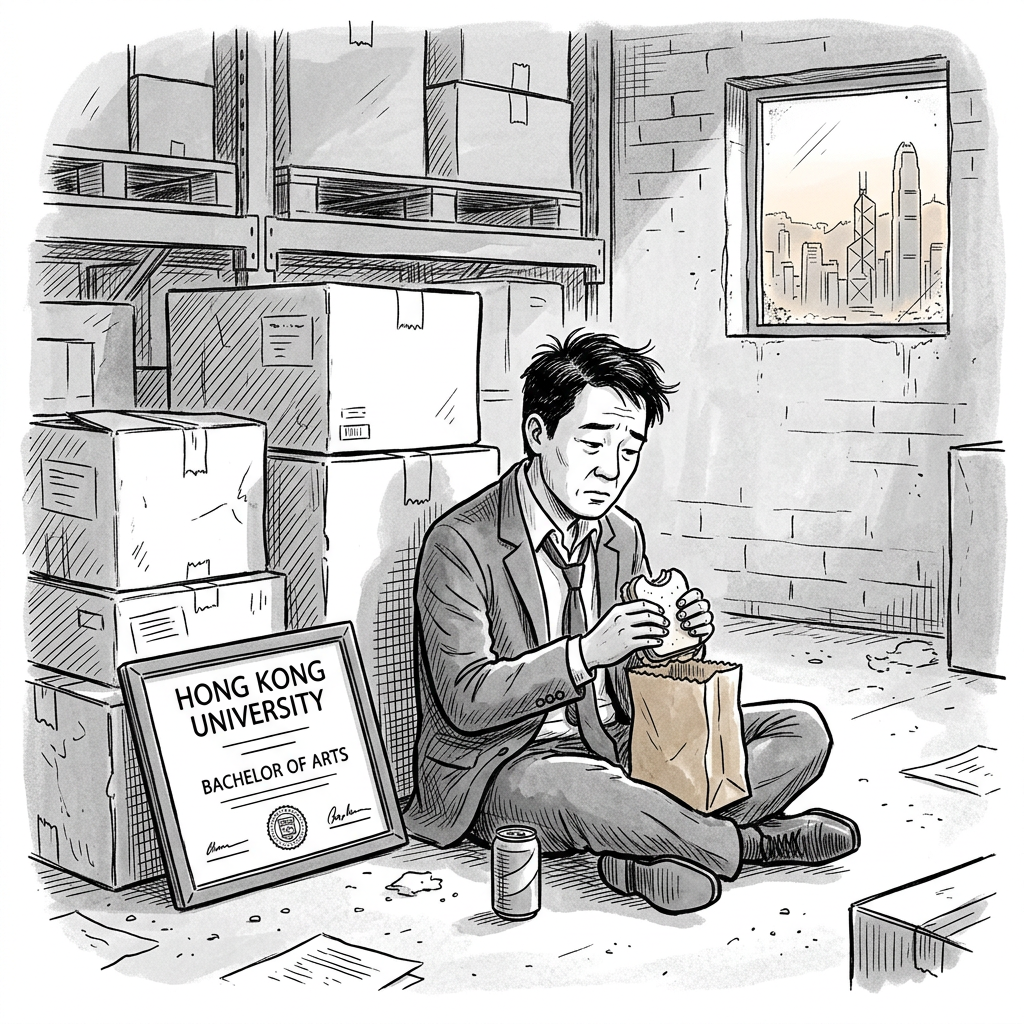
Now the other ones. The ones who left.
Not the activists. Not the people who testified before Congress and got book deals and speaking fees and asylum cases processed in eighteen months because they had name recognition and media contacts and someone at a think tank who could make a phone call. I am not writing about them. They made their choices and those choices came with rewards that most people never get, and I have written about that asymmetry before and I do not need to write about it again.
I am writing about the families. The ones who sold flats in Sha Tin and Tseung Kwan O. The ones who pulled their kids out of schools mid-term. The ones who cashed out MPF accounts at a penalty, packed what they could, and flew to Manchester or Nottingham or Reading because Boris Johnson held a press conference and said come, we owe you this, and they believed him because they had been watching the news and the news said Hong Kong was over and the United Kingdom was the lifeboat and the lifeboat had a name, BN(O), and the name sounded official and permanent and safe.
Some of them went to protests. Many did not. Some of them voted pan-democrat in district elections. Many did not. Most of them were not political actors. They were parents, accountants, teachers, mid-career professionals who watched a city burn on television and then watched a foreign government extend a hand and thought: maybe. Maybe the hand is real. Maybe the other side is better. Maybe our kids will have more over there than they will have here.
They were ordinary people making a decision based on extraordinary pressure from a media environment that told them, every single day, that their home was finished.
Here is what happened to them.
Between 2021 and the end of 2025, approximately 160,000 Hong Kongers migrated to the United Kingdom on BN(O) visas. Another 54,000 went to Canada. Tens of thousands more to Australia. The total, across all four major destination countries, is approaching 384,000 people. That is not a protest movement. That is a population transfer. That is a mid-sized city emptied into countries that had a press conference ready but not much else.
Here is what the Oxford Migration Observatory found in its longitudinal survey, published in 2026. Forty percent of BN(O) visa holders in the UK report being financially worse off than they were in Hong Kong. Forty-six percent were forced to switch careers entirely. Fifty percent took a salary cut. Thirty-one percent of employed BN(O) holders are working in graduate-level occupations in the UK, but forty-eight percent of those same people held graduate-level jobs in Hong Kong before they left. That is not a rounding error. That is a professional class being hollowed out.
The Observatory’s own language is clinical but damning: many have “downgraded” and are working in jobs they are overqualified for.
The top occupations for BN(O) holders in the UK include IT professionals, warehouse operatives, and marketing professionals. Warehouse operatives. For a population where nearly two-thirds hold university degrees.
The stories behind the statistics are worse because they have names.
Walter Cheung, 59, moved to London in 2021. In Hong Kong he was a server at the Mandarin Oriental. In England he became a food packer, then a waiter at a restaurant that was not the Mandarin Oriental. Paul Leung was a warehouse manager in Hong Kong. In Manchester he became a freelance parcel delivery driver. A man identified only as Lau told the South China Morning Post that he and his wife earned a combined seventy thousand Hong Kong dollars a month in Tai Po. They had a domestic helper for their two children. They moved to England and the domestic helper, the salary, and the life they had built simply evaporated.
The British Future and Welcoming Committee survey found that 52 percent of BN(O) holders interviewed were unemployed. Forty-seven percent of those who found work said the jobs did not match their skills or experience. A December 2024 report cited cases of accountants working in kitchens, former IT and insurance professionals taking warehouse shifts. Recruiters in northern England helped new arrivals take up roles in call centers, food processing, and office administration. These were people who, in many cases, had managed teams.
A study published in Scientific Reports in November 2025 surveyed 1,310 Hong Kong migrants in the UK and found that 31.8 percent were likely experiencing adjustment disorder. Not mild dissatisfaction. A clinical designation. The most common stressors were moving to a new home, language barriers, cultural pressure, financial problems, and career breaks forced by migration. The study found that adjustment disorder remained highly prevalent even two years after arrival. They were not getting better with time. They were getting stuck.
A survey by the group Hongkongers in Britain was more direct: “Hong Kong immigrants are experiencing higher than average levels of distress.” The same survey found “high levels of loneliness,” noting that migrants “do not feel psychologically comfortable with the locals, indicating a lack of shared cultural resonance.” Students and the unemployed reported the worst loneliness scores.
The UK government’s own research, published in August 2025 based on qualitative interviews conducted in late 2023 and early 2024, found that participants who left Hong Kong for political reasons, the ones pushed rather than pulled, took longer to adjust and required more support. Some described feeling displaced rather than relocated. Some described a government that said come but never said here is how. One participant told researchers: “I feel like a lot of people who decide to move to the UK do so due to political reasons in Hong Kong. They don’t feel safe anymore, they don’t feel good for their child anymore… and maybe financial-wise because of the political reasons they don’t see Hong Kong would be any good on the economic side and so they move to the UK.” The same research found that those who tried to access mental health services struggled to get appointments and could not fully express themselves due to language barriers.
There is a parallel grief that receives almost no coverage. A 2026 study published by Springer documented what happened to the elderly parents left behind in Hong Kong when their adult children emigrated. The researchers found increasing cases of loneliness, family disconnection, and suicide in the older adult population. The identity of parent and grandparent, which had provided meaning and social structure for decades, was severed by a decision made largely by the younger generation based on headlines their parents could not verify and a visa route their parents could not use. The lifeboat had an age limit. Nobody mentioned that at the press conference.
Migrant mothers who gave up careers to follow their families reported feeling lost and struggling with self-worth. A 2026 NüVoices feature documented Hong Kong women who had been professionals, who moved to the UK and became full-time housewives not by choice but by the logic of migration, their credentials unrecognized, their networks dissolved, their identities reduced to a function they had not chosen. One woman decided to become a nail artist in England, something she had never mentioned in Hong Kong because it was considered beneath her professional status. Another started an online bakery selling matcha strawberry cake and yuzu mousse. These are not failure stories. But they are not what the press conference promised either.
A University of Birmingham survey report from October 2023 found that among Hong Kong BN(O) arrivals who secured employment, 47.7 percent took roles completely unrelated to their previous careers. Nearly 70 percent had held professionally certified positions in Hong Kong. In the UK, their credentials dissolved on contact with the job market. The lack of local knowledge, local networks, and recognized qualifications created a wall that education alone could not climb.
And here is the part that should make the people who waved goodbye feel something.
BN(O) visa holders in the UK are subject to a condition called “no recourse to public funds.” Unlike Ukrainian or Afghan arrivals under other humanitarian schemes, Hong Kongers cannot access the welfare safety net even when facing financial hardship. A 2023 survey found that more than one in five BN(O) households were living beyond their means. Almost one in ten had no savings left to draw on. Many had burned through the money they brought from Hong Kong, the proceeds from selling their flats, their retirement funds, their children’s education savings, spent on rent and groceries and utilities in a country where the cost of living was higher than anticipated and the salaries were lower than imagined and nobody had explained that a BN(O) visa gets you in the door but not much further.
In Canada, the situation produced a different flavor of the same disappointment. Applications through the special Hong Kong immigration streams plummeted from 10,403 in 2022 to 455 in 2023. Sixty percent of permanent residency applicants were still waiting for decisions as of April 2024. Processing delays threatened legal status, employment, health coverage. Canada reduced its Hong Kong-specific immigration target to 6,900 for 2026. The welcome mat was being pulled back while people were still standing on it.
And then, in early 2026, the UK government proposed new settlement requirements. A minimum annual income of 12,570 pounds. B2-level English language tests, equivalent to A-level standard. Requirements that, according to a Hong Kong Watch survey, 62 percent of BN(O) visa holders could not meet at the time of application. Thirty-six Labour MPs signed a letter calling it a broken promise. In Nottingham, a woman named Moon Ma who had sold her flat in Hong Kong and moved with her husband in 2021 told the BBC she felt helpless. “It’s scary and unfair because we believed it was a promise,” she said. Her husband, Max, told the same reporter: “In the UK the money is very hard to earn. In Hong Kong we make money much more easily.” The promise was dissolving in real time, and the people who had structured their entire lives around it were watching it happen from rented flats in cities where they knew no one and their professional qualifications meant nothing and the nearest dim sum was forty minutes by bus.
I want to talk about what they left behind. Not the politics. The infrastructure.
They left a city where an emergency room visit costs fifty-one US dollars. They arrived in a country where the NHS puts you in a queue that stretches months or years, where fourteen-hour waits in A&E are not news but furniture, where the system is so strained that the word “crisis” is no longer a description but a permanent state of affairs. Hong Kong spends roughly six to seven percent of GDP on healthcare and achieves a life expectancy of 85.9 years. The UK spends around eleven percent and achieves 81. The United States, where some of them ended up, spends eighteen percent and achieves 79. The numbers are not close.
They left a city where violent crime is negligible. They arrived in a country where knife crime has increased over 80 percent in the last decade, where the Hong Kong government now issues outbound travel alerts for the UK citing stabbing attacks in London and Cambridgeshire. Read that again. The Hong Kong government warns its residents about safety in Britain. The city that the Western press described as dangerous is issuing safety advisories about the country that described itself as a refuge.
They left a city where the trains run on time, where the MTR carries millions of people daily with mechanical precision, where the bus system works because someone built it to work and then kept it working. They arrived in a country where rail strikes are seasonal, where delays are structural, where “good service on all lines” is a minor miracle rather than a baseline expectation.
They left a city where overstaying a visa is not a philosophical debate but an arrest at the airport. They arrived in a country where nearly 37,000 people crossed the English Channel in inflatable boats in 2024 and the government’s response was to spend billions on an asylum system with a backlog of over 200,000 cases. They left a place where rules are rules. They arrived in a place where rules are suggestions discussed on panel shows.
And here is what nobody prepared them for.
They arrived in democracies. Some of them voted. Many did not. That is the part that should stop you cold. They sold flats and cashed out pensions and pulled children from schools and flew to the other side of the world, and the thing they were supposedly gaining, the thing that justified all of it, the mechanism that the press and the politicians and the think tanks told them was worth the sacrifice, many of them never even used it. They had a voice. They did not raise it. They were too busy working shifts that did not match their qualifications, too exhausted navigating a system that did not recognize their credentials, too consumed with the daily logistics of surviving in a country that said come but never said here is how. The vote was there. It sat unused on a Thursday in May while they worked, or waited, or wondered whether their settlement application would be approved before the rules changed again.
The ones who did vote discovered that the vote did not produce a functioning hospital. It did not produce a safe street. It did not produce a train that arrived on time or a border that meant something or a government that could process its own paperwork within the same decade it received the application.
In the UK, they watched elections produce governments that cannot staff emergency rooms, cannot house their own population, cannot prevent thirty-seven thousand people from floating across a thirty-three-kilometer channel on inflatable rafts. The voice changed nothing about their daily experience of living in a country that is operationally worse, by every measurable indicator, than the city they left. And many of them did not even use the voice. They were too busy surviving to participate in the mechanism they supposedly moved for.
Many of them had never thought much about democracy in Hong Kong before 2019. They were not activists. They were not constitutional scholars. They were people who went to work and came home and took their kids to tutorial centers on Saturdays and ate at cha chaan teng on Sundays. The democracy argument reached them the way it reaches most people, through headlines, through social pressure, through the ambient conviction of their peer group that something was being taken from them and that somewhere else would give it back.
Nobody explained to them what they would find on the other side. Nobody told them that the countries they were moving to had their own filtering mechanisms, their own democratic deficits, their own gaps between the promise of participation and the reality of outcomes. Nobody told them that the vote they were gaining would not translate into the things they were losing. And nobody told them that once they arrived, many of them would not even vote, because democracy is not actually why people leave. Stability is why people stay. And they left stability for a symbol, and then did not even use the symbol.
They traded a government they did not elect for governments they could elect and largely did not. The unelected government ran hospitals for fifty-one dollars, trains on schedule, and streets you could walk at three in the morning without a thought. The elected governments cannot do any of these things. That is the transaction. Nobody told them it was a bad trade because telling them would have meant admitting that democracy is not the thing that makes a society function. Competence is. And competence is distributed without regard to how a leader was selected.
Some of them know this now. Some of them knew it before they left and left anyway because the momentum was too strong or the social cost of staying was too high or their children were asking questions they did not know how to answer. Some of them will never admit it because admitting it would mean the sacrifice was for nothing, and people do not easily say that about decisions that cost them everything they had built.
But the data says it. The data does not care about pride.
Here is what the eulogists missed while they were writing from abroad.
In June 2026, Hong Kong was ranked the second most competitive economy in the world by the IMD World Competitiveness Yearbook, behind only Singapore, ahead of Switzerland, ahead of every Western economy on earth. The ranking reflected improvements across the four competitiveness factors measured: second in government efficiency, third in business efficiency. That is not a city on life support. That is a city outperforming the countries that declared it dead.
In the first half of 2026, Hong Kong’s GDP grew 5.1 percent year on year, the strongest half-yearly performance in nearly five years. The government raised its full-year forecast to 3.5 to 4.5 percent. Unemployment sits at 3.7 percent.
Meanwhile, the UK economy, the lifeboat, is forecast to grow 0.9 percent in 2026. Unemployment is at 4.9 percent and climbing. Public sector debt is at 95.9 percent of GDP. The trade deficit hit 18.6 billion pounds in three months. The country that invited 160,000 Hong Kongers to come build new lives cannot build enough housing, cannot staff its hospitals, cannot keep its trains running, and is now telling those same Hong Kongers they might not meet the income threshold to stay permanently in the country that told them to come.
The United States is running a federal deficit of 1.89 trillion dollars. Consumer inflation remains above target. Real wages are negative. Credit card delinquencies are rising. The personal savings rate has dropped to historic lows. Low and middle-income households are losing purchasing power. The country that sanctioned Hong Kong as an unusual and extraordinary threat to its national security cannot keep its own consumers solvent.
Stephen Roach, the former chairman of Morgan Stanley Asia, declared Hong Kong “over” in a Financial Times commentary in February 2024, written from his faculty position at Yale. He then softened the claim, calling it a “wake-up call.” He then doubled down in a speech at the Foreign Correspondents’ Club in Hong Kong that June. By late 2025 he was acknowledging a financial sector rebound while insisting the city remained diminished. The thesis changes with the season. The confidence never does. The IMD measured Hong Kong across 172 data points and 92 survey questions and ranked it second in the world. One of these assessments was based on measurement. The other was based on a feeling, by a man who keeps revising. The people who packed their bags based on the feeling are now discovering what the data always said.
I am not mocking the people who left. These are people who made a decision based on information they had at the time, information provided largely by a Western media apparatus that told them their city was dying and that the lifeboat was real and that the other side of the water was better. Some of them genuinely felt unsafe. Some of them made a calculation about their children’s futures. Some of them were swept up in a momentum that felt inevitable, where everyone they knew was leaving and staying started to feel like a political act rather than a life choice. Most of them were not protesters. Most of them were not activists. They were people who watched a story unfold on television and in WhatsApp groups and made the most consequential decision of their lives based on a narrative they had no reason to distrust, because it came from everywhere, from the BBC and the Times and CNN and their friends who had already gone and said it was fine, it’s fine here, you should come.
But I am asking a question that someone needs to ask.
Was it worth it?
Forty percent are worse off financially. Nearly a third are clinically distressed. Half took pay cuts. Half switched careers entirely. They cannot access welfare. Their qualifications are not recognized. Their settlement pathway is being rewritten underneath them. They can vote, and most of them do not, and the ones who do have produced nothing that works as well as what they left behind. And the city they left, the one the headlines said was dead, is still here. Still functioning. Still safe. Still cheap. Still efficient. The MTR still runs. The hospitals still cost pocket change. Mrs. Leung is still making noodles. The harbor still lights up at night.
The Western media did this. Not alone. Not without help. But they did it. They told these people that Hong Kong was over. They told them the lifeboat was safe. They told them democracy was waiting on the other side, and that democracy would keep them warm, and that the freedom to vote would compensate for the freedom to walk to a hospital without wondering if they could afford it. They sold a story. The story was simple and clean and emotionally satisfying and it was wrong in all the ways that mattered most to the people who believed it.
I live in Hong Kong. I pay fifty-one dollars for an emergency room visit. I walk home at midnight and nothing happens. My wife’s handbag is safe. My qualifications are recognized. My career is intact. My flat is mine. The city functions. The government is competent. I do not vote for the Chief Executive, and my trains run on time and my streets are clean and my healthcare costs less than a streaming subscription.
384,000 people left. Some of them are doing fine. Some of them are building new lives that will eventually stabilize. I do not begrudge anyone their choices. But tens of thousands of them are worse off by every measurable metric, financial, professional, psychological, and they are living inside the evidence that a vote does not produce a functioning society. It produces a voice. What you get for that voice depends entirely on whether the government you elected can actually govern. And the ones they elected cannot. And many of them never even voted.
The people who stayed did not stay because they were afraid to leave. They stayed because they looked around and the clinic was still nineteen dollars and the street was still safe and the school was still fine and the noodles were still there. They stayed because the math worked. They stayed because staying is not a political statement. It is a calculation. And the calculation, for most people, still works.
The emergency expired. The people who left are still leaving, but at less than half the rate of the peak years. The slowdown is partly because the UK’s economy is stagnant. Partly because Hong Kong is growing at five percent while Britain struggles toward one. And partly, I suspect, because the people who already went told the people still thinking about it what it is actually like on the other side. The letters home are not what the press conferences promised. The reality is not what the headlines described.
Mrs. Leung is making noodles. Somewhere in Nottingham, Moon Ma is checking whether her settlement pathway still exists. Somewhere in Manchester, a former warehouse manager is clocking in as a parcel delivery driver at a salary that does not meet the new income threshold his government just invented. Somewhere in London, a man who once served guests at the Mandarin Oriental is packing food in a facility where nobody asks about his previous career and nobody cares that he spent decades learning how to anticipate what a guest needed before the guest knew it themselves.
The Western media did not write about Walter Cheung becoming a food packer. They did not write about the accountant now working in a kitchen. They did not write about the mothers who lost their professional identities and started baking yuzu mousse cake for strangers on the internet because it was the only space that felt like theirs. They wrote about the press conference. They wrote about the promise. They did not write about what happened after the promise was collected and the people who collected it discovered it was denominated in a currency that does not spend.
I did not write this to be cruel. I wrote it because someone has to say what the data says.
And what the data says is this: the lifeboat leaked. The promise was conditional. The democracy was real and many of them never used it and the outcomes were worse regardless.
And the city they left behind, the one that was supposedly dead, is still here, still making noodles, still running trains, still treating patients for fifty-one dollars, still keeping its streets safe at midnight, still governed by someone nobody voted for, still working, still ranked second in the world by people whose job is to measure these things rather than to feel them from a distance.
I hope the people who left find what they are looking for. I genuinely do. And I hope the people who told them to leave, the newspapers and the think tanks and the economists who pronounced a city dead from thousands of miles away, I hope they occasionally wonder how Moon Ma is doing in Nottingham, and whether she passed the new English test, and whether her settlement application will be approved, and what happens to her if it isn’t.
Because she believed the promise. And the promise believed in nothing but itself.
I am still here. Mrs. Leung is still here. 7.5 million people are still here. The second most competitive economy on earth is still here.