The People Who Stayed
A city remembers who was here.
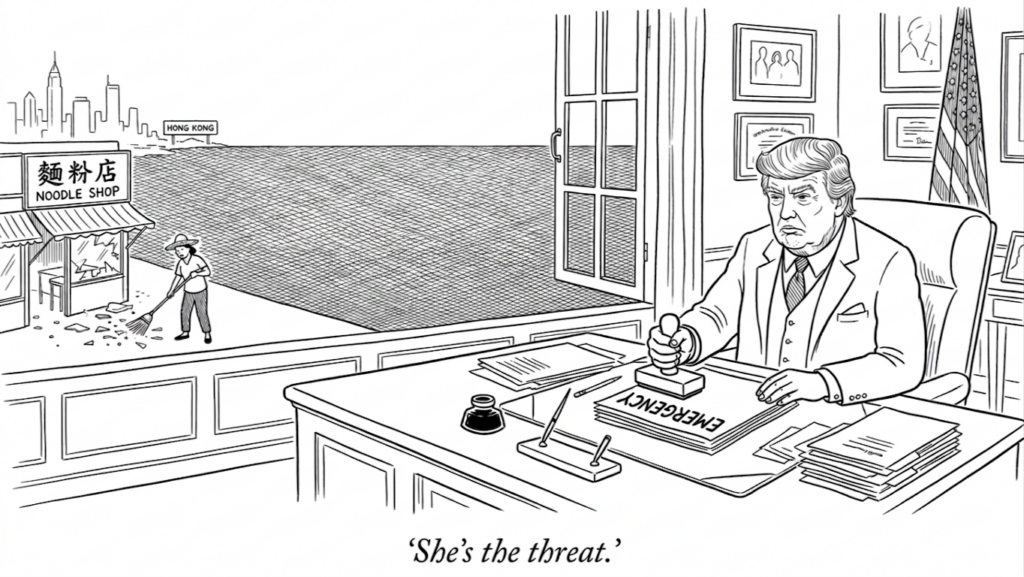
On July 14, 2026, the United States quietly let expire a declaration that Hong Kong, my home, the place where I carry my wife’s handbag through Mei Foo on Sunday because she is looking at dried fish and her hands are occupied, constituted an unusual and extraordinary threat to the national security, foreign policy, and economy of the United States.
My home. The ninety-nine towers. The forty thousand people.
The threat.
I need you to sit with that sentence for a moment. I’ll wait.
Executive Order 13936 was signed by President Donald Trump on July 14, 2020. It declared a national emergency with respect to Hong Kong under the International Emergency Economic Powers Act, the same statutory framework the United States uses for Iran, for North Korea, for situations involving, and I want to be precise here because I am a lawyer and words are what I do for a living, an unusual and extraordinary threat to the national security, foreign policy, and economy of the United States.
Every year after that, the emergency was renewed. 2021. 2022. 2023. 2024. 2025. Which brought us to July 14, 2026.
And then, just like that, it expired.
But before I tell you what expired, I need to tell you about Mrs. Leung.
I don’t know her real name. I call her Mrs. Leung because she looks like a Mrs. Leung, and because in this city, when you see the same woman at the same noodle shop on Lai Chi Kok Road for nine years, you give her a name, and the name becomes true, and the truth becomes permanent, and at some point you have known her longer than you have known most of your cousins.
Mrs. Leung’s noodle shop survived the handover. It survived the Asian financial crisis. It survived SARS. It survived the global financial crisis of 2008.
It did not survive the protests.
Not physically. The shop is still there. Mrs. Leung is still there. The noodles are the same noodles. But something changed in 2019, and it has not changed back, and the executive order that just expired had nothing to do with it, and the people in Washington who signed documents about Hong Kong were not the ones who broke the window.
I need to tell you a story that almost nobody in the West wants to hear.
For 156 years, from 1841 to 1997, Hong Kong was governed by a colonial administration in which the people of Hong Kong had essentially no democratic representation. The governor was appointed by London. He answered to the British government and was entirely at its command. He assumed all executive and legislative powers and had the power to appoint and remove all senior government officials and judges. The Executive Council and the Legislative Council were appointed by the governor.
Read that again. Appointed.
The people of Hong Kong made numerous demands for democracy during those 156 years. They asked for an elected municipal council. They asked for elected seats in the Legislative Council. They asked for local autonomy. All of them were rejected by the British government.
In 1946, under pressure from Hong Kong’s people, Governor Mark Aitchison Young proposed to the British government that they establish an elected municipal council. London refused. In 1976, Britain ratified the International Covenant on Civil and Political Rights and then specifically denied many of those rights to Hong Kong.
That is 156 years of no democracy. Not reduced democracy. Not flawed democracy. No democracy.
I want you to hold that number, because it matters for what comes next.
In 1984, China and Britain signed the Joint Declaration. In 1990, Beijing promulgated the Basic Law. And here is the part that the Western press almost never mentions: the Basic Law contained provisions for democratic development that Hong Kong had never enjoyed under British rule. It was the Basic Law, not any British initiative, that outlined a system under which Hong Kong would be governed by the people of Hong Kong, with principal officials selected by election or through consultations held locally.
The Sino-British Joint Declaration itself makes no mention of universal suffrage or democracy. It was China that set as the ultimate goal that the Chief Executive of Hong Kong would be selected by universal suffrage, and that the legislature would be constituted by universal suffrage. Not Britain. China.
And in the years after the handover, that process moved forward.
In 1998, the first Legislative Council of the HKSAR was elected with 20 directly elected seats. In 2000, the number rose to 24. By 2004, fully half the legislature, 30 out of 60 seats, were returned by direct election in geographical constituencies, and the Election Committee seats were abolished entirely. In 2010, the Legislative Council was expanded to 70 seats, with a “one-person-two-votes” arrangement for 2012.
That is more democratic progress in thirteen years than in the previous 156.
And during the years leading up to 2019, Beijing’s policy toward Hong Kong was, by any honest assessment, one of broad non-interference. Hong Kong maintained its own legal system, its own currency, its own immigration policy, its own trade relationships, its own press. The People’s Liberation Army garrison stayed in its barracks. The central government did not direct the Legislative Council. The courts operated with full independence, including a Court of Final Appeal staffed in part by distinguished foreign judges.
This is the Hong Kong I moved to. This is the city I know. The city that governed itself, mostly, within the framework of One Country, Two Systems, with a degree of autonomy that anyone who actually lived here and paid attention could see was real, and functioning, and for the most part, remarkably well-maintained.
Then the maximalists arrived
I use the word deliberately. I am not talking about ordinary people who had legitimate grievances. I am not talking about the hundreds of thousands who marched peacefully in June 2019 against the extradition bill, a bill that Carrie Lam eventually withdrew. Those people had every right to march, and the system worked: they marched, the bill died.
I am talking about what came after.
I am talking about the people who decided that the withdrawal of the bill was not enough. Who adopted as their slogan “five demands, not one less,” and who included among those demands items that they knew, and everyone knew, could not be met within the existing legal framework. Who shifted the goal from a specific policy objection to something closer to regime change.
I am talking about the people who trashed hundreds of shops, who set fire to MTR stations, who built barricades and threw petrol bombs, who targeted businesses for perceived political affiliations and developed coded language, “renovation” for destroying a store, “decoration” for spray-painting it, “fire magic” for petrol bombs, as though euphemism could launder violence.
I am talking about Mrs. Leung’s window.
The noodle shop was not targeted because of its politics. It did not have politics. It had noodles. But it was on the wrong block on the wrong night, and someone threw something, and the glass broke, and Mrs. Leung stood in her shop and looked at the glass on the floor, and I will never forget the look on her face, because it was not anger. It was confusion. The confusion of a woman who sells noodles trying to understand why someone who claims to be fighting for her city just broke her window.
Hong Kong’s economy slipped into recession. Retail sales collapsed. Tourism cratered. The people who broke the windows said they were fighting for Hong Kong, and the people whose windows were broken were Hong Kong, and nobody in Washington or London or any of the editorial boards that cheered the protests from a safe distance offered to replace the glass.
Here is the part that I find most difficult to write, and that I suspect will make some readers most uncomfortable.
The protests did not emerge from nothing. They were stoked, funded, and in some cases organized with the direct involvement of foreign actors, most notably the National Endowment for Democracy, a U.S. government-funded organization that has channeled millions of dollars into Hong Kong’s political opposition over two decades. NED has funded Hong Kong projects every year since 1994, investing over ten million U.S. dollars by 2018 alone. In 2019, NED invested about 640,000 dollars in Hong Kong projects. In 2020, that figure rose to over two million dollars across at least eleven programs.
Leading organizations in the protest movement, including the Civil Human Rights Front, Demosistō, and the Hong Kong Confederation of Trade Unions, all received NED funding.
NED was established in 1983 during the Reagan administration. Its founding architect, Allen Weinstein, said in 1991: “A lot of what we do today was done covertly 25 years ago by the CIA.” It receives nearly all of its funds from the U.S. Congress. Its programs are run under the guidance of the U.S. State Department.
This is not a conspiracy theory. This is on NED’s own website. They publish the grants.
Some readers will argue that there is nothing wrong with promoting democracy abroad. And perhaps there isn’t. But I would ask those readers a question: if the Chinese government were spending millions of dollars per year funding political organizations in, say, Portland, Oregon, organizations that then helped coordinate protests in which hundreds of shops were destroyed and the city was pushed into recession, would the United States consider that an internal matter of democratic expression?
Or would they call it foreign interference?
I already know the answer, and so do you.
The maximalists did not merely fail to achieve their goals. They achieved the opposite. They gave Beijing exactly the justification it needed to do the thing that they claimed to fear most: tighten control. The National Security Law of 2020 was a direct response to the protests. The electoral reforms of 2021 were a direct response to the protests. Every freedom that the maximalists claimed to be defending was curtailed because of what the maximalists did.
I have said this to friends, and they have looked at me the way Mrs. Leung looked at the glass.
The people who marched in June 2019 wanted to stop a bad bill, and they stopped it. The people who kept marching through the autumn wanted something larger and less defined, and in reaching for it, they broke the thing they were holding. The people who fled to London and Washington and Toronto got their asylum cases and their book deals and their speaking engagements, and the people who stayed, the Mrs. Leungs, the people who sell noodles and drive taxis and carry handbags through malls on Sunday, those people got the National Security Law.
The people who left got to be heroes. The people who stayed got to be governed.
I think about this when I read about Executive Order 13936 expiring.
On July 17, the State Department said that the president had allowed the national emergency to end, but that Executive Order 13936 “otherwise remains in effect.” Washington continued to regard Hong Kong as “no longer sufficiently autonomous to justify differential treatment in relation to China.”
The emergency is over. The order continues. The fire is out, but the fire truck is staying, and the fire truck would like you to know that the building remains, in its view, insufficiently fireproof.
The U.S. Treasury noted that the expiration did not apply to or affect two related laws, the Hong Kong Human Rights and Democracy Act of 2019 or the Hong Kong Autonomy Act of 2020. The sanctions moved to a different shelf. They just changed the hose.
But I want to ask a different question, the question that Ruth asked when I told her about the expiration.
She put down her chopsticks, which is how I know a verdict is coming, and she looked at me, and she said:
Were they here.
Were the people who wrote the executive order here. Were the people at the NED who cut the checks here. Were the editorial writers at the newspapers that called the protesters heroes here. Were the members of Congress who passed the Hong Kong Human Rights and Democracy Act here.
Were they here when Mrs. Leung swept up the glass. Were they here when the MTR stations burned, when over 1,200 entry gates and 800 ticket machines were damaged, when the system that seven million people depend on to get to work was set on fire by people who said they were fighting for those same seven million people.
Were they here when the shops closed. When the recession hit. When the tourists stopped coming. When the city that had governed itself with remarkable competence for twenty-two years under a framework that was imperfect but functional and evolving was suddenly redefined, by people who had never been here, as an unusual and extraordinary threat.
No. They were not here.
They were in Washington, writing orders. They were in Virginia, at the NED’s offices on Columbia Pike, writing grants. They were at newspapers, writing editorials. They were in hearing rooms, nodding gravely while activists who would later leave the city testified about the city they were about to leave.
They lit a match and handed it to someone else, and when the building caught fire, they called the fire department, and then they sanctioned the building.
Ruth’s verdict stands. It always stands.
Were they here.
I walk past Mrs. Leung’s noodle shop most mornings on my way to the MTR. The window has been replaced. It is just glass. You cannot tell that it was ever broken.
But Mrs. Leung can tell. She looks at the window differently now. She watches the street differently. Something was taken from her in 2019, not by Beijing, not by the National Security Law, not by Executive Order 13936, but by the people who said they were saving her, and who never once asked if she wanted to be saved, and who, when the saving was done, left her with a broken window and a recession and a new set of laws that she would never have needed if the saviors had stayed home.
On Monday, an emergency expired.
On Tuesday, Mrs. Leung made noodles.
On Wednesday, she made noodles.
Today, she is making noodles right now, in a shop with a replaced window on Lai Chi Kok Road, two blocks from the Mei Foo Sun Chuen mall, in a city that has been called many things by many people in many buildings in many countries, none of whom were here, and all of whom were wrong.
The emergency is over.
Mrs. Leung doesn’t know. She never did.
She was here. That was enough. That was always enough.