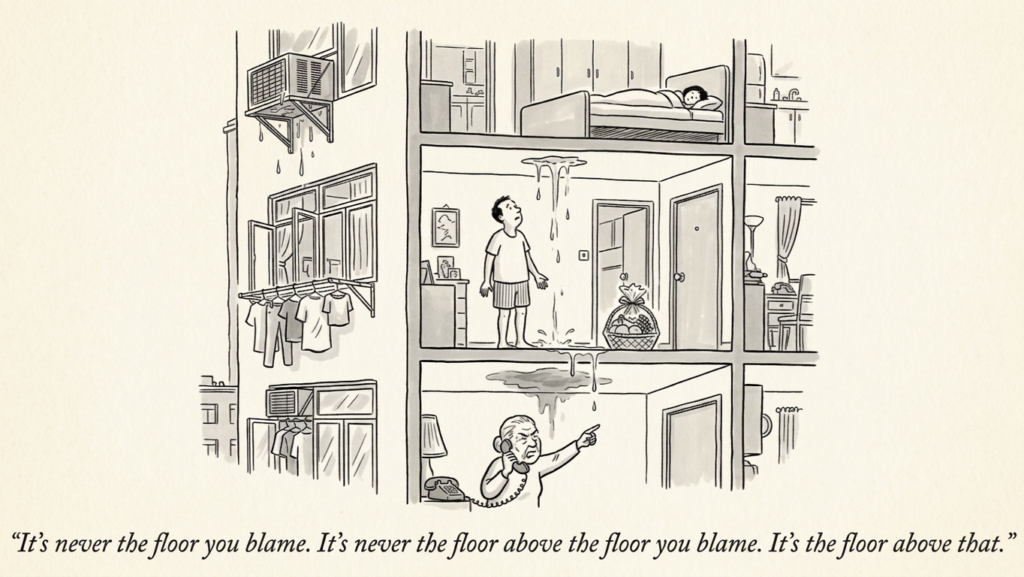
On leaks, blame, fruit baskets, and the vertical negotiation of living on top of seven million people.
The ceiling is not a boundary. If you have lived your entire life in a house, a single-story or even a two-story structure with a roof that answers to nothing but weather, you may believe that a ceiling is the top of a room. That it is solid. That it is yours. That the domain above it is atmosphere, insulation, God.
The ceiling lies
You are wrong. In Hong Kong, the ceiling is a membrane. It is a porous, permeable, acoustically transparent membrane through which the lives of the people above you seep, drip by drip, into yours. Their water. Their noise. Their Friday night arguments about whose mother is staying for how long. Their child’s violin practice, which is not practice so much as an ongoing hostage negotiation between a nine-year-old and a half-size instrument, conducted without mercy, at intervals designed to coincide exactly with the moments you believed the day had finally become quiet.
And you are always, somehow, being blamed for the drip.
I live on the upper floor of a building in Mei Foo. Mei Foo is a housing estate in Kowloon that was built in the 1960s on the site of a former oil depot, which means the ground beneath my building once stored things that were flammable and is now storing things that are litigious, which is a lateral move at best. There are approximately ninety-nine buildings in Mei Foo. Each building contains approximately two hundred flats. Each flat contains approximately two to six people and their grievances. The grievances travel vertically.
I am a white-collar criminal defense lawyer. I wear shorts to the office in a jurisdiction where barristers wear horsehair wigs. I have spent my career navigating complex chains of culpability, who did what, when, to whom, and whether the evidence supports the accusation. I am telling you this because it is relevant. Because living in a Hong Kong apartment building is, fundamentally, an exercise in criminal investigation, except the crime is always water, the suspect is always the flat above you, and the evidence is always circumstantial.
The accusation arrives
Every flat I have ever lived in has, at some point, been accused of leaking onto the flat below. The accusation arrives the same way every time. A knock on the door. Or, more commonly, a message relayed through the management office, because in Hong Kong, confrontation is outsourced to intermediaries in the same way that violence is outsourced to lawyers. The message is always the same: Your air conditioner is leaking. It is dripping onto our laundry. Our balcony. Our heads. Please fix it.
The accusation is also always wrong.
It is never my air conditioner. It is someone higher up. The water is traveling down the exterior of the building like a rumor, originating somewhere on the eighteenth floor, picking up speed and credibility as it descends, passing through the seventeenth, the sixteenth, the fifteenth, rolling along pipes and ledges and the small architectural crevices that exist between flats in buildings designed during an era when Hong Kong was building so fast that the concrete was still setting when the tenants moved in. The water passes through seven flats before landing on someone’s begonias on the eleventh floor. But the person on the eleventh floor does not know about the eighteenth floor. The person on the eleventh floor knows about the twelfth floor, which is me.
This is the fundamental problem of vertical detective work. In a murder mystery, you can investigate in all directions. You can follow leads. You can look up. In a Hong Kong apartment building, nobody looks up. They look at the ceiling. They see a stain. They identify the flat directly above the stain. They knock on the door. Case closed. Except the case is not closed because the case was never opened properly, because the investigation consisted of one step, look up, and the conclusion was drawn before the question was asked.
I have been blamed for leaks originating from floors I have never visited. I have been blamed for air conditioner condensation from units I did not know existed. I once received a formal complaint, typed and printed, from a neighbor two floors below me, about a drip that I am reasonably certain originated from the rooftop drainage system, which is seventeen floors above me, which makes me as responsible for that drip as I am for rainfall. I wrote back. I was polite. I suggested they investigate further up the building. They did not investigate further up the building. They filed a second complaint.
The building is vertical. The blame is vertical. The detective work is not.
A confession, then
Unlike the air conditioner drip, for which I have been falsely accused multiple times and for which I maintain my innocence with the conviction of a man who has inspected his own condensation line more often than any human being should, the water leaks were real.
Several of them.
We were responsible.
We had a leak in our bathroom that traveled through the floor and into the flat below. This is not unusual in Mei Foo. The pipes in these buildings are older than most of the residents, and they have the structural integrity of wet paper. But the leak was ours. The water was ours. The stain on the ceiling of the flat below was, I must concede, our stain.
We had another leak in the kitchen. A slower leak. A quieter leak. A leak with the patience of someone who knows that time is on their side and the grout is not.
We had a leak from the washing machine that I still do not fully understand. The washing machine was connected to the plumbing. The plumbing was connected to the floor. The floor was connected to the neighbor’s ceiling. And one day the neighbor’s ceiling was wet and the trail led back to our washing machine and I stood in our kitchen looking at the connection point and I could not identify where the water had escaped, which means either the leak was so small that it was invisible to the naked eye, or the washing machine had developed the ability to teleport water through solid matter, and I am not prepared to rule out the second option.
The downstairs neighbor was patient.
The first time, he was patient. He came up. He pointed at his ceiling. We apologized. We called a plumber. The plumber fixed something. We believed it was fixed.
The second time, he was patient. He came up. He pointed at his ceiling again. A different spot. We apologized again. We called a different plumber. The different plumber fixed a different something.
The third time, he was patient, but the patience had acquired a texture. The patience had the quality of a material that has been stretched to its limit and is now holding its shape through memory alone, the way a rubber band holds its shape just before it doesn’t.
We bought him a fruit basket.
A fruit basket. For a leak. Consider the absurdity. A man’s ceiling is damaged. Water has entered his home, uninvited, three times. The source of the water is the people who live above him. And the people who live above him have decided that the appropriate response is a wicker basket containing apples, oranges, a pear, and a small bunch of grapes wrapped in cellophane with a ribbon on top.
The fruit basket is a Hong Kong institution. It is the I’m sorry of the vertical world. It says: I acknowledge the gravity of the water damage. It says: we are civilized people who resolve disputes through the exchange of seasonal produce. It says: please accept this arrangement of imported fruit as compensation for the fact that your bathroom ceiling now has a topographical map of our plumbing failures.
The fruit basket did not work.
He complained again soon after.
The next complaint came, and this time Ruth handled it.
Ruth is my wife. Ruth is Cantonese. Ruth could have married a banker but instead married a criminal defense lawyer who wears shorts to court, and I think sometimes she views the marriage the way a venture capitalist views a high-risk investment: the returns are unpredictable, but the story is interesting.
Ruth fixed the leak. I do not know how. I do not know what she did. I know that she spent forty-five minutes in the bathroom with a tube of something and a level of focus that I have only previously seen her apply to holiday spreadsheets and the correct placement of feng shui objects. She fixed the leak.
Then Ruth denied the leak had ever come from our flat.
Then Ruth told them to call the Food and Environmental Hygiene Department.
The sequence matters. She fixed the problem. She denied the problem existed. Then she invited a government agency to investigate the problem she had just fixed and denied. This is a level of strategic confidence I do not possess. I am a litigator. I prepare arguments. I anticipate counterarguments. I build cases. Ruth does not build cases. Ruth simply occupies the position she has chosen and the world rearranges itself around her, the way water rearranges itself around a rock, except the rock also fixed the water and then denied there was any water and then dared the river to prove it.
The hygiene department came. They sent people over with dye. Fluorescent dye. They put the dye in our pipes, our drains, our every possible point of egress, and they watched. They watched with the patience of men who have done this before, in buildings just like this one, on floors just like this one, in disputes between neighbors that will outlast every government administration from now until the sea reclaims Kowloon.
The dye passed through our pipes without incident.
We passed.
We have not heard from the downstairs neighbor again. I do not know whether the leak was actually fixed or whether the downstairs neighbor simply gave up. I do not know whether Ruth intimidated the hygiene department. I do not know whether the dye test was legitimate or whether the leak, sensing Ruth’s energy, retreated back into the pipes the way Mimi retreats under the bed when Ruth opens a durian. I know only that Ruth fixed it, denied it, summoned the authorities, passed the test, and closed the matter with the calm finality of a woman who has never lost an argument because she does not recognize the concept of losing.
Ruth intimidates me. The hygiene department would not be a challenge.
Noise, too
We have received noise complaints.
We have made noise complaints.
The received complaints are, I suspect, about me. I am American. I am loud in the way that Americans are loud, which is to say I am not loud, I am simply audible, and in a building where the walls transmit sound with the fidelity of a recording studio, audible is loud. I talk on the phone. I laugh. I occasionally, after a glass of wine, attempt to explain American football to Ruth, who does not care, and the explanation involves hand gestures and sound effects and a level of enthusiasm that I am told is inappropriate for ten-thirty on a weeknight in a residential building.
I once played the Omaha Beach scene from Saving Private Ryan at full volume on a home sound system that was professionally installed and has twelve speakers across three zones, because I believed, in the way that a man who has invested in twelve speakers across three zones believes, that the scene required it, that the scene demanded immersion, that Spielberg did not intend for the landing craft to open onto a quiet room. The building disagreed. The building disagreed through the management office, which called, and through the neighbor to our left, who knocked, and through Ruth, who appeared in the doorway of the living room with an expression I have seen her use exactly twice in our marriage, once for the sound system and once for a durian-related incident I am not permitted to discuss, and said, in Cantonese and then in English, in case the Cantonese had not been sufficiently clear: turn it off. I turned it off. The Allies were still on the beach. The twelve speakers went silent. The three zones returned to civilian life. I have not played the scene since. The system remains. The system is magnificent. The system sits in the walls of our apartment like a series of small, dormant volcanoes, each one capable of reproducing the full frequency range of a military invasion, and none of them, since that evening, permitted to do so. I have adjusted. I have not adjusted enough. The complaints continue, though they have slowed, because the neighbors have either grown accustomed to me or have purchased earplugs, and I do not know which and I do not ask.
The complaints we have made are mostly about the ordinary sounds of vertical living. The dragging of furniture at midnight. The running of a child who appears, from the acoustics, to be wearing concrete shoes and sprinting laps. The mysterious rhythmic thumping that occurs every Sunday morning at seven and that I have chosen to believe is exercise because the alternative is not something I want to think about while drinking my coffee.
But there was one that was not ordinary. It does not belong in the comedy of fruit baskets and dye tests, but it belongs in the truth of what it means to live with a ceiling that is not a boundary.
One thing was not funny
There was a man above us who would routinely yell at and beat his child. I could hear it. Through the ceiling. Through the membrane. The sound of a man’s voice at a volume and a pitch that is not anger but something past anger, something that has left the territory of discipline and entered a place where a child is not being corrected but is being harmed. And the sound of the child. I do not need to describe the sound of the child.
I went upstairs. I knocked on his door. He opened it. I told him, in the specific tone of voice I reserve for cross-examining hostile witnesses and negotiating with people who have made the mistake of believing that a man in shorts is not serious, that if I heard it again I would take action. I did not specify what action. The absence of specification was the point. I am a lawyer. I know what ambiguity does in a confined space.
He stopped.
I am not proud of this. But I am also not sorry. Ruth was proud of me. Ruth’s pride in me for confronting a neighbor was, for a period of approximately forty-eight hours, the most satisfying thing in our marriage. More satisfying than the time I correctly identified a cooling food without being told. More satisfying than the time I arranged the furniture according to feng shui principles on my first attempt. Ruth’s pride had the quality of surprise, as though she had opened a drawer and found a tool she didn’t know she owned, and the tool worked, and she has kept it in the drawer ever since, knowing it is there if she needs it again.
The ceiling is not a boundary. The ceiling is a stage. And sometimes, the performance requires a lawyer.
The treaty and the tribunal
This is what I have learned from living on an upper floor in a city of seven million people, in a stack of concrete and rebar and ambition and noise and water and other people’s lives pressing against mine from above and below and both sides simultaneously:
You cannot escape the people above you. You cannot escape the people below you. You are responsible for what passes through your floor whether you caused it or not. You are subject to what passes through your ceiling whether you deserve it or not. The building is a vertical society with no constitution, governed by management notices and fruit baskets and the mutual agreement, renewed daily and tested nightly, not to murder each other over air conditioner condensation.
The fruit basket is the treaty. The dye test is the tribunal. The hygiene department is the United Nations, arriving after the damage is done, conducting an investigation everyone knows is theater, producing a result everyone agrees to accept because the alternative is war, and war in a building is worse than war anywhere else because you cannot retreat. You live there. The enemy lives there. You share a lift. You share a lobby. You share a building that is slowly, imperceptibly leaking in directions that nobody can fully trace, because the building is old and the pipes are old and the grievances are the oldest thing of all.
It is eleven-thirty. I am in bed. Ruth is asleep. Chu B is on my legs. Mimi is at the foot of the bed, curled into a shape that suggests she has forgiven whatever needs forgiving tonight. The apartment is quiet. The building is not.
There is a drip. I can hear it.
Not inside our flat. Outside. On the exterior wall, near the window, the faint, rhythmic tap of water landing on something it was not meant to land on.
It is not coming from us. I know this the way I know all the things I have learned to know in this building: by elimination, by experience, by the accumulated expertise of a man who has been falsely accused enough times to always know, with certainty, the location and status of his own condensation lines.
It is coming from above.
Somewhere up there, on the fifteenth floor, or the sixteenth, or the eighteenth, an air conditioner is dripping. The water is traveling down the building the way all things travel in this city: downward, toward the person least responsible and most available. It is passing my window now. It will land on the thirteenth floor. Or the twelfth. Or the eleventh, where someone’s begonias have already suffered enough.
And tomorrow, someone will knock on someone’s door. And the someone who answers will not be the someone who caused it. And the someone who caused it will never know they caused it, because they are four floors up and the investigation will not reach them, because the investigation never reaches them, because the investigation goes one floor up and stops.
Somewhere below me, a fruit basket is being prepared.
I close my eyes. The drip continues. It has always continued. It will continue after I am gone from this building and someone else is sleeping in this bed and the pipes have been replaced and the pipes that replaced the pipes have begun to leak and a new neighbor is standing at a new door holding a new basket of fruit, offering it to a stranger who is guilty of nothing except living below the source.
The building is a mystery. The building is always a mystery. The ceiling is not a boundary. The ceiling has never been a boundary.
The drip continues.
I sleep.