On high-trust societies, unlocked doors, and why a man from Adams feels safest in a city where nobody knows his name.
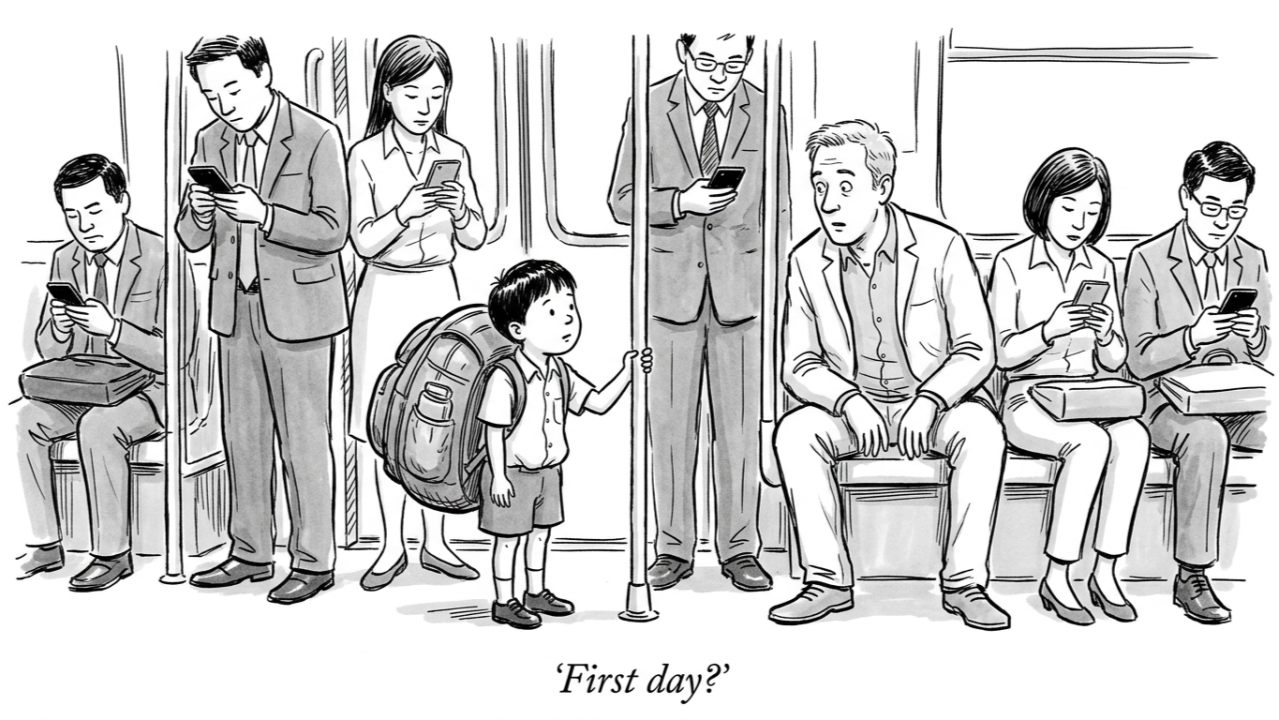
There is a child on the MTR. He is five, maybe six, in a school uniform that is slightly too big for him in the way that school uniforms in Hong Kong are always slightly too big, because mothers here buy for the child the child will become, not the child the child is, and the child is expected to grow into the uniform the way he is expected to grow into everything else the city has planned for him. His backpack is enormous. It sits on his back like a turtle shell, stuffed with textbooks and a water bottle and whatever else a five-year-old needs to survive a Wednesday, and he is standing on the Tsuen Wan line at rush hour, holding the pole with one hand, his fingers not quite reaching around it, and he is alone.
Not lost. Not crying. Not scared. Just commuting.
Not lost. I need to be clear about this. He is not looking around for a parent. He is not crying. He is not exhibiting any of the signs that a child alone on public transit in most cities in the world would exhibit, the confusion, the fear, the slow dawning recognition that the adult who is supposed to be here is not here and the world is very large and very loud and very full of strangers. He is calm. He is bored. He has the posture of a man who has been commuting for thirty years and has long since stopped noticing the other passengers, except the other passengers are adults in business suits and he is a child whose feet do not touch the floor when he sits down, and he is navigating the busiest transit system on earth with the navigational certainty of someone who has done this before and will do it again tomorrow and the day after that and every day until the uniform fits.
His mother is not here because his mother does not need to be here. She put him on at one station. He will get off at another. Between those two points, the city will hold him. Not a specific person. Not a grandmother waiting at the platform, not a neighbor who agreed to watch, not any single individual who has accepted responsibility for this child’s safe passage from A to B. The city. Seven million people and a transit system that moves five million of them a day and a social contract so deeply embedded in the infrastructure that it does not require discussion or enforcement or even acknowledgment. The contract says: this child belongs to all of us. The contract says: he will arrive. The contract says: you do not need to worry, because worry is not how this works. Trust is how this works. And the trust is so complete, so ordinary, so unremarkable, that nobody on this train is looking at this child, because a child alone on the MTR is not a cause for concern. It is a Wednesday.
I am looking at this child. I am the only one looking at this child, because I am from a place where this would be remarkable, and I have lived here long enough to know that it is not remarkable, and I am still not able to stop the part of my brain that was built in the Berkshires from remarking on it.
Ruth, my wife, would not look at this child. Ruth was this child. Ruth grew up in this system, rode this system, was delivered by this system from school to home and back with the same trust that the system extends to every child in every uniform with every oversized backpack, and if I pointed at this kid and said isn’t that something, she would look at me the way she looks at me when I pull the blanket over my legs in a room she finds perfectly comfortable, with the patient confusion of a woman who has accepted that the man she married experiences the world at a slightly different temperature than everyone else. She would not see trust. She would see a kid on a train. The way a fish does not see water.
I see water. I see it because I have swum in other water, and I know what it feels like when the water changes.
In Adams, Massachusetts, I walked to school in first grade. Not with a parent. Not in a group. Down streets where every adult on every porch knew my name and my mother’s name and my grandmother’s name and the name of the dog and the approximate time I was expected to pass and the fact that if I was not passing at approximately that time, a phone call would be made, not to the police, not to a hotline, to my mother, who would receive the information and act on it with the calm efficiency of a woman operating within a system she understood and trusted completely, because the system was not a system. It was a town. And the town was watching. And the watching was not surveillance. The watching was the whole point.
There was a crossing guard. A cop. Maybe Gino Balardini, or something close to it, because the spelling of everything in Adams is approximate. The town was built by Polish and French-Canadian mill workers whose surnames were designed by people who did not believe in vowels and were deeply suspicious of consonant clusters that could be resolved in fewer than four letters. The running joke in Adams, and I say this with the full affection of a kid who grew up in it, is that every Polish name ends in -ski because they can’t spell toboggan. The joke is older than the town. Nobody remembers who told it first. Everybody tells it second.
The watching was not surveillance. The watching was the whole point.
Gino, or the man whose name I lost to time, was not a crossing guard in the way that modern parents understand the term, a reflective vest and a stop sign on a stick and a liability framework. Gino was a cop who stood at the crosswalk and knew every kid by name and was happy, always happy, always joking, the kind of man whose mood was so consistently good that you suspected it was either a gift or a condition. I used to imitate a police whistle when I crossed. Not the shrill, panicked whistle of a man directing traffic. The sharp, clean, two-note blast that cops use, which I had practiced with the dedication of a six-year-old who had found his one talent, and which I can still do, forty years later, in a high-rise apartment in Kowloon, to the confusion of my wife and the alarm of the cats. I would walk up to the crosswalk, blow the whistle, and Gino would laugh, because Gino always laughed, because Gino was part of the trust. He was not guarding the crossing from the children. He was guarding the children the way the town guarded the children, which is to say he was standing there, being known, knowing them, and the standing and the knowing were the same thing.
At lunchtime, I walked next door to a small store that had a lunch counter. I was six. Six years old. Alone. Leaving school in the middle of the day. I told my teacher I was going to lunch. That was the sentence. That was the entire protocol. A six-year-old raised his hand and informed his teacher that he was leaving the building to go eat at the store next door, and his teacher said okay, because what else would she say, because this is what children did at lunchtime, because the lunch counter was next door and the town was the town and the child would come back in forty minutes with a jawbreaker in his cheek and nobody would convene a meeting about it.
Try that sentence now. Put it in the mouth of a first grader in 2025. Watch what happens. The teacher’s face alone would be an emergency. The word they use now is elopement, when a child leaves a building without authorization, the same word we use for running off to get married, as though a six-year-old walking thirty yards to a lunch counter is an act of desperate flight requiring an incident report and a phone tree and a locked door that will never be unlocked again. The school would lock down. The mother would get a call. The mother would get a file. And the man at the lunch counter, the man who knew my name and my order and the precise location of the jawbreaker jar, would get a visit from someone whose job it is to ask questions about men who feed other people’s children.
That man does not exist anymore. Not because he died. Because the town made him impossible. Walking into a restaurant, sitting at the counter, ordering lunch. Not because my parents were negligent. Not because supervision was unavailable. Because supervision was everywhere, invisible, embedded in the architecture of a town where the density of acquaintance was so high that anonymity was not possible. You could not be unknown in Adams. You could not be unseen. The mountain saw you. The churches saw you. The bars between the churches saw you, especially the boys at the Grille. The woman at the counter at Pop’s Variety saw you and chose not to see you, which is a different thing, and which I have written about elsewhere. The town was a closed circuit, every node connected to every other node, and within that circuit a six-year-old could walk to a restaurant and eat a cheeseburger and nobody called anyone because there was nothing to call about. The kid was fine. The kid was always going to be fine. The town had him.
The man at the lunch counter, I don’t remember his name. The place was called Bill’s. The man knew my family. He knew my order. Lunch cost ninety-five cents. My mother gave me a dollar. That left a nickel, which was exactly enough for a jawbreaker from the candy jar by the register, a glass jar filled with jawbreakers in colors that did not correspond to any flavor found in nature, colors that existed only in the imagination of a candy manufacturer who had decided that neon green was a taste and neon blue was a different taste and children would accept both without question, which we did, because we were six and the jawbreaker cost a nickel and the man behind the counter handed it to you without asking, because he knew. He knew the dollar. He knew the ninety-five cents. He knew the nickel. He knew the jawbreaker. He knew the kid. The whole transaction was performed without negotiation, without uncertainty, without any of the friction that occurs when two strangers conduct business, because there were no strangers. There were no strangers anywhere. The concept of a stranger in Adams was as foreign as the concept of a hot tub in Mong Kok. Theoretically possible. Practically nonexistent.
They took a photograph of me at that counter. I do not have the photograph. I do not know what happened to it (Note: someone sent me the picture, I have inserted below). But I know it existed, because it hung on the wall, a picture of a six-year-old sitting at a lunch counter with a cheeseburger and a lemon-lime soda, a regular, a man of the community, a person whose patronage was valued and whose portrait was displayed with the same pride that a Manhattan steakhouse displays a photograph of Frank Sinatra. Except the Manhattan steakhouse displays Sinatra because Sinatra was famous. Bill’s displayed me because I was there. Because showing up was enough. Because the trust that put me on that stool at six years old, alone, with a dollar in my pocket and a jawbreaker waiting, was the same trust that put the photograph on the wall, a town saying I see this child and the child is mine and I am keeping a record.
He thinks trust is weather. Ordinary. Ambient. Always there.
The child in that photograph does not know what he has. He thinks this is what the world is. He thinks every world is a world where people know you and feed you and take your picture and hang it on the wall. He thinks trust is weather. Ordinary. Ambient. Always there.
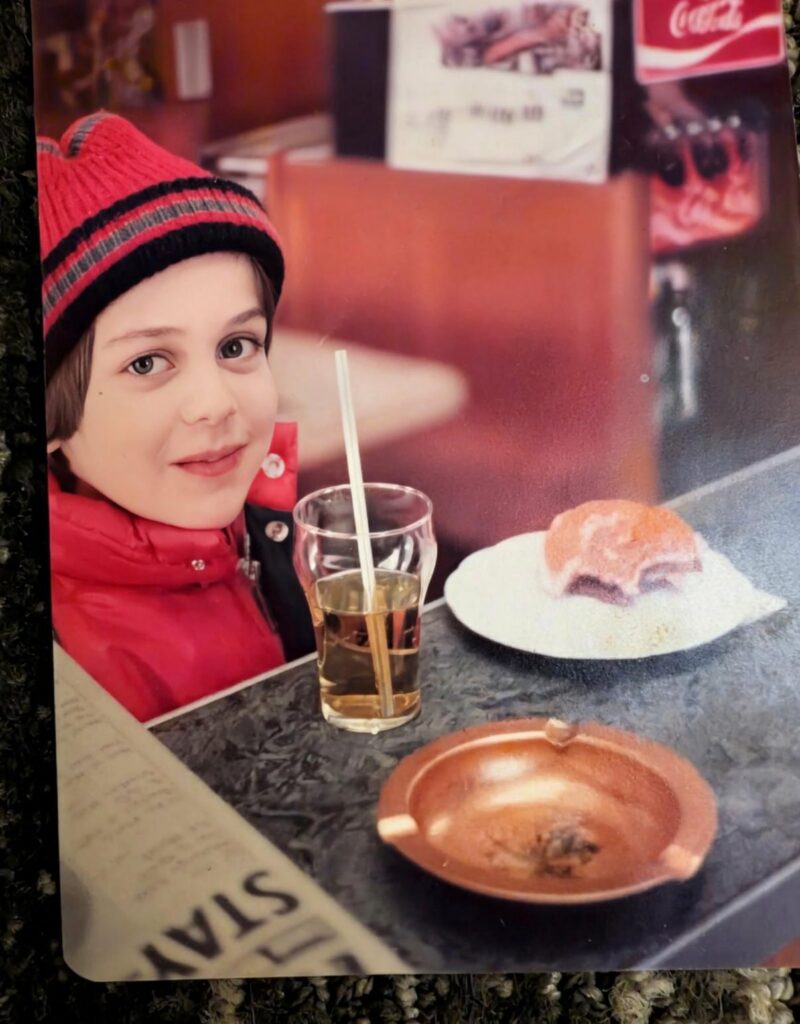
He is wrong. He will learn this.
Both places were places where you could walk the streets at any hour without fear. This is the thing I did not understand until I had lived in both, that Adams and Hong Kong, despite being separated by eight thousand miles and seven million people and every conceivable difference in language, culture, food, climate, architecture, and the acceptable number of knives a man may carry in his pocket, were both, in their own ways, high-trust societies. The phrase sounds like something from a sociology textbook, and it is, but it is also the feeling of walking home at two in the morning and not calculating your route based on which streets are lit. It is the feeling of leaving your bag on a chair in a cha chaan teng and going to the counter and coming back and the bag is there. It is the feeling of not thinking about the feeling, which is the highest form of trust there is.
In Adams, people left their doors unlocked. Not as a statement. Not as a philosophical position on the nature of community. They left their doors unlocked because locking them would have implied that someone might come in, and the implication was absurd, because in Adams, people did come in, all the time, through the front door or the side door or the kitchen door, and the coming-in was the point. The trust was intimate. It was built on the density of knowing. I know you. You know me. Your mother told my mother something at the post office. My father knew your father at the mill. The connections were so numerous and so tangled that the web itself was the lock. You did not need a deadbolt when you had six hundred people who would notice a stranger the way a body notices a splinter.
They left their keys in their cars. A car, in the driveway, unlocked, keys in the ignition, engine cold, sitting there all night with the implicit invitation of a vehicle that trusts the world not to take it. Nobody took it. The car sat. The keys dangled. The town slept and woke and the car was there and the keys were there and nobody told a story about it because there was no story. The absence of theft was not newsworthy. It was climate.
In Hong Kong, the trust is different. Nobody here leaves their keys in the car, because nobody here has a car, or if they do, they park it in a secured garage, and the garage is secured not because the city is dangerous but because space is expensive and a parking spot in Mei Foo costs more than a house in Adams and you protect what costs that much with a gate and a card and a camera. The trust here is not intimate. Nobody in my building knows my name. Nicole, my barber of ten years, does not know my name. The woman at the cha chaan teng on Dundas Street does not know my name. The trust here is structural. It is the trust of a city that has agreed, collectively, without discussion, that the system works and we will all operate within the system and the system will hold. You return the wallet because returning the wallet is what is done. You do not touch the bag on the chair because the bag on the chair is not yours. The child rides the MTR alone because the MTR delivers children and the city receives them and the transaction requires no name, no acquaintance, no photograph on a wall. The trust is anonymous. It is impersonal. It is, in its own way, miraculous.
And in both places, it is fraying at the edges.
The sticker was a piece of trust made adhesive.
In the late 1970s, fire departments across America began distributing Tot Finder stickers. I remember them. Small, reflective, usually a red triangle with the silhouette of a child inside, and you placed them on the window of the room where your child slept. The idea was simple and good: if there is a fire, the firefighter will see the sticker and know that a child is in that room and go to that room first. The sticker was a piece of trust made adhesive. It said: I am telling you where my child sleeps, because I trust that the person who sees this information will use it to save my child. The sticker assumed that the world was full of firefighters. The sticker assumed that the only person who would ever look at your child’s window and care what was behind it was a person coming to help.
Then children were abducted from their bedrooms. Not many. Not often. But enough, and publicly enough, and horrifyingly enough, that the calculus changed. The sticker that said my child sleeps here to a firefighter also said my child sleeps here to everyone else. The Tot Finder sticker, the symbol of trust, became a liability. A thing designed to protect became a thing that exposed. The stickers came down. Parents peeled them off the glass and threw them away and installed locks that had never been installed and stopped leaving keys in cars that had always held keys and began, slowly, unevenly, irreversibly, to close the doors that had always been open.
The walk to school closed with them. Not all at once. Not with a single law or a single incident. But the distance between a six-year-old blowing a police whistle at Gino Balardini and a parent being prosecuted for neglect because her five-year-old walked to school alone is not forty years. It is a straight line. The same country that hung my photograph on the wall of a restaurant because a six-year-old leaving school and eating lunch by himself was charming now calls the police when a six-year-old eats lunch by himself, and the police do not laugh, and the six-year-old does not get a jawbreaker, and the parent gets a file.
I do not know exactly when the doors in Adams started locking. I was not there. I was here, on the other side of the world, in a city where the doors were never open in the Adams sense but where the streets were open in a way that Adams could never match. The Tot Finder sticker is the story of American trust in miniature. A gesture of faith, made in good faith, exploited by the thing it did not account for, and withdrawn. The withdrawal was rational. The withdrawal was correct. The withdrawal was also the end of something, and America crossed the distance between a sticker on the glass and a lock on the door in a single generation, and I do not think it is coming back.
Has it happened here? In this city where a five-year-old rides the MTR alone and nobody looks twice?
I do not know. I know that wallets are still returned. I know that bags are still on chairs. I know that I walk the streets of Mong Kok at three in the morning and the only thing I fear is the price of a taxi. I know that the child on the MTR is still there, every morning, in his uniform, with his backpack, alone, unafraid, delivered. I know that the social contract holds. I can feel it holding, the way you feel a floor holding beneath you, not because you are testing it but because you are standing on it and it has not given way.
But I also know what happens when it gives way. I have seen the stickers come down. I have seen the doors close. I have seen a town that left its keys in its cars learn to take them inside, and the learning was not dramatic, it was not a single event, it was the slow, quiet accumulation of reasons, each one small, each one rational, each one another millimeter of distance between the world you trusted and the world you locked yourself against.
The kid gets off at Mei Foo. My stop. He steps onto the platform with the decisiveness of a person who has never once gotten off at the wrong station, adjusts the straps of his enormous backpack, and walks toward the exit without looking back. He does not look back because there is nothing behind him to look back at. The train delivered him. The city delivered him. The contract held.
The photograph is gone. The restaurant is gone. The jawbreaker jar is gone. The man behind the counter whose name I cannot remember is gone, or if he is not gone he is old, and the counter is someone else’s counter now, and no six-year-old sits at it alone with a dollar and a cheeseburger and the absolute, unexamined certainty that the world is safe because the world has always been safe and the man knows your name and the jawbreaker is waiting. Gino is gone, or if he is not gone he is no longer standing at the crosswalk, and no six-year-old is blowing a police whistle at him on the way to school, though the whistle is not gone, the whistle is in a high-rise apartment in Kowloon, in the mouth of a man who is forty years too old to be doing it, and the cats do not appreciate it, and Ruth does not appreciate it, and I do it anyway, because some things survive the crossing even when the crosswalk doesn’t.
The kid is still on the train. And I am still watching.
But the kid is on the train. The kid is still on the train. And the sticker is still on the window. And the porch light is still on. And I am watching, from inside the water, the only man on the platform still looking, still checking the temperature, still hoping it holds.