Things I Notice
Ten Things I Love About Boston
An incomplete and geographically divided list.
A few weeks ago I wrote a list of the ten things I love about Hong Kong. I said I would not be taking questions. This was a lie. I took questions. I took questions from colleagues, from strangers on LinkedIn, from a man at the wet market in Mei Foo who I am fairly certain was asking me about dried scallops but who may have been commenting on my ranking methodology, and from Ruth, whose questions were not questions but corrections delivered in the grammatical form of questions, the way a subpoena is technically an invitation.
Boston built it and Hong Kong got the finished product.
Ruth’s primary correction was that I had written an entire essay about Hong Kong without mentioning Boston, which, she said, was like writing a biography of the moon and leaving out the earth. I told her that seemed like an overstatement. She said it was not. She said that everything I am, every quality she married and every quality she tolerates, and the distance between those two categories is considerable, came from either Adams, Massachusetts, or Boston, and that Hong Kong received the finished product and Boston built it and if anyone deserved a list it was the city that did the actual work.
She is correct. She is always correct.
I grew up in Adams, a small town in the Berkshires where the biggest event of the year was the Fourth of July parade and the only thing anyone agreed on was that the Yankees were the enemy. I wore Red Sox gear like a uniform. Still do. Adams is not Boston. Adams is two and a half hours west of Boston, through the mountains, past the Mohawk Trail, through a series of towns that get progressively larger and progressively less interested in your opinion about anything until you reach the Mass Pike and the road straightens out and the skyline appears and you understand, in the way that a kid from a town of eight thousand understands when a city materializes in front of him, that you have arrived somewhere. That the world is not Adams. That the world is bigger than the parade and the diner and the mountain everyone pretends is impressive, and it has been waiting for you, and it does not know your mother.
I was not visiting. I went to Boston University School of Law. I lived in Boston for years. I became whatever I was going to become in Boston, which turned out to be a man who wears shorts to a law office in a common law jurisdiction in Asia where barristers wear horsehair wigs, but we will get to that. I have written about all of that elsewhere, at length, because the distance between Adams and Hong Kong passes directly through Boston and I have never found a way to tell the story without stopping there.
10
The Energy
This is last because it is the hardest to explain and the easiest to dismiss and also because I am fifty-six and my relationship with energy has changed. In my Hong Kong essay I put energy at number ten there too, and the reason is the same: it is the thing that matters most and the thing you sound dumbest trying to explain.
Boston hums. Not the way Hong Kong hums, which is the hum of a city that has never once in its history considered slowing down and which I described in the Hong Kong essay as the feeling of being at the crossroads of everything. Boston hums differently. Boston hums the way a city hums when it has been here since 1630 and has decided that its history is not a museum exhibit but a living argument, an argument it is having with itself at all times, in all neighborhoods, at all volumes.
The students in September. The runners along the Charles in April. The men outside the bars in Southie who have opinions about the Bruins that they are prepared to share whether you have asked or not. The woman in the North End who has been making the same bread for forty years and who regards your interest in her bread with the suspicion of a person who has seen trends come and go and is not impressed by any of them. The energy of Boston is not the neon energy of Hong Kong, it is not the vertical energy of a city that builds up because it cannot build out. It is the horizontal energy of a city that has spread itself across a landscape and filled every inch with argument and history and weather and people who pronounce words wrong with total conviction.
Now I am a man who lives in Mei Foo and goes to bed at ten-fifteen and wakes at five-forty and sits in the dark writing essays about cities. But when I land at Logan, when the cab crosses into the city and the skyline appears, the skyline that I first saw from the Mass Pike as a kid from Adams, the hum comes back. Not the same hum as Hong Kong. A different hum. An older one. The one that was installed first.
9
The Seasons
Hong Kong has two seasons: hot, and the three weeks in January when you put on a jacket and everyone acts like the city has entered an ice age.
Boston has four seasons and it is serious about all of them.
Fall in Boston is the thing that postcards are trying to capture and cannot. The leaves along the Charles River in October, the light at four in the afternoon when it comes in low and gold and the air has turned, that specific New England turn when summer releases you and the world exhales and everything is briefly, impossibly beautiful. I used to run along the Esplanade in October. I use the word “run” loosely. I moved at a pace that was faster than walking and slower than anything a person who runs would recognize as running, but I was on the Esplanade and the leaves were changing and the river was doing the thing it does when the light hits it in fall, which is shimmer in a way that looks like someone has paid it to perform, and the rowers were out on the water in their shells, eight bodies moving as one, cutting through the shimmer with a silence that seemed wrong for the amount of effort involved, and I thought, every time, every October: this is the most beautiful city on earth.
Winter in Boston is not a season. It is a character trait.
And then winter arrives. And winter in Boston is not the polite winter of cities that have winter as a season. Winter in Boston is winter as a character trait. It is not something that happens to the city. It is something the city does. The wind off the harbor comes through you, not around you, through you, as though your coat and your sweater and your undershirt and your skin are all optional and the wind has decided to deal directly with your skeleton. January in Boston is a test of faith. February in Boston is a test of marriage. By March, when the rest of the country is discussing spring, Boston is still encased in a grey, frozen, wind-scoured grimness that would make a Norwegian reconsider his options, and you are standing on the platform at Park Street waiting for the Green Line and the Green Line is not coming because nothing is coming because the T, Boston’s public transit system, has entered its annual winter negotiation with the concept of functioning and the negotiation is not going well.
I miss seasons. I take the absence of seasons for granted in Hong Kong, and the thing I have lost by living in a city where October looks exactly like August, which looks exactly like June, which looks exactly like a man sweating through his shirt at nine in the morning, is the drama. The production. The slow theatrical performance of a New England year, which moves through four acts and a long intermission and emerges, every spring, into a finale that you have earned by surviving, and the surviving is the point.
Ruth does not miss the production. Ruth grew up without seasons and sees no reason to want them. Ruth sees a photograph of snow the way I see a photograph of the humidity index in August, which is with the understanding that it is beautiful from a great distance and should remain at that distance permanently.
8
Newbury Street
This one is Ruth’s. I need to be clear about that.
Ruth loves Newbury Street. Ruth loves Newbury Street the way she loves Causeway Bay, with the consuming, navigational, borderline architectural devotion of a woman who has memorized the location of every shop and can walk eight blocks without consulting a map or a phone and emerge, forty-five minutes later, holding bags. The bags contain things I will not be asked about. I will not be consulted on the purchases. I will be consulted on the carrying, which is my role, and which I perform with the silent, load-bearing resignation of a man who learned long ago that his opinion about shopping districts is neither requested nor relevant.
I have as much love for Newbury Street as I do for Causeway Bay, which is none. I have said this to Ruth. Ruth has heard me say it. Ruth has not adjusted her plans. Ruth’s plans are not subject to my affection or the absence of it. Newbury Street happens to me the way weather happens to me, not because I have chosen it but because I am married to a woman who has, and the marriage does not include a veto on shopping districts, a fact I did not read in the fine print because there was no fine print, there was only Ruth, standing on Newbury Street, holding a bag, looking at me the way she looks at me when she knows I would rather be anywhere else and does not care.
Newbury Street runs eight blocks from the Public Garden to Mass Ave, and every block gets slightly less expensive and slightly more interesting, which is a law of urban geography that applies with the precision of physics. The Copley end is all designer storefronts and women carrying bags that cost more than the first car I ever drove, and the display windows are arranged with the reverence of museum exhibits, each item lit as though it has been selected to represent the pinnacle of human achievement, which it has not, it is a handbag. The Mass Ave end is record shops and tattoo parlors and a burrito place and a coffee shop where the barista has opinions about the roast that are delivered with the seriousness of a man presenting expert testimony, and you stand there holding your cup and nodding and understanding nothing because you are a man who has been drinking the milk tea at cha chaan tengs in Mei Foo for fifteen years and your palate has been permanently and irreversibly calibrated to a standard that artisan pour-over cannot reach.
Ruth prefers the Copley end. I prefer the Mass Ave end. This tells you everything about us. It tells you the same thing that the distance between Causeway Bay and Sham Shui Po tells you, which is that some people are drawn to the polish and some people are drawn to the edge and the marriage survives because neither of us has ever asked the other to switch. But if we are being honest, and I am being honest because Ruth is going to read this, the marriage survives on Newbury Street because I carry the bags and do not comment on their contents and Ruth pretends that I am enjoying myself and neither of us examines the pretense too closely, because some pretenses are load-bearing and removing them would compromise the structure.
7
The Dim Sum
This is the one that will start arguments and I am ready for every single one of them.
Boston’s Chinatown, specifically the dim sum in Boston’s Chinatown, was, in its prime, as good as Hong Kong. I have said this to Ruth. Ruth’s response was a sound I will not attempt to reproduce in text, a sound that combined dismissal, disbelief, and the particular frequency of a wife who has been personally offended by a factual claim, and the combination produced something that I can only describe as the Cantonese equivalent of the pfft I once witnessed from Sheila at the Bounti Fare, which I have also written about previously.
But I am right.
There was a period, before I moved to Asia, when Sunday dim sum in Boston was a religious experience conducted with bamboo steamers instead of incense. The restaurants in Chinatown, on Beach Street and the blocks around it, were run by families who had brought the recipes from Guangdong and Taishan and had not diluted them, had not adjusted them, had not committed the American sin of adaptation. The har gow were translucent. The siu mai were correct. The turnip cake was crisp on the outside and soft inside and the ratio was exact, the ratio that Hong Kong has maintained for centuries and that every other city in the world gets slightly wrong, and Boston got it right, and this is a fact that the culinary world has failed to acknowledge and that I will continue to assert until someone proves me wrong, and no one has, and Ruth’s pfft is not proof, it is an opinion, and the opinion of a wife who grew up eating dim sum in Kennedy Town does not constitute peer review.
You either point or you lose.
The chaos was the same. The carts, the shouting, the specific joyful anarchy of a Cantonese dining room at capacity on a Sunday morning, where the pushing ladies steer their carts between tables with the navigational aggression of minibus drivers on Nathan Road, the minibus drivers I wrote about in the Hong Kong essay, the ones who treat lane markings as philosophical suggestions, and the decision-making window for each dish is approximately two seconds. You either point or you lose. The har gow cart does not circle back. The har gow cart has other tables, other people, other pointing, and if you were not fast enough that is your problem and the har gow’s schedule does not accommodate regret.
It has changed. Boston’s Chinatown has changed the way Southie has changed, the way everything changes, which is to say: the buildings are the same and the soul is different. But if you had told me in 2005 that I would move to Hong Kong and eat dim sum that was only marginally, fractionally, almost imperceptibly better than what I had been eating on Beach Street, I would have believed you, because it was true. Ruth does not believe me. I have stopped trying to convince her. Some arguments are not worth winning. This one is. I just cannot.
6
The Universities
Boston has more universities per square mile than any city that is not actively trying to become a university. Harvard, MIT, Boston University, Boston College, Tufts, Northeastern, Brandeis, Berklee, Emerson, Suffolk, and approximately forty more I am forgetting, each one producing a September wave of students that doubles the population of certain neighborhoods and triples the line at every coffee shop within a half-mile radius and then disappears in May, leaving behind abandoned furniture on curbs and the faint atmospheric residue of ambition.
I went to Boston University School of Law. I have written about this in the Fallen Angels essay, about how I did not plan to become a lawyer in Hong Kong, about how Hong Kong happened the way everything in my life has happened: I was moving, something was in front of me, and I did not stop. But Boston is where it started. Boston University School of Law is where a kid from Adams, a kid who had been floating through high school with undiagnosed ADHD and a guidance counselor’s file that said more about the system’s failure to understand me than about my failure to understand the system, walked into a building on Commonwealth Avenue and sat down in a classroom where people were expected to think, and to think about thinking, and to argue about the thinking, and the arguing was not the thing you got in trouble for, the arguing was the thing, the entire thing, the reason the room existed.
I had spent my whole life being told, in the quiet, devastating shorthand of grades and report cards and the faces of teachers who had given up, that I was not smart. Boston University School of Law did not tell me I was smart. It told me I was unprepared, which is different, and the difference saved my life. Unprepared means the material is available and you have not yet reached it. Not smart means the material is unavailable and you never will. The distinction is everything. The distinction is the distance between Adams, where I was the kid who could not sit still, and Boston, where the sitting still was no longer required because the law moves and I move and for the first time the frequency matched.
The density of universities makes the whole city feel like a place where education is atmospheric, where the kid walking down Commonwealth Avenue with a backpack is the same kid I was, learning to argue, learning to read, learning that the brain he had been told was broken was not broken. It was mismatched. And the match was Boston, and I found it, and I will be grateful for the finding for the rest of my disorganized life.
5
Southie
South Boston. Southie. The neighborhood that has been gentrified so thoroughly that writing about its former self feels like writing a eulogy for a person who is still alive but has had so much work done that even the family is not sure.
Southie before the condos. Southie before the yoga studios and the cold-pressed juice and the brunch places with exposed brick and a fifteen-dollar avocado toast that would have gotten you laughed out of any kitchen on East Broadway in 1992. Southie when it was Irish and working-class and Catholic in the way that Adams was Catholic, meaning not as a religion exactly but as an infrastructure, the organizing principle around which everything else arranged itself, the churches and the bars and the schools and the families and the fights and the forgiveness and the bars again.
St. Patrick’s Day in Southie. Specifically, St. Patrick’s Day at Triple O’s.
Triple O’s was Whitey Bulger’s bar. I need to say that plainly because the name means nothing without it. Whitey Bulger, the most notorious gangster Boston produced in the second half of the twentieth century, a man who ran the Winter Hill Gang and the FBI simultaneously and who was on the run for sixteen years and on the Most Wanted List for twelve and who conducted a significant portion of his business from a bar on West Broadway in South Boston called Triple O’s Lounge. That bar. That is where I am telling you I spent St. Patrick’s Day.
There was an air of danger. I do not know how else to describe it. You walked in and the air was different. Not menace exactly but adjacent to menace, the way a dog that is not growling but is also not wagging its tail is adjacent to something you should pay attention to. The men at the bar were not the kind of men who explained themselves. The conversations were not the kind of conversations you joined. The room had a charge, a low, constant, atmospheric charge, the charge of a place where the wrong word to the wrong person on the wrong night would produce consequences that the city’s official systems, the courts, the police, the procedural apparatus of law and order, would not be involved in resolving. You felt it. Everyone felt it. And you stayed anyway, because it was St. Patrick’s Day and you were young and the beer was cold and the danger, the real danger, the danger that had a name and a reputation and a face that everyone in Southie knew, was part of it. The danger was the texture. The danger was the thing that made it Triple O’s and not some bar. Some bars have atmosphere. Triple O’s had history, and the history was still happening, and you were standing in it, holding a beer, pretending you belonged, which you did not, which nobody who was not from Southie truly did, but the pretending was tolerated because the door was open and the money was green and St. Patrick’s Day was the one day when the room expanded to include everyone and the charge, the low atmospheric charge, dropped just enough to let you breathe.
The day started early because the parade started early and the drinking started before the parade and the parade was not really a parade, it was a moving negotiation between the city’s Irish population and the concepts of public order and volume control, and the negotiation was cheerful and loud and resolved, every year, in favor of volume.
It’s different now. The people who made Southie Southie have been largely priced out by people who want to live in a neighborhood called Southie without knowing what Southie was. This is gentrification. This is every city. This is the thing that happens when a place becomes desirable to the people who did not build it and the people who built it can no longer afford to live in it and the building, the actual building of a neighborhood’s character, is the thing that made it desirable in the first place, and the desirability is the thing that destroys it. Hong Kong knows this. Hong Kong has watched it happen in Sheung Wan and Sai Ying Pun and everywhere the escalator reaches, the escalator I have written about elsewhere, eight hundred meters of conveyor belt through the middle of the city’s chest. The mechanism is the same. The accent is different.
But I remember. Memory is its own neighborhood. In that neighborhood, Triple O’s is still open, and Whitey is still at the end of the bar, and the air still has that charge, and the parade is still loud, and nobody has asked me to explain what I mean by any of it and I am not volunteering.
4
The Accent
Nobody talks like Boston. Nobody. The accent is not an accent. It is a declaration of origin, a regional identity compressed into vowel sounds and the systematic, deliberate, city-wide abandonment of the letter R, which has been removed from the language not through carelessness but through conviction, left on the side of the Mass Pike like a piece of furniture that no longer fits in the apartment.
In my Hong Kong essay I wrote about the Octopus card, the piece of plastic I have carried for fifteen years that works on trains and buses and at 7-Eleven and at the wet market. The Octopus card is infrastructure. The Boston accent is also infrastructure. It is the system by which the city sorts its own people. You can tell Southie from Cambridge in three words. You can tell Dorchester from Back Bay in a syllable. The accent is a geography of the mouth, and every neighborhood has its own coordinates.
I did not grow up with it. I need to be clear about this. People assume that Massachusetts is Massachusetts, that every mouth in the commonwealth produces the same sounds, and this is wrong the way assuming everyone in China sounds like someone from Beijing is wrong. Adams is in the Berkshires. The Berkshires are western Massachusetts, two and a half hours from Boston, through the mountains, past towns where people talk the way people in small New England mountain towns talk, which is their own way, flatter, unhurried, shaped by hills and winters and the specific cadence of a place where nobody is rushing because there is nowhere to rush to. We pronounced our Rs in Adams. We pronounced them with the full, committed, consonant-forward conviction of people who had never been told the Rs were optional.
When I arrived in Boston for law school, the accent hit me like weather. The kid at the sub shop. The woman on the Green Line. The classmate who said “arbitration” in a way that removed two letters and added a syllable I had never heard. The accent was the city talking to itself in its own language, a language I was adjacent to but not inside. I never fully acquired it. You cannot acquire the Boston accent in a classroom. You cannot acquire the Boston accent at all. It is not a skill. It is a birthright, conferred at a specific latitude and longitude, and the boundary is precise, and Adams is outside it, and I accepted this the way I accepted that I would never be tall, which is to say with the understanding that the thing I wanted was not available in my size.
The accent was the city talking to itself in its own language.
But I loved it. I loved it the way you love a city’s signature, the thing it does that no other city does. “Park the car in Harvard Yard” is the sentence that non-Bostonians use to imitate the accent and it is the sentence that tells you, immediately, that the person imitating it has never been to Boston, because nobody in Boston has ever said that sentence. Nobody parks in Harvard Yard. And the imitation is always wrong. Always slightly off. Like a cover band playing a song they learned from another cover band.
Ruth hears the Boston accent and hears only chaos. Vowels in crisis. The English language having an argument with itself that nobody is winning. The first time I took her to Fenway and the men behind us spent nine innings conducting a conversation that was technically in English, Ruth leaned over in the fourth inning and said, “What language is that.” I said English. She said, “Are you sure.” She was not being funny. She was genuinely asking.
In Hong Kong, Ruth speaks to me in English that is precise, clipped, efficient, Cantonese-inflected in ways that I find beautiful and that she does not believe are there. My English is whatever Adams left me with, reassembled over years in Boston and then over fifteen years in Asia. I do not have the Boston accent. I have the accent of a man from the Berkshires who lived in Boston long enough to love it and then moved to Hong Kong long enough to become whatever he is now, which is a man who pronounces his Rs except after the second beer, when something loosens, something old and geographic, not the Boston accent but the Massachusetts in me, the broad, flat, vowel-heavy something that Adams installed and that no amount of Hong Kong polish has fully overwritten. Ruth has heard it. She has looked at me when it surfaces and said, “What was that.” And I have said, “What was what.” And she has been quiet for a moment, the Ruth quiet, the quiet I have learned over fifteen years to read the way seismologists read instruments, and then she has said, “It explains a lot.”
She did not specify what it explained. She did not need to.
Bonus
The North Street Grille
This was not on the original list. It was not on the original list because I did not think of it as an entry, I thought of it as a fact, the way you do not list breathing as a hobby.
Every time I go to Boston, every single time, I eat breakfast at the North Street Grille. Not once during the trip. Every day. Every morning. The way Mrs. Leung makes noodles on Lai Chi Kok Road, a woman I have written about in another essay, the woman whose window was broken and whose noodles survived everything, I go to the North Street Grille. It is the first thing I do in the morning and it is the thing I look forward to the night before and it is the thing I think about on the plane from Hong Kong, thirteen time zones away, and the thinking starts approximately over the Urals and does not stop until I am sitting at the counter.
Ruth comes with me. Every morning. I need to say this because in the Hong Kong essay Ruth was the woman who did not come down to the lobby, the woman who hung up, the woman who knew I would find my way. At the North Street Grille, Ruth comes. She does not sleep in, because Ruth does not sleep in, has never slept in, will never sleep in, not in Hong Kong and not in Boston and not in any time zone in between. Ruth is a woman who wakes before the city does with the immediate, fully operational alertness of a person who considers unconsciousness an inefficiency. So she comes. She sits next to me at the counter and she orders and she eats and we do not talk very much because the morning does not require talking, the morning requires eggs and coffee and the particular silence of two people who have been married long enough that the silence is not empty, the silence is full, the silence is a room they have furnished over fifteen years and the furniture is comfortable and nobody needs to rearrange it.
The eggs. The coffee. The particular atmosphere of a breakfast place in the North End that has not been renovated into something it is not, that has not installed Edison bulbs or a chalkboard menu or an avocado toast that costs more than a parking ticket. The North Street Grille is a breakfast place. It does breakfast. It does breakfast with the focus and lack of pretension of a place that has decided what it is and is not interested in being anything else, and this, in a city that is constantly reinventing itself, in a country that considers reinvention a virtue and stillness a failure, is a kind of courage.
The man at the next stool is reading a newspaper. A physical newspaper. He is reading it the way the watchmaker on the escalator in Hong Kong, the man I wrote about in the escalator essay, the man with the magnifying loupe on his forehead who holds pieces of time in his fingers and has never once looked up, reads a watch. With attention. With the kind of presence that does not require narration. He does not know I am watching him. He does not know that a man from Mei Foo who eats congee six mornings out of seven is sitting next to him, with his wife, feeling, for the duration of this breakfast, like he is home.
3
The North End
The North End is the Italian neighborhood that has survived everything. The Big Dig, which was a twenty-two-billion-dollar highway project that tore the city apart for sixteen years and then buried itself underground and left behind, among other things, a park and the residual suspicion that the entire project was managed by people who had never managed anything. The tourists. The slow creep of chain restaurants into every American neighborhood that was ever interesting. The North End has survived because the North End does not care. The North End cares about sauce. The North End cares about bread. The North End cares about whether your grandmother’s recipe is better than my grandmother’s recipe, and the answer is no, and this is not negotiable, and please sit down and eat something, you look thin, and you do not look thin, you look fine, but in the North End everyone looks thin because thin means you have not been fed recently enough and the North End considers that a civic emergency.
Mama Maria. I need to tell you about Mama Maria.
I have been going to Mama Maria since I was six years old. Six. I have celebrated birthdays, anniversaries, my law school graduation, the passage of the bar exam, and at least two events that I am not at liberty to discuss in print but which involved decisions that were significant enough to require a meal at the only restaurant that my family considers appropriate for decisions of that magnitude. Mama Maria is not a restaurant. Mama Maria is a coordinate. It is the fixed point on the map of my family’s life, the place where we go when something has happened, and in my family something is always happening, and the something always requires pasta and a table on the second floor and the specific atmosphere of a place that has known you since you were a child sitting in a chair that was too big for you, eating something you could not pronounce, watching your father order wine with the deliberate, ceremonial gravity of a man who understood that the ordering was part of the meal and the meal was part of the life and none of it was to be rushed.
A hand is out, you fill it.
The tables at Mama Maria are close. This is important. The tables are close in the way that apartments in Mei Foo are close, in the way that seats on the MTR at rush hour are close, in the way that Hong Kong itself is close, which is to say that your experience is, by the physics of proximity, also your neighbor’s experience. You are eating dinner. The couple at the next table is also eating dinner. And the distance between you is measured in inches, and the inches are not enough to constitute privacy, and the absence of privacy is not a flaw, it is a feature, because Mama Maria is not a place where you eat in isolation. It is a place where the whole room eats together, whether the room has agreed to this arrangement or not.
One evening. Ruth and I were at Mama Maria. The couple next to us was close enough that I could have read the woman’s menu without adjusting my posture. I ordered the pear tart. The pear tart at Mama Maria is a thing I will not attempt to describe because the description would fail and the failure would be an insult to the tart. It arrived. It was hot. Ruth looked at it. Ruth said, “Can I have some.”
Not “can I have some?” with the rising inflection of a question. “Can I have some” with the flat, declarative certainty of a woman who has already decided that she is having some and is notifying me as a courtesy.
I picked up the entire tart. I placed it directly into her open hand. It was hot. The tart was hot. Ruth’s hand was not expecting a hot tart. Ruth made a sound. I will not describe the sound except to say that it was not a word in any language and it was loud enough that the woman at the next table, a stranger, a person I had never met and will never meet again, turned to look. She watched Ruth holding the hot tart. She watched me watching Ruth hold the hot tart. She looked at the tart. She extended her hand.
“Can I have some too?”
I gave her some. Of course I gave her some. You are at Mama Maria. The tables are close. A stranger has asked. In the North End, food is not property. Food is a current that moves through the room, and the room includes whoever is in it, and the woman at the next table was in it, and her hand was out, and the tart was hot, and the moment was the most Italian thing I have ever experienced in my life and I am not Italian, I am from Adams, which is about as Italian as a boiled potato, but forty years of eating at Mama Maria has installed something in me, some operating code that my mother’s kitchen did not provide and that the North End wrote into my system one meal at a time, and the code says: a hand is out, you fill it.
Ruth says this story makes me sound generous. I was not being generous. I was being Italian by proximity, which is the condition of having eaten at the same North End restaurant for fifty years and absorbing, through repetition, the conviction that food is everyone’s and a stranger who extends a hand gets fed. The same way I absorbed the Adams code, the Massachusetts code, the code where an insult is a compliment and a boot to the chest is a greeting, the code I have written about in the Dummies essay and that Ruth has spent fifteen years trying to decode and has never fully cracked because the dictionary does not translate across thirteen time zones.
2
Fenway Park and the Boston Red Sox
I grew up in Adams, Massachusetts. Adams is Red Sox country the way Vatican City is Catholic, not by choice but by geography, by birth, by the fundamental organizing principle of the universe as understood by everyone within range of the Berkshires.
I own more Red Sox hats than a grown man should own. More than I own suits. Ruth knows this. Ruth has seen the shelf in our flat in Mei Foo where I keep the hats arranged in chronological order by season, and she has looked at the shelf and she has looked at me and she has said nothing, because there is nothing to say to a fifty-six-year-old man who can recite the starting lineup of the 2004 ALCS from memory but cannot tell you, at this moment, where his passport is. Ruth has accepted the hats the way she has accepted the shorts, the inability to order soup in Cantonese, the lobby incident I confessed to in the Hong Kong essay, and the general condition of being married to a man who moved to a city of seven million people on the other side of the earth and brought with him a suitcase full of Red Sox gear and a set of priorities that no reasonable person would recognize as reasonable.
Fenway Park.
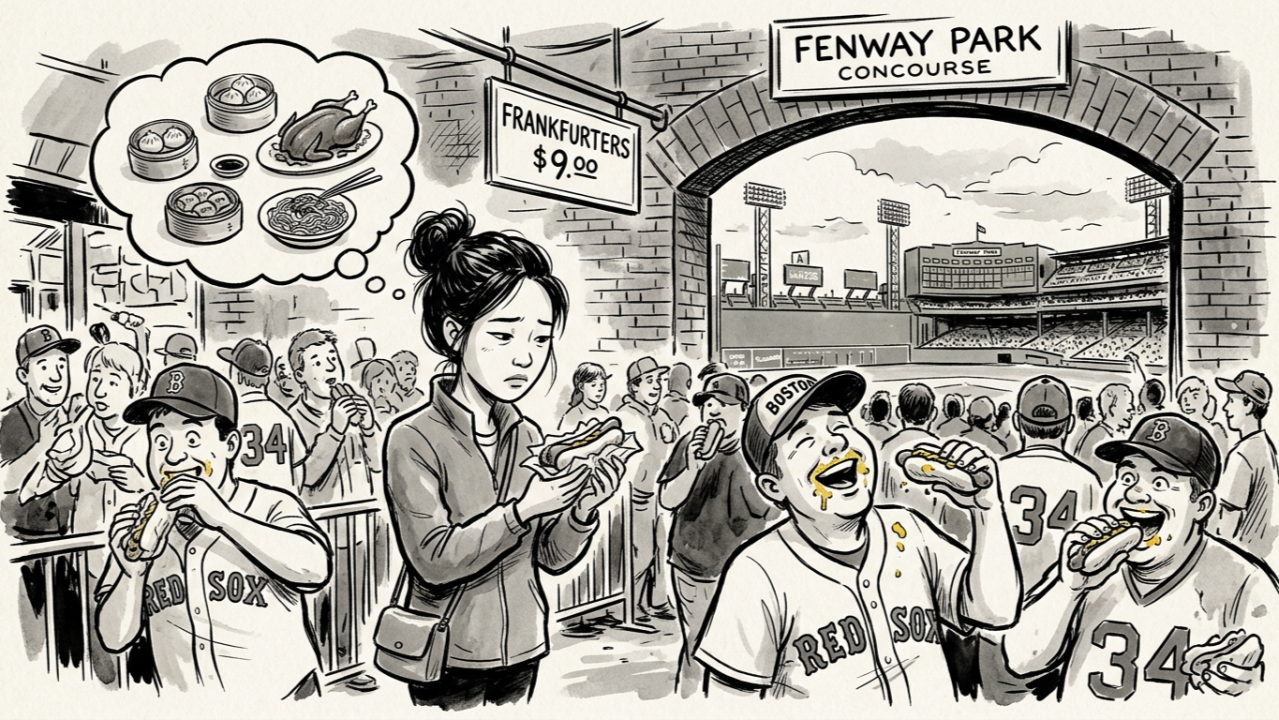
There is a moment when you walk through the gate at Fenway and the concourse is dark and the concrete is old and the smell is the smell, the Fenway smell, a combination of sausage and beer and popcorn and age and something else, something that has no name because it is not a substance but an accumulation, the accumulation of a hundred and fourteen years of people walking through this same gate and feeling the same thing I am about to feel, and then you come through the tunnel and the field opens up. The grass. The dirt. The Monster, which is not a wall but a presence, a thirty-seven-foot-high presence that has been watching over left field since 1912 with the patience and the permanence of a thing that has decided it is not going anywhere and you are welcome to adjust. The seats that were built for a person who existed in 1912 and who was apparently the size of a modern child. The Citgo sign beyond the outfield. The sausage vendors on Lansdowne Street.
The field opens up and the whole city snaps into focus.
And the understanding, which is not rational and does not need to be, that this rectangle of grass in the Fenway neighborhood of Boston is the geographic center of something you do not have a word for because the word has not been invented yet and if it were invented it would be in a Boston accent and the rest of the world would not be able to pronounce it.
I need to say something about 2004 and I need to say it carefully because I am in Mei Foo and Ruth is in the next room and if she hears me getting emotional about baseball again she will deliver a verdict that is both accurate and devastating and I am not prepared for that tonight.
The year the curse broke. I was there. Not at Fenway. In St. Louis, at Busch Stadium, for Game Four of the World Series, the game that ended eighty-six years of the most poetically sustained suffering in the history of American sports. I was in the stadium. I watched it happen. And then, through a series of events that I cannot fully explain and that I am saving for another essay because the events deserve their own telling, I ended up at the team’s celebration after the game. I was in the room. With the players. With the champagne. With the trophy. A kid from Adams, a man who had been wearing Red Sox gear like a uniform since before he could read, standing in a room with the men who had just done the thing that generations of his family had believed would never be done.
And I almost got into a fight with Barry Bonds.
I am not going to tell that story tonight. That story requires its own essay and its own context and a level of emotional preparation that I do not currently possess. But I will tell you that it happened, and that the combination of champagne and proximity to the greatest moment in Red Sox history and the presence of Barry Bonds produced a series of decisions that were, in retrospect, consistent with everything you already know about me if you have read the Fisk Road essay or the Jack Gallivan essay or the Fallen Angels essay, which is that I am a man who has replaced strategy with momentum since approximately the age of fifteen and who has never once, in the long stumble of his life, arrived at a destination he originally intended.
Ruth does not understand baseball. She has never learned the rules. She does not know what a balk is. She does not know what an earned run average measures. She does not care. But Ruth loves the energy of Red Sox games, and of course she does, because she is from Hong Kong.
Hong Kong is a city of eight million people compressed onto a rock in the South China Sea, a city where the energy is the point, where the crowd is the event, where the collective roar at Happy Valley when the horses round the final turn is the same roar that fills Fenway when the ball is hit deep to left and forty thousand people rise as one. Ruth grew up inside that frequency. The density, the noise, the specific electricity of a place that is packed with people who care about the same thing at the same time, that is Hong Kong on any given Tuesday, and that is Fenway on a Friday night. Ruth does not need to understand baseball to understand Fenway. She needs to understand crowds. And Ruth has understood crowds her entire life.
She sits next to me and she does not watch the game. She watches the crowd. She watches the man three rows down who has been yelling at the umpire since the second inning with a commitment that borders on professional. She watches the family in matching jerseys. She watches the old man in the seat behind home plate who has not moved, has not spoken, has watched every pitch with the silent, forensic attention of a person who has been doing this for sixty years and does not need to perform his devotion. Ruth watches all of this and she is, in her way, at home, because a stadium full of people who care too much about something that does not matter is the same everywhere, and Ruth has been in that stadium before, in a different city, in a different language, and the language does not matter. The energy does. The energy is the same.
Baseball is not a sport to me. It is a language. The first language I learned, before Cantonese and before legalese and before the language you speak when you have lived in a foreign city for fifteen years and become a person who writes essays about the two cities that made him. Ruth does not speak this language. But she speaks the language of the room, the Fenway room, the room that holds forty thousand people and vibrates at a frequency she recognizes because it is the frequency of her city too. And that is enough. That is more than enough. That is the thing.
1
It’s Where I Started
Hong Kong is home. I wrote that. A few weeks ago. In an essay that ended with Ruth not coming down to the lobby to get me, and the city bringing me back, and the line about standing in it. I said I would not be taking questions. I meant every word of it. Hong Kong is where I live, where Ruth is, where the wontons are, where the MTR takes me everywhere for eight dollars, where Mrs. Leung makes noodles on Lai Chi Kok Road and the woman on the escalator smells like Tiger Balm and certainty and the boy with the backpack mouths words from a textbook that will determine his future on a machine that climbs a mountain.
But Boston is where I started. Boston is the reason I was available to be any of this.
Adams made me. A small town in the Berkshires where Jack Gallivan called the smartest kids dummies and meant it as love and the kid floating on the edges with undiagnosed ADHD and a brain that could not receive the signal because the signal was too slow did not know yet that the frequency would find him. Adams gave me the stubbornness and the friends whose stories I have been telling for forty years, Pete and Mark and Trevor and Christy and the Fisk Road sparks and the Sears phone call and the golf ball that hit Barbara Dunn in the forehead, all of it, the entire catastrophic, magnificent inventory of a childhood spent in motion in a town of eight thousand people who could not escape each other and did not, when it mattered, want to.
Boston took the raw material and made something of it. Boston University School of Law took a kid from Adams and told him he was unprepared instead of stupid, and the distinction was everything. The North End taught him that food is a current and a hand that is out gets filled. Fenway taught him that you can believe in things that do not make sense and the believing is the sense. The North Street Grille taught him that some mornings are sacred and some counters are churches and some eggs are eaten with Ruth beside him and the silence between them is the fullest room in the city. And the Charles River taught him that a city can be old and cold and brutal in February and still be the most beautiful thing he has ever seen because it is his, because he found it, because a kid from Adams drove two and a half hours east and the skyline appeared and the world got bigger and the bigger did not frighten him. It called him forward.
And the forward took him to Miami, where it was snowing in April back in the Berkshires and he had had enough and he flew south with no plan and there she was. The elbow. The Cantonese girl. The whole reason he is sitting in a flat in Mei Foo fifteen years later writing about two cities when most people can barely commit to one. I have written about that elbow, in the Fallen Angels essay, about every day we rub elbows with many people and some of them will change your life and you won’t know it when it happens. That elbow was Ruth.
I live in Hong Kong now. I will probably live in Hong Kong for another fifteen years, God willing, knees willing, Ruth willing, Ruth especially willing, because Ruth’s willingness governs my geography the way gravity governs trajectory, which is to say completely and without appeal.
Some places are where you became.
But when I am very old, if I am lucky enough to be very old, and someone asks me where I am from, I will not say Hong Kong. I will not say Mei Foo. I will not say Asia.
I will say Boston.
Ruth will be standing next to me. She has always been standing next to me, at every table, in every city, in both the places I have written about and the thousand places I have not. She will hear me say it. She will roll her eyes, the Ruth roll, the one that has been in continuous production since approximately our first date and shows no sign of discontinuation. And she will say, “You’re not from Boston. You’re from Adams.” And she will be correct, because she is always correct, and it will not matter, because some places are not where you were born. Some places are where you became. And where you became is always, always home.
Even when you are standing in a different one.
Even when the different one has better noodles.
Even when the different one has Ruth.
Boston does not have Ruth. Hong Kong does. This is why I live in Hong Kong. This is the reason. Not the taxes, not the MTR, not the harbour at night. Ruth. Ruth is the reason, and the reason is sufficient, and everything else, the ten things in the Hong Kong essay and the ten things in this one, is scenery.
Beautiful scenery. Two cities’ worth of it. But scenery.
She is the city. She has always been the city.
And I found her because I left one.