Things I Notice
The Thirty-Seven Steps and the Wooden Clog
On what your feet are saying, the threshold at every door, and why a city of cabinets can’t explain a kick to the chest.
In Hong Kong, a woman will walk up a forty-five-degree incline in four-inch stilettos with the composure of a person who has made a private arrangement with gravity and does not intend to renegotiate. This is not an occasional sighting. This is Tuesday at six-fifteen on Pottinger Street, the old stone steps that run from Queen’s Road up to Hollywood Road at a grade that would qualify as a hiking trail in the Berkshires, and she is ascending in heels that could puncture drywall, moving at a pace that suggests the mountain should not have been placed in her path, and if the mountain disagrees, the mountain is wrong. She does not hold the railing. She does not slow down. She reaches the top. She turns a corner. She is gone. The mountain remains, defeated.
The construction workers are in flip-flops. Bamboo scaffolding, forty stories high, lashed together with nylon ties in a lattice that sways visibly in the wind, and the men climbing it are wearing rubber sandals you buy in a bin outside a pharmacy for twelve Hong Kong dollars, the kind with precisely one structural element between your foot and the void. These men are walking steel beams in them. Not carefully. With the flat-footed certainty of men who have been walking steel beams in flip-flops since before the building beneath them existed, because the building beneath them did not exist until they walked those beams. Hong Kong was built by men in flip-flops. Every tower in the skyline. Every glass monument to capital that people photograph from the Star Ferry. A man in twelve-dollar sandals built it while the future tenants were still in business school trying on their first pair of Ferragamos. Nobody mentions this.
The grandmothers in black cloth shoes, flat as paper, pad through wet markets at five a.m., making no sound on the tile, because a grandmother at a wet market is not there to be heard by the floor. She is there to negotiate the price of garoupa down to a number that reflects her assessment of its worth, and her assessment is final, and the fishmonger knows it, and the shoes have nothing to do with it except to deliver her to the point of combat without announcing her arrival.
The men in Italian leather in Central, sweating through their socks by nine a.m., because Hong Kong in summer is not a climate, it is a personal insult delivered by the atmosphere to every man who has made the decision to encase his feet in cowhide while the humidity reads ninety-seven percent.
By August, the shoes are casualties. By September, they are replaced. By October, the replacements are dying. The men keep buying, because the shoes are not shoes. They are the uniform. The uniform says: I belong in this building. The uniform says: I earn enough to destroy four-thousand-dollar shoes every season and feel nothing. The uniform lies, in some cases. But in Central, a convincing lie and a truth are the same thing, provided you’re wearing the right shoes.
The platform sneakers that add four inches to a teenager in a city where square footage costs more per inch than anywhere on earth, as if the extra altitude qualifies as additional real estate. The bedroom slippers worn to 7-Eleven at midnight by people who have decided that below the ankle, the social contract does not apply after ten p.m. The hiking boots that appear on Saturday mornings like a citywide costume change, purchased at a shop in Wan Chai where the staff assess your arch with the gravity of a cardiologist assessing a murmur. On Monday the boots are back in the closet and the Italian leather is back on the feet, and if you saw the same person on Saturday and Monday you would swear they were different people. In Hong Kong, they are.
Threshold
And the slippers at the door.
Every door. Every apartment. Every threshold in this city, a row of shoes lined up outside or just inside, removed and replaced, the outdoor self peeled off at the boundary and the indoor self pulled on. You cannot enter a home in Hong Kong with your outdoor shoes. This is not a suggestion posted on a doormat in the passive-aggressive font of a person who has given up. This is law, the kind enforced by something older than any court, which is the expression on the face of a woman whose floor you have just violated with a sole that walked through Mong Kok this morning, past the fish guts and the construction dust and the ten thousand insults the street applies to anything that touches it. You look at the shoes by the door. You add yours to the row. You put on the guest slippers. Inside is different from outside. There is a self you walk the city in and a self you live in, and the door is where one ends and the other begins, and the shoes are the evidence you leave behind.
I did not grow up with any of this. I grew up in a town where shoes told one story all day and the story did not change.
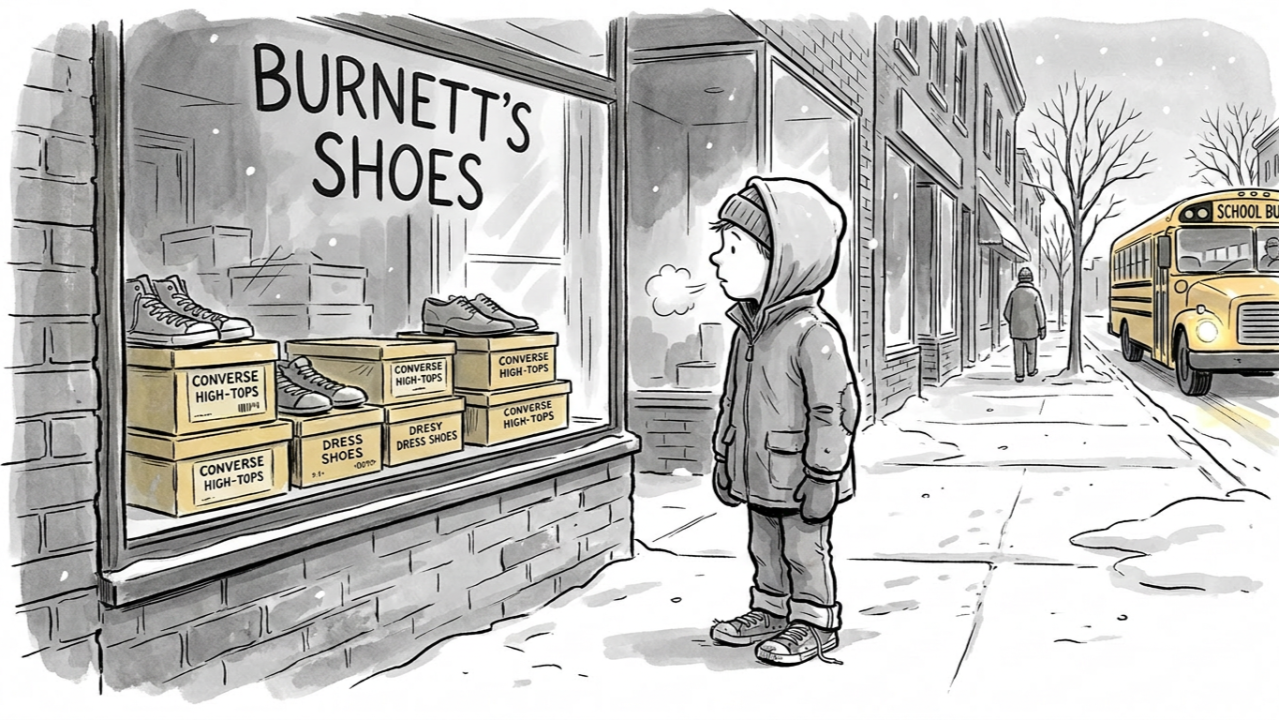
In Adams, Massachusetts, I waited for the school bus outside Burnett’s shoe store on a sidewalk where, on certain mornings in January, the air was cold enough to freeze your nose hairs on the inhale, a sensation I will describe for anyone who has not experienced it as the inside of your nostrils becoming briefly, startlingly aware that they are made of tissue and not stone. You stood there. You stomped your feet. You watched your breath perform and disappear. And behind you, in the window of Burnett’s, which in 1985 was still stocked with inventory from approximately 1957, sat rows of Converse high-tops in colors nobody had worn since the days of Leave It to Beaver, work boots in boxes yellowed at the edges, and dress shoes whose style had come and gone and come again and gone again while they sat in that window waiting for a customer who had either died or moved to Florida, which in Adams amounted to the same thing. Burnett’s did not update. Burnett’s endured. The shoes in that window were a museum exhibit, curated by indifference, and I stood in front of them every morning in whatever my mother could afford at the end of the season when Kmart marked things down, which was one pair of sneakers, worn from September to June, worn to transparency, held together by will and the particular adhesive quality of teenage indifference to personal appearance.
My favorite shoes are Vans. They have been my favorite shoes since the early eighties, when the Suki brothers wore them behind the counter at the Oasis Liquor Store. The Oasis, and I want to stay with that name for a moment, because someone chose it, someone stood in front of a sign printer in the northern Berkshires and said yes, Oasis, that’s the one, a word that means a place of water and shade and life in the middle of a desert, and applied it to a store that sold Jim Beam and Marlboro Reds on a street near where the last factory had closed and the snow came in October and did not leave until it was good and ready, which means that someone understood, with the precision of either a poet or a man who had been drinking his own inventory, that in Adams the desert was not sand but time, and the water was eighty proof, and the shade was a ceiling with a drop tile missing.
The Oasis, for anyone unfamiliar with the spiritual geography of Adams, Massachusetts, occupied a position on the town’s moral axis that is best understood through the following fact: Adams had a bar between every church, and Adams had a lot of churches. Notre Dame. St. Stanislaus. St. Thomas Aquinas. The Baptist church on the corner. The Methodist church up the hill. Between each of them, as if placed by a municipal planner who understood that the soul requires equal access to salvation and its opposite, a bar, or a liquor store, or in the case of the Oasis, a place where you could purchase alcohol and also encounter the Suki brothers in Vans. The Oasis was down the street from the Sahara, which was a bar, which means that someone in Adams placed an oasis within walking distance of an actual desert and nobody involved appears to have been joking. The town’s relationship to drink was not a contradiction of its relationship to God. It was the other half of the same sentence. You went to church on Sunday. You went to the Oasis on Monday. Sometimes the order reversed. Sometimes the personnel overlapped. Nobody found this remarkable. The Oasis was as much a part of the town’s infrastructure as Notre Dame, and it served approximately the same function, which was to give people a place to go where someone behind the counter knew their name.
The one shoe that followed me from Adams to Hong Kong without changing its story.
The Sukis were into skateboarding. They were not from Burnett’s window. They were from somewhere else, somewhere that involved wheels and concrete and a posture toward the world that Adams did not teach but could not entirely prevent, and the Vans were the evidence. I did not skateboard. I was not a Suki brother. But the Vans said something I wanted to be true about myself, something flat and fast and low to the ground, and I have been wearing them ever since, across decades and continents and every version of myself that came after, which means the Vans are the one thing that survived the threshold.
The boots that walked the parking lot walked the kitchen. The sneakers that ran the hallway at Hoosac Valley ran the living room. The mud that came in on the sole was part of the house the way the mountain outside the window was part of the house, not an intrusion but a feature, evidence that the world out there and the world in here were continuous, uninterrupted, a single territory that did not require a costume change at the boundary because there was no boundary. Sneakers if you were young. Work boots, Timberlands or Dunhams or whatever your father handed down from whatever shift he was coming off, if you were a man who used his hands, and in Adams most men used their hands, because the mountains did not maintain themselves and the driveways required plowing and the wood required splitting and none of these activities were performed in Italian leather.
Impact
And in the case of one woman, a wooden clog.
Erica was in the class behind us at Hoosac Valley. I know her husband. He is my friend. I know of Erica. At a gathering, without preamble, without provocation I can locate in any known chain of causation, Erica planted a wooden clog into the center of my chest. Not a glancing blow. Not a brush. A full, committed, load-bearing kick, the kind that begins in the hip and travels through the leg with the accumulated force of a decision that was made before I entered the room and possibly before I was born. The clog itself was a relic, a shoe that belonged in a museum in Rotterdam or on the foot of a woman carrying milk across a field in a painting nobody looks at anymore, and instead it was here, in the Berkshires, connecting with my ribcage at a velocity that suggested Erica had either studied the physics of impact or did not need to.
I have no explanation. I have tried. I am a lawyer. I build arguments for a living, construct narratives from evidence, find the thread that connects one event to the next in a sequence a judge can follow. There is no thread here. There is only a woman, a shoe older than the country we were standing in, and my sternum, and the brief, clarifying understanding that the three of them had met on purpose even if I could not identify whose purpose it was.
What I know is this: indifference does not kick. Apathy does not aim. You do not haul off and deliver a seventeenth-century farming implement to the chest of a man who does not occupy space in your understanding of the world. The clog meant I was accounted for. It meant that somewhere in Erica’s map of people who exist, I had a coordinate, and the coordinate was close enough to reach with a foot. This is, in Massachusetts, among the more reliable confirmations of personhood available.
One woman, one clog, one absolutely unexplained act of blunt-force acknowledgment.
And the clog was the truest shoe in the room, because Erica did not have two selves. Erica had one self and it was the self that arrived and the self that departed and the self that, in the intervening minutes, redistributed my skeleton without changing expression. The clog was not a costume. It was not the outside self being worn indoors by mistake. It was just Erica, undivided, the same woman on both sides of every door she has ever walked through. No threshold. No transition. No cabinet full of alternate versions in their original boxes. In Adams, that’s all there is.
In Hong Kong, I have lost count of my shoes. That is a lie. I counted. Dress shoes for court, running shoes for the waterfront, sandals for the building, leather for client dinners, boots for the trail on Saturdays. And fourteen pairs of Vans, because even the shoe I point to when someone asks which version of me is the real one has replicated itself until it fills its own shelf, the same flat sole in the same flat style bought again and again as if repetition were the same thing as permanence, which it is not, which the shelf knows even if I pretend otherwise. All of them lined up inside the door, each one a man I can become by lacing up. The divorce lawyer. The runner. The neighbor. The man who pretends he belongs in a restaurant where the bill will exceed his first month’s rent in Adams. And fourteen copies of the kid from Burnett’s window, which is not continuity. It is a man who loved one shoe so much he turned it into a collection, which is the most Hong Kong thing I have ever done. Too many men in one closet, waiting their turn.
Ruth’s collection dwarfs mine the way the South China Sea dwarfs a puddle. Ruth, my wife, has not fourteen pairs but an inventory that would require an auditor and possibly a cataloguing system developed for use by the Smithsonian. We have cabinets. Multiple cabinets. I want to be clear about the plural. Cabinets, in the way that a library has shelves, floor to ceiling, dedicated to the single purpose of housing shoes in their original boxes, each box labeled, each pair preserved in the tissue paper and cardboard it arrived in, stacked with the precision of an archive. Jimmy Choo. Manolo Blahnik. Christian Louboutin with the red soles that cost more per square inch than the apartment we live in. Tory Burch, in several colors, because one Tory Burch is apparently a question and three is an answer. Salvatore Ferragamo. Valentino with the rockstud straps. Stuart Weitzman for the boots that go over the knee in a city where the temperature rarely justifies anything over the ankle. The cabinets are not a closet. They are a gallery. They are Burnett’s window if Burnett’s had money and taste and a rotation policy. Each box is a self Ruth tried on, decided to keep, and filed for future reference, and the filing system is immaculate, and the collection grows, and mine sit beneath hers in the spatial hierarchy of our apartment like a footnote beneath a novel.
She removes them at the door the way she breathes. She has done this for the duration of our marriage and the duration of her life before it. I have been in Hong Kong for decades and I remove my shoes too, but I do it with the faint reluctance of a man who still tells himself he is one person all day, despite the evidence lined up inside the door, pair after pair, like a jury he has chosen not to consult. Ruth has seen me lace the Italian leather for court and the running shoes for the waterfront and the sandals for the elevator and the Vans for the version of myself I like best. She does not comment. She does not need to. Ruth knows that the man she married is not one man but a closet full of men who have agreed to share an apartment and a name, and fourteen of them wear Vans and insist they are the original.
In Adams, I had one pair. Standing outside Burnett’s with frozen nose hairs and dead men’s Converses in the window behind me. One, and it was me, and everyone who saw me, from Jack Gallivan in his checkered pants to the heads in the parking lot, saw the same kid, because there was only one.
A closet full of shoes is not one pair. I have tried to pretend otherwise, to treat the Vans as the real ones and everything else as concessions, costumes, the professional accommodations of a man whose actual self is flat and fast and low to the ground. But fourteen pairs of the same shoe is not fidelity. It is accumulation dressed as loyalty. And a concession you make five mornings a week is not a concession. It is a life. I have more lives than I am willing to count, same as Ruth, except that Ruth has organized hers and I have told myself mine don’t count.
Ruth’s cabinets are not a woman divided into pieces. I have been wrong about that, or dishonest, and in an essay the distinction collapses under its own weight. Ruth looked at a city that demands a different shoe for every room and chose to meet that demand with the precision of a woman who does not lose things, not her keys, not her composure, not herself. The boxes are labeled. The filing system is immaculate. The tissue paper is folded. That is not fragmentation. That is a woman who has mastered the arithmetic of a city that multiplies you whether you consent or not, and who has decided that if she is going to be multiplied, the terms will be hers. A cabinet full of original boxes is not one self divided into pieces too small to contain the whole. It is one self who knows exactly where every pair is and does not confuse the shoe with the woman wearing it. I am the one with no system, too many selves in a pile by the door, held together by fourteen pairs of Vans and the story I have been telling about them since 1983.
La Rochefoucauld wrote: We are so accustomed to disguise ourselves to others that in the end we become disguised to ourselves. Same century as Erica’s clogs, a coincidence I do not need but appreciate. A man could spend an entire life presenting a version of himself so polished that the original disappeared beneath it like a floor beneath a shoe. Still there. Still bearing the weight. No longer visible to anyone, including the man standing on it.
I saw a pair of shoes outside a door in my building once. Men’s leather, mid-range, the shoes of a man who worked in an office but not in Central. They sat outside the door, toes pointing outward, as if the man who left them intended to return. As if the man inside intended to become the man outside again, to resume the walk, to re-enter the version of himself those shoes carried through the city.
He did not return. The shoes sat. Nobody moved them. In a building with forty thousand people, nobody touched the shoes outside 14-F, because the shoes outside a door are sacred in the way that any object a person intended to come back for is sacred, and removing them would be an admission that the intention had failed, that the walk was over, that the door was no longer a threshold but a wall.
I do not know what happened. I know the shoes were there for three weeks, and then one day they were gone and so was everything else, and the door was just a door again, belonging to no one, asking nothing. The Vans are the shoe I wore through. The shoes at 14-F are the shoe that got left behind, pristine, pointing outward, still holding the shape of a man who never came back to fill them.
I think about those shoes. I think about my sneakers in Adams, worn through to the sock, the sole peeling away from the toe like a mouth trying to speak. I think about Ruth’s cabinets, every box labeled, every pair accounted for, the immaculate archive of a woman who has never misplaced herself despite owning more shoes than Burnett’s carried in a decade. I think about the Vans, the fourteen pairs I point to when I want to believe I am still the kid outside Burnett’s, even though the kid outside Burnett’s owned one pair of anything and would not have recognized the man with a shelf full of the same shoe bought over and over, calling it continuity.
She is the most certain person in Hong Kong, in a city of cabinet people.
The grandmother turns the corner of the wet market in her black cloth shoes. She has one pair. She has had one pair for longer than my building has existed. She does not need cabinets. She does not need a closet full of options or the original box. She decided, at some point that predates my comprehension, who she was, and the decision was final, and the shoes are the proof. Her shoes make no sound on the wet tile, and she does not look up, and the market closes around the space she leaves behind.
I look down at my Italian leather. They say nothing about the mountain. They say nothing about Burnett’s window or the frozen sidewalk or the one pair of Kmart sneakers worn to nothing. They say nothing about the Suki brothers or the Oasis or the flat, fast thing I wanted to be true about myself before I knew what true meant.
Tonight I will take them off at the door. I will line them up next to Ruth’s, next to the Vans, next to every self I have assembled in thirty years of living in a city that multiplies you whether you ask it to or not. Ruth will be inside. She will not look up. She does not need to. She has been watching a man change his shoes for the duration of a marriage and she has never once confused the shoe with the man, which is more than I can say for myself.
And I will stand there a moment on the cool tile, in the silence between the man who walked in and the man who lives here, and I will think about a boy on a frozen sidewalk in Adams who owned one pair of shoes because one pair was all there was. He was not undivided because he had figured something out. He was undivided because his mother bought what she could afford when Kmart marked things down, and what she could afford was enough, and he wore it until it fell apart, and he never once stood at a door wondering which version of himself to be.
I have been wondering ever since. Fourteen pairs of Vans and I am still looking for the one that feels like that, like the first pair, like the only pair, like a shoe worn so thin you could feel the cold of the sidewalk come through and know it was the ground, the actual ground, not separated from you by money or choice or the insulation of a life that offers you too many ways to be yourself. My mother could not afford that insulation. She gave me the ground instead, and the ground was enough, and I did not know it was a gift until I had spent half a lifetime buying shoes to replace it.
The grandmother is gone. Her shoes made no sound. Somewhere in Adams, it is January, and a boy is standing outside Burnett’s in the only shoes he owns, and the bus is coming, and his feet are cold, and he is not wondering who he is.