On butlers, Rock Bars, and why Robert Louis Stevenson was wrong.
There is a saying, attributed to Robert Louis Stevenson, that it is better to travel hopefully than to arrive. Stevenson was a brilliant man, a man who gave us Jekyll and Hyde and Treasure Island and a number of other things that have outlasted most of what the rest of us will ever produce, and I say this with the deepest respect for his legacy and his craft: he was wrong. He was wrong because he had never stayed at Ayana Bali. He had never walked into a private pool villa at the southern tip of Jimbaran and realized, within the first eleven minutes, that the arriving was better than the hoping, that the thing itself was better than the anticipation of the thing, that for once, for once in a life that has been defined by the gap between what was promised and what was delivered, the delivery exceeded the hope by a margin so wide you could land a plane in it.
If Stevenson had stayed at Ayana Villas he would have revised the aphorism. He would have said: it is sometimes better to travel hopefully than to arrive, unless you are arriving at Ayana, in which case, arrive quickly, because the villa has a private pool and the pool is heated and the pool is actually heated, genuinely, verifiably, get-in-up-to-your-neck-and-stay-there heated, and I need to stop here and explain why I am leading a hotel review with the temperature of a swimming pool, because that requires context, and the context requires a garden hose, four girls from Pittsfield, and a friend named Jason, and if you have been following along you already know the story and if you haven’t I cannot help you except to say: I have a history with water that is supposed to be warm and is not.
The history is long. It started in a hot tub in Adams, Massachusetts, in 1986, when my friend Jason filled a perfectly heated hot tub with a garden hose at the precise moment four girls arrived to get in. It continued, decades later, at an Angsana Hotels & Resorts property in Zhuhai, where my wife and I booked a Sea View Pool Duplex Villa specifically for its private heated pool and discovered, upon entry, that the pool was heated in the same way that a promise is kept by a corporation that has decided your complaint is worth less than the electricity it would cost to turn on the heater. Which is to say: it was not. The pool was ice cold. We could not get past our knees. The hotel told us our inability to enter the water was a “personal comfort preference,” which is a phrase I will carry with me to my grave, not because it was hurtful but because it was so perfectly, so magnificently corporate that it deserves to be studied by linguists.
I mention all of this because when I tell you that the pool at Ayana Bali was warm, I need you to understand the weight of that sentence. I need you to understand that I am a man who has been betrayed by bodies of water on two continents and across four decades, a man for whom the phrase “heated pool” triggers not relaxation but a stress response refined by years of thermal disappointment, and when I stepped into the private pool at our villa at Ayana and the water was the temperature it was supposed to be, the temperature it was advertised as, the temperature that a reasonable human being would expect a heated pool to be, I stood there, up to my chest, in Bali, and I felt something I had not felt since before Jason picked up that hose in 1986.
I felt trust.
Ruth, my wife, who is Cantonese and who has spent our entire marriage watching me test the temperature of every body of water with the suspicion of a man who has been burned, or more precisely, frozen, said nothing. She got in. She stayed in. She did not have to get out. She did not have to stand on the steps, knee-deep, arms crossed, wearing the expression of a woman who has been promised warmth and received a lesson in thermodynamics. She swam. In warm water. In a pool that worked. At a hotel that delivered what it said it would deliver.
This, in my experience, should not be remarkable. It should be the baseline. It should be the minimum. And yet here I am, writing about it as though a hotel keeping its pool at the advertised temperature is an act of extraordinary moral courage, because after Zhuhai, after Cathay, after six months of being told that things that were broken were functioning as designed, a hotel that simply does what it says it will do feels less like a transaction and more like a miracle.
But the pool was not the thing. The pool was the foundation, the proof of concept, the evidence that Ayana was a place where the words matched the reality. The thing was everything else.
I grew up in Adams, Massachusetts, a town of 8,000 people where the closest thing to a butler was Albert at the hardware store on Summer Street, who would help you find a specific bolt if he was in the mood and if you didn’t ask too many questions and if the Red Sox were winning. Albert was a good man. Albert would give you the shirt off his back, or at least the bolt off his shelf. But Albert was not reachable by WhatsApp at two in the morning, and if you had texted Albert at two in the morning to ask for a fresh towel, Albert would have driven to your house and used the towel to strangle you, and the town would have sided with Albert.
At Ayana, there is a butler. I want to be precise about this, because the word “butler” has been so thoroughly debased by the hospitality industry that it now means anything from “a person who actually butles” to “a front desk clerk who has been given a new title and a WhatsApp number.” At Ayana, the butler butles. Genuinely. Attentively. With the kind of quiet, anticipatory competence that makes you feel not like a guest but like a person who is being looked after, which is a different thing entirely, and which I did not fully appreciate until I experienced the difference.
You need something, you send a message. The response is immediate. Not “immediate” in the way that Cathay Pacific uses the word “immediate,” which means four months of silence followed by a man named Jasper who has never heard of you. Actually immediate. The kind of immediate where you look at your phone and the reply is already there, as if the butler has been standing on the other side of the screen, waiting, the way Albert used to stand behind his counter, except Albert was standing there because he had nowhere else to go and the butler is standing there because the butler is genuinely, professionally, constitutionally committed to making sure you have what you need.
The food was extraordinary. I say this as a man who lives in Hong Kong, a city that takes food with the seriousness that other cities reserve for religion and politics and parking. I say this as a man who eats dim sum every Sunday in a room full of grandmothers who would cut you for the last har gow. I say this as a man whose mother-in-law, a Cantonese woman with standards that could strip paint, once admitted that the dim sum at China Pearl in Boston was as good as Hong Kong’s, an admission so rare and so seismically significant that I have been dining out on it, metaphorically, for years. The food at Ayana met the standard. Different cuisine, different tradition, different everything, but the same underlying commitment: people who care about what they are doing, making food that reflects that care, served in a place that understands that a meal is not a transaction but an experience, and that the experience begins before the first bite and continues after the last.
The Rock Bar. I need to talk about the Rock Bar, because the Rock Bar is the kind of place that, if you described it to someone in Adams, they would assume you were lying. It is built into the cliff face above the Indian Ocean. You take a cable car down to it. The views are the kind of views that make you stop talking, and I am a person who does not stop talking, as anyone who has read anything I have ever written can confirm. Ruth and I sat there, drinks in hand, watching the sun do what the sun does over the Indian Ocean when it has decided to show off, and I thought about the bars in Adams, the ones wedged between the churches on Park Street, where the view was of the parking lot and the drink was a Bud Light and the sunset was whatever came through the window if you were sitting on the right side, and I loved those bars and I love them still, but the Rock Bar at Ayana is something else. It is a place that makes you feel, briefly and powerfully, that the world is larger and more beautiful than the version of it you carry around in your head, and that feeling, for a kid from Adams who grew up thinking the Berkshires were the edge of the known universe, is worth the trip by itself.
And then the monkeys came.
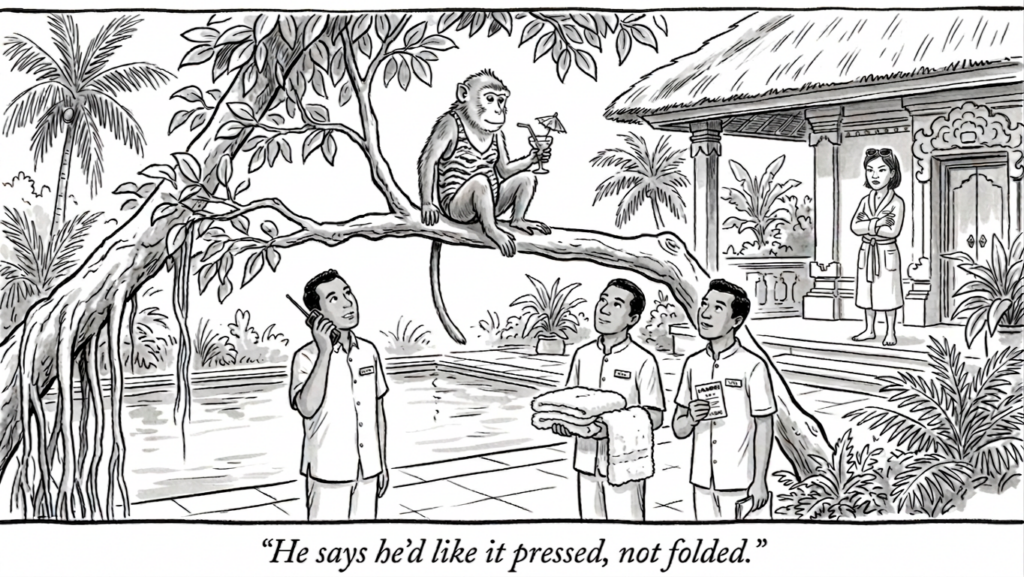
I need to tell you about the monkeys. Specifically, I need to tell you about what the monkeys did to Ruth’s bathing suit, and what the staff at Ayana did about what the monkeys did to Ruth’s bathing suit, because this is the part of the story that tells you everything you need to know about the difference between a hotel that has a customer service policy and a hotel that has a soul.
We were in the villa. The villa has a backyard, or what functions as a backyard, an outdoor space that is private and lush and tropical in the way that things in Bali are tropical, which is to say, aggressively, unapologetically, with the full commitment of a landscape that has been growing things since before humans showed up and has no intention of stopping. Ruth had left her bathing suit out to dry. This was a reasonable decision. It was a sunny day. The bathing suit was wet. Putting a wet bathing suit in the sun to dry is not a controversial act. It is not a decision that, under normal circumstances, requires a risk assessment.
These were not normal circumstances.
These were monkey circumstances.
They came over the wall like a commando unit. Three of them, maybe four, moving with the speed and purpose of creatures who have done this before, who have trained for this, who have spent their entire evolutionary history perfecting the art of entering spaces that do not belong to them and taking things that are not theirs, which, now that I think about it, is also a serviceable description of the British in Hong Kong, but that is a different essay.
The lead monkey, and I am calling him the lead monkey because he moved with the confidence of a monkey who had authority, grabbed Ruth’s bathing suit off the railing and was over the wall and gone before either of us had processed what was happening. Just gone. Into the trees. With Ruth’s bathing suit. A Cantonese woman’s bathing suit, stolen by a Balinese monkey, from the backyard of a villa where everything had been perfect, every single thing, the pool, the food, the butler, the Rock Bar, all of it perfect, and now a primate was disappearing into the jungle canopy with my wife’s swimwear and my wife was standing in the backyard with the expression she reserves for moments when the universe has done something so specifically, so personally absurd that anger is not available as a response because the situation has exceeded the parameters within which anger operates.
I want to be clear: in Adams, if a raccoon stole your bathrobe off the clothesline, you would deal with it yourself. You would not call anyone. You would not file a report. You would mutter something about the raccoon, maybe tell the story at the Corner Lunch the next morning, and you would buy a new bathrobe. That is how Adams works. You handle things. You do not burden others with your raccoon problems.
At Ayana, I told the butler. I told the butler because the butler was there, reachable, responsive, and because I had spent enough time at Ayana by this point to understand that the butler was not the kind of butler who would hear “a monkey stole my wife’s bathing suit” and transfer me to a different department. I sent the message. I expected sympathy. Maybe a polite acknowledgment. Maybe a recommendation for where to buy a replacement in Jimbaran.
They launched a search party.
They actually sent people to look for Ruth’s bathing suit. In the trees. On the grounds. Wherever the monkeys might have taken it. Staff members, plural, were deployed to recover a single bathing suit from a monkey who had, by this point, a significant head start and the home-field advantage of an entire tropical forest.
They found it.
I do not know how. I do not know where. I do not know what negotiation occurred between the staff of Ayana Bali and the monkey who had taken it, and I do not want to know, because the not knowing is better than any possible explanation. They found it, they returned it, and then, without being asked, without any suggestion from us that this was necessary or expected or even desired, they had it laundered.
They laundered a bathing suit that had been stolen by a monkey.
Ruth, when the laundered bathing suit was returned to the villa, folded, clean, looking better than it had before the monkey got involved, held it up and examined it with the critical eye of a woman from Hong Kong who has opinions about laundry the way other people have opinions about politics.
“It’s softer,” she said.
I do not know if the monkey improved the bathing suit. I do not know if the laundering improved the bathing suit. I do not know if the entire experience, the theft, the search, the recovery, the laundering, was, in some cosmic sense, the bathing suit’s hero’s journey, a trial by primate from which it emerged stronger, softer, and more fully itself. What I know is that my wife’s bathing suit was stolen by a monkey and returned to her in better condition than it left, and at no point during this process did anyone at Ayana tell her that the monkey’s behavior was “not a safety issue” or that her experience of having her belongings stolen by wildlife was a “personal comfort preference.”
No one offered her 18,000 miles. No one suggested that the bathing suit had performed as designed. No one sent a man named Jasper.
They just fixed it.
This is what I kept thinking about, sitting at the Rock Bar that evening, watching the sun go down over the ocean with a drink in my hand and a wife in a freshly laundered bathing suit beside me. I kept thinking about Albert. Albert, on Summer Street, in Adams, who took the thing back and said he was sorry and fixed it, not because he had attended a seminar but because you lived three streets away and he would see you at church. The staff at Ayana have never been to Adams. They will never see me at church. They will probably never see me again. And they chased a monkey through the grounds of a resort to recover a bathing suit and then laundered it, because that is what you do when you give a damn, when the service is not a policy but a reflex, when the short distance between a problem and its solution is not cluttered with case numbers and escalation promises and four months of silence and a man named Jasper who has never heard of you.
Ayana is not perfect. Nothing is perfect. The monkeys will come back. They have institutional knowledge now. They know where the bathing suits are. They will be back, and they will be bolder, and someday a monkey will steal something that cannot be laundered and returned, and on that day, the staff of Ayana will have to make a decision about how far they are willing to go.
Based on what I saw, I think they will go far. I think they will go as far as it takes. I think they will chase the monkey. I think they will always chase the monkey. Because that is the difference between a hotel that has a five-star rating and a hotel that deserves one, and the difference is not the thread count or the infinity pool or the cable car to the cliff bar, though all of those things are wonderful. The difference is whether, when something goes wrong, when the monkey comes over the wall, when the pool is cold, when the bathing suit is gone, someone fixes it. Quietly. Immediately. Without being asked to file a case number.
Ruth and I are already talking about going back. Not because of the pool, though the pool was warm. Not because of the Rock Bar, though the Rock Bar was magnificent. Not because of the food, though the food was the kind of food that makes a man who eats dim sum in Hong Kong every Sunday sit up and pay serious attention.
Because it felt like home. Not Adams home. Not Hong Kong home. A different kind of home, the kind of home that exists only when every single person in a place has decided, collectively and without reservation, that the person standing in front of them matters, and that whatever they need, whether it is a warm pool or a fresh towel or a bathing suit that a monkey stole, they will get it, and they will get it now, and they will get it with a smile.
Stevenson said it is better to travel hopefully than to arrive. Stevenson never arrived at Ayana. We did. And the arriving was better than the hoping, the staying was better than the arriving, and the leaving was the only hard part, which is the highest compliment I know how to pay a place, and I am a man who has been paying compliments to places and people for a long time and has never once, not once, said it about a hotel.
Ruth, for her part, said it more efficiently, the way Ruth says everything more efficiently, because she is Cantonese and I am from Adams and the distance between those two communication styles is the distance between a scalpel and a sledgehammer.
“Book it again,” she said.
I’m booking it again.