Or: Garlic Salt and Charity Stickers
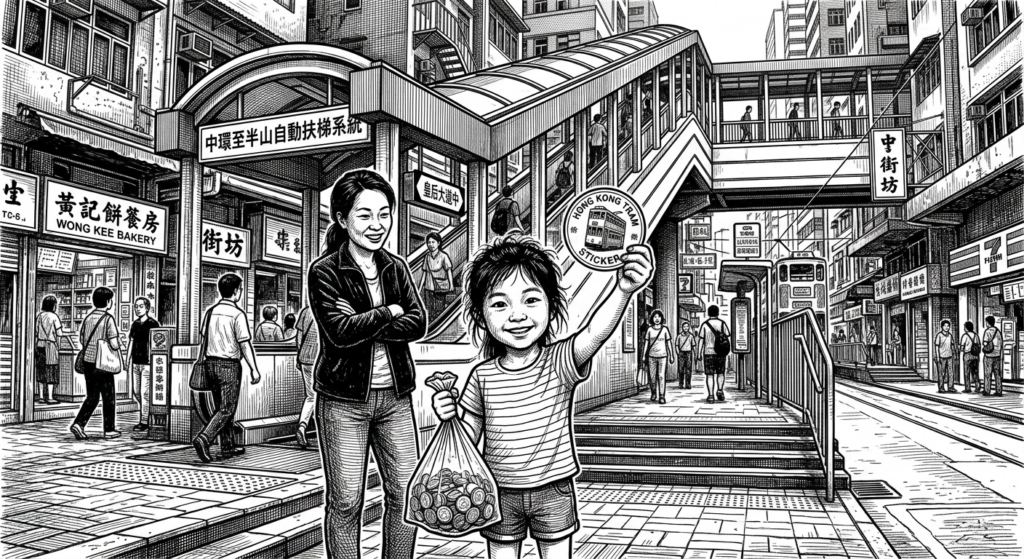
On certain Saturday mornings in Hong Kong, and sometimes a stray Wednesday, small girls station themselves outside MTR exits and supermarket entrances with a plastic bag for coins and a roll of stickers. They are selling flags. Not actual flags, not anymore, though the Cantonese name stuck, 賣旗日, sell-flag day. What you get for your coins is a little round sticker bearing the logo of whichever charity drew that day’s government permit. The transaction is simple. You drop money in the bag, the child peels a sticker and puts it on you, and for the rest of the morning nobody else asks.
I had no idea what was happening the first time. I’d been in Hong Kong maybe three weeks. A girl, couldn’t have been older than seven, was standing with her mother near an escalator, bag in hand, sticker at the ready. I fumbled for coins. She took them, smiled, and went straight for the sticker placement. Aimed right at my groin. I sidestepped like I was dodging a taxi on Des Voeux Road. Her mother laughed. Ruth laughed. I didn’t.
It was perfectly innocent, of course. The kid was short. My waist was her eye level. She was going to stick it where she could reach, and what she could reach happened to be alarming to a man from a country where you don’t let strangers’ children near that zip code under any circumstances. The whole Western scaffolding of stranger danger and appropriate contact and liability, the entire apparatus I didn’t even know I was still carrying, fired every alarm at once. Over a sticker.
Ruth told me later I think too much. She picked her chopsticks back up and went back to her noodles.
She’s probably right. But the moment stayed with me because it was one of those hairline cracks where you see how much cultural operating system you’re still running underneath the surface. Hong Kong is one of the safest cities on earth. A seven-year-old can ride the MTR alone at rush hour and nobody blinks, because the city runs on a kind of public trust that most Western cities destroyed decades ago and now pretend was never possible. A child selling stickers on a Saturday morning with her mother two feet away is not a safeguarding concern. It’s a community functioning the way communities are supposed to function, where a kid can participate in civic life without a risk assessment and a background check.
And yet my reflexes didn’t know that. They were still calibrated to a world where public space is threat space, where children and strangers don’t mix, where the civil body has been so thoroughly atomized that a small act of contact registers as intrusion. That’s not caution. That’s damage. The reflex itself is the evidence.
The thing is, I was trained as a fundraiser too, just badly. In high school they sent us out door to door selling spices. Little cardboard boxes of garlic salt and Italian seasoning that nobody wanted, pitched to neighbors who already had a full spice rack and were just too polite to close the door on a fifteen-year-old. We had quotas. We had prizes for top sellers. The kid who moved the most units got a glass mug with the school logo. The kid who moved the fewest learned what shame tasted like at sixteen. And the money didn’t go to charity. It went to the school, to cover some budget line that taxes were supposed to handle but didn’t. They turned teenagers into commission salesmen for institutional overhead and called it a learning experience. What it actually taught me was that fundraising was a transaction where somebody loses, and the kid holding the product gets the worst end of it. I still can’t look at a jar of garlic salt without feeling something close to resentment.
The flag-day girls are the opposite of that in every way. I only figured out the mechanics gradually, the way you learn anything in Hong Kong, by watching. You notice the girls aren’t out every Saturday. Sometimes you’ll see them three weeks running, then nothing for a month. Each charity gets one government-approved day a year, and the Social Welfare Department parcels out maybe fifty-seven or fifty-eight slots across the calendar. One charity per territory-wide day, or three on regional days, split between Hong Kong Island, Kowloon, and the New Territories. Always 7 a.m. to 12:30. Always supervised. Always accounted for. I once watched a mother help her daughter count the bag at the end of a shift on a bench in Sheung Wan, the girl’s legs not long enough to touch the ground, both of them sorting coins like it was the most serious work in the world. Because it was. That money, every dollar of it, goes to the charity named on the sticker. Expenses can’t exceed ten percent. Nobody is selling spices for the principal.
But what matters more than the money is the thing you can’t count. A seven-year-old walks up to a stranger and holds out a bag. The stranger drops in a coin. The girl peels a sticker, places it on the stranger’s shoulder, and says 多謝. Something happens in that exchange that no curriculum can manufacture. The child learns she belongs to the city. She learns that strangers are not threats but neighbors who will pause for two seconds and two dollars when a small person asks them to. And the trust runs in every direction at once. You trust the child, the child trusts you, the mother trusts the street, the street trusts the morning. An entire city agrees, without discussion, that this is how it works. That agreement is the actual infrastructure. Everything else is just stickers.
It doesn’t stop when the sticker goes on. The instinct is woven into the place. The Community Chest has been running Walks for Millions since 1971, entire families showing up at dawn to walk a ten-kilometer route through the city for whatever cause drew that year’s permit. The Jockey Club covers the overhead so every dollar lands where it’s supposed to. Office workers pay to dress down on Casual Days. And since 2023, even the flag-day bags come fitted with QR codes so the kid with no cash has no excuse. But the threads I notice most are the quiet ones, the ones you’d never see from outside.
Ruth donates every year to the same charity. Once a year, she also arranges to have meals delivered to elderly people, the ones who can’t get out anymore, the ones whose kitchens went cold when the last person who cooked for them stopped coming. I asked her once why that one, out of everything. She said when you’re old and you can’t cook, a hot meal is not a meal, it’s someone telling you they know you’re still here. She didn’t elaborate.
That’s the part I didn’t understand when I first arrived, and it took a seven-year-old aiming a sticker at my groin to start figuring it out. Hong Kong doesn’t talk about civic duty the way the West does, in white papers and curriculum frameworks and TEDx talks about social capital. It just does it. It sends children into the street with plastic bags and stickers and lets the city teach them what it means to belong to something larger than your family. It puts hot food at the door of someone who eats alone every night. It trusts strangers with proximity to children and children with proximity to strangers, not because it’s naive, but because the whole machine only works if everyone agrees that small transactions between people who don’t know each other are the ordinary, unremarkable glue of a place that still functions. The West used to have that. I remember it, dimly, the way you remember a house you moved out of when you were young. You know the rooms were there. You just can’t find them anymore.
I buy a sticker whenever I see the girls now. I know the drill. Drop the coin, offer the shoulder, say 多謝. They don’t go for the groin anymore, or maybe I’ve just learned to angle myself correctly. Ruth says it only took me four years.