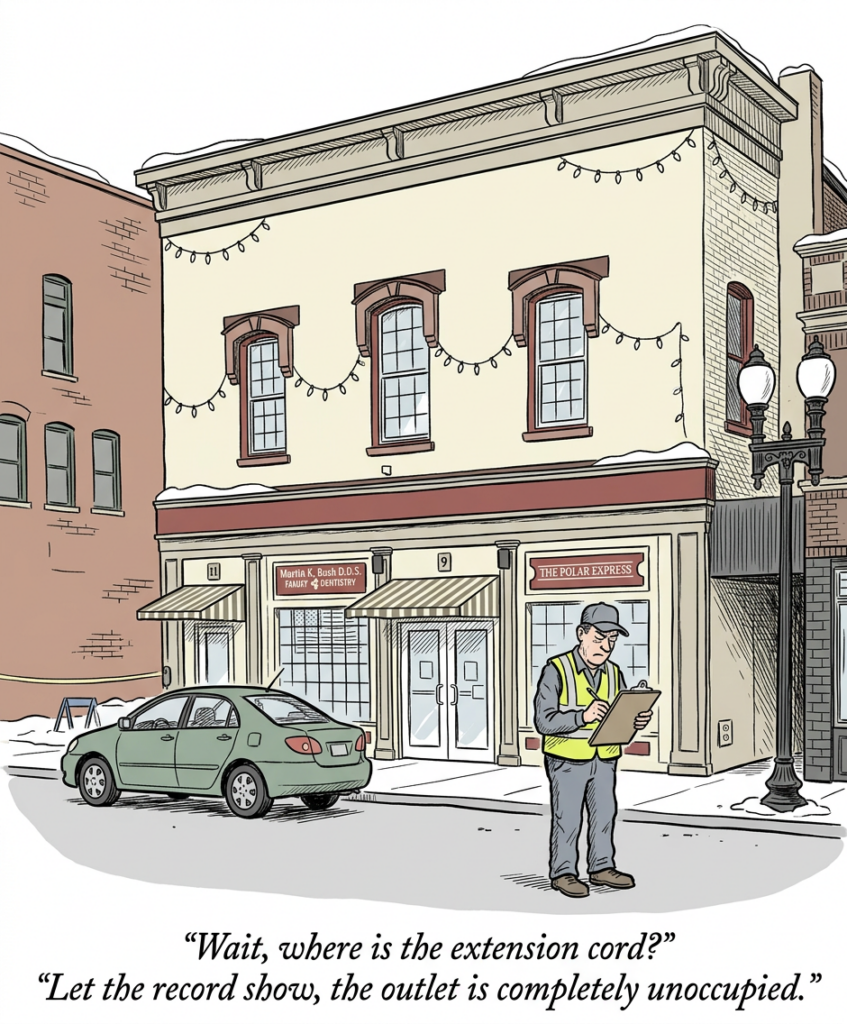
When I was seven years old, the town of Adams, Massachusetts, strung lights on Park Street for the last time.
I did not know it was the last time. You never do. You are seven and the lights are up and your mother is holding your hand and the whole street is glowing and you are not thinking about municipal budgets or fiscal years or the slow collapse of the tax base in a post-industrial mill town in the Berkshires. You are seven. The lights are up. Your mother’s hand is warm. The street is beautiful. That is the whole world.
The next year the lights were not there. Budget cuts. Nobody made a speech. Nobody held a ceremony. The lights just did not go up. And the year after that they did not go up. And the year after that. And at some point, I could not tell you when, because grief in a small town does not announce itself, it just becomes the ordinary, I stopped expecting them. We all did. The town that used to choose to be beautiful at Christmas stopped choosing, and the stopping became the way things were, and the way things were became permanent, and I grew up in a town that used to light itself up and no longer could, and nobody ever said why in a way that a kid could understand, because the why was money, and money is not a why that satisfies a child who remembers his mother’s hand and the glow on Park Street and the feeling that the town had done something just for him.
That was 1977. Maybe much earlier. I am not sure. What I am sure of is that the lights did not come back. Not the next year. Not the year after. Not in the decade I lived there after that. The fireworks on the Fourth of July stopped too. Adams, Massachusetts, a town that used to celebrate itself, stopped celebrating, and the stopping lasted so long that an entire generation grew up not knowing what they had missed.
I left. I went to law school, then Hong Kong, where I have lived for fifteen years in a flat in Mei Foo with Ruth, who is Cantonese and who has listened to me talk about Adams with a patience that should qualify her for sainthood or at minimum a tax deduction. I have written about Adams from eight thousand miles away more times than is healthy. I have written about the churches and the bars between the churches. I have written about Jack Gallivan calling the smartest kids dummies and meaning it as love. I have written about the parade and the mountain and the diner and the women at the Corner Lunch and the men at their stools at AJ’s.
But I have never written about what happened after I left. What happened after I left is the part that matters now.
After I left, the lights came back.
This is not that kind of Christmas movie.
Not from the town. The town never brought them back. The town could not or would not, and after enough years, the distinction stopped mattering. But the people. The people brought them back. One house at a time. One extension cord at a time. One inflatable Santa and one string of LEDs and one family deciding, on their own, with their own money and their own time and their own electricity bill, that Adams was still worth lighting up.
Dr. Martin K. Bush has his dental practice at 9 Park Street. Park Street. The street where I watched the lights with my mother when I was seven. The street where the town stopped trying. Dr. Bush puts up a holiday light display every year. He runs it from the Friday after Thanksgiving through January 1. It is not a small display. It is the kind of display that people drive to see. The kind that residents told the local news they look forward to every year. The kind that has become, over time, one of the reasons Park Street still feels like Park Street at Christmas, even though the town itself gave up on Christmas lights over forty years ago.
His building used to be Shea’s, the clothing store that sat on Park Street from just after the Civil War until the 1990s. I know that building. I mopped the floors of that building. I was the janitor there in high school, pushing a mop through a store that had been selling clothing and drapes and window shades on Park Street since before my great-grandparents were born. The floors creaked in a way that only a hundred and twenty years of foot traffic can make a floor creak. I knew every corner of it. The back room. The stairwell. The places where the mop caught on the uneven boards. A store that outlasted the mills and the cotton boom and the population decline and everything else Adams threw at itself, and then quietly closed the way everything in a small town quietly closes, not with a funeral but with a lock on the door and a FOR SALE sign and the slow realization that nobody is coming back.
Now it houses Dr. Bush’s practice. And every November, the man strings lights on the building where I used to push a mop, on the street where my mother held my hand, in the town that stopped lighting itself up when I was seven, and he lights it up anyway. On his own. Because someone has to. Because if you wait for the town to do it, you will wait forever, because I waited, and it has been over forty years, and they never did.
He is not the only one. There is a house on Howland Avenue that goes so far over the top it is listed on national Christmas light websites. Seventeen houses entered the town’s first-ever Holiday Home Decorating Contest in 2024, a contest the Adams Revitalization Committee organized under the theme “Light Up the Night.” The Holiday Lights Parade is in its sixth year now, Santa escorted by police and fire and EMS through the streets. The people of Adams rebuilt Christmas in Adams without the town’s help, one house at a time, one display at a time, one man on Park Street deciding every November that the street deserves to glow even if nobody in Town Hall is going to make it happen.
This is the part of the Christmas movie where the music swells. Where you lean forward. Where you think: they did it. They brought it back. The town lost something beautiful and the people, stubborn and generous and unwilling to let the dark win, brought it back with their own hands and their own money and their own time, and the town is lit up again, and everything is going to be fine.
On January 15, 2026, Dr. Bush received a complaint about unsafe conditions in a rental unit tied to his holiday display. The complaint referenced an “authorized inspection” conducted on January 7. The inspection reportedly verified the complaint.
The display had been taken down on January 1.
The display had been taken down on January 1, and the inspection was conducted on January 7, and I need you to understand what that means. It means a code enforcement officer named David Rhinemiller conducted an authorized inspection of a holiday light display that had not existed for six days. He inspected nothing. He inspected air. He inspected the ghost of Christmas lights, the memory of music, the fading echo of whatever had been playing from a speaker that was, by January 7, in a box in a basement, because Christmas was over, because it was January 7, because Dr. Bush takes his display down on January 1 the way he does every year, because that is what you do, because the holiday ends and you put the lights away and you go back to being a dentist on Park Street until next November when you do it all again because nobody else is going to light up this street and somebody has to.
But Rhinemiller did not just inspect nothing. He measured nothing. He took decibel readings. Between 10 and 10:30 a.m. and again at 5 p.m. He recorded a high of 88 decibels and 84 decibels, respectively. He recorded an average of 74. He put these numbers in an official report. He wrote them down, on paper, with the authority of a public employee conducting an authorized enforcement action against a property owner on Park Street.
The report itself notes that there were no decorations when the measurements were taken.
He wrote it down. In his own report. The thing he was inspecting did not exist. He knew it. He wrote it. And then, in the same report, he recorded decibel readings of a sound that was not playing from a display that was not there, and submitted the report as the basis for a correction order that could have resulted in a twenty-five thousand dollar fine, up to one year in jail, or both, for Dr. Bush.
Eighty-eight decibels. That is roughly the volume of a food blender, or a garbage disposal, or city traffic at a busy intersection. Rhinemiller stood on Park Street on January 7 with the Christmas lights gone and the music off and recorded 88 decibels of something. What was it? Traffic. Wind. A bird. His own breathing. The sound of a man’s professional credibility leaving his body at moderate volume. We will never know, because the report does not say, because the thing it was supposed to be measuring was not there and the man measuring it knew it was not there because he wrote that it was not there in the same document where he recorded the measurements.
He also spelled “decibel” wrong. The report refers to the average “decimal” level. Decimal. Not decibel. The unit of measurement that is the entire basis of the enforcement action is misspelled in the enforcement action.
Ruth, when I told her this, said the man misspelled “decibel” and still has his job. She said I misspell “necessary” every single time and people pay me to write. She is not wrong. But I am not issuing correction orders that carry jail time. I am misspelling words in essays about my hometown from a flat in Mei Foo, which harms no one except Ruth, who has to read them.
Dr. Bush requested a public hearing. He asked the obvious questions. What was the decibel reading during the inspection? When was it taken? What equipment was used? What is the acceptable noise level? These are the questions of a man who knows there was no music playing because there was no display because it was January 7 and the display ends on January 1 and this is not complicated and he should not have to explain it, but here he is, requesting a hearing, because a man with a clipboard came to his property and measured the volume of silence and wrote it down wrong and now he is facing criminal consequences for a Christmas light display that was in a box in his basement.
The hearing was scheduled for March 4. It was canceled due to what was described as “a clerical error.”
A clerical error. In a case about a false report. The hearing about the false paperwork was canceled because of an error in the paperwork scheduling the hearing about the false paperwork.
David Rhinemiller has been charged with a misdemeanor for allegedly submitting a false report as a public employee. His arraignment has been rescheduled to September 4. Dr. Bush’s criminal complaint application indicates that Rhinemiller acknowledged the sound was turned off. He acknowledged it. The sound he measured at 88 decibels was off. He knew it. He measured it anyway. He wrote it down anyway. He submitted it anyway. He issued the correction order anyway.
Rhinemiller remains employed as a code enforcement officer in Adams. He is still the guy. He still shows up at your house if someone complains about your fence. A man charged with filing a false government document is still authorized to file government documents.
Dr. Bush has never received an apology.
I want to tell you what this means. Not legally. Not procedurally. I want to tell you what this means in the story of a town that lost its Christmas lights in 1977 and spent forty years in the dark.
It means the town killed the lights twice.
The first time, it was money. The first time, you could almost forgive it. The mills were gone. The tax base was shrinking. The town could not afford to light up Park Street and Summer Street, and so it didn’t, and a generation of kids grew up without the lights, and that was sad but it was understandable in the way that poverty is understandable, which is to say it is not forgivable but it is at least explicable.
The second time, it was a man with a clipboard.
The second time, it was not budget cuts. It was not fiscal necessity. It was a code enforcement officer fabricating an inspection of a display that did not exist, measuring sound that was not playing, recording numbers that correspond to heavy machinery in a report that misspells the relevant unit of measurement, and issuing a correction order that could send a man to jail for putting up Christmas lights. For putting up Christmas lights on Park Street. On the street where the town gave up. On the street where one man decided, every year, that giving up was not acceptable.
In every great Christmas movie, there is a moment when the thing that everyone loves is threatened. The building is going to be torn down. The parade is going to be canceled. The man in the red suit is going to be arrested. And the whole town rallies. The whole town shows up. The whole town says: no. Not this. You can take a lot of things from us but you cannot take this, because this is the thing that makes us us, and without it we are just a place where people live instead of a place where people belong.
Adams. This is that moment.
A man on Park Street has been lighting up your town every Christmas for years. He takes the lights down on January 1. He has never been anything but a neighbor doing what neighbors in small towns do. He has been doing for free what the town stopped doing in 1977. He picked up what the town dropped and he has held it every year since, and in return, a public employee fabricated an inspection of his property, measured silence at the volume of a garbage disposal, misspelled the word, and the town’s response has been to take eight months, cancel a hearing, reschedule an arraignment, and never once say sorry.
I mopped the floors of that building. I was sixteen, seventeen, pushing a mop through Shea’s after hours. A kid with a bucket and a key. The building was already old then. I knew every corner. And when I was done mopping, I walked out onto Park Street and it was dark. Not dark like nighttime. Dark like a town that had stopped trying. Dark the way Adams was dark every December from 1977 until men like Dr. Bush decided to fix what the town had broken.
He fixed it. He and the family on Howland Avenue and the seventeen houses in the decorating contest and the volunteers at the Holiday Lights Parade. They fixed it. They took a town that gave up on Christmas and made it glow again.
And now a man with a clipboard and a misspelled report is trying to make it dark again.
I live in Hong Kong. Every night at eight o’clock, forty-three buildings on both sides of Victoria Harbour fire lasers into the sky. It is called A Symphony of Lights. It is not very good. Ruth says so and she is right. But it is there, every night, and the being there is the point. A city that lights itself up every night is a city that has decided it is worth lighting up. The decision is the pulse.
They are retiring the show this year. The finance secretary said it had “completed its historical mission.” They are replacing it with seasonal festivals. The word immersive was used.
At least they are replacing it with something. I say this as a person from a place that does not replace things. I say this as a person from Adams, Massachusetts, where the lights went out in 1977 and nobody replaced them with anything until private citizens did it themselves, decades later, out of their own pockets, on their own time, because they loved their town more than their town loved them back.
Dr. Bush loves Adams more than Adams has loved him back.
He deserves an apology. He deserves it today. He deserved it in January. He deserved it the moment someone looked at that report and saw that it documented an inspection of a display that was not there, measuring sound that was not playing, at volumes that correspond to a blender in a room that contained no blender, spelled wrong.
The man at Bill’s knew my name. Gino knew every kid at the crosswalk. The town held because the people in it held each other. When someone in Adams does wrong, the town is small enough to notice, and the noticing is supposed to be the corrective. The corrective is not an arraignment in September. The corrective is a knock on the door and the words I’m sorry and the understanding that in a town this small, you cannot outrun what you did because there is nowhere to run to.
Park Street is not long. You can see one end from the other. Dr. Bush is at 9 Park Street. And every November, he decides that the street is worth lighting up, the same decision the town used to make and stopped making, the same decision his neighbors on Howland Avenue make, the same decision seventeen families made in 2024 when they entered a decorating contest because someone finally organized one, because the people of Adams have been waiting forty years for permission to make their town beautiful at Christmas and they are done waiting.
In the Christmas movie, this is where the whole town shows up. The whole town lines Park Street. The whole town says: this man lit us up when we could not light ourselves. This man did what we stopped doing. This man took our street and made it glow every winter and we will not let a misspelled report and a fabricated inspection and a bureaucrat with a clipboard take that away from us, because we have already lost this once, we lost it in 1977, and we are not losing it again.
Adams. Come on. You are better than this. You have always been better than this.
Say sorry. Mean it. Take the man’s job before he measures something else that isn’t there.
And next November, when Dr. Bush strings his lights on the building where I used to push a mop, on the street where my mother held my hand, on the street where the town gave up and one man refused to, next November, when those lights come on, show up. Stand on Park Street. Look at what he built. Look at what he has been giving you every year, for free, in a town that took its own lights away forty years ago and never brought them back.
He brought them back. He has been bringing them back every single year.
The least Adams can do is let him.