I have been writing about Hong Kong for a while now. About democracy, about the Basic Law, about what it means to live in a city that the Western press has decided is dead. I have pushed back against Stephen Roach. I have discussed Articles 45 and 68 openly and said the Basic Law requires Hong Kong to implement universal suffrage, under my own name, from my own flat. I have said things that my friends in America insisted would get me arrested, and I have remained, stubbornly, unarrested.
But something has been nagging at me for years, and I have never written it down, and I am writing it down now because the double standard has become so large it has its own gravitational field and nobody in the Western commentariat seems willing to acknowledge it exists.
Singapore.
Singapore is Hong Kong’s eternal rival. Same region. Same British colonial origin. Same common law system. Same role as a financial gateway. Same population size, roughly. Same obsessive efficiency, same tiny footprint, same miracle-on-a-rock narrative that business schools love to teach and travel magazines love to photograph. When companies leave Hong Kong, where do they go? Singapore. When Western journalists write about the “death” of Hong Kong, what is the implied alternative? Singapore. When the Wall Street Journal moved its Asia headquarters out of Hong Kong in 2024, where did it land? Singapore.
The implication is always the same. Singapore is the free one. Singapore is the safe one. Singapore is the one where the rule of law still works and the press can still breathe and international business can still operate without looking over its shoulder.
This is, and I say this as a lawyer who has spent his career reading documents and comparing what people say with what actually exists, one of the most spectacular feats of perception management in modern geopolitics.
Let me tell you about Singapore’s democracy.
The People’s Action Party has held power in Singapore since 1959. That is sixty-seven years. Sixty-seven consecutive years of single-party rule. Not single-party rule in the way that Japan’s LDP has dominated through factions and coalitions and the occasional loss. Single-party rule in the way that the sun dominates the solar system. The PAP has won every single general election since self-governance began. Every one. In the most recent election, May 2025, the PAP took 87 of 97 seats with 65.57 percent of the popular vote. The only opposition party in parliament is the Workers’ Party, which holds ten seats. Ten. Out of ninety-seven.
Singapore has something called Group Representation Constituencies, a system where most seats are contested not individually but in groups of four or five, meaning an opposition party cannot run a single candidate in most districts. It must field an entire team, which requires funding, which requires organizational capacity, which requires the kind of institutional depth that is nearly impossible to build when the ruling party has spent six decades ensuring you cannot build it. The GRC system was introduced in 1988. The PAP designed it. The PAP benefits from it. The PAP has never lost a GRC to anyone other than the Workers’ Party, and the Workers’ Party holds exactly two.
This is the country that Western media holds up as the free alternative to Hong Kong.
Now let me tell you about what happens to the opposition in Singapore.
J.B. Jeyaretnam was Singapore’s most prominent opposition politician for decades. He was sued for defamation by PAP leaders so many times, and ordered to pay damages so large, that he was declared bankrupt. A bankrupt person cannot serve in parliament. He was removed from his seat. He spent years trying to pay off the damages. He died in 2008 without ever returning to parliament. No PAP leader has ever lost a defamation suit against an opposition figure in Singapore’s courts. Not once. In the entire history of the country.
Chee Soon Juan, leader of the Singapore Democratic Party, was sued by Prime Minister Goh Chok Tong and Lee Kuan Yew following the 2001 general election for questioning a loan to Indonesia. Damages were assessed in 2005 at approximately half a million Singapore dollars. He could not pay. He was declared bankrupt in 2006, rendering him ineligible to stand for parliament.
Tang Liang Hong, a Workers’ Party candidate, was sued during the 1997 election campaign by eleven PAP leaders in thirteen separate actions. Damages initially totaled more than eight million Singapore dollars, later reduced on appeal to approximately three and a half million. He fled the country. He was declared bankrupt in absentia. He never returned.
This is not ancient history. Singapore’s courts have continued to find journalists and media organizations liable for defamation over their reporting on government figures. Reporters Without Borders has repeatedly described Singapore’s legal system as being weaponized against journalism. Self-exiled journalist Terry Xu, formerly editor of The Online Citizen, who was convicted of criminal defamation in 2021, has continued to face legal pressure from government ministers after leaving the country.
The pattern has been running for fifty years. The mechanism is elegant. You do not need to arrest journalists or opposition politicians if you can bankrupt them instead. The courtroom achieves what the prison cell would, but with the appearance of due process. The opposition leader is not detained. He is simply sued into personal insolvency and rendered legally ineligible to hold office. The journalist is not jailed. She is simply made to understand that reporting critically on the government carries a financial cost that no individual can absorb. The chilling effect is absolute and it wears a suit.
Now let me tell you about Singapore’s Internal Security Act.
The ISA allows the government to detain anyone, indefinitely, without trial, without charge, without judicial review, if it determines the person poses a threat to national security. Said Zahari, editor of a Malay-language newspaper and leader of an opposition party, was detained under this law for seventeen years. Without trial. Seventeen years in a cell because the government decided he was a threat and no court was permitted to disagree.
In 1963, in an operation called Cold Store, 107 opposition politicians, trade union leaders, and activists were arrested in a single night under the ISA. The government called them communists. Many were held for years. The law remains on the books today. It has never been repealed. Malaysia, which originally passed the same law, repealed its version in 2012. Singapore kept it.
Now let me tell you about caning.
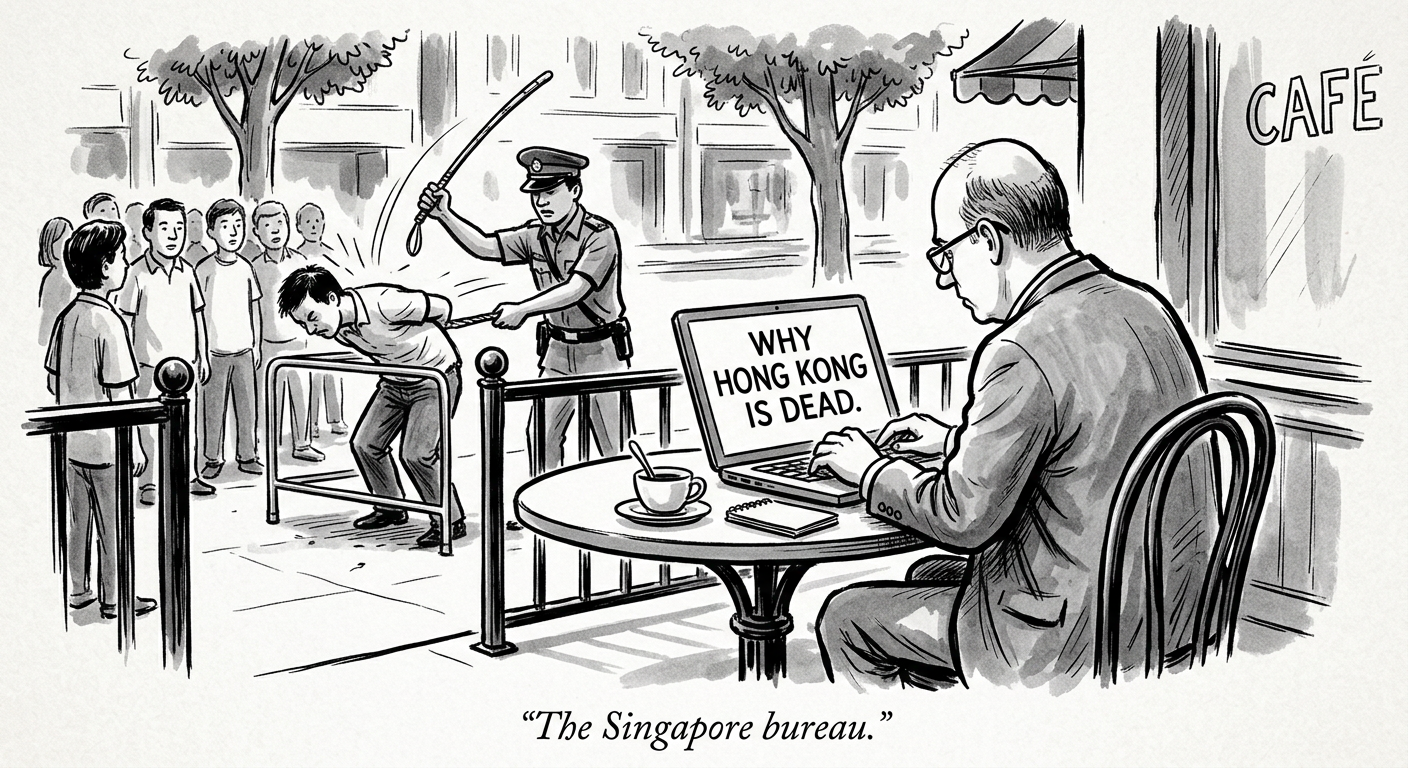
Singapore canes people. I do not mean this metaphorically. I mean that the government of Singapore straps a person to a frame and strikes them with a rattan cane so hard that the skin splits open and the scars are permanent. This is not a relic of colonial law that sits unused in a statute book. It is active. It is routine. Singapore canes people for vandalism, for overstaying a visa, for drug offenses, for robbery, for sexual crimes, and for a list of other offenses that grows longer than you would expect from a country the Western press treats as a model of modern governance. The punishment is mandatory for certain crimes, meaning a judge cannot decline to order it even if the circumstances suggest mercy. Thousands of people have been caned. The government does not publish exact figures, but estimates run into the thousands per year.
This is corporal punishment in 2026, in a first-world financial center, in the country where the Wall Street Journal moved its Asia bureau because Hong Kong was insufficiently free. A country that flays people with a rattan cane as a matter of routine criminal justice. A country where an American teenager, Michael Fay, was caned in 1994 for vandalism, and President Clinton personally appealed for clemency, and Singapore said no, and the story dominated American news for weeks, and then everyone forgot, and the caning continued, and continues, and nobody in the Western press has ever suggested that this practice is incompatible with Singapore’s role as an international financial hub.
Imagine, for one moment, that Hong Kong caned people. Imagine that the government of Hong Kong strapped a man to a wooden frame and beat him with a rattan stick until his skin split open, as a matter of law, for offenses as minor as overstaying a visa. Imagine the op-eds. Imagine the Congressional hearings. Imagine the sanctions. Imagine the New York Times editorial with the headline “Hong Kong’s Descent Into Barbarism.” Imagine the CNN segments. Imagine the boycotts.
Now ask yourself why none of that exists for Singapore. The answer is the same answer it always is.
Protests are restricted to a single designated location, the Speakers’ Corner in Hong Lim Park, and even there, a permit is required, and the conditions are strict, and the government retains the power to deny permission. Everywhere else in the country, public assembly for political purposes without a permit is illegal.
The press is controlled through a combination of state ownership, licensing requirements, and the ever-present threat of defamation. The Newspaper and Printing Presses Act requires all newspapers to be licensed annually by the government. MediaCorp, the only television broadcaster, is owned by Temasek Holdings, the state investment arm. Singapore ranks among the lowest in the developed world on the RSF Press Freedom Index. Reporters Without Borders describes it as “an example of what not to be in regard to freedom of the press.”
The government passed POFMA, the Protection from Online Falsehoods and Manipulation Act, in 2019, which gives ministers the power to order “corrections” on any online content they deem false. Not a court. A minister. The minister decides what is true and what requires correction, and the platform or individual must comply or face penalties.
This is Singapore.
Now. Where are the op-eds?
Where is the Wall Street Journal editorial board declaring Singapore “over”? Where is Stephen Roach writing from his apartment in New Canaan that Singapore’s political system is incompatible with international commerce? Where is the Congressional-Executive Commission on Singapore? Where is the Singapore Human Rights and Democracy Act? Where are the sanctions? Where are the breathless CNN segments about the death of Singaporean freedom?
They do not exist. They have never existed. In sixty-seven years of single-party rule, in fifty years of bankrupting opposition politicians through defamation suits, in decades of detention without trial, in a country where the press is state-controlled and protests are confined to a single park and a minister can declare your speech false by executive order and the government canes people with a rattan stick as a scheduled punishment for dozens of criminal offenses, the Western commentariat has produced almost nothing. A Human Rights Watch report here and there. An Amnesty International press release. But no sustained campaign. No sanctions regime. No institutional hostility. No exodus of companies citing political risk.
The Wall Street Journal, whose Asia edition was itself restricted in Singapore in 1987 when its circulation was cut to 400 copies for refusing to publish the government’s reply to an article, moved to Singapore from Hong Kong citing concerns about press freedom. The same newspaper that fled Hong Kong over press freedom concerns relocated to a country that had previously censored it. Nobody found this ironic enough to write about.
Why?
The answer is simple and it is the answer that explains everything about the Western posture toward Hong Kong.
Singapore’s restrictions are not attributed to China.
That is the whole thing. That is the entire difference. Hong Kong’s constraints are framed as Chinese authoritarianism expanding into a free society. Singapore’s constraints, which are older, deeper, more comprehensive, and more systematically enforced, are framed as the domestic policy choices of a sovereign nation. One triggers the geopolitical anxiety of Western capitals. The other does not. One is a story about the rise of China. The other is just Singapore being Singapore, which it has been for sixty-seven years while the West watched and said nothing and invested billions and moved its regional headquarters and its journalists and its bank accounts without a single sanction or a single act of Congress.
Hong Kong has a freer press than Singapore. I am aware of how that sounds. I am aware that the Western narrative has decided otherwise. But look at the mechanisms. Hong Kong does not have a law that lets a minister order corrections on online speech. Hong Kong does not have a licensing regime that requires newspapers to renew their right to publish annually. Hong Kong does not have a state monopoly on television broadcasting. Hong Kong has never restricted the circulation of a foreign newspaper for refusing to print a government reply. Hong Kong has never bankrupted an opposition politician through serial defamation suits. Hong Kong’s courts have never produced a record in which no government official has ever lost a defamation action. Not once. In the entire history of the jurisdiction. Hong Kong does not cane people.
I am writing this from Hong Kong. Under my own name. Nothing is happening to me. I have discussed democracy, stated the Basic Law requires universal suffrage to be implemented, criticized Western hypocrisy, called the 2019 protests anti-democratic, responded to one of the most cited economists on earth, and published all of it on the open internet. If Singapore’s press freedom environment is the standard the Western press considers acceptable for international business, then Hong Kong exceeds that standard by a considerable margin.
And yet. And yet the narrative persists. Hong Kong is dead. Singapore is alive. Hong Kong is authoritarian. Singapore is pragmatic. Hong Kong is a warning. Singapore is a model.
The difference is not freedom. The difference is whose flag flies over the restrictions.
I do not want to be misunderstood. I am not attacking Singapore. I have friends in Singapore. I have colleagues there. It is a well-run city with extraordinary infrastructure and a quality of life that most of the world would envy. The people there are not suffering under a brutal regime. They live well. Their streets are clean. Their schools work. Their government, whatever its methods, has produced outcomes that most democracies cannot match.
But that is exactly my point. If you are going to accept Singapore’s model, with all its restrictions on speech and assembly and press and political competition and its government-administered corporal punishment, and call it a functioning, investable, livable place, and you should, because it is, then you cannot turn around and call Hong Kong dead for operating under a system that is, by every measurable metric, less restrictive. You cannot celebrate one and eulogize the other unless the thing that bothers you about Hong Kong is not actually the governance model. Unless what bothers you is something else entirely. Unless the word you are looking for is not “authoritarian” but “Chinese,” and you are not willing to say it out loud, and so you say “freedom” instead and hope nobody checks the comparative data.
I am checking the comparative data.
Singapore has never held a genuine multi-party election in sixty-seven years. Hong Kong held them for decades and was offered universal suffrage in 2014, which its own opposition rejected. Singapore detains people without trial under a law from 1960. Hong Kong’s National Security Law, for all the Western anxiety it generates, requires judicial proceedings. Singapore bankrupts its opposition through the courts. Hong Kong’s opposition bankrupted itself by choosing confrontation over compromise when universal suffrage was on the table. Singapore canes people until their skin splits. Hong Kong abolished corporal punishment in 1990.
Nobody is writing op-eds demanding democracy for Singapore. Nobody is sanctioning Singapore. Nobody is holding Congressional hearings. Nobody is calling Singapore “over.”
The double standard is not subtle. It is not hidden. It is not a matter of interpretation. It is sitting in plain sight, in the op-ed pages of the same newspapers that moved their offices to Singapore, and it tells you everything you need to know about what the Hong Kong discourse is actually about.
It was never about freedom.
It was always about China.