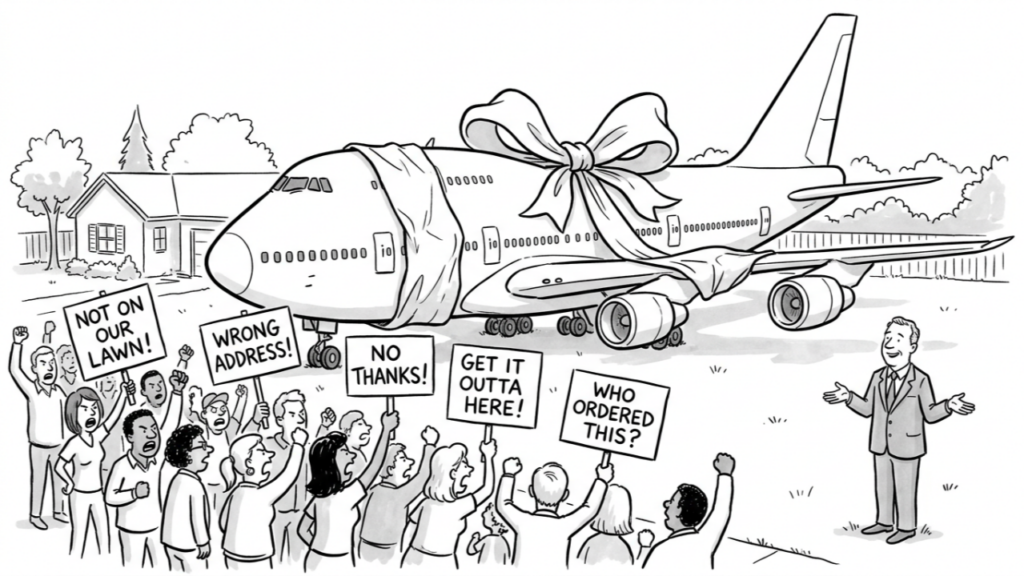
I was sitting on the couch when the news broke. Ruth looked up from her phone and said, “Qatar gave America a plane and people are angry about it?” I said yes. She said, “A whole plane? For free?” I said yes. She went back to her phone and said, “Americans are very strange.” She’s from Hong Kong. She has seen governments do far worse things than accept a free 747. She has also seen people get angry about far less. But a free plane making people furious was, in her professional opinion, a new one.
A Boeing 747 worth four hundred million dollars. Gifted to the United States Department of Defense by the Qatari royal family. Converted into Air Force One. Used to transport the President of the United States. And people are outraged.
The ethics concerns write themselves, apparently. A foreign government gave America a plane. How dare they. This is corruption. This is influence. This is unprecedented.
Fine. Let’s talk about Qatar, the Qatar plane and gifts. Let’s talk about unprecedented.
Between 2001 and 2016, the Clinton Foundation raised an estimated two billion dollars. Two billion. From U.S. corporations, foreign governments, foreign corporations, political donors, and individuals. Among those donors: somewhere between one and five million from the State of Qatar. Between ten and twenty-five million from Saudi Arabia. Between five and ten million from Kuwait. Between one and five million from the United Arab Emirates. Between one and five million from Oman. Six foreign governments in the top donor tiers. The total from Arab states alone was estimated between thirteen and forty million dollars, depending on which end of the disclosed ranges you believe. And after Hillary Clinton lost the 2016 election, donations collapsed, from $249 million the year she became Secretary of State to $20 million by 2018. If that money was about saving lives in Africa, it would not have evaporated the moment the Clintons could no longer deliver access to American power. The money was not about charity. The money was about proximity.
And the person running American foreign policy toward those exact governments, during the years several of those donations arrived, was Hillary Clinton.
Qatar donated at least one million dollars to the Clinton Foundation while Hillary Clinton was Secretary of State, earmarked for Bill Clinton’s sixty-fifth birthday. The foundation confirmed it never informed the State Department, in violation of an ethics agreement Hillary Clinton had personally signed before her confirmation. That agreement existed for one reason: to prevent exactly the situation that then occurred. A foreign government gave money to the private foundation of the Secretary of State’s family while that Secretary was making policy decisions that affected the donor. The foundation’s defense was that the donation did not represent a “material increase” in Qatar’s support. The State Department said it had no record of the gift being submitted for review.
Nobody called that an emoluments crisis. Nobody demanded congressional hearings. The word “unprecedented” was not deployed on cable news.
Now let’s talk about where that two billion dollars went.
The Clinton Foundation is not a traditional grantmaking foundation. It is what’s called an “operating foundation,” which means it mostly spends money on itself. Between 2009 and 2012, the foundation raised over five hundred million dollars. Of that, approximately seventy-five million, roughly fifteen percent, went to actual charitable grants to outside organizations. Nearly one hundred ten million went to employee salaries and benefits. Over twenty-five million went to travel. And a staggering two hundred ninety million dollars, nearly sixty percent of all money raised during that period, was classified as “other expenses.” That is not a rounding error. That is two hundred ninety million dollars that did not go to charity, did not go to salaries, did not go to travel, and was not explained further.
The foundation’s defense is that it “implements programs directly” rather than writing checks to other charities, so all that spending on staff and conferences and offices and travel is itself the charitable work. When you define paying your own people as charity, everything qualifies. CharityWatch gave it an A rating on that basis. Critics pointed out that the A rating was earned by counting internal expenditures as philanthropic activity. Both things can be true. What cannot be disputed is that a private organization controlled by one American family took in two billion dollars, spent the vast majority of it on its own operations, and did so while one member of that family was the nation’s chief diplomat and another was collecting speaking fees as high as seven hundred fifty thousand dollars per appearance, sometimes paid by entities with business before the State Department. UBS, after Hillary Clinton’s State Department helped settle a tax dispute in the bank’s favor, increased its foundation donations from sixty thousand to six hundred thousand dollars and paid Bill Clinton one and a half million for a series of Q&A sessions with its CEO.
The structural conflict of interest is not a matter of interpretation. It is architectural. Two billion dollars of it.
But this is not a story about the Clintons. The Clintons are just the most documented example of a game that every modern president has played.
The Bush family and Saudi Arabia had a relationship so deep it was practically a joint venture. The Carlyle Group, where George H.W. Bush served as a senior advisor, had Saudi investors including members of the Bin Laden family. After September 11, 2001, members of the Bin Laden family were flown out of the United States while civilian aircraft were still grounded. The Bush Presidential Library received millions in foreign donations, much of it from the Gulf. Nobody called it an emoluments violation. It was philanthropy.
Biden’s son sat on the board of a Ukrainian energy company collecting fifty thousand dollars a month while his father was the Obama administration’s point man on Ukraine policy. Hunter Biden then pursued business deals in China that, by remarkable coincidence, seemed to track his father’s diplomatic travel schedule. When a laptop full of emails surfaced confirming much of this, the story was suppressed by social media platforms and dismissed by fifty-one former intelligence officials as having “all the hallmarks of Russian disinformation.” It did not. It was a laptop. With emails on it. About business deals that were real.
Obama was clean enough during his term, then signed a sixty-five-million-dollar book deal and a Netflix production agreement within months of leaving office. The companies that paid him had interests before the federal government for all eight years of his presidency. Nobody calls that corruption. It is called a post-presidency. The distinction between a bribe and a reward is apparently just a matter of timing.
Reagan sold weapons to Iran and funneled the proceeds to Nicaraguan rebels in violation of an explicit congressional prohibition. His National Security Advisor was convicted. His Defense Secretary was indicted. Reagan said he did not recall. Nobody impeached him.
Ruth, who has been listening to me read this aloud while she folds laundry, says “So every president is corrupt?” I say no. I say the system is designed so that money flows toward power and power protects the people who facilitate the flow, and that this has been true for so long that it is not corruption anymore. It is the operating system. She says, “That is what corruption means.” She is not wrong.
Now back to the plane.
Qatar gave the United States government a tangible, physical asset worth four hundred million dollars. It was accepted by the Department of Defense. It is being used to transport the President. It will not go to a family member’s personal foundation. It will not pay for conferences in Davos. It will not fund anyone’s salary. It will not show up as a “program service” in a tax filing. It will not be classified as “other expenses.” It is a plane. It flies. The Commander-in-Chief sits in it.
You can argue that foreign gifts to any government create the appearance of influence. That is a legitimate concern. But if the concern is influence, then the question is simple: which is more dangerous, a foreign government giving the Department of Defense an airplane, or a foreign government giving millions to the private family foundation of the Secretary of State while she is in office? Which is more corrupting, a plane that belongs to the institution of the presidency, or two billion dollars flowing through an organization that spent two hundred ninety million on “other expenses” in four years and couldn’t explain what that meant?
One of those things is a four-hundred-million-dollar asset that benefits the United States government. The other was a two-billion-dollar pipeline of foreign and corporate cash flowing into a family enterprise that employed the donors’ friends, hosted their parties, paid one and a half million to the founder’s husband for chatting with a bank CEO, and blurred every conceivable line between American diplomacy and private enrichment.
One of those things caused outrage. You already know which one.
And to those who are outraged, specifically outraged, about this president: you have pursued him through every court in the country. State courts, federal courts, civil courts, criminal courts. You have indicted him, convicted him, fined him, impeached him twice. You have called him corrupt on every platform available to the English language for the better part of a decade. And he is still here. Still governing. Still signing executive orders. Still getting on the plane.
This is not a defense of the man. This is an observation about the machine.
Because this is not new. It was not new when the Clintons did it. It was not new when the Bushes did it. It was not new when Biden’s son did it. It was not new when Reagan’s National Security Council did it. The only thing that changes, administration to administration, is which team is holding the ball and which team is screaming about the rules. The rules have not changed. The rules do not apply. The rules have never applied. That is the rule.
If you are angry about foreign money and presidential ethics, you are not wrong. But you are late. And you are selective. The game has always worked this way. The only thing that changed is you started paying attention when you didn’t like the player.
Don’t hate the president. Hate the game.
Ruth says, “You should also mention that the plane is very nice.” She has a point. It is a very nice plane.