An incomplete and emotionally compromised list.
I have lived in Hong Kong for fifteen years. Fifteen years is long enough to stop calling yourself an expat and start calling yourself a person who lives somewhere. Fifteen years is long enough to know which exit at Mong Kok station puts you closest to the wonton place, and which exit puts you in a handbag market you did not ask for. Fifteen years is long enough that when someone at a dinner party in Singapore or London says “oh, Hong Kong, I’ve heard it’s changed,” I do not engage, because I am fifty-six years old and I do not have the evening to spare and also they are wrong and also they are right and also it is complicated and also the wontons are still good and that is what matters.
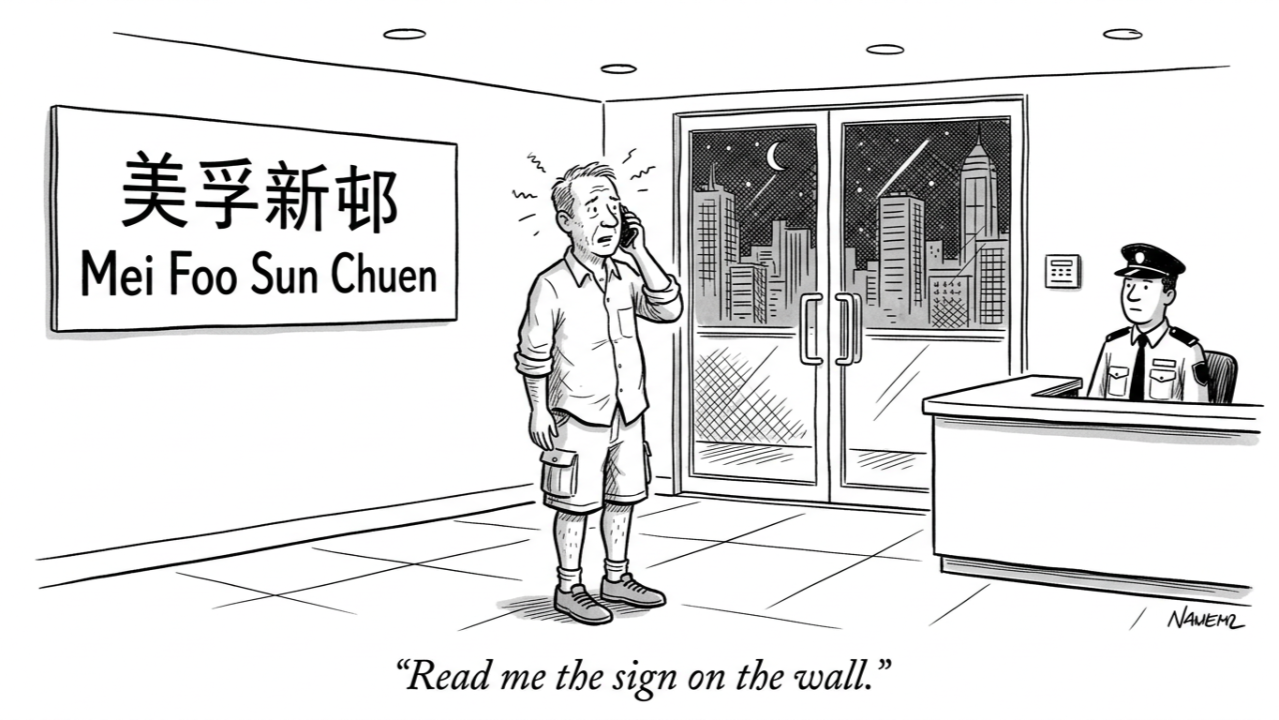
Ruth says I am not allowed to write another essay about Hong Kong without acknowledging that I once got so drunk I got lost in my own building lobby. She is correct. I live in Mei Foo. I have lived in Mei Foo for years. I have walked through that lobby thousands of times, sober, caffeinated, burdened with groceries, half-asleep, in typhoon signal eight with the rain going sideways. And yet one evening, after a work dinner that became a second dinner that became a bar that became a different bar that became a taxi I do not remember, I stood in my own lobby, a lobby I have entered and exited more times than I have had thoughts, and I did not know where I was. I called Ruth. Ruth said “where are you.” I said “I don’t know.” She said “read me the sign on the wall.” I read her the sign on the wall. It was the name of our building. She hung up. She did not come down. She has never let me forget this. She will never let me forget this. She is correct to never let me forget this.
Here are the ten things. They are ranked. The ranking is correct and I will not be taking questions.
10. The Energy
This is last because it is the hardest to explain and the easiest to dismiss and also because I am fifty-six and my relationship with energy has changed. I used to thrive on the pace. The density. The neon. The harbour at night when you come over the Peak and the whole thing is laid out below you like a city that is actively daring you to be bored. The feeling of being at the crossroads of something, everything, Asia itself, money and food and ambition and history all compressed into a space the size of a reasonable ranch in Montana.
Now I am a man who goes to bed at ten-fifteen and wakes at five-forty and sits in the dark writing essays about how I used to have energy. The buzz is no longer my fuel. But it is still there, still humming, and when I have been away for more than two weeks I feel its absence the way you feel the absence of caffeine, not as a craving exactly, but as a dullness, a flattening, a suspicion that wherever you are is moving at the wrong speed. Ruth does not have this problem. Ruth carries her own energy with her the way some women carry a handbag. Ruth’s energy is not location-dependent. Ruth’s energy is Ruth-dependent. But I am not Ruth, and I need the city to remind me that the world is moving and I should probably move with it, or at least watch it move from a cha chaan teng with a milk tea.
9. The Proximity To Everything
Hong Kong is four hours from Tokyo. Three from Bangkok. Three and a half from Seoul. Under two from Taipei. You are, at all times, one short flight from a different cuisine, a different language, a different temperature. This is the kind of thing you do not appreciate until you are somewhere else and you want to go to Japan and the options are: fly to Singapore, wait four hours, fly to Tokyo, arrive destroyed, or fly to Jakarta, wait three hours, fly to Tokyo, arrive more destroyed. From Hong Kong I can be eating ramen in Shinjuku before Ruth finishes deciding what to pack. From Hong Kong the whole of Asia is a long lunch break. I take this for granted. I take this for granted the way I take oxygen for granted and I am wrong about both.
8. Low and Simple Taxes
Salaries tax capped at fifteen percent. No capital gains. No VAT. No inheritance tax. I am aware that listing tax policy in an essay is the written equivalent of showing someone your stamp collection, and I am aware that no one has ever been seduced by a conversation about marginal rates, and I am aware that Ruth, upon reading this entry, will say “you are the least sexy man alive,” and she will be correct, but she will also be correct that we have saved hundreds of thousands of dollars over fifteen years by living in a jurisdiction that does not treat income as a moral failing to be punished progressively. When you start dealing with tax residency across multiple countries, when you are hypothetically a man maintaining a flat in Mei Foo while holding investments in three currencies, you realize that Hong Kong’s tax system is not just low. It is elegant. It is the Marie Kondo of tax systems. It sparks joy. I cannot believe I just wrote that.
7. The Hiking and Nature
People who have never been to Hong Kong assume it is a concrete slab with a harbour view. People who have never been to Hong Kong picture a vertical mall with weather. They are not entirely wrong, but they are also not aware that seventy-five percent of Hong Kong’s territory is countryside, that Dragon’s Back is a forty-minute bus ride from Central and feels like another planet, that Sai Kung has beaches that would be famous if they were anywhere more Instagrammable, that the MacLehose Trail exists and is one hundred kilometers of jungle and coastline and geological improbability packed into a territory you can drive across in an hour.
I have hiked Lion Rock. I have stood on Lion Rock and looked down at the city and felt the specific feeling of a man who lives in one of the densest urban environments on earth and is also, somehow, standing on a mountain. I did not enjoy the hike. I enjoyed being done with the hike. I enjoyed telling people I hiked Lion Rock. Ruth hiked it faster than me and waited at the top and took a photo of me arriving, red-faced and mortal, and sent it to her mother with no caption, which was the caption.
6. The Efficiency of Everything
Government paperwork gets processed. Packages arrive the next day. The banking system works. You can see a specialist the same week you call. You can register a company in a day. You can get a new ID card in an hour. Everything in Hong Kong operates on the fundamental assumption that your time has value and the system’s job is to not waste it.
I did not appreciate this. No one appreciates this. It is impossible to appreciate efficiency until you have experienced its absence, until you have stood in a government office in another country and been told “tomorrow, maybe,” and understood that “tomorrow” does not mean tomorrow and “maybe” does not mean maybe and the entire concept of linear time has been replaced by something more circular, more philosophical, more deeply incompatible with the way my brain was built. Ruth does not appreciate this either, but for the opposite reason. Ruth has never known anything else. Ruth grew up in a city where things happened now, where the MTR arrived in three minutes and the government form came back in a week and the doctor saw you on Thursday, and she assumes, with the serene confidence of a woman who has never been disappointed by a bureaucracy, that this is simply how the world works. When we travel and it doesn’t work like that, Ruth does not adapt. Ruth does not recalibrate. Ruth stands at the counter with the posture and expression of a woman who has been personally insulted by inefficiency, and I, the American, the man from a country where the DMV is a form of purgatory, find myself saying “this is normal, this is how it works everywhere else,” and Ruth looks at me as if I have said something both untrue and unacceptable, which, to her, I have.
5. Safety
I walk home at three in the morning through any neighborhood in Hong Kong without a thought. Not without a second thought. Without a first thought. The thought does not occur. The thought has never occurred. I leave my laptop on a café table and go to the bathroom and the laptop is there when I return because of course it is there, where would it go, this is Hong Kong, things do not go places they were not put.
Children ride the MTR to school alone. This sentence, if you have not lived in Hong Kong, sounds like negligence. If you have lived in Hong Kong, it sounds like Tuesday. The city works. The city works in the way that certain machines work, silently, invisibly, with such consistency that you forget they are working at all until you go somewhere else and realize that the thing you thought was normal was actually extraordinary and you have been living inside a miracle of public order and you didn’t even notice because you were too busy complaining about the humidity.
The one caveat: I did get lost in my own building lobby, as previously noted, but that was not a safety issue. That was a drinking issue. The lobby was perfectly safe. I was the problem.
4. Domestic Helpers
This is the one that people outside Hong Kong do not understand and people inside Hong Kong cannot imagine living without, and the gap between those two positions is the width of an ocean and also the width of a very specific kind of privilege that I am aware of and grateful for and will not pretend is anything other than what it is.
A live-in helper. Full-time. Cooking, cleaning, childcare, errands, the management of a household in a way that frees you to do your work and live your life and never once argue about whose turn it is to do the dishes because it is always her turn because that is her job and she is paid for it and she is good at it and she has been with us for years and she knows where everything is and Ruth knows where everything is and I know where nothing is and this system works for everyone.
When people move to Bali or Thailand they hire help, yes, but it is different. Part-time. Multiple staff. Language barriers. The management of the help becomes itself a job, a second household to run, and you find yourself spending the time you saved by hiring help on the project of managing the help and the efficiency gain collapses like a soufflé opened too early. In Hong Kong the system is structured, regulated, understood. Everyone knows the arrangement. Everyone has made peace with the arrangement. The arrangement works. I would miss the arrangement. I already miss the arrangement when I travel, and I come back and everything is exactly where it should be and dinner is almost ready and I remember that this, this right here, is civilization.
3. The MTR and Public Transport
The MTR is clean. The MTR is punctual. The MTR costs almost nothing. The MTR takes you everywhere. The Octopus card, a piece of plastic I have carried for fifteen years, that has touched more surfaces than my hand, that works on trains, buses, ferries, at 7-Eleven, at the wet market, at the parking garage, at vending machines I did not know existed, the Octopus card is the single greatest piece of infrastructure I have ever used and I include indoor plumbing.
I do not drive. I have not driven in fifteen years. I do not own a car. I do not want a car. In Hong Kong a car is not a necessity, it is a hobby, an expensive hobby, like collecting wine or maintaining an opinion about watches. The MTR takes me from Mei Foo to Central to Ruth’s favorite dim sum place to the airport to the hiking trail to the harbour and back and it does this in air-conditioned silence at three-minute intervals and it costs eight dollars and it has never once made me wait and it has never once smelled like a person who has made poor life choices.
In Bali you need a scooter. In Bali traffic is a theological concept. In Bali the distance between two points is not measured in kilometers but in prayers. I am fifty-six years old. I do not want to ride a scooter. Ruth does not want to ride a scooter. Neither of us wants to die on a scooter in Bali in a way that makes our obituary funny to strangers. So you sit in the back of a car, in traffic, watching scooters weave past you like a school of fish that has collectively decided that lane markings are a suggestion and mortality is a rumor, and a trip that Google Maps says is twelve minutes takes forty-five, and you arrive wherever you are going with the specific exhaustion of a person who has done nothing but sit and yet feels like they have survived something. Ruth says I am being dramatic. Ruth says this from the same back seat, gripping the same door handle, having watched the same scooter miss our mirror by the width of a prayer. Ruth is being dramatic too. She will not admit this. She does not need to. Her knuckles are white. I can see them.
2. The Food
Of course the food is number two. Of course the food is almost number one. Of course the food is the thing that every person who has ever left Hong Kong talks about first and longest and with the most specific grief, the most granular loss, the loss not of “food” in the abstract but of that wonton noodle place, that cha chaan teng, that dim sum spot on a random Tuesday when you didn’t plan it and didn’t need to plan it because it was just there, always there, three minutes from wherever you were standing.
Forty Hong Kong dollars. That is what a bowl of wonton noodles costs at the dai pai dong. Forty dollars. Five USD. The wontons are handmade. The broth has been going since before I moved here. The noodles are the thin springy kind that exist nowhere else on earth with this exact texture, this exact alkaline bite, this exact ratio of shrimp to pork in the filling. This bowl, this specific bowl, would cost fifteen American dollars in New York and they would get it wrong. They would get the noodles wrong. They would get the broth wrong. They would add something, some innovation, some “twist,” and the twist would ruin it the way all twists ruin things that were already perfect.
Dim sum on a Tuesday. Not a special occasion. Not a birthday. Tuesday. You sit down and the carts come and the har gow come and the siu mai come and the char siu bao come and you eat until you are a different shape and the bill is a hundred and fifty dollars for two people and you leave and it is still Tuesday and you have done nothing remarkable and everything remarkable and the city has fed you the way a grandmother feeds you, without asking, without ceremony, with the assumption that you are hungry because you are alive and alive people eat.
The range. Michelin Cantonese. Proper Japanese, not the approximation, the real thing, omakase that would be three stars in Tokyo, here, in Sheung Wan, above a shop that sells dried seafood. Indian in Chungking Mansions that has no right to be as good as it is. Thai on every corner. Korean in every mall. And all of it, all of it, within a ten-minute walk from wherever you are standing because the city is dense and the density means you are always ten minutes from something extraordinary and you are never, ever, required to plan.
Ruth eats with the commitment and focus of a professional. Ruth has opinions about dim sum the way she has opinions about everything, comprehensively, constitutionally, with a ranking system I am not privy to but which governs our weekends absolutely. When we travel, Ruth enjoys the local food. Ruth does not complain. But on the third day Ruth will say, quietly, to no one, to the air, “I could eat a good har gow,” and I will know that the clock has started, that we are now counting the days until we return to a city that feeds us the way we need to be fed.
1. The Octopus Card Works at the Wet Market
I’m kidding.
1. It’s Home
It’s home. That’s the thing. That’s the whole thing. Fifteen years of mornings and evenings and typhoon signals and red rain warnings and the harbour at night and the Peak on a clear day and the sound of Cantonese in the market and the way the city lights up at Chinese New Year and the way it empties at Chinese New Year and the way it fills back up and keeps going, always keeps going, never stops going, eight million people on a rock in the South China Sea who have collectively decided that this improbable vertical experiment in density and commerce and noise is where they live and they are going to live here well, thank you, and you are welcome to join them if you can keep up.
I cannot always keep up. I am fifty-six. My knees have filed a formal complaint about the stairs in Sheung Wan. My ears have lodged a grievance about the construction outside our building in Mei Foo that has been ongoing since, by my estimation, the Qing Dynasty. My body has written a letter to management about the humidity in August, a humidity so thick and personal that it feels like being worn by the weather rather than wearing it.
But it is home. It has been home longer than anywhere since Adams, Massachusetts. Ruth is home, obviously, Ruth is home in the way that a person is home, portable, permanent, locationally independent. But Hong Kong is home in the way that a place is home, fixed, specific, defined by its coordinates and its smells and its sounds and the particular way the light comes through the window at six-fifteen in the morning when the sun is coming up over the harbour and the city is already awake because the city is always already awake and I am in it and it is in me.
I got lost in the lobby once. Drunk, confused, fifteen meters from my own front door, calling my wife to ask where I was. She told me. She hung up. She did not come down.
She knew I’d find my way. I always do. The city always brings me back.
Even when I’m standing in it.