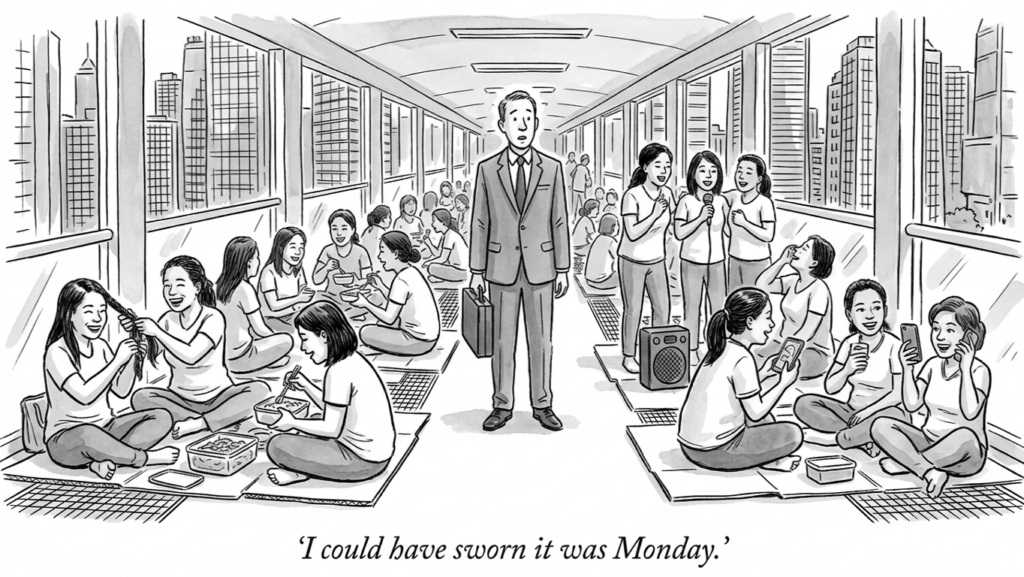
Every week, Hong Kong transforms. Most people who live here don’t even notice.
Hong Kong runs on domestic helpers. This is not a metaphor. There are roughly 370,000 of them, overwhelmingly women, overwhelmingly from the Philippines and Indonesia, and they are the invisible infrastructure that keeps this city functional. They raise the children. They cook the meals. They clean the apartments. They care for the elderly. They do this six days a week, often from dawn until well after dark, living in the homes of their employers, in bedrooms that are sometimes bedrooms and sometimes repurposed closets and sometimes a partitioned corner of the kitchen.
They make this city possible, and on Sundays, they take it back.
If you’ve never been in Central on a Sunday, you haven’t seen Hong Kong. Not really. The elevated walkways that on Monday morning carry bankers and lawyers in pressed suits to their glass towers become, for one day, the living rooms and kitchens and beauty parlors and dance studios of tens of thousands of Filipina domestic workers. They lay out cardboard and blankets and sit in groups that spill across every available surface, the walkways near World WideHouse, the open spaces around Statue Square, the corridors beneath HSBC’s headquarters, where Norman Foster’s architectural marvel becomes a picnic ground.
They eat together. They sing karaoke from portable speakers. They braid each other’s hair. They video-call their children back in Manila or Cebu or Davao, holding their phones up so their kids can see the skyline behind them, the skyline they helped build in every way except the one that gets acknowledged.
In Causeway Bay and Wan Chai, the Indonesian helpers gather. Victoria Park becomes, for a few hours, a miniature Jakarta, the food, the language, the laughter, all of it suddenly and unmistakably Indonesian. The geography of Sunday Hong Kong maps almost perfectly onto national lines, an informal partition that no one organized but everyone understands.
I thought I’d seen it all. I was wrong.
There is a section of Mei Foo, tucked beneath the residential towers, where a pedestrian walkway bends behind a row of shops and opens into a space that most residents walk past without noticing. It’s not on any map. It’s not on any tourist itinerary. If you stumbled onto it by accident, you might think you’d wandered into a small village market somewhere in Central Java.
I found it because I was lost, which is how I find most interesting things in this city.
There were maybe thirty women, seated on mats and low stools, working sewing machines that they had somehow transported to this concrete alcove. Not hand-stitching. Actual machines, the compact portable kind, plugged into power strips that snaked toward outlets I couldn’t identify and decided not to investigate. They were making clothes. Not mending. Not hemming. Making, cutting fabric from patterns, assembling garments with the kind of focused efficiency that suggested this was not a hobby.
Finished pieces hung from makeshift racks fashioned out of rope and wire, strung between pillars. Dresses. Blouses. Children’s clothing. Some were intended to be sent home. Others were clearly for sale.
Around the corner, and I use “around the corner” loosely because the boundaries between activities were more suggestion than fact, I found what I can only describe as an outdoor hair academy.
Twenty women, maybe more, seated in rows on plastic stools, each working on the hair of the woman in front of her. The scale of it stopped me. This was not a few friends braiding each other’s hair on a day off. This was organized. Structured. An older woman, the instructor, clearly, by the way the others watched her hands, moved between the rows, pausing at each pair, adjusting a grip here, demonstrating a parting technique there, occasionally taking the comb herself to show how a particular braid should be anchored. She had the quiet authority of someone who had done this for years, who had perhaps run a salon back home, and who was now, on her one day off, running one again.
Some of the women practiced cuts on mannequin heads propped on overturned buckets. Others worked on each other, capes draped over shoulders, spray bottles lined up on the ground, scissors and clips laid out on towels with the precision of a surgical tray. One woman sat patiently scrolling through her phone while three others took turns sectioning her hair, weaving increasingly elaborate patterns, then undoing them and starting again. Practice. Repetition. Getting it right.
Twenty women learning a trade on a Sunday afternoon in a hidden corridor of a housing estate, with no permits, no signage, no tuition receipts, no certificates waiting at the end. Just skill, transferred in the open air, hand to hand, one braid at a time. Every single one of them building something for a life that would come after this one, after Hong Kong, after years of cleaning someone else’s apartment, after the sacrifice had been made and the money sent and the time served. A salon back in Surabaya. A shop in a village outside Bandung. Something of their own.
This is the point in the essay where the debate arrives, and it arrives whether you invite it or not.
Hong Kong’s minimum allowable wage for foreign domestic helpers is, as of this writing, $5,100 per month. Hong Kong dollars. That’s roughly $655 USD. For six days a week of live-in work. The employer is required to provide food and accommodation, which in practice means the quality of your life depends almost entirely on the character of the family you work for. Some helpers are treated as family. Some are treated as furniture. Most exist somewhere in between, in that vast and complicated middle ground where gratitude and resentment and obligation and affection coexist in ways that no employment contract can capture.
$655 a month. In one of the most expensive cities on earth.
The number is difficult to defend in isolation. It is difficult to hear it and not feel something tighten in your chest, especially when you see these women on Sundays, laughing and cooking and sewing and cutting hair, and you realize that this is their one day, their only day, and they are spending part of it working, building a side income, learning a trade, preparing for a future that Hong Kong is not going to provide.
But the number doesn’t exist in isolation. It exists in the context of a family in a village outside Surabaya where a woman’s monthly remittance pays for her mother’s medication, her children’s school fees, her brother’s motorcycle repair shop, her niece’s college entrance exams. It exists in a context where $655, minus the cost of living that your employer already covers, becomes $500 or more sent home every month, which becomes
$6,000 a year, which in parts of Indonesia or the Philippines is not poverty wages but transformative money. The kind of money that moves a family from one class to another in a single generation.
I’ve met helpers who put siblings through medical school. I’ve met helpers who built houses back home, actual houses, designed over video call and constructed by relatives with money wired monthly from a HSBC branch in Tsim Sha Tsui. I’ve met helpers who have been in Hong Kong for fifteen years, who have raised other people’s children with extraordinary tenderness, who miss their own children with a pain they carry so quietly you might never notice it unless you asked.
The debate about wages is real, and it matters, and the women at the center of it are not abstractions. But the debate as it’s usually conducted, outrage on one side, economic justification on the other, tends to flatten the women themselves into arguments. They are not arguments. They are people making calculations of breathtaking complexity, weighing years away from home against futures they are building from a distance, deciding every single day that the sacrifice is worth it, or struggling with the possibility that it isn’t.
The woman teaching hairstyling in Mei Foo is not a victim. She might also be underpaid. Both of these things can be true at the same time, and holding them together without collapsing into one narrative or the other is, I think, the least we owe her.
On Sunday evenings, the city reverts. The cardboard is folded and carried away. The walkways are cleared. The sewing machines disappear into bags and are carried back to apartments where they’ll be stored in whatever corner has been allocated. The mannequin heads are wrapped in plastic bags. The scissors are tucked into pouches. By Monday morning, the elevated walkways belong to the bankers again, and the women who turned them into a village are back in kitchens and living rooms across the territory, invisible once more.
But for one day a week, they are the most visible people in Hong Kong. They are louder than the city usually allows. They take up space that the city usually denies them. They turn sterile commercial infrastructure into something warm and human and defiantly alive, and they do it every single week, rain or shine, typhoon signal permitting.
I take the MTR in Mei Foo sometimes. It’s a transfer station, a place you pass through on your way to somewhere else. Most people never surface. Most people never walk the long way around the estate and find the hidden corridor where twenty women sit in rows learning to cut hair on a Sunday afternoon, building futures with their hands while the city hums along above them, oblivious.
But it’s there. Every Sunday. Whether you see it or not.
Hong Kong’s greatest infrastructure isn’t the MTR or the escalators or the harbor tunnels. It’s the women who keep the city running six days a week and, on the seventh, remind you that they were here all along.