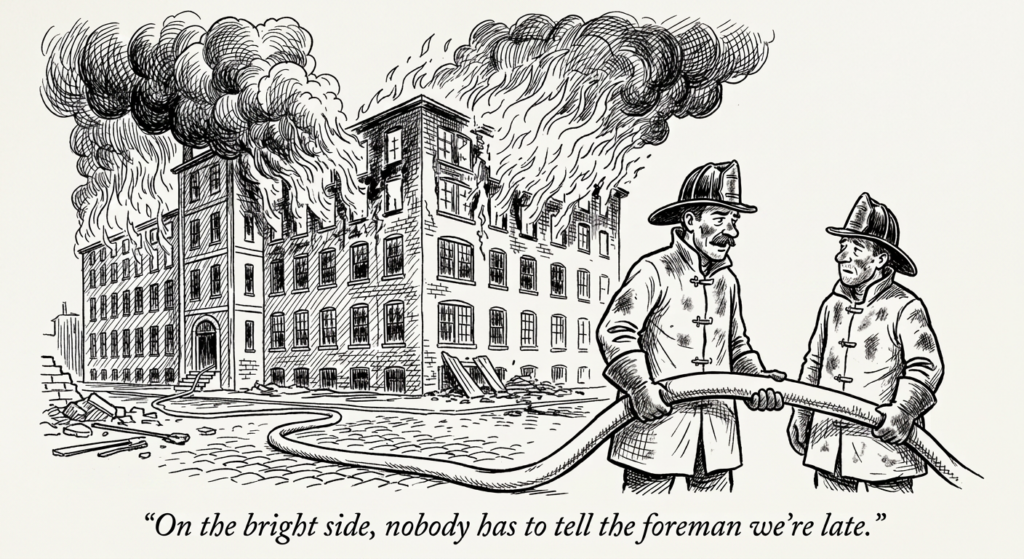
150 Years of Volunteers, and a Painting of Goofy Nobody Bothered to Save
There is a building on Park Street in Adams, Massachusetts, that used to be a restaurant called the Firehouse Cafe. Before that it was a restaurant under a different name. Before that it was another restaurant under another name. Every few years someone new would look at the old Alert Hose Company station, built in 1890 and judged at the time to be the most impressive hose house outside Boston, and think they were the one who could finally make it work. Mediterranean. Duck confit. A wine list. Reservations recommended. None of them made it work. Before all that, it was used by the Adams Ambulance Service. The building outlasted every one of them, the way it has outlasted everything since 1890, and now it sits there again, closed, dark behind the glass, the brick still there, the bones still there, the second-floor tin ceiling still there, and nobody inside at all.
I do not begrudge anyone who tried. Buildings need to be used or they die, and a restaurant is better than a parking lot. But I will tell you that sitting inside a renovated firehouse eating tapas always felt like attending a funeral where someone has replaced the eulogy with a TED talk about adaptive reuse. The building remembers what it was. You can feel it in the walls if you are paying attention, which most people were not, because the risotto was very good and the lighting was flattering and nobody wants to think about fire when they are trying to enjoy a glass of wine on a Friday night.
I think about fire.
I was young. I do not remember how young exactly, because memory does not organize itself by calendar when you are a child. Memory organizes itself by sensation. By cold. By light. By the sound of something that should not be making a sound at that hour. And what I remember about the fires is all sensation, all fragments, all the things a child notices when he is standing on a sidewalk in the middle of the night wearing a coat that was pulled over his pajamas because nobody had time to tell him to get dressed properly.
The Arnold Print Works. November 1984. The complex had been vacant since Arnold went bankrupt in 1981, but vacant buildings burn just as well as occupied ones, sometimes better, because there is no one inside to notice the smell before it becomes the fire. More than a hundred firefighters from five communities responded. When former Adams Fire Chief William Chittenden arrived, he knew immediately. “I knew I was going to need help,” he told a reporter. They prevented the blaze from spreading to adjacent structures. They could not save the Print Works itself. The estimated damage exceeded half a million dollars, which does not sound like much until you remember that the building had already been valued at nothing, was already dead, was already a ghost of the mill economy that had fed this town for a century, and that what burned that night was not a factory but a memory. A former employee named Edward Hakes stood watching it go. “That,” he said softly, “was my life.”
I remember standing with neighbors. I remember the adults watching something they understood in a way I did not. Their parents had worked in those mills. Their parents’ parents had worked in those mills. They themselves had given a good portion of their lives to those buildings, and now those buildings were turning to light and ash in real time, and there was nothing to do but stand there and watch it happen. I remember someone’s hand on my shoulder. I do not remember whose.
Then there was the Glenview.
Christmas Day, 1984. The Glenview was a bar on Summer Street. It was the kind of place that existed in every small town in the Berkshires in the 1980s, the kind of place where men went after shifts and stayed longer than they intended and came home smelling like something their wives chose not to name. It was not fancy. It was not historic in any way that would get it on a register. It was just there, the way bars are just there, part of the architecture of a town the way a tooth is part of a mouth, unremarkable until it is gone and then suddenly you notice the gap every time you look.
It was also, by 1984, a place with a reputation that had outgrown its welcome. The town had hauled the Glenview into license hearings after the place was accused of soliciting female customers for prostitution with a male. The town knew. Everybody knew. In Adams, everybody always knows. The Glenview was a bar that had been circling the drain for a while before the fire gave it the final push, and nobody in a position of civic authority shed many tears over the loss of the license. But a bar is still a bar. People still drank there. People still told stories there. And children still noticed the painting on the door.
What I remember about the Glenview is the painting of Goofy.
Someone, at some point, for reasons that were never explained to me and likely could not be explained by anyone, had painted a large portrait of Goofy on one of the doors. Not a small Goofy. Not a tasteful, ironic, postmodern Goofy. A big, full-color, unmistakable Goofy, grinning that idiot grin, ears flopping, occupying an entire door panel of a bar on Summer Street in Adams, Massachusetts, as though Walt Disney himself had decreed that this particular establishment required cartoon supervision. I do not know why it was there. I do not know who painted it. I know only that it was there, and that when the Glenview burned on Christmas night, the painting of Goofy burned with it, and that nobody mourned the painting specifically because there were larger things to mourn, but I mourned it, quietly, in the way a child mourns something absurd that he loved without understanding why.
I stood outside that fire too. Middle of the night. Christmas. The same coat over the same pajamas. The same neighbors. The same wrong light in the sky.
And there was the Catholic rest home, off East Street. A different year. I do not remember which. People always said it was haunted, even before the fire. That was the reputation, the thing kids whispered about on the walk home from school, the reason you took the street instead of the shortcut passing too close to the windows. Then it burned, and whatever ghost story had attached itself to the place became something harder to dismiss, because now the building looked the part. Charred and open and wrong. Not alive and not dead. Kids had always dared each other to go inside before the fire. Some said they heard things. I do not know what they heard. I know only that a building where old people had lived became a building where old people had died or been carried out, and that afterward it sat there like a wound the town could not quite bring itself to stitch closed.
Different fires, different years. But always the same company. Always the same volunteers. Always the same men who left their dinners and their beds and their families and ran toward it, every time, because that is what they had been doing since thirty-three young men gathered at the Greylock House on May 20, 1876, and decided that this town needed a hose company and they were going to be it.
One hundred and fifty years.
I need to say that again because the number deserves its own sentence. One hundred and fifty years of men volunteering to run toward fire. One hundred and fifty years of unpaid service in a town that has lost most of its mills, most of its industry, most of the economic base that originally justified the formation of a fire district in 1873. The mills are gone. The Print Works is ash. The Glenview is a memory with a cartoon dog painted on its door. The Zylonite Mill fire of 1886 claimed two lives. The Renfrew Jacquard Mill fire of 1891 caused between four hundred and fifty thousand and eight hundred thousand dollars in damage and put eight hundred people out of work. The Notre Dame School fire of 1916 happened while the company was at a muster in Pittsfield, because timing has never cared about convenience. Stanley’s Lumber Yard in 1956 made nineteen families homeless. The Berkshire Metal Spinning building in 1984 burned on a night when temperatures hit seventeen below zero. Seventeen below. Men standing outside in turnout gear in seventeen below, pointing hoses at a building that did not care whether they froze.
And they are still doing it. In February 2024, a house fire on East Jordan Street sent the owner to Berkshire Medical Center with burns after he pulled his dog and three kids out before firefighters arrived. Chief John Pansecchi said there was so much fire on arrival they could not go inside. They attacked from the outside, repositioning the ladder truck around power lines, smoke visible for miles. Adams, North Adams, Cheshire, and Savoy responded. In March 2025, a smoking wall in a duplex on West Street, fire creeping between 22 and 24, smoke rising through floorboards. Pansecchi and his crew opened up the second floor and the porch, found the hot spots, hit them fast. “You knew something was going on,” the chief said. “It was just a matter of finding it.” In April 2025, the old MacDermid Graphics mill on Harmony Street, a 237,000-square-foot former industrial complex dating to 1881, went up at 7:30 in the morning. Eight fire companies responded. Ten hours on scene. The roof collapsed. Two schools closed over air quality concerns. The state fire marshal deployed drones and hazmat teams. Investigators later found no evidence of arson but cited the property owner for code violations, unpermitted hot work, oxy-acetylene torches cutting scrap metal inside a building that was supposed to be vacant. Three citations, a hundred dollars each. The fire did not care about the citations.
My brother-in-law Mark served with the Alerts. My nephew Mark also served with the Alerts. Their family’s commitment to public service is exceeded only by their commitment to using the same first name for consecutive generations, which is either a tribute to tradition or a failure of imagination, depending on which Mark you ask. Both will tell you the same thing, which is that when the pager went off you did not think about it. You went. You did not weigh the cost-benefit. You did not consult your schedule. You went because you said you would, and because the men before you said they would, and because in Adams that promise has weight that does not require explanation.
Fewer of them now. The roster has struggled to hit thirty. They lowered the membership age to nineteen in 2021, because the young people keep leaving and the ones who stay have jobs and families and the kind of lives that make volunteering for the possibility of standing in seventeen-below weather an increasingly difficult sell. But they are still there. Still answering. Still wearing those Prince Albert style buff-and-white uniforms from 1893 in parades, still carrying the silver speaking trumpets their predecessors won in competitions in the 1880s, still holding the Annual Ball that has, on occasion, drawn nearly two thousand attendants, still restoring the 1976 Maxim pumper that arrived on the company’s hundredth anniversary and is being brought back to life for the hundred-and-fiftieth.
The 150th. This year. 2026. The parade. The ball. The Maxim rolling down the street one more time.
I live in Hong Kong now. There are no volunteer fire departments in Hong Kong. The Hong Kong Fire Services Department is professional, full-time, salaried, pensioned. They respond in minutes. They are excellent. And they are not the same thing. Because what the Alert Hose Company represents is not firefighting. What it represents is the decision, made freely, made without compensation, made for a hundred and fifty consecutive years, to be responsible for your neighbors. To be the person who goes.
Ruth and I went back to Adams two winters ago. I took her to the old firehouse on Park Street, the one that was still a restaurant then, still trying to be something other than what it was. The tin ceiling was there. The brick was there. The bones of 1890 were there. We sat down. The cold had that Berkshire weight to it, the kind that settles into your jaw and stays, and Ruth ordered a hot toddy. It arrived on ice. She looked at me. She looked at the bartender. She looked at the glass, in which whiskey, honey, and lemon were doing their best impression of a cocktail that had given up on its own identity.
The defining characteristic of a hot toddy, the thing that separates it from whiskey with lemon juice, is that it is hot. The word “hot” is in the name. It is the first word. But in Adams, cocktail nomenclature is more suggestion than commitment, and the bartender served it cold with the quiet certainty of a man who has never once Googled a recipe. Ruth drank it anyway. She looked up at the tin ceiling, the brick, the height of the place. “So what was this?” she said. “A firehouse,” I said. “Volunteer. 1890. The Alert Hose Company.” She looked around again, slower this time, the way you look at a room once you know what it used to hold. “And they just ran into burning buildings,” she said. Not a question. A statement. I nodded. They just ran into burning buildings. For a hundred and fifty years, they just ran into burning buildings.
That is enough. That is exactly right.
Happy 150th, Alerts. I am not there. But I remember. The light in the sky. The hand on the shoulder. Goofy grinning on the door of the Glenview, stupid and beautiful and gone. And thirty-three men at the Greylock House who said yes, whose yes has held for a century and a half without breaking once.