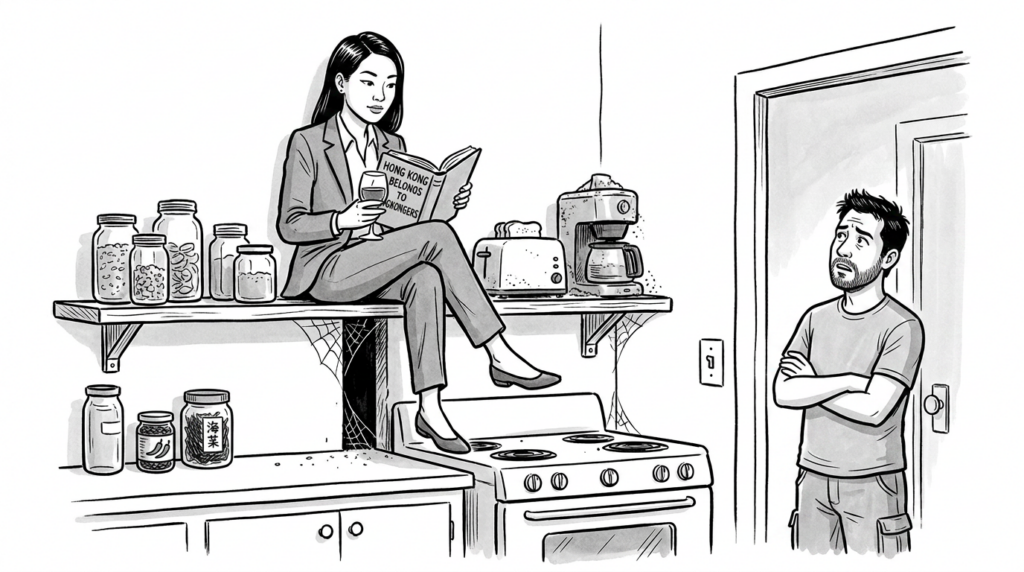
The Space Between the Wall and the Stove, and Why My Wife Almost Ended Up There
When I first came to Hong Kong, I did not know what it meant to be left on the shelf. I thought it was about inventory. I thought it was about the porcelain figurines in the Hollywood Road shops that tourists photograph and nobody buys, the ones that sit there accumulating dust and indignity in equal measure until someone’s nephew eventually marks them down to clear space for more dust and more indignity. I was wrong. It took me about three months of practicing law in this city to realize that every unmarried woman over the age of twenty-eight was apparently the subject of a quiet, rolling, multi-generational family crisis that made my own mother’s disappointment about law school look quaint.
I did not understand, those first few months, why my female colleagues would suddenly vanish from Friday night drinks. I did not understand why they returned on Monday looking like they had been through something, some ordeal that left them hollow-eyed and slightly hostile in a way that had nothing to do with billing hours. I did not understand why one of my associates, a woman who ran actual marathons and looked entirely fresh afterward, could be visibly wrecked on a Monday by what turned out to be a single coffee date arranged by her aunt. Twenty-six miles of pavement did nothing to her. One hour with a man who worked in “crypto consulting” and still lived with his mother destroyed her for the week.
I should clarify. I am a solicitor. My colleagues are other lawyers. And lawyers in Hong Kong, as it turns out, are just as susceptible to the shelf as anyone else, possibly more so, because arguing is not a quality that traditional Cantonese mothers consider desirable in a prospective daughter-in-law, and my colleagues argue professionally, at billable rates, with footnotes.
Over the years I have heard enough stories from the women I work with to fill a small and very depressing library. I have changed their names, obviously, though you will know the names are invented because none of them are Chlorophyll or Photosynthesis or Goggles, and nobody in this piece is named Something, though one of them probably should be, because Something is approximately what the matchmaking agencies delivered.
There is Cathy, who I see regularly for hot pot. Cathy is a lawyer. Cathy is single. Cathy is also the kind of person who reads the fine print on everything, argues with waiters about portion sizes, and once sent back a soup dumpling because the pleating was, in her professional opinion, structurally insufficient. The last time a group of us went to Haidilao, someone at the table, not Cathy, secretly told the staff it was her birthday. It was not her birthday. Her birthday had been six months earlier. None of us corrected the record. We sat there with our bubbling pots and watched as a squadron of male waiters materialized from the back, clapping in unison, bearing a cake she had not requested, and began serenading her with the full Haidilao birthday performance, the synchronized routine, the hand gestures, the volume that suggests the entire restaurant is being held hostage by enthusiasm.
Cathy’s face went through several stages. Confusion. Recognition. Betrayal. And then a slow, dawning awareness that four handsome young men were standing at her table, singing directly to her, making sustained eye contact, and that this was the most male attention she had received in six months, and it was entirely manufactured by her friends as a joke. She sat there. She let them sing. She blew out the candle with the expression of a woman who had decided to accept the moment for what it was, even if what it was happened to be a lie orchestrated by people who were supposed to be on her side. She did not get a date. She did not even get a phone number. She got a cake she didn’t ask for, a song she didn’t earn, and a table of colleagues who were laughing so hard one of them knocked a sauce dish off the lazy susan. Cathy forgave us. Eventually. She still brings a coupon every time we go.
Then there is Grace, a junior solicitor who went to a matchmaking agency that charged five thousand dollars for a “consultation.” Five thousand. For what turned out to be a woman in her sixties looking at Grace’s photograph, sighing audibly, and saying, “You are pretty, but you are too old. You should smile more.” Grace smiled. The woman sighed again. Grace did not get a match. Grace did get a refund, because Grace is a lawyer who drafted a demand letter on agency letterhead and emailed it to their legal department at eleven o’clock at night with a cc line that included the Consumer Council. The refund arrived by Friday. The agency did not explain why a smile consultation cost five thousand dollars.
There is Vivian, a litigation associate, who downloaded every dating app available in Hong Kong and went on forty-two dates in a single calendar year. Forty-two. She kept a spreadsheet. The spreadsheet had columns. Job. Height. Lives with parents. Has a car. Can hold a conversation for more than ten minutes without mentioning cryptocurrency, his ex-wife, or both. She showed me the spreadsheet once. It was meticulous. It was comprehensive. It was organized with the same precision she applied to discovery requests, and it was just as depressing to read. She is still single. The spreadsheet is now in its third year. She calls it her disclosure schedule. I do not think she is joking.
There is Christina, who asked her mother to stop introducing her to men. Her mother said, “I am just trying to help.” Her mother then introduced her to a man who was forty-five, lived with his mother in Sha Tin, and described himself as a “crypto consultant,” which in Hong Kong is a job title that means unemployed but owns a laptop. He spent the entire dinner explaining why Bitcoin was the future and why women should be more supportive of their partners’ visions. Christina paid for dinner. Christina left. Christina’s mother called the next day and asked what went wrong. Christina told her mother exactly what went wrong, in a memo format, with bullet points, numbered paragraphs, and a conclusion section recommending that all future introductions be subject to a minimum due diligence review including, but not limited to, a verified employment history, a residential address that does not belong to the candidate’s mother, and a basic screening for personality disorders. She told me later she considered billing her mother for the time but decided it would create a conflict of interest.
And there is Sarah, a corporate associate who approached dating with the same precision she applied to due diligence on a mid-market acquisition. Before every Bumble date, she prepared a full set of speaking points. Not a mental list. Not a few questions jotted on the back of a receipt. Typed. Organized by topic. She had a section for Career and Ambition. A section for Family Background and Expectations. A section for Hobbies and Interests (His). A section for Hobbies and Interests (Hers, to Be Mentioned Casually So As Not to Appear Intimidating).
She had first-date points, second-date points, and, with the guarded optimism of a woman drafting a term sheet for a deal she expected to fall through, third-date points. She rehearsed them in the mirror. She timed herself. She wanted to make sure she did not ramble, did not seem too eager, did not seem too intense, did not seem too lawyerly, though she failed on all three counts consistently because she is, in fact, a lawyer, and intensity is not something you switch off at the door of a wine bar in Sheung Wan just because you’ve changed out of your suit. She told me once she considered creating a PowerPoint to bring on dates. She decided it would be “too aggressive.” The fact that she considered it, debated it internally, and only ruled it out on strategic grounds rather than on the grounds that it is insane tells you everything about what dating has become for professional women in this city. She is now dating a man she met at the gym. She did not prepare speaking points for him. She says it is going better. I believe her, mostly because she hasn’t mentioned updating the deck.
These are successful women. Lawyers. Professionals. Women who run departments and close deals and file motions and manage teams and arrive at the office before I do and leave after I do and bill more hours than I do and do it all without a single day where they look like the job has beaten them. And every one of them, without exception, carries somewhere in the back of her mind the quiet, gnawing awareness that none of it matters if she is unmarried. That she is, in the eyes of a society that has decided to weigh women on a scale with only one metric, a leftover. A thing not chosen. Inventory that failed to move.
The Cantonese have phrases for this. They are not kind phrases. There is 剩女, which means leftover woman, the way you might describe surplus stock, something that was available and simply not selected. And there is 嫁唔出, which means, essentially, a woman who cannot manage to get married, as though marriage is a task like parallel parking, and some women simply lack the spatial awareness to pull it off.
But those terms sounded almost clinical to me, almost polite, compared to what Ruth gave me one night over dinner.
I had been talking about the piece. Describing it. Muttering something about how the whole system sounded to me like clearing out a cluttered utility closet, sorting women into categories of useful and not useful and forgotten. Ruth set her chopsticks down slowly. She looked at me with the expression she reserves for moments when I have said something so inadequate that she needs to decide whether to correct me or simply let me live in my wrongness forever. She chose to correct me.
“攝灶罅,” she said.
I looked at her.
“Sip zo laa,” she said again, slower, as if the problem was pronunciation and not comprehension. “It is the space between the wall and the stove. The crack. The gap where you put things that are not useful but you cannot throw away. It is where dust collects. It is where you find the things you lost years ago and forgot you were looking for.”
“So it’s a shelf.”
“It is worse than a shelf. A shelf is at least visible. A shelf is at least a surface someone can see. The space between the wall and the stove is where things go to be forgotten. It is where you put the woman who is too old to marry but too young to give up on entirely. It is where you put the daughter who makes too much money and has too many opinions and does not know how to smile at the right time.”
“That is very bleak.”
“That is very Cantonese.” She picked up a piece of steamed fish with her chopsticks, examined it for bones with the focus of a surgeon, and added, without looking up: “That is why I drink wine.”
I sat with this for a moment. I thought about it. I did the math.
“You were thirty when we got married,” I said.
She did not look up from the fish.
“So technically, you were on the shelf.”
Now she looked up.
“That’s just math,” I said. “Thirty is the number. You were thirty. You were on the shelf. I took you off the shelf.”
“You did not take me off anything.”
“I am just saying. If we had met a year later, you would have been past the shelf entirely. You would have been the sip zo laa. Wedged down behind the stove. Dusty. Your mother would have been lighting incense for your marital prospects.”
The stare she gave me lasted approximately four seconds, which does not sound long until you are on the receiving end of it.
“Are you finished?”
“I am just observing.”
“You are observing that if you had arrived one year later in my life, I would have been demoted from a leftover product to forgotten debris behind a kitchen appliance. That is what you are observing.”
“Correct.”
“And you think this is a good thing to say to your wife. The wife who could have married a banker.”
“What?”
“There were bankers. They were interested. They had predictable hours. They did not come home and recount discovery disputes for forty-five minutes over dinner.”
“I do not recount discovery disputes for forty-five minutes.”
“Last Thursday. Forty-five minutes. I timed it.”
“That was a complex matter.”
“It was a disclosure dispute about document categories. A banker would have told me about his bonus. I would have preferred the bonus.”
“That is hurtful.”
“That is honest. I chose you over a banker. So do not talk to me about shelves.”
She went back to her fish. I sat there recalibrating, the way you do when Ruth has said something that is simultaneously devastating and irrefutable and delivered with the calm of a woman who has already won and is simply allowing you to realize it at your own pace.
“Fine,” I said. “But were you ever actually worried? About the shelf?”
She paused. Put her chopsticks down. Looked at me with something that was not quite amusement and not quite pity but lived somewhere in the neighborhood of both.
“I was on the shelf,” she said. “I was not left. I was sitting there comfortably. I had a book. I had a glass of wine. I was doing fine. The shelf was not a prison. It was a bench. I sat there until someone worth my time came along.”
“And I came along.”
“You came along.”
“And I was worth your time.”
“You were adequate.”
“Adequate.”
“Adequate is the highest praise I give anyone. And it is better than a banker would have gotten.”
She picked up her chopsticks. Went back to the fish. The conversation was over. I have been married to this woman long enough to know when a conversation is over, and it is always over exactly when Ruth decides it is over, and not one sentence before or after.
But here is the thing I kept thinking about, long after dinner, long after the wine, long after Ruth had fallen asleep and I was sitting in the living room looking out at the lights of Mei Foo and turning the whole thing over in my head the way you turn over a word you cannot translate because the translation does not exist in your language.
The shelf is real. I know it is real because I have watched it operate on women I respect, women I work with, women who are smarter than me and work harder than me and are better lawyers than me and yet carry, like a stone in a coat pocket, the weight of a society that has decided they are incomplete. I have watched Grace spend five thousand dollars to be told she does not smile correctly. I have watched Vivian build a spreadsheet with forty-two rows and no result. I have watched Christina threaten to bill her own mother. I have watched Sarah rehearse conversation in a mirror before a date the way I used to rehearse openings before a judge, and I have thought, every time, the same thing: this is absurd. This is structurally, mathematically, demonstrably absurd.
Hong Kong has more women than men. The ratio is roughly 852 men for every 1,000 women, which means that even if every single man in this city decided tomorrow to get married, there would still be women left over, not because something is wrong with them but because the arithmetic does not balance and never has and never will. There are, in the most literal sense, not enough men. And yet the society has decided that the deficit is the women’s fault. That the women are the ones who failed. That the women are the ones who need to smile more, lower their standards, pay five thousand dollars to be sighed at, build spreadsheets, rehearse talking points, and spend their Sundays in Sha Tin having dinner with a forty-five-year-old crypto consultant who lives with his mother, all because the alternative is the crack between the wall and the stove, where the dust collects, where the forgotten things go.
Over a million women aged fifteen and above in Hong Kong have never married. A million. That is not a personal failure. That is not a million individual women who each, independently, forgot to smile at the right moment. That is a structural fact dressed up as a character flaw, and the entire matchmaking industry, the entire apparatus of aunties and agencies and dinner introductions and spreadsheets and speaking points, exists to service a problem that is not a problem at all but a ratio, a simple, cold, immovable ratio that no amount of smiling will fix.
I think about what Ruth said. About the shelf not being a prison. About it being a bench. About sitting there with a book and a glass of wine, waiting, choosing to wait, because waiting is not the same as being left, and the difference between those two things is the difference between a woman who has no options and a woman who has looked at her options and decided that none of them, not the crypto consultant, not the man who asked about marriage on the third date like he was trying to close a deal before quarter-end, not the forty-two entries on Vivian’s spreadsheet who collectively could not clear a bar that any reasonable person would consider already on the ground, none of them were adequate.
Adequate. Ruth’s word. The highest praise she gives anyone.
I think about Cathy, who sat under the Haidilao spotlights while four men sang to her because her friends lied about her birthday, and who blew out a candle on a cake she did not earn and still went home alone, and who will be back at hot pot next month with a coupon and a story and the same quiet, unbroken composure of a woman who has decided she will not settle for a serenade she did not ask for from men who are being paid to perform enthusiasm. Cathy is not on the shelf. Cathy is not behind the stove. Cathy is at the table. And if the right person ever shows up, he will need to clear a higher bar than a birthday candle and a set of synchronized claps.
I think about the women in the surveys who said their greatest fear was becoming a leftover. Not failure. Not poverty. Not illness. Being unmarried. Seventy percent of educated young women in the region, standing at the start of careers that could take them anywhere, and the thing that frightened them most was a word. A label. A slot on a shelf they had done nothing to deserve.
And I think about Ruth, thirty years old when I met her, with bankers circling and options open and her mother presumably halfway to lighting the incense, sitting on her bench with her book and her wine, not anxious, not desperate, not smiling on command for a woman in a matchmaking office, just waiting. Just choosing. Just being adequate, in the fullest and best sense of a word she has bent into the highest compliment I will ever receive.
The shelf is not a place of shame. It never was. It is a waiting room. And the women in it are not leftovers. They are not surplus stock. They are not debris wedged behind an appliance. They are women who looked at what was being offered, did the assessment, reviewed the terms, and decided, professionally, personally, with the full clarity of people who know what adequate means and will not accept less, that the deal was not good enough.
And if the society cannot understand that, if the mothers cannot stop crying and start listening, if the matchmaking agencies cannot stop charging five thousand dollars to sigh at photographs, if the aunties at Lunar New Year cannot stop asking the question that everyone in this city asks every unmarried woman over twenty-eight as though it is any of their business, then the society is the problem. Not the women. Never the women.
Ruth told me, when I read her an early draft of this, that I should publish it but that no one would repost it. She said people would read it and nod and think about it and save it but not share it, because sharing it would mean admitting they were part of the problem, and nobody wants to be part of the problem out loud.
She also said I made her sound like she drinks too much wine.
She also said both things are true.
She also said my book is on a shelf too, but for different reasons, and those reasons are poor sales, and unlike the women in this essay, the book earned its position.
Then she picked up her chopsticks. Went back to what she was doing. The conversation was over.
Somewhere in Hong Kong tonight, a woman is sitting at a dinner with a man her mother found. The man is telling her about blockchain. She is calculating, quietly, how much of this she can endure before the bill comes. She will pay for dinner. She will go home. She will add a row to a spreadsheet or delete an app or draft a memo to her mother or do none of those things and instead pour a glass of wine and sit on her bench and read her book and wait, because waiting is not a failure, and the shelf is not a sentence, and adequate is not a low bar but the highest one there is, and she will clear it when she is ready, on her own terms, in her own time, and not one minute before some crypto consultant in Sha Tin thinks she should.
The shelf belongs to her. She is not stuck on it. She is sitting on it. Comfortably. With a book. With wine. And if the right person eventually walks by, she will look up.
And if he is adequate, she might even smile.
Comments
One response to “Left on the Shelf”
Interesting read. My guess is that a person needs to work out:- “is getting off the shelf a priority (really)?” If it is then one needs to step into a less calculated predictable environment. The current culture does not “work ” in solving the problem:- therefore move into another culture. Go work abroad , ,maybe take a significant pay cut lower standard of living etc but one has entered a new culture where opportunities arise. Choose culture carefully, ensure at least one or two good reliable contacts in that environment who can help if all goes pear shaped