Merchandise exports surged 50.7% in July on the back of AI-related chips, but air cargo volumes fell and the port keeps bleeding boxes. The city is richer than ever and physically emptier than ever. What does that mean for logistics operators?
The numbers released Tuesday by Hong Kong’s Census and Statistics Department are difficult to overstate. Merchandise exports hit HK$672.5 billion (US$86.2 billion) in July, up 50.7% year on year. Imports rose 41.0% to HK$677.4 billion. For the first seven months of 2026, export growth has averaged 40.9%. The government called it “particularly impressive.”
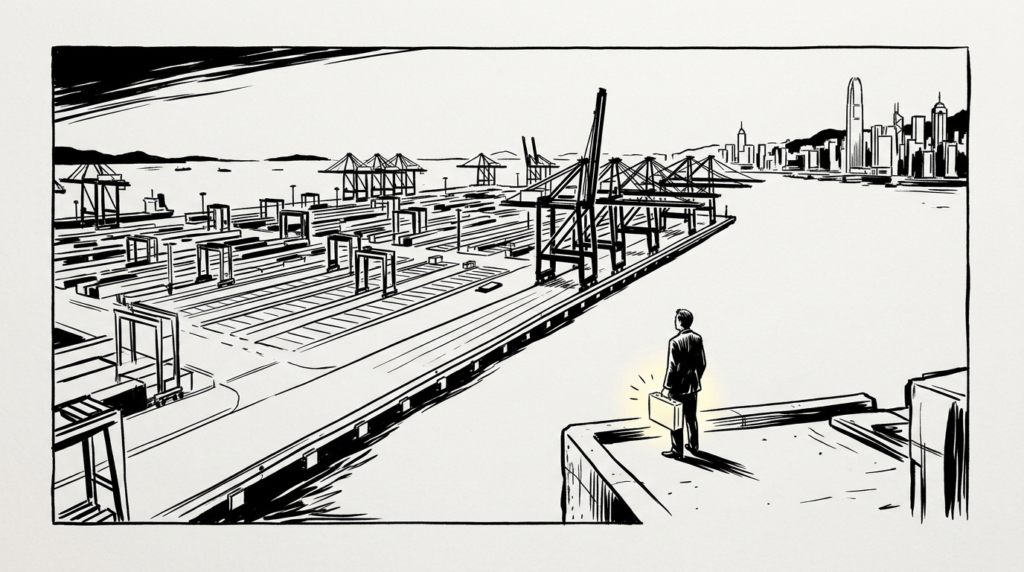
And yet: on Monday, the Airport Authority reported HKIA handled 422,000 tonnes of cargo in July, down 1.9% from a year earlier. Air cargo exports specifically fell 8.4%. Over at Kwai Tsing, Hutchison Port Holdings Trust told investors in its half-year results that Hong Kong container throughput dropped 5% in the first half of 2026, to around 3.3 million TEU. Full-year 2025 port volumes of 12.995 million TEU were already down 5.1% on the year before, the continuation of a decline that has seen Hong Kong lose nearly half its peak container traffic since 2011.
So how does a city post 50% export growth while its physical logistics infrastructure handles less cargo year after year?
The answer weighs almost nothing
The short explanation is semiconductors. A Bloomberg review of official customs data found Hong Kong handled 52% of China’s $239 billion in chip imports in the first five months of 2026, a record share, up from roughly a third a decade ago. Between January and May, the city re-exported $124 billion worth of semiconductors to the mainland alone.
The Hong Kong Trade Development Council now estimates AI-related electronics account for 57% of the city’s total exports, up from 44% in 2024. Barclays puts the true figure closer to 70%, depending on how broadly AI-linked components are classified. The HKTDC more than doubled its full-year 2026 export growth forecast to above 20%, citing what it calls an “AI-driven technology upcycle.”
Here is the physical logistics implication that matters: a single 300mm silicon wafer can be worth $50,000 or more and weighs half a kilogram. A 40-foot container of consumer electronics might hold $2 million in value. A 40-foot container of advanced GPU modules can hold many multiples of that. Value is decoupling from volume in the most literal sense.
What this means for forwarders and carriers
For air cargo operators at HKIA, the picture is oddly mixed. Overall cargo throughput is up 3.2% year to date at 2.92 million tonnes. Southeast Asia volumes are up 14%, Europe up 11%. But outbound exports are falling, and the decline in North America-bound cargo reflects both US tariff disruption and the broader reconfiguration of trade flows.
The paradox for air freight forwarders is that the highest-value cargo moving through Hong Kong (chips, AI server components, advanced electronics) often travels in relatively small physical volumes on existing passenger belly capacity or dedicated freighter services. Tonnage growth may stagnate while revenue per kilo on those specific lanes increases. That is good for yield management if you have the right product mix, but it does nothing for traditional general cargo handlers watching their throughput flatten.
For ocean carriers calling Hong Kong, the port’s slide is now structural and well understood. The city dropped out of the world’s top 10 container ports in 2023 and shows no sign of recovering that position. Mainland ports in Shenzhen, Nansha, and Ningbo have captured the manufactured goods that once transited Hong Kong’s terminals. What remains in the container port is increasingly residual: river trade, regional transshipment for southern China, and niche project cargo.
Not dead, but transformed
The temptation is to write Hong Kong off as a logistics hub in terminal decline. The container throughput data supports that story. But “Hong Kong is dead” misreads what is actually happening. The city has quietly become the world’s single most important transit node for AI-related trade between global suppliers and Chinese manufacturers. More than 80% of the semiconductor shipments passing through Hong Kong by value are destined for mainland China. About 40% originate from Chinese suppliers themselves, a fifth from Taiwan, and the rest primarily from Singapore and South Korea.
“Hong Kong’s strength lies in facilitating the movement of AI-related goods rather than producing them,” Oxford Economics economist Yongshi Mai told Bloomberg.
That is a description of a re-export hub operating at extraordinary velocity and value density, even as its traditional container port withers. The boom helped Hong Kong’s economy expand at its fastest pace in almost five years in the first quarter of 2026, driven substantially by this trade. Hong Kong’s economy is, quite literally, growing on goods that barely register on a cargo scale.
The risk nobody is pricing
The vulnerability is obvious: this boom is almost entirely dependent on sustained AI infrastructure investment and on the continued tolerance of Hong Kong’s role by both Washington and Beijing. The US has imposed direct tariffs on Hong Kong exports, and Washington’s semiconductor export controls have repeatedly tightened. During Trump’s first presidency, Washington stripped Hong Kong’s special customs privileges, no longer treating it as separate from China.
If the US concludes that Hong Kong is serving as a conduit for restricted chip technology reaching Chinese military end-users, the regulatory response could be severe and sudden.
For logistics operators, the practical question is not whether Hong Kong is alive or dead. It is alive, spectacularly so, in a way that generates enormous trade value but relatively little physical cargo handling demand. The companies that thrive here going forward will be those built for high-value, compliance-intensive, security-screened semiconductor logistics, not those waiting for the container ships to come back. They are not coming back.