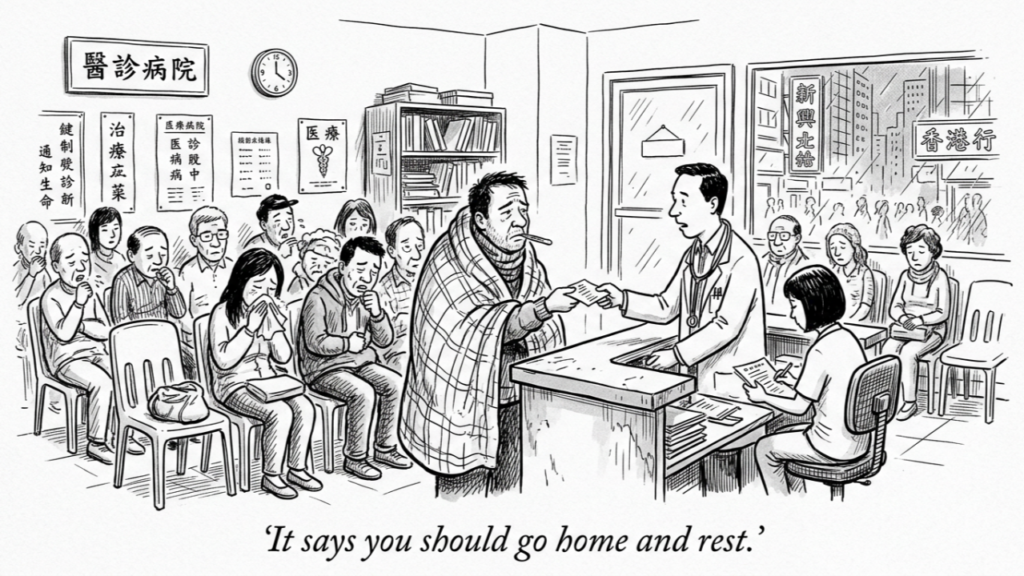
On paperwork, permission to be ill, and why a man with a fever of 102 is sitting in a plastic chair in Mei Foo instead of his bed.
I am sick. I want you to know this from the beginning. I am sick and I am not in bed. I am not in bed because I live in Hong Kong, and in Hong Kong you cannot be sick in bed. You can be sick in a waiting room. You can be sick in a plastic chair under fluorescent lights that have never healed anyone of anything. You can be sick in a queue that stretches from the reception desk to the door and then bends, like a river meeting a wall, back along the corridor toward the pharmacy, where other sick people are waiting for medicine they have not yet been prescribed by a doctor they have not yet seen because the doctor is seeing the sick person ahead of you, who is also wondering why he is here instead of in bed, and the answer for him is the same as the answer for you: the note. The sick note. The medical certificate. The small piece of paper, now an electronic document with a QR code that your HR department can scan like a carton of milk, that proves, to the satisfaction of your employer and the Employment Ordinance and the entire administrative architecture of a city that does not trust you to know when you are unwell, that you are, in fact, unwell.
In Adams, Massachusetts, where I grew up, the system was a phone call.
You were sick. Your mother called the school. She said he’s sick. The school said okay. That was it. No note. No certificate. No QR code. No queue. Your mother’s word was the note. Your mother’s voice on the phone at seven-thirty in the morning did not need corroboration because the town knew your mother and your mother’s word was her bond and if she said you were sick then you were sick. The possibility that she had fabricated your illness was so alien to the social contract of a town where everyone knew everyone and reputation was the only currency that mattered more than showing up that nobody considered it. You were sick. You stayed in bed. Your mother made you soup. You watched television. You recovered. Nobody produced a document.
I tried to explain this to my wife, Ruth. I told her that in America, when you are sick, you stay home. You call your boss. You say I’m sick. Your boss says feel better. No doctor. No note. No waiting room. Just a phone call and a bed and the basic, unexamined assumption that a person who says they are sick is probably sick, because why would you lie about being sick when being sick is not a reward, being sick is being sick, and who wants that.
Ruth looked at me the way she looks at me when I describe things about America that she finds either quaint or structurally unsound.
“No note,” she said.
“No note.”
“And they believe you.”
“They believe you.”
“That would never work here.”
She is right. It would never work here because the sick note is not a medical document. The sick note is what replaces the mother’s phone call when the employer is a corporation and the employee is a number and the number does not get the benefit of the doubt. In Adams, the surveillance was social. In Hong Kong, the surveillance is administrative. Both systems work. One of them lets you stay in bed.
Here is what happens when I get sick. I wake up. I feel terrible. My body has the specific, unmistakable heaviness of a man whose immune system has begun a war and has not yet decided whether to win it. I want to stay in bed the way every sick person in the history of sickness has wanted to stay in bed, which is completely, totally, with the full commitment of a body that is telling me, in the only language a body speaks, which is pain, that I should not be vertical.
I get up. I get dressed. I leave my apartment. I go to the doctor. Not because I need a doctor. I know what I have. I have a cold. The doctor is going to look at me and tell me to rest and drink water, which I knew before I left my bed, which is where I was before I was sick in a taxi, before I was sick in an elevator, before I was sick in a waiting room full of other sick people who also left their beds to prove they deserve their beds.
I am now sicker than when I arrived. The waiting room contains approximately thirty people. Every single one of them is sick. This is not a room full of well people pretending to be sick. This is a room full of sick people who have been forced by the system to gather, together, in an enclosed space with recirculated air, sharing their illnesses in a democratic exchange of pathogens that would make an epidemiologist weep. The man next to me is coughing. The woman across from me is coughing. A child in the corner is coughing with the specific, barking energy of a four-year-old who does not understand germ theory and does not cover his mouth because he is four and four-year-olds understand coughing, not containment, and he is doing it into the air, into the room, into my lungs, which walked into this building with one illness and are now conducting negotiations with several more.
The doctor sees me. The consultation takes four minutes. He looks at my throat. He takes my temperature. He confirms what I already know, what I told him when I walked in, what I could have told him from my bed, over the phone, saving myself the trip and the plastic chair and the four-year-old’s cough and the two hours of my life I have just spent proving to a medical professional that the sick person who walked into his office looking sick and sounding sick was, in fact, sick.
He tells me to rest. He tells me to drink water. He writes the note.
This is the circular genius of the system. The note requires a doctor. The doctor requires a visit. The visit requires leaving your bed. Leaving your bed makes you sicker. Being sicker requires more rest. More rest requires another note. And the whole thing spins on an axis of paperwork and plastic chairs while the bed, the warm, quiet, healing bed, sits empty all morning, waiting for the person who should have been in it three hours ago.
And here is the calculation that I believe every employed person in Hong Kong has performed at least once: would it be easier to just go to work?
The answer, disturbingly often, is yes.
I have gone to work sick because going to work sick takes less time than proving I am sick. I have sat at my desk and coughed and been miserable and my colleagues have said you should go home and I have not gone home because going home requires going to the doctor first and the doctor requires the waiting room and the waiting room requires two hours and by the time I have the note it will be three in the afternoon and I will have spent my entire sick day obtaining permission to have a sick day.
I should say, in fairness, that not everyone approaches the sick note with resignation. Some approach it with entrepreneurial creativity.
A Hongkong Post worker bought one hundred and thirty fake doctor’s notes on Taobao. The online shopping platform. The place where you buy phone cases and kitchen gadgets and, apparently, forged medical certificates in bulk. He used them to take six hundred and thirty-five rest days over four years, pocketing over two hundred thousand dollars in sick leave allowance. He pleaded guilty to thirty-nine charges. The prosecution only pressed thirty-nine because one hundred and thirty was too many to prosecute individually, which is its own kind of achievement. He did not just cheat the sick note system. He industrialized it.
During COVID, three people were arrested for uploading fake positive rapid antigen test results to a government platform. One woman submitted a positive test belonging to a family member. Another submitted an image she screenshotted from a news article. She used a news photograph as medical evidence. The audacity is so extraordinary that I cannot decide whether to be appalled or impressed.
And a student at Chinese University was suspended for forging sick notes to get out of an exam. This is not unusual. What is unusual is that the same student also forged a death certificate to get a scholarship waiver. A death certificate. This student looked at the bureaucratic requirements of a scholarship renewal and decided that the most efficient solution was to kill someone on paper, and I find this so perfectly, so comprehensively Hong Kong that it could be printed on the MTR map as a point of cultural interest.
A doctor at Queen Mary Hospital told the press that some patients come to the A&E department, the accident and emergency department, the place for actual emergencies, just to get sick notes. Not because they are having an emergency. Because they need the paper. Over half the cases at A&E departments are classified as semi-urgent or non-urgent. The system designed to prevent abuse is consuming the resources that should be treating actual illness.
And the system’s response? Not to trust people. Not to consider whether a phone call might suffice. The Hospital Authority introduced electronic certificates with digital signatures and QR codes to prevent forgery. More technology. More verification. Tighter locks on the same door, while nobody pauses to ask whether the door needed to be locked in the first place.
Ruth says I am being American about this. She says in a city of seven million people, you cannot run a sick leave system on the honor system, because the honor system requires the kind of social pressure that exists in a town of eight thousand people where everyone knows your mother. She says the sick note is the substitute for the small town. The note is what replaces the mother’s phone call when there is no mother the employer knows.
She is right. She is always right. That is the problem with being married to a woman who is always right in a city that agrees with her. I have no allies. I have a fever and no allies and a QR code.
The doctor calls my name. I stand. I walk to the consultation room. He looks at my throat. He takes my temperature.
“You’re sick,” he says.
“I know,” I say.
He writes the note. I take the note. I go home. I get into bed. Mimi jumps up. Chu-B jumps up. The apartment is quiet. The bed is warm.
Ruth texts me. “Did you get the note?”
“I got the note.”
“Send it to HR.”
I send it to HR. HR scans the QR code. The QR code confirms that I am sick. My sickness is now verified, authenticated, digitally signed, and filed. I am officially, institutionally, bureaucratically ill.
I could have told them that this morning. From my bed. In my pajamas. The way my mother told Hoosac Valley forty years ago with a phone cord that reached the wall and a voice that no one questioned.
But this is not Adams. This is Hong Kong. And in Hong Kong, the body is not a reliable witness. The body needs a co-signer.
The note is on file. Chu B is on my chest. The fever is doing what fevers do. I close my eyes.
I am sick. I was always sick. I just needed permission.