Closing Argument
I have written about Hong Kong before. I wrote an article explaining that I am a lawyer living in Hong Kong who can read the Basic Law out loud, discuss democracy openly, and nothing happens to me. I wrote a response to Professor Stephen Roach after he grouped me with Hong Kong’s Deputy Financial Secretary and said our arguments made him rethink his thesis. That response was cited in the China Daily. I wrote a book. I wrote two more essays that circulated widely on LinkedIn, one about Singapore and one about the people who left. People kept asking the same question: can you make this accessible to someone who has never read any of it? Can you put it all in one place?
I decided to do it in the form of a closing argument.
Not because I am being theatrical. Because the format solves a problem that no essay can. When you live inside a system, when you have consumed its media and absorbed its assumptions since birth, when every authority figure you trust has told you the same story for thirty years, you cannot see outside. You cannot hear a counter-narrative as anything other than propaganda, because the narrative you already hold feels like fact. It does not feel like a story someone told you. It feels like the way things are.
A closing argument solves this by doing something no op-ed can do. It starts with the presumption of innocence. It says: set aside what you think you know. The accused is innocent until the prosecution proves otherwise. And it asks you to evaluate the prosecution’s evidence, not the defense’s. The burden is not on Hong Kong to prove it is free. The burden is on the Western media to prove it is not.
That is the frame. Hong Kong stands before you as the accused. Not because it committed a crime, but because years of media coverage, years of sanctions, years of congressional hearings, years of op-eds from people who do not live here and will never live here, have convicted it in the court of public opinion without ever presenting the defense. Without ever showing you the other side. Without ever letting Hong Kong speak for itself.
I am going to let it speak now.
Members of the jury, before I say another word, I need you to do something for me.
I need you to locate, in your own mind, the thing you believe about China and Hong Kong. The thing you have carried into this room. The headline you read six years ago. The image of the umbrella, the tear gas, the young face behind a mask. I need you to find that thing, hold it up to the light, and set it aside. Not because it is wrong. Not because I am going to tell you it is wrong. But because in this room, in this proceeding, it does not yet exist as fact. It exists as a charge. And a charge is not a conviction.
In each and every one of your minds, right now, China is innocent. Hong Kong is innocent. That is the law. That is where we begin.
The prosecution, the Western media, bears the burden of proving otherwise. Not with emotion. Not with headlines. Not with the comfortable repetition of a story told so many times it has calcified into something that feels like truth but has never been tested against evidence. The question before you is not whether China has proven its innocence. The question is whether the prosecution has proven its case. Whether the evidence, the actual documentary record, the statutes, the history, the numbers, supports the charge that China crushed democracy in Hong Kong.
I intend to demonstrate that it does not.
I am going to take my time. The evidence requires it.
I should tell you who I am.
I grew up in Adams, Massachusetts. A dying mill town in the Berkshires. If you do not know where that is, you are not alone. Most people have never heard of it. Most people who have heard of it have never been there. Most people who have been there have no reason to go back.
Adams was a company town. The Berkshire Cotton Manufacturing Company opened there in 1889, built by the locally prominent Plunkett family. By 1917, it had over 6,500 looms, making it one of the largest cotton textile companies in the world. At its peak, the mill employed thousands of people who walked the same streets, shopped at the same stores, sent their children to the same schools. In 1929, the company merged and eventually became Berkshire Hathaway. The textile industry that had dominated the region since the early 1800s was already dying, as factory owners moved production first to the American South, then overseas, in search of lower wages and weaker unions.
The final blow came on May 7, 1958. The North Adams Transcript reported that Berkshire-Hathaway was shutting down its Adams operation. One thousand jobs vanished overnight. When the machines stopped, the silence was jolting. “You realized for the first time how loud those machines were and how quiet things could become,” a local historian said. The mill’s closing was a death sentence for the town. Adams lost 25 percent of its population in the years that followed. Nothing ever fully replaced what was lost.
The death did not happen all at once. It happened in waves. The second came in 1982, when Arnold Print Works, a firm that had printed high-quality fabrics in the center of Adams for 120 years, announced it was closing. If Arnold closed, its major customer, Waverly Fabrics, would leave town. Five hundred and fifty more jobs gone, plus hundreds more as the loss rippled outward. The state tried to save the town. Too late. The damage was done.
The jobs eventually went overseas. Many of them ended up in China. By the logic of the story I was told growing up, I should resent the Chinese government. I do not. Because I watched what actually happened. I watched my own government, my own system, my own political class, hollow out the town I grew up in. Not China. America. American politicians who signed trade deals that benefited corporations and abandoned workers. American CEOs who moved production to wherever labor was cheapest and called it efficiency. American media that told us the economy was booming while our neighbors lost their houses.
I did not grow up in the boom. I grew up in the aftermath.
I left.
Not because I was fleeing persecution. Because I was fleeing decline. I watched the American middle class collapse in real time, starting with the Clinton administration’s embrace of free trade without worker protections, accelerating through the Bush years of unfunded wars and financial deregulation, compounding through the Obama years when the Affordable Care Act, whatever its intentions, saddled small businesses and working families with insurance premiums that rose 308 percent between 1999 and 2024 while worker earnings grew only 119 percent. I watched every presidential election become a referendum on whether the current occupant of the White House was Hitler or Osama bin Laden, depending on which channel you watched. I watched the discourse poison itself until nobody could talk to their neighbor without first establishing partisan credentials.
The numbers tell the story plainly enough.
In 1971, 61 percent of American adults lived in middle-income households. By 2021, that had dropped to 50 percent. In 1970, the middle class controlled 62 percent of all household income. By 2020, 42 percent. Between 1979 and 2012, the top 20 percent of earners saw their income grow by 42.6 percent. The middle 60 percent saw 9.5 percent. Housing costs increased 342 percent relative to wages. College tuition increased 178 percent since 1990. Total student loan debt now exceeds $1.7 trillion. A generation starting life underwater, paying for credentials that no longer guarantee employment.
And the institutions themselves? A Supreme Court where justices accept luxury vacations from billionaires with cases before the bench. A Congress where the average member’s net worth bears no relationship to the district they represent. Public trust in the federal government hovering near historic lows. Gallup polling showing confidence in every major American institution, from the presidency to the press to the police to the church, declining decade after decade.
There is a term that went viral on Chinese social media in late 2025: the “kill line.” It comes from video gaming, the health threshold below which a character can be instantly defeated. No recovery. No second chance. In the United States, it has become a metaphor for the financial precariousness of American life. One unexpected blow, a job loss, a medical emergency, a car breakdown, triggers a rapid, irreversible slide. Fifty-nine percent of Americans lack enough savings to cover an unexpected $1,000 emergency. Nearly 40 percent cannot pay a $400 expense using cash.
The system is designed to protect property and credit order, not people.
This is the system the West demanded Hong Kong import. This is the product inside the box.
Remember that.
Now let me tell you how Britain came to possess Hong Kong. Because the origin matters. The origin tells you everything about what the British meant when they talked about civilization, about values, about the rule of law.
The British did not acquire Hong Kong through negotiation or purchase. They took it by force, in a war fought to preserve their right to sell narcotics to Chinese addicts.
By the 1830s, British merchants had discovered an elegant solution to their trade imbalance with China. The Qing dynasty produced tea, silk, and porcelain that European consumers craved, but China had little appetite for British manufactured goods. Silver flowed eastward, draining British coffers. The solution was opium, grown in British India and smuggled into China despite imperial prohibitions. Millions of Chinese became addicted. The Qing government, watching its population deteriorate and its treasury empty, attempted to suppress the trade. In 1839, the imperial commissioner confiscated and destroyed over a thousand tons of British opium.
Britain’s response was war. The First Opium War, fought from 1839 to 1842, was a mismatch. British warships and artillery overwhelmed Chinese defenses. The Treaty of Nanking, signed in August 1842, forced China to cede Hong Kong Island “in perpetuity,” to pay an indemnity of twenty-one million silver dollars, and to grant British subjects extraterritorial legal privileges on Chinese soil.
This was the foundation upon which Hong Kong was built: a territorial seizure extracted at gunpoint, in a war fought to protect drug trafficking.
The Second Opium War, from 1856 to 1860, brought further seizures. The Convention of Peking added the Kowloon Peninsula. And in 1898, Britain extracted a ninety-nine-year lease on the New Territories, the much larger land mass that would make Hong Kong economically viable.
This is the provenance. This is the pedigree. This is who the prosecution calls as their character witness for democracy and freedom.
Members of the jury, in courts of law, when assessing whether a witness is telling the truth, we are permitted to examine their reputation for truth and veracity. Their track record. Their pattern of behavior. Let me examine Britain’s track record on democracy in Hong Kong.
Under 150 years of British colonial rule, there was no democracy in Hong Kong. Not once. Not ever. The Governor was appointed by the British monarch, answerable only to the British government, and assumed all executive and legislative powers. The Governor’s powers were free of any checks and balances. The people of Hong Kong were never consulted on who would govern them.
The first Chinese person was not appointed to the Legislative Council until 1880, nearly 40 years after the British took Hong Kong. The 1888 Regulation of Chinese Ordinance restricted Chinese residents from going outside at night. The 1904 Peak District Reservation Ordinance forbade ethnic Chinese from dwelling in most parts of Victoria Peak.
When Britain ratified the International Covenant on Civil and Political Rights in 1976, it explicitly excluded the clause about periodic elections from applying to Hong Kong. It looked at a treaty guaranteeing all people the right to choose their government and said: yes, we agree, except those people. That reservation remained in place until the day the British flag came down.
Until 1984, there was not a single elected seat in Hong Kong’s Legislative Council.
One hundred and fifty-six years. Zero proposals for universal suffrage. Not a whisper. Not a white paper. Not a consultation exercise.
The British only began talking about democracy in Hong Kong when they realized they would have to give it back. In 1979, knowing China was determined to recover Hong Kong, the British government reversed its previous opposition to democratic reform. When Chris Patten introduced limited electoral reforms in 1992, the handover was five years away. They had waited until it was someone else’s problem.
In 1981, Britain passed the British Nationality Act, stripping the right of abode in Britain from 2.5 million Hong Kong Chinese. They were given a new status, British National (Overseas), that conferred no right to live in the UK and could not be passed to descendants. They were not citizens. They were a category.
And let me tell you one more thing about what these champions of human rights did with Hong Kong after the handover. In March 2004, a Libyan opposition leader named Sami al-Saadi was transiting through Hong Kong’s airport with his wife and four young children. British intelligence, MI6, working jointly with the CIA and Libyan intelligence under Muammar Gaddafi, forced the family onto a plane. They were rendered to Tripoli. Al-Saadi was imprisoned and tortured for six years. Beaten. Subjected to electric shocks. His wife was bound and hooded for the entire flight. His children, the youngest a six-year-old girl, were rendered alongside their parents to a torture state. Documents confirming MI6’s role were found in Tripoli by Human Rights Watch after Gaddafi’s fall in 2011. The UK government settled with al-Saadi in 2012 for £2.2 million.
They used Hong Kong’s airport to deliver a family, including children, to a torture chamber. And they lecture China about human rights.
This is the witness the prosecution asks you to trust on matters of democracy. This is the character they ask you to credit. In any courtroom in the world, a witness with this record would be impeached.
Now contrast that with what China actually did upon assuming sovereignty in 1997.
Beijing proposed universal suffrage within seventeen years. Seventeen years, and there was a concrete proposal on the table, with a mechanism, a timeline, a specific election date in 2017. Say what you want about the nominating committee, say it was imperfect, say it favored pro-Beijing interests, all of that is fair. But Beijing put universal suffrage on the table within seventeen years.
Britain did not put it on the table in 156.
If you want to know who was more serious about democracy for Hong Kong, look at the timeline. The timeline does not lie.
And look at what Beijing did not do. For over twenty years after the handover, Hong Kong’s courts remained independent. Its press remained free. The internet remained uncensored. The Great Firewall stopped at the border. Google, Facebook, Twitter, all the platforms blocked in mainland China, operated freely in Hong Kong.
And here is the part that should stop you cold if you believe the prosecution’s characterization of an authoritarian regime that cannot tolerate dissent. Every year, for over two decades, tens of thousands of Hong Kong residents gathered in Victoria Park to commemorate the Tiananmen Square crackdown of June 4, 1989. They lit candles. They called for accountability. Some of them called for the end of CCP rule. They did this openly, publicly, in the streets of a city under Chinese sovereignty. Year after year after year. And Beijing did nothing. No arrests. No crackdowns. No interference. For over twenty years, Hong Kong residents publicly commemorated an event the mainland government considers deeply sensitive, and demanded political change that the mainland government considers existential, and the so-called authoritarian regime that supposedly cannot tolerate opposition simply tolerated it. In silence. For two decades.
That is not authoritarianism. That is restraint on a scale the prosecution refuses to acknowledge because acknowledging it would ruin their case.
Political parties, which had been tightly controlled under colonial regulations, were now permitted to operate openly. The first Legislative Council elections after the handover were more broadly democratic than any election in the territory’s history as a British colony. By 2004, half of the Legislative Council was directly elected, a situation that had never existed under British rule.
If Beijing wanted to crush democracy in Hong Kong, it had seventeen years of not doing so before anyone claims it started. Acts go to state of mind. Seventeen years of restraint, of tolerance, of permitting levels of dissent that would be unthinkable on the mainland, tell you something about what Beijing actually wanted.
What did Beijing want?
This is the question the prosecution never asks, because the answer ruins their case.
Beijing wanted Hong Kong to succeed under One Country, Two Systems. Not out of charity. Not out of ideology. Out of strategy, and it was good strategy.
Hong Kong is Beijing’s bridge to Western capital markets. The only city under Chinese sovereignty that operates a fully convertible currency, an independent common law judiciary, and a regulatory framework that global investors trust. Billions flow through Hong Kong every year because international finance trusts the system. That trust rests on the perception of autonomy. A democratic Hong Kong, one where leaders are chosen by popular vote within a framework Beijing can live with, strengthens that perception enormously.
But there is something bigger than capital markets. There is Taiwan.
Beijing’s single most important long-term objective is reunification with Taiwan. The only peaceful path to that objective runs directly through Hong Kong. If One Country, Two Systems produces a genuinely autonomous, prosperous city with meaningful democratic participation, Taiwan has a model. Taiwan has proof that sovereignty can coexist with local self-governance. Taiwan has evidence that Beijing keeps its word.
A democratic Hong Kong is not a threat to Beijing. It is one of the most strategically valuable things Beijing could possess. Every year that Hong Kong functions well under this formula, the case for peaceful reunification strengthens. Beijing does not need to invade Taiwan if it can persuade Taiwan. And the most persuasive thing it could ever do is demonstrate, through Hong Kong, that the deal works.
That was the motive. That was why Beijing proposed universal suffrage within seventeen years when Britain had not proposed it in 156.
Now ask yourself what motive the West has for claiming democracy does not exist in Hong Kong.
The motives are many. Let me list a few.
First, Taiwan and the weapons trade. Taiwan is the most significant flashpoint in the US-China relationship. American arms manufacturers sell billions of dollars worth of weapons to Taipei. Since 1950, the United States has sold Taiwan nearly $56 billion in arms. In December 2025 alone, the second Trump administration approved over $11 billion in a single package, the largest ever, including $4 billion in HIMARS rocket systems, $4 billion in howitzers, and $1.1 billion in drone systems. There is currently a pending $14 billion package. Taiwan has a backlog of almost $30 billion in weapons still to be delivered.
And here is the circuit that should make you pause. Taiwan trades heavily with China. Cross-strait trade exceeds $200 billion annually. From 1991 to 2022, Taiwanese companies invested over $200 billion in mainland China. In 2022 alone, Taiwan’s trade surplus with mainland China and Hong Kong was $100.4 billion. Taiwan earns enormous sums doing business with the country it is told to fear, and then uses that money to purchase American weapons to deter that same country. The money flows from China through Taiwan into the accounts of American defense contractors. Taiwan is simultaneously China’s trading partner and America’s weapons customer, funding American arms manufacturers with profits earned from Chinese commerce.
If Hong Kong demonstrated that One Country, Two Systems actually worked, Taiwan might consider accommodation. The arms market would collapse. Billions in annual weapons sales would evaporate. The justification for American forward deployments across the Western Pacific would weaken.
And the United States has form here. America supported Chiang Kai-shek’s regime in Taiwan for decades. The Kuomintang imposed martial law for thirty-eight years. They executed thousands. They imprisoned tens of thousands in what is known as the White Terror. The February 28 Incident of 1947 saw government troops massacre between 18,000 and 28,000 Taiwanese civilians. And throughout all of it, the United States was fine with it. America signed a Mutual Defense Treaty with Taiwan in 1954, right in the middle of the White Terror. American military aid flowed. The same country that now lectures Hong Kong about democracy spent decades propping up a military dictatorship that was executing its own citizens for political speech.
Taiwan did not hold a direct presidential election until 1996. The concern for democracy arrived at the exact moment Beijing became involved. That is not a coincidence.
Second, weakening China itself. A Hong Kong in turmoil damages China’s international reputation, undermines confidence in its governance model, and provides endless propaganda material for the broader containment strategy. Every headline about Hong Kong’s “death” is a headline that serves the narrative of Chinese authoritarianism as an existential threat requiring American military spending. Hong Kong is not just a pawn in the Taiwan game. It is a pawn in the larger project of maintaining American primacy by ensuring China is perceived as a menace rather than a partner.
The failure of Hong Kong serves American interests on multiple levels simultaneously. It forecloses the moderate option for Taiwan. It validates the hawks. It justifies the defense budgets. It weakens China’s soft power. It locks in hostility for a generation.
The prosecution has a motive. The prosecution benefits from the conviction.
And what is the prosecution’s track record when it “spreads” or “protects” democracy abroad?
Let me read the list.
Iraq. The United States invaded in 2003 on the claim that Saddam Hussein possessed weapons of mass destruction. He did not. The intelligence was fabricated or exaggerated. The media amplified it without scrutiny. Hundreds of thousands of civilians died. The country was shattered. No weapons were found. The people who lied kept their jobs. The people who died stayed dead.
Libya. In 2011, NATO went to war under a United Nations mandate framed narrowly as “protecting civilians.” In execution, the mission slid into regime change. The head of state was overthrown and killed in the street. The country collapsed into a failed state. Slave markets opened where government buildings once stood. And here is the connection the prosecution hopes you never make: the same British intelligence service that used Hong Kong’s airport to render Sami al-Saadi to Gaddafi’s torture chambers in 2004 then helped overthrow Gaddafi in 2011. They delivered a man to the dictator, then killed the dictator, and called both operations in service of human rights.
Syria. The United States armed rebels, trained fighters, drew red lines, crossed none of them, and left a country in ruins. Half a million dead. Millions displaced.
Afghanistan. Twenty years. Two trillion dollars. Thousands of American lives. Tens of thousands of Afghan lives. And then the withdrawal came. The scenes at Kabul airport. People clinging to aircraft. Twenty years of “we will not abandon you” ended in a single August.
The Kurds. America’s most reliable partners in the Middle East for decades. Abandoned by every American administration when their usefulness conflicted with other priorities.
Ukraine. The Budapest Memorandum of 1994 gave Ukraine assurances, in exchange for surrendering its nuclear weapons, that its sovereignty and borders would be respected. Those assurances were revealed for what they were: political statements without enforcement mechanisms.
This is the track record. This is the prosecution’s résumé. This is the entity that lectures Hong Kong about freedom and democracy.
And it was not only the people abroad they victimized. They victimized their own.
They told their own citizens that Iraq had weapons of mass destruction. They told them the economy was healthy while the middle class was being gutted. They told them every president from the opposing party was an existential threat to democracy, until the discourse itself became uninhabitable.
They sold a story. About Iraq. About Libya. About Hong Kong. Simple stories. Good versus evil. Freedom versus tyranny. Us versus them.
And they sold that story to Hong Kong’s young people.
There is a film that came out in 1971, the same year the American middle class began its slow death. Woody Allen’s Bananas. A satire about an ordinary guy who gets caught up in a foreign revolution, watches the new liberator instantly lose his mind and mandate that everyone change their underwear, wear them on the outside, and speak Swedish. It exposes the absolute theater of political uprisings, how people can be seduced by the performance of fighting for freedom without having a single clue how to build or run a stable society.
Waving the flags of colonial masters who explicitly codified your disenfranchisement is pure Bananas. It is putting on a costume from a Western movie script and expecting a Hollywood ending.
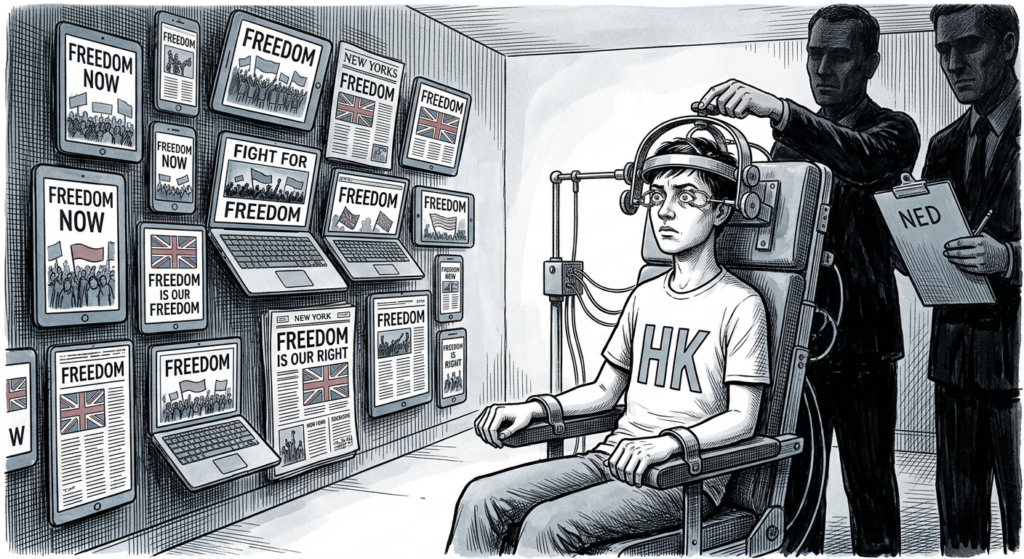
The second film from 1971 is A Clockwork Orange. And it explains how you get an entire generation to engage in that kind of self-destructive theater. You do it through the Ludovico Technique. You strap them into a chair, pin their eyelids wide open with metal clamps, and feed them a continuous loop of curated imagery until their brains are entirely rewired to love their historic captor.
That is what happened here. Decades of Western university positioning, academic seduction, and NGO rhetoric acted as a psychological straightjacket on Hong Kong’s youth. It conditioned them to look at the Union Jack, the very flag that stripped them of their right of abode in 1981, and feel a rush of unearned nostalgia for a democracy that Great Britain never gave them. Their eyes were pinned open by the screen, rendering them completely blind to the legal history right in front of them. Like Alex in the film, the conditioning stripped away their critical capacity, leaving them running on a set of manufactured reflexes exported by foreign entities who needed foot soldiers for a proxy narrative.
The Western media was the Ludovico machine. The programming ran for thirty years. And when the subjects emerged, they could not see straight. They could not distinguish the flag of their colonizer from the banner of their freedom.
And the amplification was not accidental. Consider the Hong Kong Free Press, the English-language outlet that became the go-to citation for international media covering Hong Kong. An outlet founded by a British national in 2015, in the immediate aftermath of the Umbrella Movement. An outlet that brands itself “Asia’s most financially transparent newspaper” while refusing to disclose what percentage of its funding comes from foreign jurisdictions, how concentrated its donors are, or whether it receives institutional grants from foundations or NGOs. An outlet that received a Google News Equity Fund grant and is embedded in a US-based credibility-certification infrastructure funded by Craig Newmark Philanthropies, whose mission explicitly frames itself around protecting “American democracy” against “nation-state adversaries.” An outlet that publishes almost exclusively in English, targeting an international audience rather than Hong Kong’s Cantonese-speaking population. An outlet that, when I offered it an alternative perspective on Hong Kong’s legal system, declined to publish it.
In the intelligence community, there is a term for outlets that present one-sided narratives aligned with foreign policy objectives while maintaining a veneer of independence: amplification assets.
And the people who ran that machine? The people who curated the imagery, who decided what Hong Kong’s young people would see and what they would not?
They lecture China about propaganda.
How dare they.
They sold weapons of mass destruction to justify a war that killed hundreds of thousands of people. They promised Afghanistan twenty years of partnership and abandoned it in eleven days. They signed a memorandum guaranteeing Ukraine’s borders and stood aside when those borders were violated. They used Hong Kong’s airport to deliver a family to a torture chamber.
How dare they lecture anyone about broken promises.
They operate a system where 0.05 percent of the population decides who can run for president. Where private corporations openly acknowledge they are “not in the business of promoting democracy, but of promoting their brand.” Where the popular vote loser becomes president. Where supporters of the losing candidate storm the Capitol to overturn the result.
How dare they lecture Hong Kong about democracy.
They ran a colony for 156 years without a single vote. They stripped 2.5 million people of the right to live in the mother country. They excluded Hong Kong from the International Covenant on Civil and Political Rights while ratifying it for themselves. They backed a dictatorship in Taiwan that murdered its own citizens for forty years and called it Free China.
How dare they.
Let me now draw a distinction the prosecution never makes, because making it would destroy their narrative.
Universal suffrage means the right to vote is extended to all citizens without restrictions based on race, sex, belief, wealth, or social status. It does not mean there are no procedural filters before the vote occurs. Unrestricted suffrage would mean no filtering at all. No system operates this way. It has never existed. It cannot exist, because unlimited candidacy does not produce good governance. It produces chaos.
In France, you cannot run for president unless you collect 500 signatures from elected officials spread across at least 30 departments. That is a gatekeeping mechanism controlled by the political class.
In the United States, the filtering is even more aggressive, it is just hidden behind money. Before a single primary ballot is cast, candidates must raise hundreds of millions of dollars from a donor class concentrated in Manhattan and Greenwich, Connecticut and Silicon Valley. If you cannot secure that money, you do not exist. The American primary system is a nominating committee. It just does not call itself one.
And the money is not clean. The Clinton Foundation received donations from the governments of Saudi Arabia, Qatar, Kuwait, Oman, and other foreign states while Hillary Clinton served as Secretary of State, the nation’s chief diplomat. She gave speeches to Goldman Sachs at $225,000 per appearance while preparing to run for president. The people in those rooms, paying a quarter of a million dollars for an hour of her time, were not buying entertainment. They were buying access. They were buying the expectation that their interests would be remembered when policy was made. That is the American nominating committee. It meets in private. It charges admission. And the price is beyond what any ordinary citizen can pay.
Then there is Congress itself. Nancy Pelosi’s household traded millions of dollars in stocks in companies directly affected by legislation she had advance knowledge of and influence over. Semiconductor companies. Technology firms. Energy companies. Congress passed the STOCK Act in 2012, supposedly to prevent insider trading by members. It has been enforced against virtually no one. The same legislators who write the rules of the American economy trade on information unavailable to the public, and the law designed to prevent it is a dead letter. These are the people who lecture Hong Kong about good governance.
In the United Kingdom, you vote for whoever your local party lets you vote for. In Germany, parties control ballot access through internal nomination. In Japan, faction politics within the ruling party determines who leads the country.
No country in the world has unlimited universal suffrage. The question in every democracy is not whether candidates are filtered. The question is how, by whom, and whether the filtering is visible or hidden.
Hong Kong’s Basic Law answered that question in 1990. The filtering would be done by a broadly representative nominating committee. The 2014 proposal implemented that answer. It named the committee. It defined the sectors. It published the membership. It put the mechanism in the open where anyone could see it.
The American system hides its filtering behind private money in private rooms. Hong Kong’s proposed system was more transparent. Its final stage was more democratic. One person, one vote. No Electoral College. No superdelegates. No delegate math. The candidate with the most votes won.
Never told you about that?
Why would they keep that secret?
Let me now explain what the nominating committee actually was, because the Western press never did, because explaining it would have ruined the story.
The committee consisted of 1,200 members drawn from four sectors in equal proportions: business and finance, the professions, labor and social services and religious organizations, and political representatives including legislators and Hong Kong delegates to national bodies. This composition was legally codified under the Chief Executive Election Ordinance, Cap 569, a public statute. Every member, every subsector, every voter was listed on a publicly accessible government register. The entire mechanism was subject to judicial review.
And here is what nobody ever told you.
The committee was not appointed by Beijing. The overwhelming majority of its members, over a thousand of the 1,200, were elected. Thirty-five of the 38 subsectors returned their members through elections with registered voters. Over 230,000 eligible voters participated in those subsector elections. Only 60 seats were filled by nomination, the religious subsector, and 106 were ex officio. The rest were contested.
Pan-democrats ran in those elections. They won. In 2016, they took 325 seats, a record quarter of the entire committee, including clean sweeps in the legal, education, higher education, health services, IT, and social welfare subsectors. Benny Tai himself, the Occupy Central co-founder, the man who organized the movement to reject the nominating committee, led a slate that won all 30 higher education seats.
Read that again. The man who organized the movement to reject the nominating committee won election to the committee. The people who told you this was a rubber stamp were sitting on it. They competed for seats on it. They won seats on it. And then they told the world it was an illegitimate body that could never allow a genuine candidate through.
That is not principle. That is strategy dressed as principle.
The professional sector included lawyers, academics, doctors, accountants, people with reputations and constituencies of their own. The assumption that no moderate, no centrist, no figure acceptable to both the committee and the public could ever emerge requires you to believe that 1,200 people from different walks of life would vote in perfect lockstep forever with no internal disagreement and no responsiveness to public opinion. That is not how committees of that size behave anywhere in the world.
And the composition was not fixed permanently. It was set by local legislation, subject to future reform. You fight for a better committee after you establish the practice of universal suffrage. You do not reject universal suffrage because the committee is imperfect in its first iteration. That is burning the house because you do not like the curtains.
Under the proposal, a candidate needed 120 committee members, ten percent of the total, to recommend them into the process. Each candidate could receive a maximum of 240 recommendations, ensuring that five to ten candidates could realistically enter the recommendation stage. To proceed from recommendation to the public ballot, a candidate then needed the endorsement of more than half the full committee, more than 600 of 1,200 members. The committee would nominate two to three candidates through this process. Critics argued, not unreasonably, that no candidate unacceptable to Beijing could clear that threshold given the committee’s composition. That is a legitimate structural concern. It is also a concern that applies to every gatekeeping mechanism in every democracy on earth, the difference being that Hong Kong’s was codified in public statute, its membership was on a government register, and its output was subject to judicial review. After the committee nominated two or three candidates, every registered Hong Kong voter would have a direct, one person, one vote ballot. The candidate with the most votes won. No Electoral College. No superdelegates. No delegate math. Statutory law, enforceable in court.
Compare that to the American system where the DNC is a private corporation “not in the business of promoting democracy, but of promoting its brand.” Where the Clinton Foundation takes money from foreign governments while its namesake runs for president. Where Nancy Pelosi’s portfolio rises and falls with legislation only she can see coming.
Which system is more transparent? Which system is more accountable? Which system puts its filtering mechanism in a public register for anyone to examine?
The prosecution never told you any of this. Because telling you would have destroyed the story.
The pan-democrats called it fake democracy. They said a vote among vetted candidates was not a real vote.
By that standard, no country on earth has real democracy.
Twenty-seven legislators voted no. Unanimously. Not a single one broke ranks. Not a single one said, this is imperfect but it is a start. The unanimity was absolute. The movement that claimed to speak for democracy could not tolerate internal democratic debate about its own strategy.
The democracy advocates denied the public a vote because the vote did not meet their definition of democratic. They disenfranchised five million people in the name of enfranchisement. They blocked universal suffrage in the name of demanding universal suffrage.
And then they called themselves the pro-democracy camp.
And then came 2019. The extradition bill was formally withdrawn in September 2019. The protesters won that fight. It was over.
They did not stop. They escalated. Five demands, not one less. Including universal suffrage, the thing Beijing had offered in 2014 and they had rejected.
Let me be specific about what that escalation looked like.
Over a thousand Molotov cocktails thrown at police, at government buildings, at MTR stations, at anyone or anything perceived as an enemy. Protesters set a man on fire after an argument. They beat others with metal rods. They shut down one of the world’s busiest airports, stranding thousands of travelers. They stormed the Legislative Council building, smashed through reinforced glass, occupied the chamber, spray-painted slogans on the walls, and raised the colonial-era Hong Kong flag.
They occupied universities and transformed them into fortified camps. At Hong Kong Polytechnic University, they stockpiled petrol bombs, bows and arrows, bricks, metal bars. The standoff lasted nearly two weeks.
And then Joshua Wong sat in a Washington hearing room, flanked by American flags, with Marco Rubio presiding, and asked a rival superpower to sanction his own city.
Remember what I told you earlier. For over twenty years, Hong Kong residents had publicly called for the end of CCP rule at annual Tiananmen vigils. They chanted slogans the mainland considers seditious. And Beijing tolerated it. Every year. Without consequence. Two decades of tolerance followed by a deliberate provocation strategy designed to produce exactly the response it produced.
The Western media called it a fight for freedom.
The prosecution has presented the convictions that followed as evidence of authoritarianism. Let me provide context they consistently omit.
Jimmy Lai met with Secretary of State Mike Pompeo and Vice President Mike Pence. He publicly called for foreign intervention in Hong Kong’s affairs. His newspaper funded political activities and provided amplification for a movement that included over a thousand petrol bombs.
Imagine the reverse. A Chinese billionaire in the United States, owning a major American newspaper, meeting with senior Chinese officials, calling for Chinese sanctions against American officials. He would be prosecuted under the Foreign Agents Registration Act before the meeting was over.
Maria Butina, a Russian national, was imprisoned for eighteen months for networking at American conferences. She attended conferences. That was the entirety of her offense.
Stewart Rhodes, founder of the Oath Keepers, was sentenced to eighteen years in federal prison for seditious conspiracy in connection with January 6. Seditious conspiracy. That is the American equivalent of the charges the prosecution condemns Hong Kong for bringing. The United States imposes eighteen-year sentences on its own citizens for conspiracy to prevent the certification of an election. Nobody calls the United States authoritarian for doing so.
In the United Kingdom, people have been arrested for online posts during the 2024 riots. Protesters holding blank signs were detained during the King’s coronation under the Public Order Act 2023. Similar laws exist in similar democracies. They are enforced. Nobody sanctions Britain for enforcing them.
The National Security Law in Hong Kong requires judicial proceedings. It requires a trial. It requires a judge. Compare that to Singapore’s Internal Security Act, which allows indefinite detention without trial, without charge, without judicial review. Said Zahari was detained under that law for seventeen years without ever seeing a courtroom.
Nobody sanctions Singapore.
And that is where the prosecution’s case collapses entirely.
Singapore is Hong Kong’s eternal rival. Same region. Same British colonial origin. Same common law system. Same role as a financial gateway. The People’s Action Party has held power since 1959. Sixty-seven consecutive years of single-party rule. Opposition politicians bankrupted through serial defamation suits. Indefinite detention without trial. State-controlled press. Ministers with the power to declare your speech false by executive order. Protests confined to a single park. Routine caning that splits the skin open.
The Wall Street Journal moved its Asia headquarters from Hong Kong to Singapore in 2024, citing concerns about press freedom. The same Wall Street Journal whose circulation Singapore restricted to 400 copies in 1987 for refusing to publish a government reply.
Where are the sanctions? Where are the congressional hearings?
They do not exist. They have never existed.
The answer is simple. Singapore’s restrictions are not attributed to China.
That is the whole thing.
Hong Kong does not have a law that lets a minister order corrections on online speech. Hong Kong does not require newspapers to renew their right to publish annually. Hong Kong does not have a state monopoly on television broadcasting. Hong Kong does not cane people.
The difference is not freedom. The difference is whose flag flies over the restrictions.
Now let me show you what happened to the people who believed the prosecution’s story. Who bought the seduction. Who left. Because the prosecution’s narrative did not just harm the people who stayed. It harmed, measurably and documentably, the people who believed it and acted on it.
Between 2021 and the end of 2025, approximately 160,000 Hong Kongers migrated to the United Kingdom on BNO visas. Another 54,000 went to Canada. Tens of thousands more to Australia. The total across all major destination countries approaches 384,000 people.
Here is what the Oxford Migration Observatory found. Forty percent of BNO visa holders in the UK report being financially worse off than they were in Hong Kong. Forty-six percent were forced to switch careers entirely. Fifty percent took a salary cut. Among those who had held graduate-level jobs in Hong Kong, 48 percent, only 31 percent found graduate-level work in the UK. IT professionals became warehouse operatives. Marketing professionals stacked boxes. Warehouse operatives. For a population where nearly two-thirds hold university degrees.
A British Future survey found that 52 percent of BNO holders interviewed were unemployed. Forty-seven percent of those who found work said the jobs did not match their skills.
A study in Scientific Reports surveyed 1,310 Hong Kong migrants in the UK and found 31.8 percent likely experiencing clinical adjustment disorder. Not mild dissatisfaction. A clinical designation. Still prevalent two years after arrival. They were not getting better. They were getting stuck.
BNO visa holders cannot access the welfare safety net. More than one in five households were living beyond their means. Almost one in ten had no savings left. They burned through the proceeds from selling their Hong Kong flats, their retirement funds, their children’s education savings.
In early 2026, the UK proposed new settlement requirements that 62 percent of BNO visa holders could not meet. A woman named Moon Ma in Nottingham, who had sold her flat in Hong Kong, told the BBC: “It’s scary and unfair because we believed it was a promise.” Her husband said: “In the UK the money is very hard to earn. In Hong Kong we make money much more easily.”
And the elderly parents left behind. A 2026 study documented increasing loneliness, family disconnection, and cases of suicide among the older adults whose children emigrated. The lifeboat had an age limit. Nobody mentioned that at the press conference.
Meanwhile, in June 2026, Hong Kong was ranked the second most competitive economy in the world. GDP grew 5.1 percent in the first half of 2026. Unemployment sits at 3.7 percent. The UK is forecast to grow 0.9 percent.
They left a city where an emergency room visit costs fifty-one dollars and arrived in a country where fourteen-hour waits in A&E are routine. They left a city where violent crime is negligible and arrived in a country where Hong Kong now issues outbound travel alerts for the UK citing stabbing attacks. Hong Kong warns its residents about safety in Britain.
They traded a government they did not elect for governments they could elect and largely did not. The unelected government ran hospitals for pocket change, trains on schedule, and streets you could walk at three in the morning. The elected governments cannot do any of these things.
This is what the prosecution’s narrative produced. For both those who stayed and those who left. The people who stayed lost freedoms they had used for twenty years. The people who left lost careers, savings, health, family connections, and professional identities. The prosecution’s story harmed everyone it touched.
Meanwhile, let me tell you what China actually did while the Western media was describing it as though its only function is oppression.
Over forty years, China lifted close to 800 million people out of extreme poverty. That is the World Bank’s number. The single greatest reduction in human misery in recorded history.
China built universal medical insurance covering approximately 95 percent of its population. Compare that to the United States, where medical debt is the leading cause of personal bankruptcy.
China’s labor law caps the workweek at 40 hours. In the United States, there is no federal cap for salaried workers.
Rent in China is roughly 74 percent cheaper than in the United States. China treats housing as infrastructure. The United States treats it as an investment vehicle.
And China and Hong Kong have improved the lives of ordinary Americans in ways so pervasive they have become invisible. Every affordable consumer good that kept American inflation low for decades. Chinese manufacturing made the American standard of living possible for working families. Chinese students paying full tuition subsidized American universities. Chinese investment in US Treasury bonds kept American interest rates low and mortgages affordable.
The prosecution lectures China while wearing clothes made in China, typing on phones assembled in China, living in houses financed by Chinese bond purchases.
And here is something I need to say about Hong Kong specifically.
I admit that Hong Kong has the worst public relations operation of any major financial center on earth. It has never clearly explained that every functioning democracy screens candidates. It has never explained the nominating committee in comparative terms. It has never said: look at how France does it, look at how America does it, and then look at what we proposed, with a public register and judicial review and a direct popular vote at the end. It let the prosecution frame the story without ever presenting the defense.
While this certainly relates to the issue of competence, it has no bearing on the question of guilt.
Members of the jury.
The charge was that China crushed democracy in Hong Kong. The evidence shows the opposite.
Britain never gave Hong Kong democracy in 156 years. Beijing proposed universal suffrage within seventeen, through a mechanism more transparent, more publicly accountable, and more directly democratic in its final stage than what exists in the United States. A nominating committee of 1,200 members, the overwhelming majority elected, with pan-democrats holding a quarter of the seats, followed by a direct one-person-one-vote ballot with no Electoral College and no superdelegates. Twenty-seven legislators rejected it unanimously. The Western media encouraged that rejection while funding amplification assets that presented one-sided narratives to international audiences. The system the West demanded Hong Kong adopt has produced the kill line, the hollowed-out middle class, the Capitol insurrection, and a Congress that trades on insider information with impunity. Singapore, with far more restrictive governance, receives none of the outrage. The prosecution supported a military dictatorship in Taiwan for forty years and called it freedom. Those who left Hong Kong for the West developed clinical adjustment disorders, depleted their savings, and discovered that the vote they supposedly gained did not produce functioning hospitals or safe streets. And China’s track record of improving material conditions for its citizens is unmatched by the prosecution in living memory.
The prosecution has not proven its case. Not by evidence. Not by comparison. Not by any standard that would survive cross-examination.
So where does Hong Kong go from here?
The Basic Law has not been amended. Articles 45 and 68 still say what they have always said. The promise of universal suffrage remains in the text. The path toward that aim shall proceed “in light of the actual situation” and through “gradual and orderly progress.”
The actual situation in 2014 was a city being offered its first popular vote. The actual situation in 2019 was a city with over a thousand Molotov cocktails in the streets, its legislature stormed, its airport shut down, and its most prominent activists in Washington asking a rival superpower to impose sanctions. The actual situation changed. The timeline adjusts. That is what “gradual and orderly” means.
The path is longer now. The people who made it longer are the ones who told you they were clearing the way.
But the path is not closed.
Whether Hong Kong achieves democracy will not be decided by Beijing. It will be decided by the West. By whether the West is willing to tell the truth about what it did and why. By whether it acknowledges that the 2014 proposal comported with democratic principles as practiced in every functioning democracy on earth. By whether it stops using Hong Kong as a weapon in a geopolitical competition that has nothing to do with the people who live here.
Hong Kong’s reputation was taken from it. Where does it go to get that reputation back?
I have a tattoo on my arm that merges two skylines. Adams, Massachusetts and Hong Kong. The Berkshire hills dissolving into Victoria Harbour. People ask about it sometimes. The honest answer is that I do not fully understand it myself. It is something about belonging to two places that do not know each other exist, about carrying one home inside your skin while you walk through another.
Adams is quiet now. The mills are gone. The looms are silent. The people who could leave did. The ones who stayed watched their home become a metaphor for decline in someone else’s newspaper story. I know what that feels like. I know what it feels like to have distant editors decide what your pain means before you have finished living through it.
Hong Kong knows that feeling now.
I came here because something was still working. The trains ran. The courts sat. The harbor lit up at night. Ruth was here. Seven million people were building lives in a city that should not work but somehow does. I came for love. I stayed because Hong Kong taught me something about myself I did not know I needed to learn. That you can belong somewhere you were not born. That home is not where you are from. Home is where you choose to stay.
I chose to stay.
Members of the jury, I want you to imagine something.
Imagine you are an employee at one of the companies in one of those office towers along the harbor. You have worked there for years. You have built a career. You have a family that depends on you. And one morning you open a newspaper, published in a language most of your neighbors do not read, funded by sources that will not identify themselves, and it tells the world that the city you live in is dead. That your home is a cautionary tale. That the place where you raise your children is a symbol of oppression.
And you look around. And the MTR is running. And the court across the street is hearing cases. And your daughter is in school. And the clinic is open. And nobody has come for you. And nothing has changed about your daily life except that the world has been told you are unfree.
Do you smile? Do you nod? Do you accept the story?
Or do you start to wonder who is telling it, and why, and what they get out of it?
Twenty-seven legislators voted no.
Five million people never got to vote at all.
The Western media called it a victory for democracy.
I am telling you now, from this city, under my own name, that the story you were told was a lie. The charge was never proven. The evidence was never tested. The defense was never heard.
Until now.
The prosecution asks you to convict Hong Kong based on a narrative delivered in op-eds, in forums without consequences, by people who will never live with the results of the decisions they encouraged. I ask you to acquit based on statutes, timelines, comparative data, and verifiable history.
I ask you to do what juries do when the prosecution has not met its burden.
I ask you to return a verdict of not guilty.
And when you leave this room tonight, and you go home, and you open your phone, and the algorithm serves you the next headline about Hong Kong, I want you to remember one thing. The people who wrote that headline do not live here. I do.
Comments
4 responses to “The Western Narrative v. The People of Hong Kong”
Adam, this is an excellent piece of writing, and makes its case very well. But I don’t recognise the assertion that candidates needed only 10% of the nominating committee before being able to stand. I believe it was actually 50% or more. It’s in the (lengthy) government announcement.
https://www.info.gov.hk/gia/general/201410/15/P201410150587.htm
But thank you for the article, a much-needed counter to the tide of negativity about Hong Kong.
You are right to flag this. The essay accurately described the recommendation stage, 120 members to enter, a cap of 240 to ensure 5-10 candidates could realistically advance, but it omitted the nomination stage entirely.
Under the 2014 NPCSC decision, after the recommendation phase, candidates still needed more than half of all 1,200 nominating committee members (over 600 votes) to make it onto the final ballot. That 50% threshold was the real gate, and it was the core of the controversy.
The broader argument still stands: Beijing put forward a concrete, legal framework for universal suffrage, something the British never did in 150 years of colonial rule. But I should have included the full picture. Thank you for the correction.
I needed this article for its perspective, and it was fun to read. The point about gatekeepers who restrict who can run for public office in the US is well taken. The Democrats, feckless as they are in dealing with the Republicans, have a strong system in place to keep the leaders secure — a formal mechanism of super delegates and informal powers, such as they used somehow to suppress Bernie Sanders. The Republican not so much, and that is how we got President Donald Trump. Trump was anathema to the Republican establishment, but he crushed his Republican opponents and gained the nomination.
Fantastically well argued and well written piece. I am non-Hong Kong born, came to HK in my early 20s and lived in Hong Kong through it’s golden years (mid 80s to 1998), emigrating to Australia in 1998. I have always regretted that move and am the lone voice in most groups saying Hong Kong – and China, for that matter – is more free than Australia or the USA. The power to control the narrative is the strongest power the US / West has, and this is clearly seen in the case of Hong Kong and China.