I’M TOLD YOU CAN’T DISCUSS DEMOCRACY PUBLICLY IN HONG KONG.
My wife does not appear in this one. She prefers to stay out of things like this. She has her reasons. They are good reasons. I respect them entirely and will say nothing further about it except that she is smarter than me about knowing when to be quiet, and I have never been smart about knowing when to be quiet, and that difference between us has been well established over the course of our marriage.
So this one is just me.
I am a lawyer. I live in Hong Kong. I was not born here. I was raised in Adams, Massachusetts, a town so small that if you called for democracy, someone would hear you from the other end of Park Street and ask what you were yelling about. I came to Hong Kong as an adult, by choice, and I stayed by choice, and I keep staying by choice, and at some point a choice you keep making every single day stops being a choice and starts being a life.
People back home tell me things about where I live. They tell me with great confidence. They tell me democracy is dead here. They tell me I have no freedom of speech. They tell me, sometimes with genuine concern and sometimes with a kind of breathless voyeuristic thrill, that I could be imprisoned for saying what I am about to say.
Red Minibus moment
I am about to say it.
The Basic Law, the constitutional document that governs Hong Kong, contains Articles 45 and 68. The ultimate aim is the selection of both the Chief Executive and all members of the Legislative Council by universal suffrage.
There. I said it. I stated what the law says. I am writing this from my apartment in Hong Kong. I am not whispering. I am not using a VPN. I am not encrypting this. I am a lawyer reading a legal document out loud, which is what lawyers do, and I am doing it from the city where I live, and nothing is happening to me.
That is the first thing I want to say. The act of discussing Hong Kong’s constitutional framework, of reading the Basic Law and noting what it contains, is not illegal. It is not dangerous. It is not brave. I am not a dissident. I am a man with a law degree and a subscription to the government gazette, and I can read.
But my friends in America do not believe this. My former classmates, my family, the people I grew up with in Adams, they have decided that Hong Kong is a place where you cannot speak, and they decided this from nine thousand miles away, based on headlines they half-read and op-eds written by people who do not live here and in many cases have never been here. They are very certain. They are very wrong.
Now. Let me tell you something about democracy in Hong Kong that the Western narrative conveniently leaves out, because it complicates the story, and complicated stories do not perform well on cable news.
Hong Kong never had democracy under the British.
I need to say that again because people seem not to hear it the first time.
For over one hundred and fifty years of British colonial rule, Hong Kong did not have democracy. The Governor was appointed by London. The Legislative Council was appointed by the Governor. The people of Hong Kong did not vote for their leader. They did not vote for their legislature. They had no universal suffrage. They had no path to universal suffrage. They were a colony, governed by a distant sovereign who selected administrators and sent them over, and at no point during that century and a half did Britain look at Hong Kong and say, these people should choose their own government.
No one in the west talks about this. No one in the American media, when they write their urgent concerned pieces about the death of Hong Kong democracy, pauses to note that the democracy they are mourning never existed under Western rule. It is not a thing that was taken. It is a thing that was never given.
And there is an irony here so large I am surprised it fits in the room. America exists because a group of colonists decided they did not want to be governed by a distant sovereign who selected administrators and sent them over. That is the founding story. That is the whole thing. No taxation without representation. We fought a war about it. We wrote a declaration about it. We built a country on the principle that colonies are an injustice.
And then, for a hundred and fifty years, we watched Britain run Hong Kong as a colony, with no representation, no elections, no self-governance, and we said nothing. We were not concerned. We were not writing op-eds. We were not holding congressional hearings about the democratic rights of the people of Hong Kong. We were fine with it. It was fine. And then Beijing put universal suffrage in the Basic Law as the ultimate aim, in writing, in the constitutional document, which is more than Britain ever did in a century and a half, and suddenly America is concerned about democracy in Hong Kong. The concern arrived at the exact moment the British flag came down. That is not a coincidence. That is a tell.
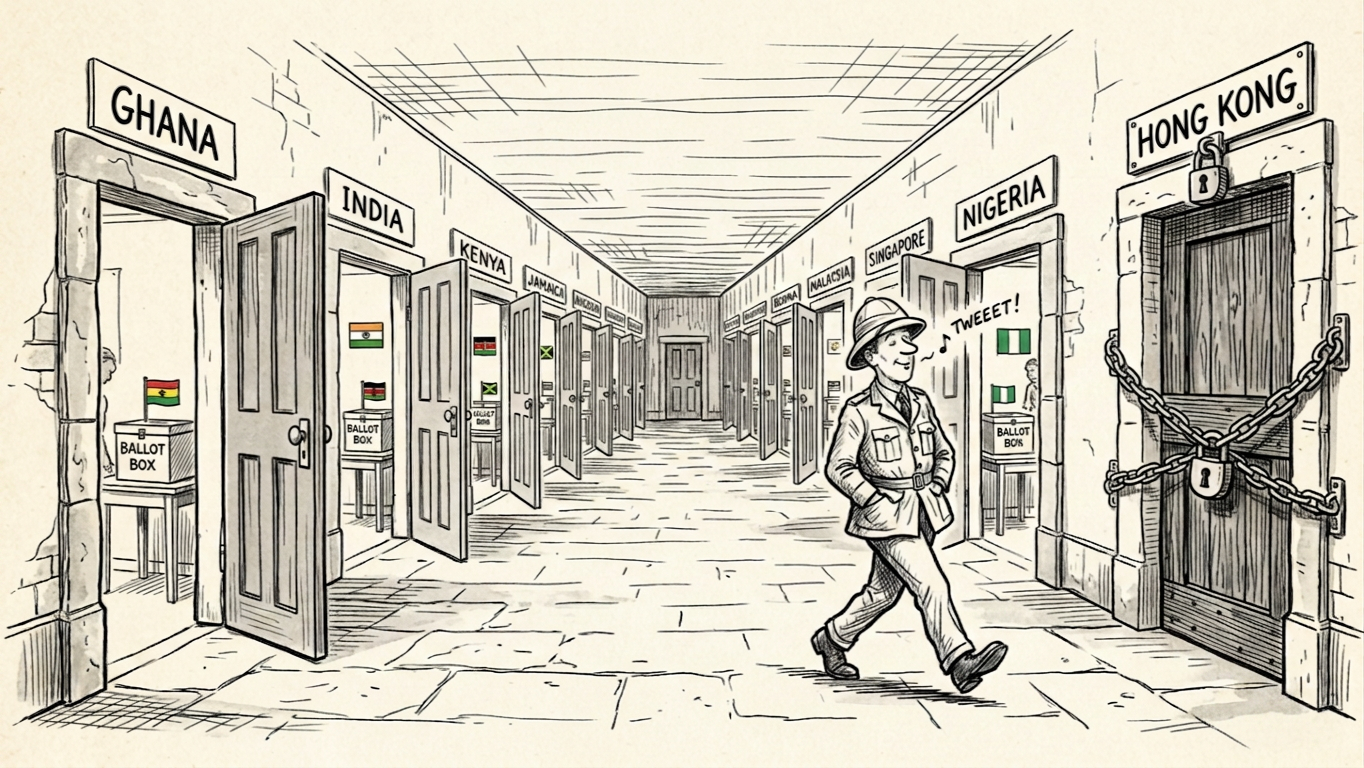
And it was not an oversight. In the 1960s and 1970s, Britain was granting independence and self-governance to colonies across Africa, Asia, and the Caribbean. One by one, territories that had been administered from London were given elections, constitutions, parliaments, flags. The sun was finally setting on the British Empire, and as it set, London handed out democracy like parting gifts at every door on the way out. Every door except this one. Hong Kong was explicitly excluded.
When Britain ratified the International Covenant on Civil and Political Rights in 1976, it entered a specific reservation for Hong Kong, carving this city out of the article that guarantees the right to vote in genuine elections by universal suffrage. Britain looked at a treaty that said all people have the right to choose their government, and said yes, we agree, except for those people over there. That was not 1842. That was 1976. The same decade Britain was lecturing the world about self-determination, it was writing Hong Kong out of the text.
Until the very end.
Chris Patten arrived in 1992. The handover was scheduled for 1997. Five years before Britain was contractually obligated to return Hong Kong to Chinese sovereignty, the last Governor suddenly discovered democratic principles. He expanded the franchise. He introduced electoral reforms. He created a more representative Legislative Council. After one hundred and fifty years of autocratic colonial governance, Britain spent its final five years building democratic institutions it had never seen fit to build before.
I am a lawyer. I notice timing. And the timing here is not subtle.
If you build nothing for a hundred and fifty years, and then you build something in the last five, the question is not why did you build it. The question is why did you build it now. And the answer, which everyone in this part of the world understood immediately, is that you built it to be an irritant. You built it so that the incoming sovereign would either have to honor institutions you never honored, or dismantle institutions and look authoritarian for doing so. It was a parting gift designed to cause problems. It was a chess move dressed up as principle.
Beijing saw it that way. Much of Hong Kong saw it that way. And frankly, if you look at the history with any honesty, it is very difficult to see it any other way. Britain did not introduce democracy in Hong Kong because it believed in democracy in Hong Kong. If it believed in democracy in Hong Kong, it had a hundred and fifty years to prove it. It introduced democracy in Hong Kong because it was leaving, and democracies are harder to govern than colonies, and making things harder for your successor is what empires do on the way out the door.
This is the context that the Western narrative skips. And without this context, the story makes no sense. With this context, you start to understand why the path to universal suffrage has been cautious, why the language says “gradual and orderly progress,” why “the actual situation” is a factor. You are dealing with a city that was handed a set of institutions designed, at least in part, to create friction, and the project of turning those institutions into something stable and genuine and actually functional takes longer than a news cycle.
Does that mean the promise is void? No. The text is still there. The ultimate aim is still the ultimate aim. Articles 45 and 68 have not been repealed. The constitutional obligation exists.
Does that mean I cannot discuss it? That is what my friends in America seem to believe. That is what the headlines have told them. That the mere act of saying “the Basic Law promises universal suffrage” will land me in a cell.
I am still here. Still typing. Still in my flat. Still a lawyer reading a law.
Now. The Nomination Committee. The nomination framework. I hear Western commentators call this anti-democratic, and every time I hear it I want to ask them a simple question.
Who picks the president of the United States?
Not the voters. Not really. Before a single ballot is cast, before a single primary, before a single debate, the field has already been filtered. And the filter is money. The Democratic and Republican parties are private organizations funded overwhelmingly by corporate donors, billionaire bundlers, hedge fund managers, and business leaders who decide, long before the public gets involved, which candidates are viable and which are not. If you cannot raise two hundred million dollars before Iowa, you do not exist. That is not a popular vote. That is a funding committee. That is a small circle of extraordinarily wealthy people deciding who is acceptable, and then letting the public choose between the options they have pre-approved.
The American primary system is a nomination committee. It just does not call itself one. It wears the language of popular participation while the actual filtering happens in private fundraisers in Manhattan and Silicon Valley and Greenwich, Connecticut, in rooms full of people whose names the public will never know, who expect specific things in return for their support, and who get those things, reliably, regardless of which party wins.
Hong Kong’s Election Committee does the same thing. It filters. It vets. It narrows. The difference is that Hong Kong is honest about the mechanism. It puts the filtering structure in the open, names it, defines its sectors, publishes its membership. America does the same filtering behind closed doors and calls it freedom.
Britain is no different. The party system determines who stands. The whip system determines who speaks. Candidate selection happens inside party machinery that the public does not control and largely does not see. You vote for who the party lets you vote for. That is true in Westminster. That is true in Washington. That is true in every functioning democracy on earth. The question is never whether candidates are filtered. The question is how, and by whom, and whether the filtering is visible or hidden.
I am not saying the systems are identical. I am saying that the distance between them is shorter than anyone in the Western commentariat wants to admit. And I am saying that people who live in countries with Electoral Colleges and superPACs and billion-dollar campaign war chests funded by the same class of business leaders who sit on nomination committees everywhere, those people should be a little more careful about calling other systems alien to democracy.
I think about Adams sometimes. I think about what democracy felt like in a town of eight thousand people where everyone knew each other. Town meetings. Show of hands. Your neighbor looking at you while you voted. That was real. That was democracy at a scale where it actually meant something, where participation was not mediated by money or party machinery or cable news.
I also think about the fact that nobody in London, during a hundred and fifty years of colonial administration, ever asked the people of Hong Kong whether they wanted a town meeting. Nobody asked them anything. And now the people who inherited that silence are being lectured about democracy by the inheritors of the people who imposed that silence, and the irony is so thick you could cut it with a knife, but nobody in the Western press seems to notice because the story is simpler without the history and simple stories get more clicks.
Here is what I know. I live in Hong Kong. I have read the Basic Law. I have just written an essay discussing democracy, universal suffrage, constitutional obligations, and the political history of this city. I have done this openly, under my own name, from my own home. I have not been arrested. I have not been silenced. I have not been visited. My wife has not been bothered. My practice has not been affected.
The people who told me this was impossible are welcome to revisit their assumptions.
I am not making a political demand. I am not calling for a timeline. I am not organizing anything. I am a lawyer who lives in a city, reading the law that governs that city, and talking about it in public. If that is something you think I cannot do, you are wrong. If that is something you think I should not do, I would ask why. And if the answer is because you read a headline once that told you Hong Kong is a place where people cannot speak, I would ask you to consider the possibility that the headline was wrong, and that you believed it because it confirmed something you already wanted to believe, and that the world is more complicated than the version of it that fits in a tweet.
I live here. I can read. I can speak. I am speaking.
That is all this is.