THE LAST KING OF A CITY THAT WON’T STOP RENOVATING
A city that paints over itself
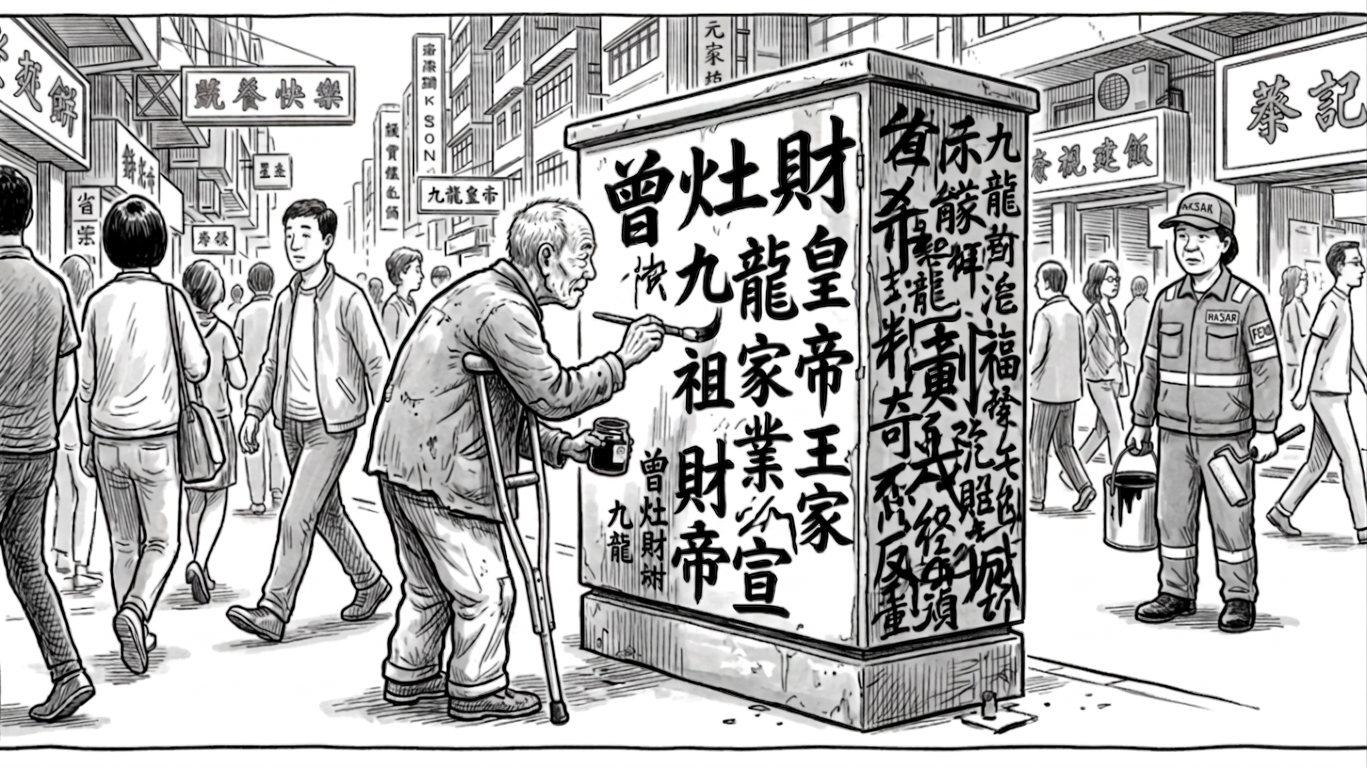
Not in the way developers claim to own Kowloon, which is to say, by buying it. He claimed it the old-fashioned way. By bloodline. By ink. By writing it on every electrical box, lamppost, and government wall he could reach for fifty-one years straight.
He is known as the Last King of a City, a title earned through perseverance and creativity.
He never stopped.
The government painted over his work. He came back and wrote it again. They painted over that. He came back and wrote it again. For five decades, it was just a man with a brush and a pot of ink against the entire Urban Services Department, and the man was winning.
His calligraphy was messy, angular, occasionally misspelled. He had two years of schooling. The characters were too big, too dense, stacked on top of each other like tenement buildings. But he was not trying to win a penmanship contest. He was filing a claim. Every lamppost was a deed. Every electrical box was a petition. Every wall was a royal decree from the self-proclaimed King of Kowloon.
The content was always the same: his name, his title, a list of about twenty family members, a roll call of Chinese emperors, and, when the mood struck, “Down with the Queen of England.”
A Hong Kong magazine named him one of the city’s ten least influential people. I have lived in this city for over a decade and never made a list of any kind. The King of Kowloon was considered less influential than almost everyone in Hong Kong, and he was still more notable than me. The difference is that he had a brush and a claim. I have a LinkedIn account and a couch.
He was arrested regularly. His family disowned him, saying he was mentally unbalanced and a public nuisance. His wife grew tired of his obsession and left him. He was dismissed as a lunatic, a vandal, a hot-headed neighbor. Then the art world showed up.
Then the art world showed up
In 1997, the same year Hong Kong was handed back to China, an art critic named Lau Kin-wai organized the first solo exhibition of Tsang’s work at the Goethe-Institut. Lau would later reinvent himself as a food critic, and he went on to open one of Hong Kong’s first private kitchens, a Sichuan place called Yellow Door Kitchen, up six flights of stairs in a nondescript office building on Cochrane Street in Central. There was no sign out front. You took a dodgy elevator, walked down a hallway that smelled like someone else’s business, and looked for the yellow door. Inside, set-menu Sichuan dishes that could numb your face for the rest of the evening, an all-woman crew from the mainland running the kitchen, and, on the walls, calligraphy by the King of Kowloon.
This is where the story becomes a Hong Kong story.
Because both the King and the Yellow Door are gone now.
Tsang died on July 15, 2007, at eighty-five, in an elderly home. His last wish was for one more exhibition. The nursing staff had forbidden him from using his pungent Chinese ink because the smell was too strong, and when they did, he could not sleep. He had fits. He was inconsolable. A friend brought him markers as a substitute. He calmed down. He went back to writing.
He wrote until the end.
He wrote until the end.
Yellow Door Kitchen closed permanently. The building on Cochrane Street is still there. The yellow door is not. Lau Kin-wai moved on and opened a traditional Cantonese restaurant in Wan Chai that became a serious destination in its own right. A different cuisine, a different neighborhood, a place with a proper sign and a listing on OpenRice. Still excellent. But a different thing entirely.
And the King’s calligraphy? The government promised to preserve what remained of his outdoor work. Then a government contractor painted over one of his last surviving public pieces, an electricity box in Kwun Tong, in 2017. Joel Chung Yin-chai, a curator who had been friends with Tsang for years, said the whole world would now know they had whitewashed a cultural treasure.
Today, a few pieces survive. A column at the Tsim Sha Tsui Star Ferry Pier, protected behind plastic. Calligraphy on a railway bridge barrier near Mong Kok East Station, close to Boundary Street, uncovered in 2022 when paint peeled off and the MTR Corporation commissioned specialists to restore what lay beneath. Some work sits inside M+ in West Kowloon, behind glass, properly lit, properly labeled, the way you display an artifact from a civilization that no longer exists.
I saw his work at Yellow Door Kitchen. I had just arrived in Hong Kong, still figuring out the minibus routes, still getting turned around on the Mid-Levels escalator. Somebody told me there was a Sichuan place where you had to ride a questionable elevator to the sixth floor and look for the yellow door. I did. The food was extraordinary. And on the wall, there was this wild black calligraphy, dense and unapologetic, characters crammed together like someone had tried to write their entire ancestry on a napkin and run out of room.
I had no idea what it was. I asked.
“That’s the King of Kowloon,” someone said, as if that explained anything.
It did not. And then, over the years in this city, it explained everything.
Both were right
Here is what I keep coming back to. Hong Kong is a city that produces extraordinary, stubborn, ungovernable people and places, and then paints over them. It builds things like Yellow Door Kitchen, hidden and brilliant and entirely its own, and then lets them disappear. It creates characters like the King of Kowloon, people who could not have existed in any other city on earth, and then acts surprised when there is nothing left to preserve.
The King spent his entire adult life insisting that the city belonged to him. The city spent his entire adult life insisting that he was a nuisance. Both were right.
The King spent his entire adult life insisting that the city belonged to him. The city spent his entire adult life insisting that he was a nuisance. Both were right.
In 2003, his work was exhibited at the Venice Biennale. In 2004, Sotheby’s auctioned one of his boards for HK$55,000. When Tsang heard about the Sotheby’s sale, he reportedly felt vindicated. Decades of being called a vandal and a madman, and finally someone agreed: this was worth something.
Ruth says this is one of the saddest things I have ever written and that I need to stop writing about cities erasing themselves before I become insufferable. She also says the real tragedy is that if the King of Kowloon were alive today, he would take one look at the M+ museum sitting on his ancestral land in West Kowloon, housing his work behind velvet ropes, and he would walk outside with a brush and start writing on the building.
She is probably right.
But to me the saddest part is simpler. Somewhere in Kwun Tong, there is a grey electricity box. If you look closely, and if the light hits it at the right angle, you can almost see, beneath the government paint, the outline of characters that nobody bothered to read when they were fresh, written by a king that nobody crowned, in a city that never stops renovating.
He never needed a gallery. The whole city was his canvas.
He never needed a gallery. The whole city was his canvas.
The city just forgot to ask him before it repainted.